Comments:


Best,
Horo

Do you have a movement shot?
Best,
Horo
I counted 20 symbols surrounding the inner dial with a weird looking dragon motif.....does it do anything but tell time?
Love the sapphire glass hands...stroke of genius, really.
Best,
Horo

Well, hope it happens after SalonQP, which I will be attending again this year. Will see you circa 9th Nov, and posting a general notice in HoMe soon. Will be part work part play for me, and visiting my Alma Mater Bristol again. PM you.
Best,
Horo


An orgy of wristshots!
The context of these pictures was a presentation organised in Paris by Ekaterina Sotnikova who distributes the hereafter brands
or production from independant
watchmakers.
All these pictures were taken today. Is it not a true hommage to independant watchmaking?


Fx
All these pictures were taken today. Is it not a true hommage to independant watchmaking?
Fx
That "Septagraph" look is intriguing...
... I am very curious. Very nice looking. Having such a wide range of products, luck her!
Ken
Ken
Septagraph
Actually, it is quite easy. Every day but not at the same time (the subdial displays these time slots), the 90mn countdown starts. You have to dedicate these 90mn just for you, just to think about your life, a blessing time just for you.
A true hedonist watch!
Fx
A true hedonist watch!
Fx
From a Long-Ago Press Release
That Borgeaud sent me back in June of 2011 when the watch was announced. It is PR, so don't blame me for the florid prose!
a
a
Watchmaking and astronomy, as we know, have been related since the dawn of time.
Among all the calendars conceived by humanity, there is one, dating back 3,000 years, that is still followed by hundreds of millions of people around the world. It is the Indian calendar called Panchang. It is divided into long eras, then in cycles of 60 years (like in 60 minutes), then in 12 lunar months, which are in turn divided into weeks of seven days, and days into 24 hours. Indian astronomers/ mathematicians took these seven 24-hour periods and then divided
them again into two 12-hour periods, with a special period lasting from sunrise to sunset—conventionally fixed between 6 o’clock in the morning and 6 o’clock at night. This 12-hour daytime period was then further divided into segments of 90 minutes. Among the day’s 90-minute periods, one is special, and they called it Rahu Kaal (the time of Rahu). This period is intended for thought and reflection rather than action. It is an intimate time, a private time. It is not a social time. It is a time that should be reserved for oneself, every day. We might call it the Strategic Period.
These temporal periods, judiciously arranged, correspond perfectly to the strategic periods of reflection, which are necessary in the daily whirlwind of time. They represent an essential step back, one too often ignored, by stressed executives during the day. These personal times are used for examining options or making choices and decisions, to avoid having to undo and redo what was badly designed or done in a hurry. In terms of management, for example, doesn’t reaching our goal require a time of reflection to observe the world around us, to understand its structures, to predict changes and to plan our courses of action? Isn’t time itself our primary resource that we must both tame and respect in order to use it in the best possible way?
Indeed and the most impressive was to be able to see them at the same time! [nt]
No message body
Q1 - the 2nd Bovet....does one use the 12 o'clock crown to adjust for both city indicators
Best,
Horo
Dear Horo..
My understanding is that the 12 o'clock crown is used to wind the watch and to set the time. Both zones are set thanks to pushers.
It is obvously a Dimier Tourbillon, this watch is a kind of evolution of the Harry Winston Z5 which also uses a Dimier movement.
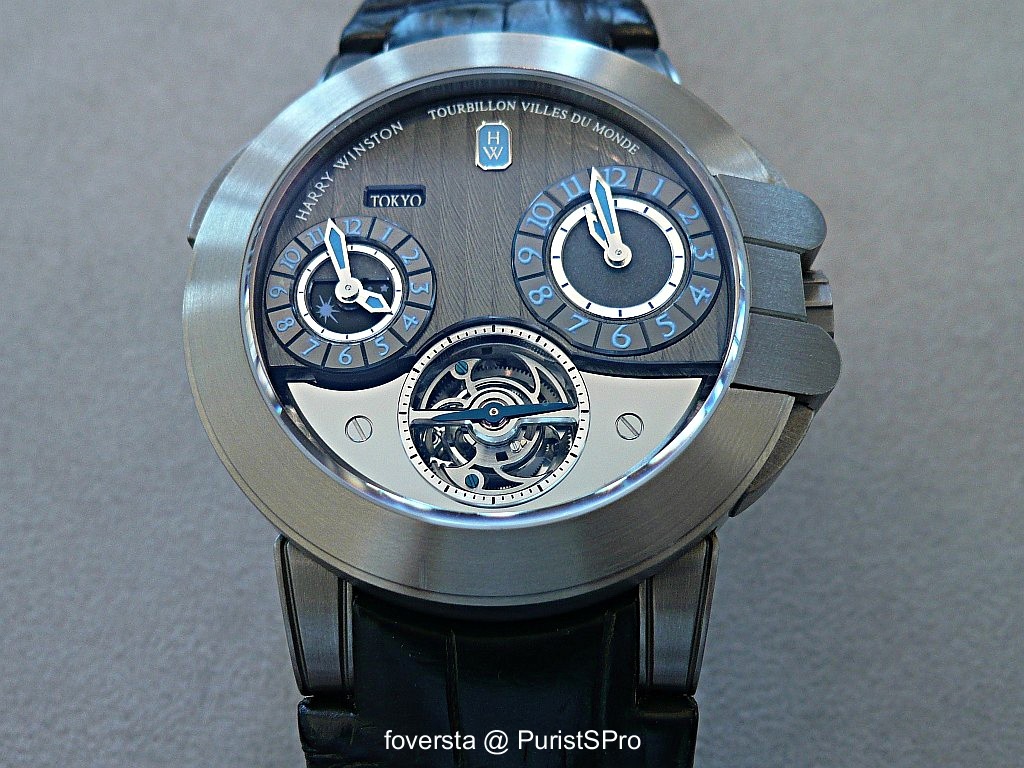
Fx
It is obvously a Dimier Tourbillon, this watch is a kind of evolution of the Harry Winston Z5 which also uses a Dimier movement.
Fx
Q2 ...I assume the outer ring goes anti clockwise and inner ring goes opposite?
Do you have a movement shot?
Best,
Horo
Q3 - the "Chinese" horoscope looking DeBethune....
I counted 20 symbols surrounding the inner dial with a weird looking dragon motif.....does it do anything but tell time?
Love the sapphire glass hands...stroke of genius, really.
Best,
Horo
Its a Mayan calendar Horo...
To commemorate this year s end of...the world.
Sublime dial,one of the finest I have seen lately,nothing moves but boy there is a lot to look at...
LE of 12 obviously,so this is a very rare wristshot......
Same caliber of the DB25 manual with mirror finish.....shame I am not one of the 12...............
Mo
Sublime dial,one of the finest I have seen lately,nothing moves but boy there is a lot to look at...
LE of 12 obviously,so this is a very rare wristshot......
Same caliber of the DB25 manual with mirror finish.....shame I am not one of the 12...............
Mo
Is it the end of the world already or again??
Well, hope it happens after SalonQP, which I will be attending again this year. Will see you circa 9th Nov, and posting a general notice in HoMe soon. Will be part work part play for me, and visiting my Alma Mater Bristol again. PM you.
Best,
Horo
Mo answered you properly!
At least while dying, you will be able to enjoy the beautiful hands of the watch.

Fx
Fx
Oh dear this is a real orgy....
Fantastic collection of wrist shots!!
You said its an exhibition?Is it a new shop in town or a distributor?
My fav for sure The DB28 lim edition with black moon,just amazing....,the DB Mayan calendar,and Kari vingt 8 with that blue dial.Whith these 3 I could close my collection......
Thanks FX
Mo
You said its an exhibition?Is it a new shop in town or a distributor?
My fav for sure The DB28 lim edition with black moon,just amazing....,the DB Mayan calendar,and Kari vingt 8 with that blue dial.Whith these 3 I could close my collection......
Thanks FX
Mo
Ekaterina is a distributor
She doesn't have a boutique but she has a galery which can be visited by appointment.
Fx
Fx
This kind of Horology
on this level of quality makes me seriously believe that watchmaking is one of the true metal art if not the most true art of metal....
Thanks For sharing Fx.
Faisal
I wouldn't be able to choose only one if I had to,
must have been a tough day Fx, I don't envy you at all!
Thanks for these pictures, I hope to see some of them in November in Paris.
Cheers,
Mark
Thanks for these pictures, I hope to see some of them in November in Paris.
Cheers,
Mark
Add up: my feedback
I've just seen this exhibition today and I must say I'm still in my dreams ...
I've seen for the first time the DB Maya : incredible work, so precise and beautiful (I understand it's the work of a well known engraver in Switzerland and that she carried on specially this project for DB). Maybe the most beautiful DB dial ...
I could look at the Vingt-8 for the first time too and I always wanted to know how really was the finishing compared to Lange or other specialists. One word: perfection.
The DB25QP is still beautiful, the Vianney H QP is perfect in sizing and very well balance (something I didn't find obvious before), the Upside down Balouard is still a watche I really like.
I must say I've been really impressed by the Bovet's you showed when I saw them: so thin, so fine finishings, beautiful engravings etc ... A very nice surprise.
Happy you talked about this very interesting woman with us, I could discuss about many subjects concerning Indies and this is really, as I always thought, a very different world.
Cheers,
Mark
This message has been edited by Boréale on 2012-10-09 06:46:16
I've seen for the first time the DB Maya : incredible work, so precise and beautiful (I understand it's the work of a well known engraver in Switzerland and that she carried on specially this project for DB). Maybe the most beautiful DB dial ...
I could look at the Vingt-8 for the first time too and I always wanted to know how really was the finishing compared to Lange or other specialists. One word: perfection.
The DB25QP is still beautiful, the Vianney H QP is perfect in sizing and very well balance (something I didn't find obvious before), the Upside down Balouard is still a watche I really like.
I must say I've been really impressed by the Bovet's you showed when I saw them: so thin, so fine finishings, beautiful engravings etc ... A very nice surprise.
Happy you talked about this very interesting woman with us, I could discuss about many subjects concerning Indies and this is really, as I always thought, a very different world.
Cheers,
Mark
This message has been edited by Boréale on 2012-10-09 06:46:16
Only you dear FX
can make such post
Just mind blowing!!!
That Mayan DeBethune ......
You have one very lucky wrist
Best regards
Damjan
Thanks for the report FX
I had the good fortune of visiting this exhibition just after it opened, and was given a comprehensive showing of these masterpieces by Mrs Sotnikova. Once again I was struck by the realisation that photographs, no matter how expertly taken, cannot begin to convey the sense of excitement and arresting beauty that marvels like these elicit. I put a downpayment on the new PSM Serpent Calendar - perhaps the very one FX is wearing in the above wristshot. A first foray for me in the world of independent watchmaking, but finances allowing, not the last.
Jean
P.S. Just discovered FX's blog: many hours of pleasanr reading in view


So many pieces to love...
... just like an orgy...
FX - are you kidding me? Unbelievable pix! What is the deal with that Gronenfeld One Hertz? Wow! Does that mean the second hand is a dead beat?
The DB (second one) looks like it might also remote control the spaceship that belongs to its owner.
The Voutilainen is top drawer. 'Nuff said.
What the hell is a Septagraph? Holy smokes.
Ludovic's pieces are fantastic... gotta say I prefer the Upside Down. And correct me if I'm wrong, but isn't "IV" the roman for "4"? Not sure why he used "IIII".
Thanks so much for sharing!
- Scott