Comments:
You do not have to have a screw down crown for swimming in a pool.


Here we go again...water resistance
of a watch.

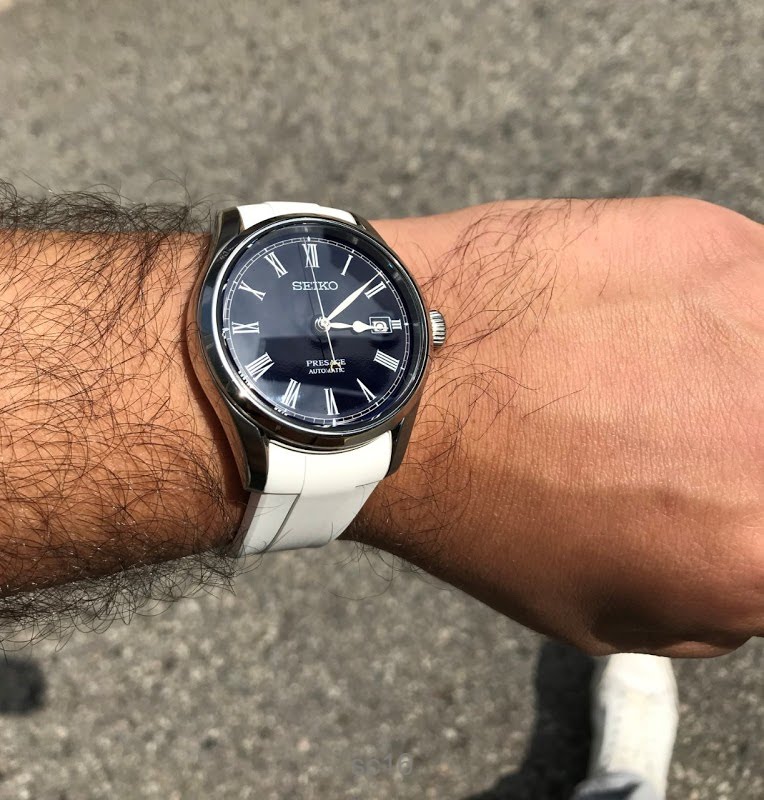

Before pic, but everyone knows it...

I need, yes need, to get a better understanding of water resistance of watches and specifically screw down crown vs non screw down crown and 50 mtr and 100 mtr.
I wanted a every day watch that i could take with me in the pool, perhaps a couple of breast strokes, and play a bit around with with no fear of water getting in the watch.
Nautilus seemed to be perfect with 120 water resistance and my understanding is that the case construction is as such that the water pressure tightens the watch even more, but please correct me if I am wrong.
Nevertheless, considering the prices currently being commanded, that was not an option. So I started growing an interest in the JLC Geophysic 1958 and waited for a full set to show against a good price. Found one, but then noticed that the Seiko presage spb069 also had a water resistance of 100 mtr which was same as the 1958. I was able to source a seiko SPB 069 and bought one recently, new from an AD - yes, I am aware that the watches currently mentioned are not in the same league, but I am summarizing the story so you don't lose interest.
But here it comes, i had this idea to put the Seiko on a white rubber strap and make it my summer watch which I can wear with shorts, and play around with in the pool, considering 100 mtr water resistance. However, when I went to a store that sold both custom strap and Seiko (AD), they told me that the watch is not made to be worn in the pool, because it doesn't have a screw down crown. My understanding is that the 1958 also doesn't have a screw down crown - no idea about the naughty nauti.
Btw, still bought the rubber strap, but somewhere else...
I can't get my head around the fact why i wouldn't be able to sit in the pool, do a couple of breast strokes with my SPB069 that has a 100 mtr water resistance - is the screw down so necessary? If so, then why does the UN torpilleur that Nico recently pointed out has a water resistance of 50 mtr with a screw down crown.
Is it the case construction...?
I understand water pressure of the watch hitting the water and there is a risk of the crown being pulled out because of that, but still...why 100 mtr water resistance...make it 50 then to be sure.
Now, I am not a technical person, so as Nicholas Cage said in a movie..explain it to me like I am a five year old.
I think the rubber strap looks great on the SPB069 and it carries it very well, but I need to understand this water resistance...
Thank you in advance for your patience!
KR,
Sc16
Before pic, but everyone knows it...
From my Seiko manual
You do ned a screw down crown for diving though.

Thanks for this...
Didn’t occur to me to check the manual and proves my point that my thoughts are correct. However, then why did the AD where i initially wanted to buy the strap said not recommendable for this watch and also that Seiko would no longer uphold the warranty if water got in the watch.
Thanks once again.
KR
Thanks once again.
KR
Your AD is an idiot!
If a watch is water resistant to 100m, then it’s water resistant to 100m... no ifs, ands, or buts about it.
What prevents water getting in are the seals in the crown tube, and as long as they’ve not degraded, then they will keep the pressurised water at bay.
When you’re washing/rinsing the watch, do so with the crown down or steeply angled away from the running water, just to be on the safe side.
Other than that, swim away ‘til your heart’s content.
What prevents water getting in are the seals in the crown tube, and as long as they’ve not degraded, then they will keep the pressurised water at bay.
When you’re washing/rinsing the watch, do so with the crown down or steeply angled away from the running water, just to be on the safe side.
Other than that, swim away ‘til your heart’s content.
That's what I thought....
considering some of the other replies - will need to take the seals into consideration for sure and having them checked.
Please give me more details from that strap 🙏🏻
It looks amazing on the Seiko and would love to have a blue one on my shippo 🤗
Here's the ISO standard for water resistance
Cazalea Opinion, explained for 5-year old - don't go in the water with a watch on unless it's a dive watch.
Seiko Opinion: expressed as a chart

SINN opinion: In order to use a watch safely when swimming we recommend a compression resistance of at least 100 m
If a Sinn watch is labeled water-resistant, it fulfils the requirements of DIN 8310 in its original specifications (similar to ISO 22810). Sinn guarantees that its water-resistant watches can withstand pressures up to at least 10 bar. This corresponds to the pressure at a depth of 100 m. Some of our classic masterpiece models are exempt from this. The water-resistance of each individual watch we produce is checked.
The maximum depth given on many watches always refers to the maximum static compressive stress which the watch case is guaranteed to withstand. When swimming, or in a jet of water (washing hands or showering), there are also directional flows with dynamic pressure peaks which impact upon the relevant parts of a watch to a greater extent than the diving depth alone.
Diving watches are recommended for intensive and frequent use in water. The compressive resistance of a diving watch is given in bar or in depth, measured in meters. When diving, the pressure increases by one bar every 10 m. In everyday use it is important to note that seals can suffer from wear or ageing and that small direct particles can build up in them as the result of a wide range of factors which arise when wearing a wristwatch. These particles can themselves assume a part of the seal function if the seal elements are already suffering from extensive wear. Tensides from detergents or similar cleaning agents can then coat such particles, making it easy from them to be washed away. For these reasons the airtightness of a wristwatch should be checked on a regular basis (once per year).
Since 2005, DNV GL has been testing our diving watches for water resistance and pressure resistance. In accordance with these certification standards, the EZM 3 and EZM 13 are pressure-resistant to 50 bar, the T1, U1, U212 and the U1000 series are pressure-resistant to 100 bar, while the T2, U2 and U200 series are pressureresistant to 200 bar and the UX series is actually pressure-resistant to any accessible diving depth. For this series, DNV GL has confirmed the pressure resistance of the case to 12,000 m and of the movement to 5,000 m diving depth. The tests are repeated at regular intervals on all of these watches in order to document the consistency of the quality.
ISO STANDARD FOR ORDINARY WATCHES
ISO watch water resistance specification ISO 22810:2010
Testing of a watch consists of:
1. Resistance when immersed in water at a depth of 10 cm. Immersion of the watch in 10 cm of water for 1 hour.
2. Resistance of operative parts. Immersion of the watch in 10 cm of water with a force of 5 N perpendicular to the crown and pusher buttons (if any) for 10 minutes.
3. Condensation test. The watch shall be placed on a heated plate at a temperature between 40 °C and 45 °C until the watch has reached the temperature of the heated plate (in practice, a heating time of 10 minutes to 20 minutes, depending on the type of watch, will be sufficient). A drop of water, at a temperature between 18 °C and 25 °C shall be placed on the glass of the watch. After about 1 minute, the glass shall be wiped with a dry rag. Any watch which has condensation on the interior surface of the glass shall be eliminated.
4. Resistance to different temperatures. Immersion of the watch in 10 cm of water at the following temperatures for 5 minutes each, 40 °C, 20 °C and 40 °C again, with the transition between temperatures not to exceed 1 minute. No evidence of water intrusion or condensation is allowed.
5. Resistance to water overpressure. Immersion of the watch in a suitable pressure vessel and subjecting it within 1 minute to the rated pressure for 10 minutes, or to 2 bar in case where no additional indication is given. Then the overpressure is reduced to the ambient pressure within 1 minute. No evidence of water intrusion or condensation is allowed.
6. Resistance to air overpressure. Exposing the watch to an overpressure of 2 bar. The watch shall show no air-flow exceeding 50 μg/min.
7. No magnetic or shock resistance properties are required.
8. No negative pressure test is required.
9. No strap attachment test is required.
10. No corrosion test is required.
NOTE: Except the thermal shock resistance test all further ISO 2281 testing should be conducted at 18 °C to 25 °C temperature. Regarding pressure ISO 2281 defines: 1 bar=105 Pa=105 N/m2.
This has since been replaced by the ISO 22810:2010 standard, which covers all activities up to specified depth and clears up ambiguities with the previous standard.[1]
In practice, the survivability of the watch will depend not only on the water depth, but also on the age of the sealing material, past damage, temperature, and additional mechanical stresses.
DIVE WATCHES ISO 6425
1. Reliability under water. The watches under test shall be immersed in water to a depth of 30±2 cm for 50 hours at 18 to 25 °C and all the mechanisms shall still function correctly. The condensation test shall be carried out before and after this test to ensure that the result is related to the above test.
2. Condensation test. The watch shall be placed on a heated plate at a temperature between 40 and 45 °C until the watch has reached the temperature of the heated plate (in practice, a heating time of 10 minutes to 20 minutes, depending on the type of watch, will be sufficient). A drop of water, at a temperature of 18 to 25 °C shall be placed on the glass of the watch. After about 1 minute, the glass shall be wiped with a dry rag. Any watch which has condensation on the interior surface of the glass shall be eliminated.
3. Resistance of crowns and other setting devices to an external force. The watches under test shall be subjected to an overpressure in water of 125% of the rated pressure for 10 minutes and to an external force of 5 N perpendicular to the crown and pusher buttons (if any). The condensation test shall be carried out before and after this test to ensure that the result is related to the above test.
4. Water-tightness and resistance at a water overpressure. The watches under test shall be immersed in water contained in a suitable vessel. Then an overpressure of 125% of the rated pressure shall be applied within 1 minute and maintained for 2 hours. Subsequently the overpressure shall be reduced to 0.3 bar within 1 minute and maintained at this pressure for 1 hour. The watches shall then be removed from the water and dried with a rag. No evidence of water intrusion or condensation is allowed.
5. Resistance to thermal shock. Immersion of the watch in 30±2 cm of water at the following temperatures for 10 minutes each, 40 °C, 5 °C and 40 °C again. The time of transition from one immersion to the other shall not exceed 1 minute. No evidence of water intrusion or condensation is allowed.
6. An optional test originating from the ISO 2281 tests (but not required for obtaining ISO 6425 approval) is exposing the watch to an overpressure of 200 kPa. The watch shall show no air-flow exceeding 50 μg/min.
7. The presence of a time-preselecting device, for example a unidirectional rotating bezel or a digital display. Such a device shall be protected against inadvertent rotation or wrong manipulation. If it is a rotating bezel, it shall have a minute scale going up to 60 min. The markings indicating every 5 min shall be clearly indicated. The markings on the dial, if existing, shall be coordinated with those of the preselecting device and shall be clearly visible. If the preselecting device is a digital display, it shall be clearly visible.
8. The following items of the watch shall be legible at a distance of 25 cm (9.8 in) in the dark: time (the minute hand shall be clearly distinguishable from the hour hand); set time of the time-preselecting device; indication that the watch is running (This is usually indicated by a running second hand with a luminous tip or tail.); in the case of battery-powered watches, a battery end-of-life indication. The presence of an indication that the watch is running in total darkness. This is usually indicated by a running second hand with a luminous tip or tail.
9. Magnetic resistance. This is tested by 3 expositions to a direct current magnetic field of 4 800 A/m. The watch must keep its accuracy to ±30 seconds/day as measured before the test despite the magnetic field.
10. Shock resistance. This is tested by two shocks (one on the 9 o'clock side, and one to the crystal and perpendicular to the face). The shock is usually delivered by a hard plastic hammer mounted as a pendulum, so as to deliver a measured amount of energy, specifically, a 3 kg hammer with an impact velocity of 4.43 m/s. The change in rate allowed is ±60 seconds/day.
11. Resistance to salty water. The watches under test shall be put in a 30 g/l NaCl (sodium chloride) solution and kept there for 24 hours at 18 to 25 °C. This test water solution has salinity comparable to normal seawater. After this test, the case and accessories shall be examined for any possible changes. Moving parts, particularly the rotating bezel, shall be checked for correct functioning.
12. Resistance of attachments to an external force (strap/band solidity). This is tested by applying a force of 200 N (45 lbf) to each springbar (or attaching point) in opposite directions with no damage to the watch of attachment point. The bracelet of the watch being tested shall be closed.
13. Marking. Watches conforming to ISO 6425 are marked with the word DIVER’S WATCH xxx M or DIVER'S xxx M to distinguish diving watches from look a like watches that are not suitable for actual scuba diving. The letters xxx are replaced by the diving depth, in metres, guaranteed by the manufacturer.
NOTE: Except the thermal shock resistance test all further ISO 6425 testing should be conducted at 18 to 25 °C temperature. Regarding pressure ISO 6425 defines: 1 bar=105 Pa=105 N/m2. The required 125% test pressure provides a safety margin against dynamic pressure increase events, water density variations (seawater is 2% to 5% denser than freshwater) and degradation of the seals.


Hear, hear! 10bar is a comfort when dashing to a parking spot in a rainstorm, and that's about it. And a point not yet mentioned...
On the whole, dive watches are much less expensive (the Nautilus, Blancpain 50, etc. obviously excepted), there are gazillions of styles, and one or two might pleasantly enlarge the aesthetic of your collection. Have you ever really seriously looked into owning one? The reissue of Seiko's 62MAS (SLA017) is particularly sweet, imho. Take a look, and…
Have a great weekend! FH
Thanks for the alternative...
No, I haven;t looked at one just yet...saw the longines legend (but if i would pursue it it would be the version without date) - I think that I am not yet ready for it, but perhaps in the future.
Like myself! Ha! I don't own one either! And I agree—despite having been tempted by the Seiko—that a date is obviously not necessary for the diver!
It's only there to make the watch more wearable as an everyday piece. Well… good to muse with you!

Sinn should know better: 10 bars does not correspond to a depth of 100 meters ....
... since the air pressure on the sea surface already is 1 bar. So 10 bar corresponds to a depth of 90 meters, not 100.
It is typical for so many erranous information given areound water tightness. The pressure resistance rating for a specific case is given for the time of production, similar to the chronometer certificate, that also is a report about a movement's performance at the time of testing. Depending on time and storage conditions, the pressure resistance can change, if the gaskets are degraded, for example for years in a shop window in bright sunshine and directly under hot halogen spotlights.The manufacturer cannot be held responsible for such a folly.
Additionally, experience shows that the average watch wearer (which excludes the crazy watch nut that is the rule on sites like PuristSPro) does not spend any thought on keeping his or her watch serviced and in good condition. These watches are seeing a watchmaker when they fail, and not earlier. Give them 100 meters of water resistance, and they believe that to be valid for decades, without any replacement of gaskets. Just ask a good watchmaker how many sports watches, including Rolexes, with completely corroded movements, caused by water immersion, they had on their tables. I am sure they will have plenty to tell.
Consequently, I see a tendence to downscale the pressure resistance rating, jut not to be made responsible for any user-initiated humidity problem. Just an example: When I bought my first expensive mechanical watch, this was a Zenith chrono, then called Class 4, later Class El Primero. This had shaped pushers, a non-screw down crown and a snapback, all features normally not connected with high water resistance. Nevertheless, it was rated to 100 meters:

A bit later, the very same watch, without any constructional changes, was rated to 50 meters only. Apparently, it were legal considerations rather than technical ones that caused that change.
On the other hand, Ulysse Nardin was the first manufacturer rating its watches with repetition to 30 meters, while all others did not give any water tightness rating, due to the slider used for releasing the chimes. Apparently, they trusted their construction enough.
A different example of a non-understandable depth rating is the Seiko Marinemaster 300, featuring a massive monocoque case and tiny crystal diameter, which normally would indicate a depth rating in the four digit range, and officially offers only 300 meters. Apparently, it should be able to withstand much higher pressures, but the manufacturer does not want to risk any claims resulting from failure at high pressure situations. And, to be honest, even after degrading of the gaskets, the Marinemaster should withstand a 300 meter water column anytime.
A different approach is the regulation of the warranty. Whhile modern movements often get a longer warranty, period, its validity is connected to the condition of a regular water tightness test at the manufacturer's service center. Sometimes, this condition is barely mentioned before the purchase. Breitling, for example, gives 5 years warranty for all B1-equipped chronographs, but only, if the watch is sent in for water tightness testing every two years. If you buy such a timepiece pre-owned, without proof of that testing, you only have two years warranty from original purchase. Omega, in the opposite, does not demand such a testing and gives a prolonged warranty.
Marcus
Specs can be governed by marketing and legal, rather than engineering
This situation reminds me of a conversation I had with the then-head of service for M-B in the US.
As I was assembling the specs for maintenance for M-B passenger cars in our reference charts, I asked why the oil change interval was 20,000 km (~12,000 mi) in the UK, but only 6000 miles in the US. Surely the engines are the same and they are filled with the same oil at the factory?
His reply "More marble in the US dealer showrooms."
As I was assembling the specs for maintenance for M-B passenger cars in our reference charts, I asked why the oil change interval was 20,000 km (~12,000 mi) in the UK, but only 6000 miles in the US. Surely the engines are the same and they are filled with the same oil at the factory?
His reply "More marble in the US dealer showrooms."
Sinn’s not all that wrong...
... just rounding up to the nearest whole number.
Air pressure on the surface has zero effect on water resistance when submerged, since it’s not Hydrostatic pressure.
Therefore, at a depth of 100m, the Hdyrostatic pressure is exerting a force of 9.81 bar, and 0.981 at 10m.
Knowing Seiko, as per the Tuna video on YT, I’d say the OP’s watch is probably capable of hitting 12-14 bar, before it fails, irrespective of all the guff posted about ISO this and Sinn that!
You and Mike missed the key concern in the OP’s post — screw down versus standard crown.
Air pressure on the surface has zero effect on water resistance when submerged, since it’s not Hydrostatic pressure.
Therefore, at a depth of 100m, the Hdyrostatic pressure is exerting a force of 9.81 bar, and 0.981 at 10m.
Knowing Seiko, as per the Tuna video on YT, I’d say the OP’s watch is probably capable of hitting 12-14 bar, before it fails, irrespective of all the guff posted about ISO this and Sinn that!
You and Mike missed the key concern in the OP’s post — screw down versus standard crown.
The irony is...
That the watch I use as my dive computer is a Garmin MK1 Descent which is rated at 100m and my sea dweller is rated 1200m. I'm a recreational diver and I have the basic PADI certification which allows you to go down to ~20m. If/when I want to go see something deeper, I'll get the certification that gets you down to ~40m. Beyond that, you enter the realm of technical diving and unless there is something really beautiful that I must see, I don't intend to do this. The deeper you go, the more air you use, and you need to incorporate decompression stops, all of which shortens your dive time. In addition, the danger increases quickly with depth. I dive to relax, in general on vacation. So recreational diving is in the 0-40m range and if a reputable watch manufacturer reports a rating of 100m, and it has been checked (and its gaskets are ok), you are good to go in the pool.
Important point: The seals have to be checked every one or two years maximum... [nt]
No message body
I don'd dive...
it was more related to sitting and relaxing in the pool and then perhaps a couple of strokes to go from one end to the other (short end not the long one). I understand gaskest/ seals are the most important factor to weigh in, other than the manufacturers advice. Thanks.