
Navel Gazing - A Question for Watchmakers and Engineers...
A watch maker recently told me that we all take magnetic fields too much for granted and that the vintage and even most of the modern watches are still sensitive to magnetisation. Is that a true statement of fact?
Second, it also occurred to me that with the use of motorised electric winders, I wonder if there is a real exposure to magnetic risk as these electric motors do have powerful magnets inside them (a necessary component). In such proximity, how sure are we that our high end pieces are not being exposed unduly to magnetic fields?
I would love to hear responses from engineers and watchmakers as to whether this navel gazing question is a real risk or - much ado about nuthin?
Cheers
Harry
added to Editor's Pick
This message has been edited by AnthonyTsai on 2008-01-26 09:43:11Oh... I forgot to add....
That I have seen many times how people put their watches next to their handphones - which do have speakers on them (which also has a magnetic component). I have seen my wife put her mobile next to her watch so often that I had to keep reminding her not to do it.
Cheers
Harry
Confucious, he say ...
... "when you cannot see your feet, navel gazing is difficult!".
But seriously, Harry, whatever is said, the number of electrically operated objects that generate an electro-magnetic field has increased exponentially since the time of Breguet, or Confucious. If we are to believe that the regulating organ of a timepiece is affected by magnetism, then it will be affected, but to different degrees and frequencies over time.
The effect of magnetism varies inversely to the square of the distance from the source of magnetism. Therefore when you move a watch away to twice the distance, the effect lessens by 4 times. Much like gravity's effect on my sagging gut. This together with the fact that magnetism has 2 poles and that these may change over time as the current varies through an electro-magnet and the uncertainty of time exposure, makes for a large number of variables.
If a watch is consistently placed in a particular position in approximation to a constant unvarying source of magnetism over a fixed time, then the effects of this constant exposure will be more easily demonstrated.
Of course, over all this, one has to consider the overlay complexity of residual magnetism left on the watch components after the source of magnetism is removed, and the resistance to these effects, or indeed its source by the depolyment of various components such as the parachrome hairsprings.
So, do you see your navel, Harry? or has your visual acuity blurred to beyond the circle of confusion? 
Oh, did I mention the Heisenberg Uncertainty Principle ...?
This message has been edited by mycroft on 2008-01-24 00:54:22!!!LOL!!! Mycroft! - you reminded me of the poor chap who was in a hot air balloon....
lost somewhere over Seattle and he shouted to a man in an open window in a building as he passed it by..."Where am I?" - to which the Microsoft Engineer correctly answered - "You are in a hot air balloon!".
Perfectly correct answer but .... you get the picture. )
Quantifing the problem...
Watches can be affected by magnetism, but the problem is to quantify the effect. There are the extreme cases of coils sticking or whatever, and the timing going to pieces. But how to know if the watch has been very slightly magentised? Is the slight change in timing due to a shock or the watch being slightly magnetised?
I'd love to see an experiment with tow idnetical movements, one in a soft-iron shield the other without, and both subjected to identical everyday conditions to understand the problem.
Given all the variables that can impact the performance, I'm not sure how to extract the magnetic art of the equation.
nick
If only...
Nick apparently from the watchmakers I spoke to...
They are insistent that magnetisation is a difficult problem to solve and it affects the timekeeping in many ways. They suggest that to avoid the risk is much better solution than to demagnetise it. Also, the degree of magnetisation even small or large plays on how the watch runs. Apparently some service repair centres do not even test for magnetisation of the movement.
Hence, my query for the issue is - how real is the risk? Where is the greatest risk found? Is an electric winder risky?
Hope someone can point me to a place where I can read more about this.
Cheers
Harry

Anecdotally
Aaron
Thanks Aaron, glad to know that demagnetisers can work with Watches...
but I have not heard who is able to do that locally. I have heard sometime ago that even demagnetisers have limited effect. But I guess it matters not - if a watch is magenetised then there is no choice but to attempt at demagnetising it.
Notwithstanding that there is a solution to demagnetise, I still have not gotten a clear answer whether it is risky to have a watch in a electric winder or in proximity of a handphone.
Cheers
Harry
Harry, on the point of winders ...
... you are correct to say that there will be a madnetic field generated by the coils and motor.
Then it all depends on whether the winder is shielded or not and how effective this shielding is. You will read often nowadays that computer monitors and certain speakers are shielded. However, what it does not say how well this is done and to what extent there is magnetic leakage of the flux field.
What you are asking are very difficult questions since there is not a lot of available information out in the public domain as this subject relates to watches.
You are need to separate the marketing hype from what is the scientific basis for claims of effective magnetic shielding. Given a strong enough magnet such as an NMR (Nuclear Magnetic Resonance) machine, very few items will be able to shield against that kind of flux strength. You will need a shield that is the size of a room! Good hunting for the info though.
I thought top end watches were mostly non iron ...
I thought top end watches were mostly non iron construction. As in Brass or even gold.
If one has a Breguet or PP etc....what components are subject to magnetic forces apart from the spring and screws??
kindest regards to all,
Jack
Jack, you are right in some respects ...
If you place a strong magnet (a good fridge magnet will do) onto the watch crystal, you actually can see the timepiece slow to a stop. I have done this personally both with mechanical and quartz watches and the effect is quite fascinating to watch yourself stop time! Try it with an old watch that you don't treasure.

an anecdote
Magnetism is still a plaguing concern for watchmakers and watch enthusiasts, even with all our modern alloys and especially because of all our modern toys. I don't think watch winders are likely to induce too much magnetism into watches placed on their spindles appropriately, but I wouldn't recommend placing them on top of the winder, which might put the watch much closer to the motor and any magnetic fields. As mentioned previously, magnetic field strength drops off as the square of the distance from the source, so every centimeter of separation is dramatically safer for the watch in question.
The timing of this discussion couldn't have been more fortuitous regarding an experience I had only today. A friend of mine dropped me a line recently saying that he thought he'd magnetized his watch. It was a watch I had serviced for him a while back (more than a year, less than three, I don't remember exactly) so I told him I'd be happy to take a look at it.
We had lunch today and he told me the watch was running about a minute and half fast per day whereas previously it had been running within about a second or two a day on average. He remembers laying it down on top of his cell phone overnight recently, and the cell phone is in a case with pretty strong magnetic clasps.
While this seems like a pretty obvious way to magnetize a watch, we both thought it interesting that this is a watch with an anti-magnetic shield. Still, that proximity to strong permanent magnetic for such an extended period of time could not be a good thing, and anyway I'd have to take a look at it to see what was what.
I took it home and took a reading on my timing machine. It showed a maximum rate in any one position of about +19 and an average rate across five positions of +13.4 seconds per day. This is not at all a minute and half of course, but in my experience, magnetized watches are a lot faster in wear than they show on a timing machine, due perhaps to the sticky hairspring sticking a lot more often when perturbed by the motion on the wrist. that's my guess anyway.
I took the back off and took out the anti-magnetic shield and ran it through the demagnetizer and put it back on the timing machine. It showed a maximum ratre of +5 seconds per day in any one position and an average rate of +0.8 seconds per day, just as it had when I was done servicing it last time. * Problem solved. Clearly it was magnetized despite the anti-magnetic shield. Lesson learned. For me at least.
_john
* I don't usually regulate a watch to such a tight average rate, preferring to leave them closer to +3 s/d in general. This allows for some leeway in terms of how the watch will run on the wearer's wrist. Because the wearer in this case is a good friend and I knew I could regulate it for him whenever he asked, I decided to leave this one as close as possible and it turned out to be the right decision with respect to how it runs on his wrist.
Thanks John for your input,....
Getting reponses from a watchmaker is most reassuring!
However, can I clarify whether your comments covers both of these watch winders? I have and am sure many have these small ones in their safes. I wonder if these can prove to be risky since the distance from the motor to the watch is measured in mere cms. I have no idea if there is any magnetic sheilding in these things.
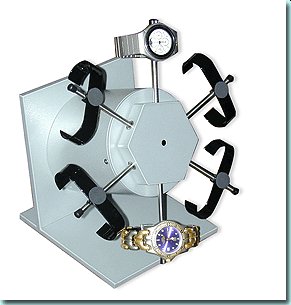
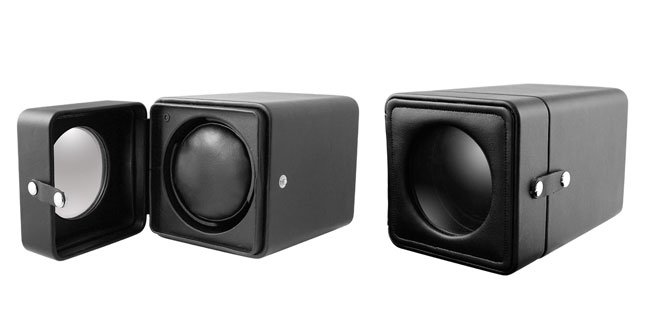
A good question & answer. Thanks John & Harry...
Will dig the materials up and post later.
Kong
De-magnetiser
This magnetism effect on watch really worries me. I am using a cheaper $500 watch winder with 4 compartment . I wonder if the cheaper watch winder has worse effect on mechanical watches. I found some watch winders very expensive ($1500 each) and I never thought of this winder factor before. Franklt speaking I have never even notice the accuracy of my wathces.
Assuming that I have magnetise all my watches over one year period, can anyone tell me how to de-magnetised my pieces or I wonder if anyone can recommend me the brand for a good effective de-magnitiser and where should I get it?