
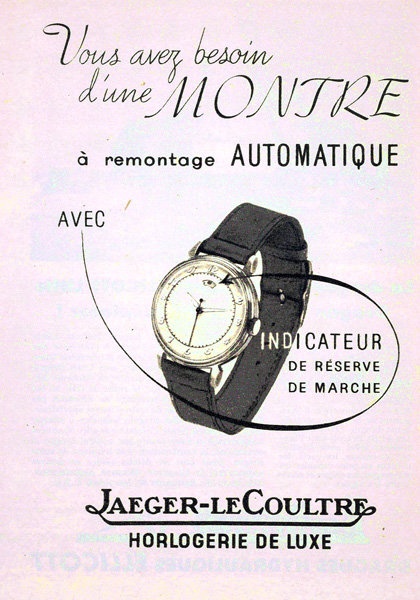
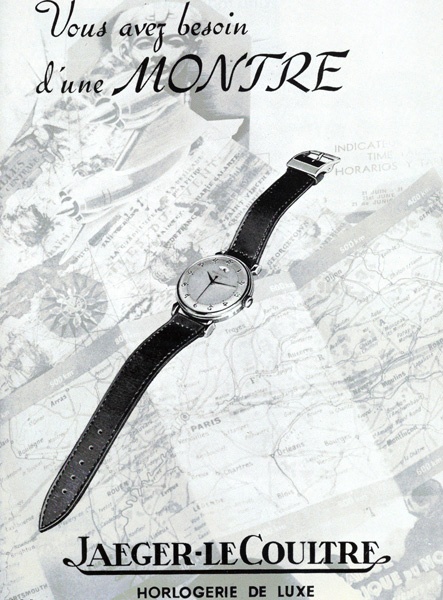
Vous avez besoin d'une montre? Think Powermatic!
This was the title of a JLC ad in the 50ies. ( Do you need a watch? )
JLC used it for several purposes, including the Powermatic, in a very creative way:
The saga of the JLC Automatic started in 1946 with a very conventional watch, housing the Cal 476 ( a 18 000 Vibrations per hour bumper movement ).
Then, 2 years after, Jaeger Lecoultre introduce the Powermatic as " their first automatic wrist watch with up and down indicator ", as said in the small booklet coming with another great automatic watch, the Futurematic, which was officially released in 1953.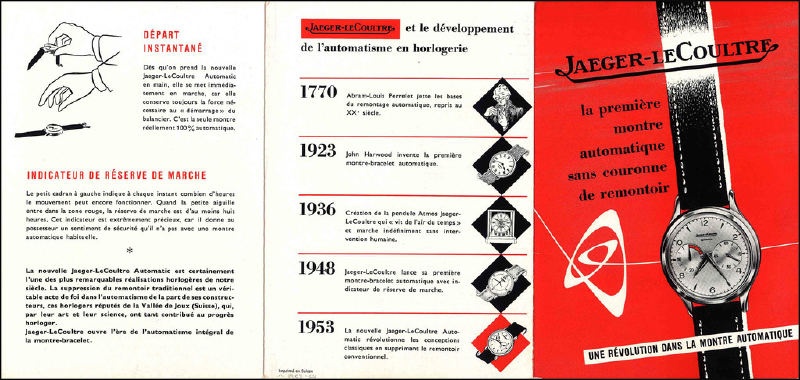
Do you know any other brand which used a power reserve indicator, even on a manual winding watch?
I would be curious to know if the Powermatic is not the first automatic watch ( and not only JLC ) to come with such an indicator, at this time...
What other brand than JLC could release such a wide offer of automatic watches, the Powermatic coexisted during 5 years with the Futurematic, and 3 years with the Memovox Ref E 853, using the Cal 815?
The Powermatic was massively produced, during its 11 years life.
Most of the Powermatic were destined for the US Market, 75 per cent, according to Zaf Basha, which makes around 75 000 of 100 000 watches!
Most of the versions are small watches, measuring 33 or 34 mm, and came in gold filled, solid yellow or rose gold or Stainless Steel cases, and different kind of lugs.
As for the dials, the situation is the same.
From luminous to applied index numbers, we sometimes add a blend of applied indexes and numbers, and also applied indexes only.
The hands could be losange, Dauphine or Baton shaped, luminous or not.
The only common points to all the Powermatic versions are that they share this small window, located just under 12 o' clock, for the power reserve indicator, which is the main characteristic of this watch, and the Cal 481, a slightly decorated 17 jewels movement, beating at 18 000 vibrations per hour, and using the rotor seen on the Cal 476.
Here are some pics of the Cal 481, which will allow you to appreciate the sober degree of decoration and finish, and also the relative small size of the movement compared to the Jumbo case on my watch: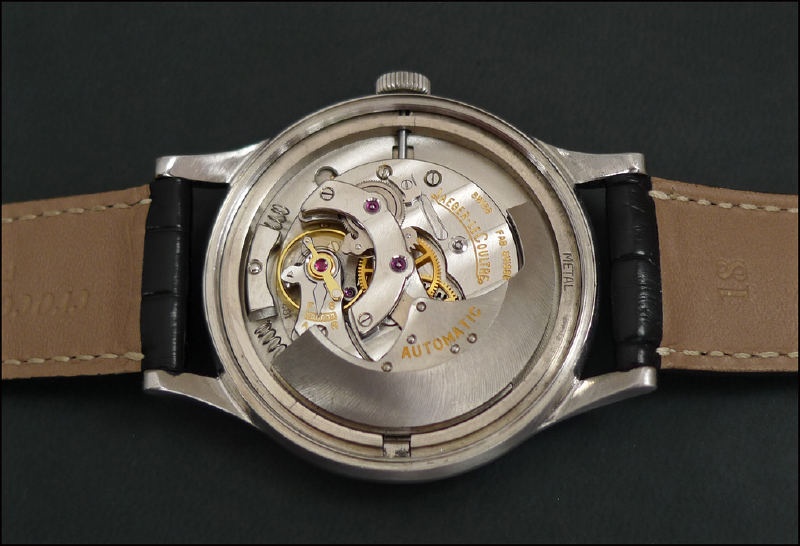
The Geneva stripes are spotting with a different light in an amazing way: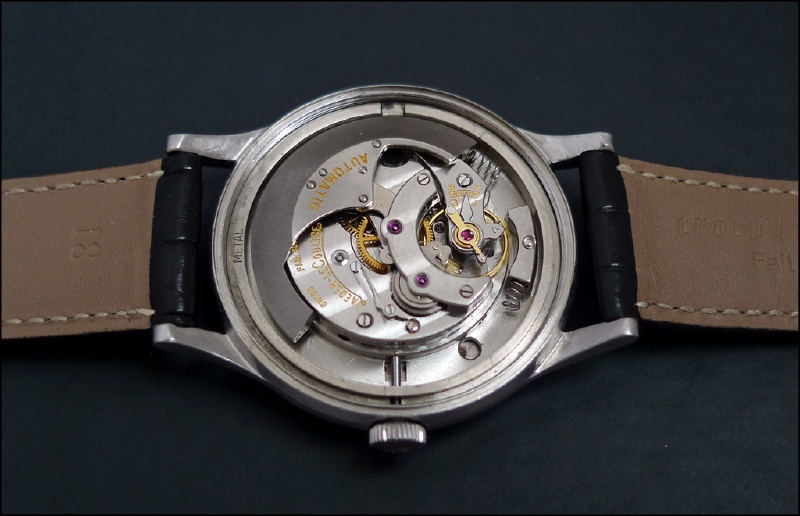
Some macros of the whole movement ...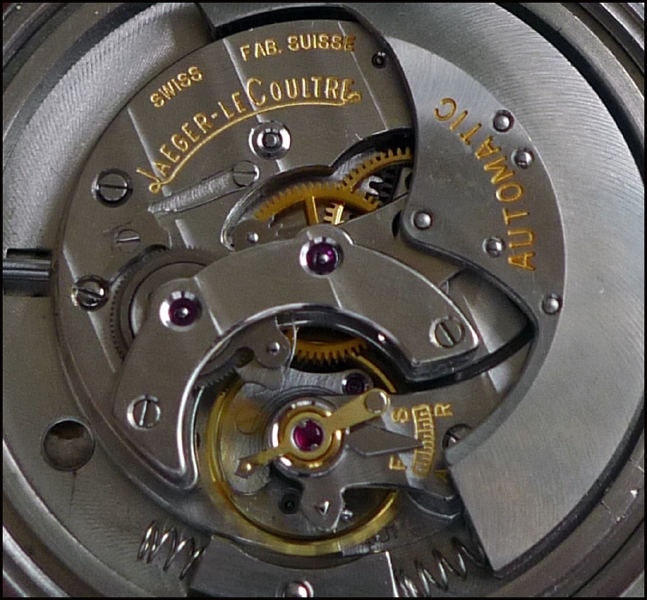
...And of the balance wheel, just above the traditional bumper: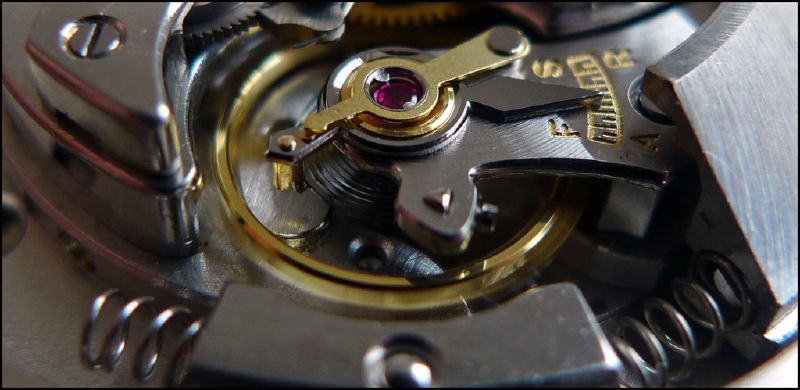
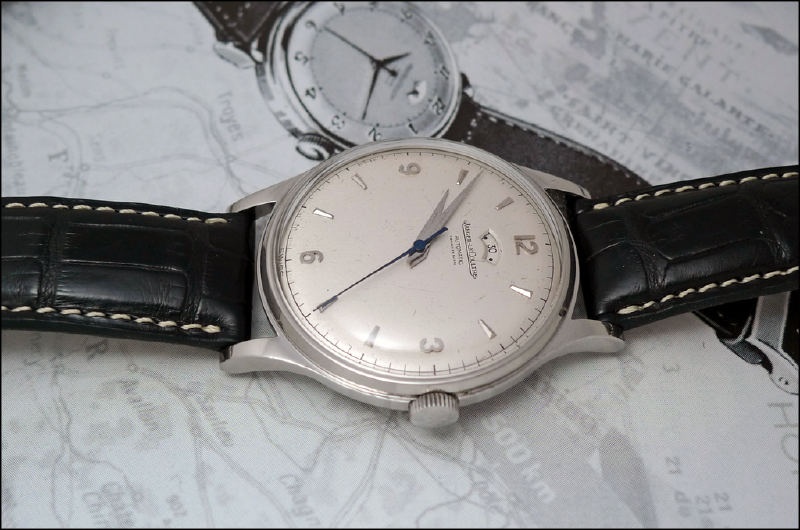
Here we'll focuse one of of the rarest declination, the Jumbo in Stainless Steel, which was also available in solid gold.
The Powermatic is unusually big for a watch of this era, with its 37 mm case.
It looks even bigger, due to the important aperture of the dial. 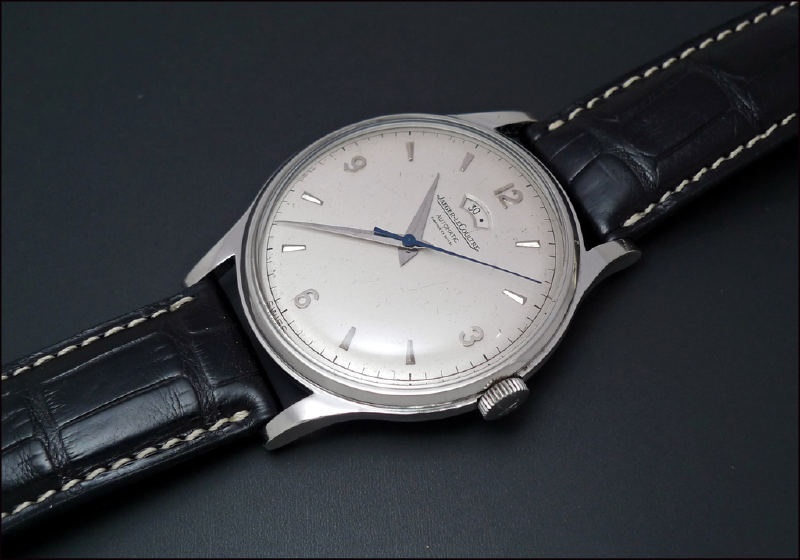
As you can see, the dial is also sober and elegant, in this configuration, with applied numbers and indexes, the Dauphine hands, the blue heated central second hand, and a small window for the power reserve indicator, which doesn't take too much space, and doesn't ruin the balance of the dial.
A detail which makes it all... A close up on the power reserve window: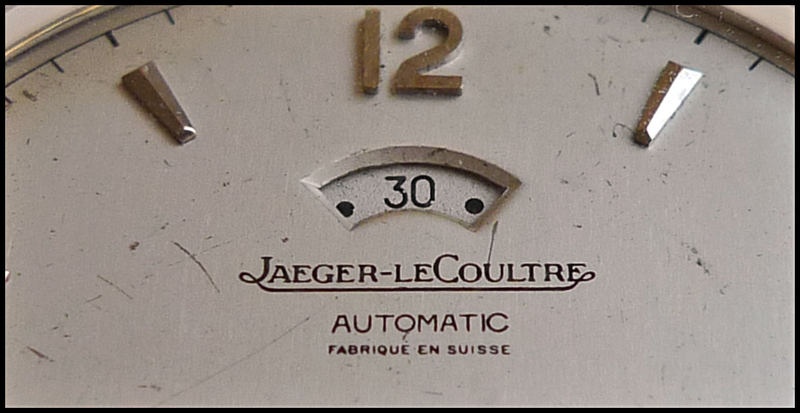
And here, when the power reserve is down, the disk shows its red zone, warning the wearer that it is time to wind the watch: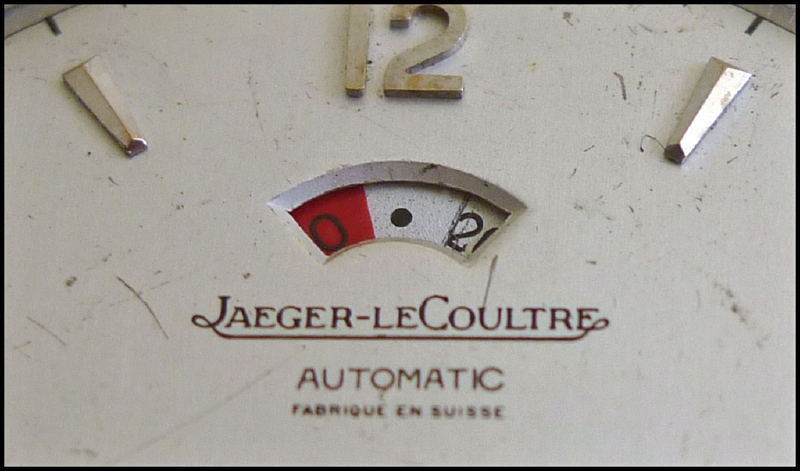
Another elegant detail is the finish of the case, whose side is brushed, when the other parts are polished, the thinness of the watch, and the superb lugs.
Please note that on my Jumbo, the crown is not the correct one, as it bears the " JL " signature, while it shouldn't: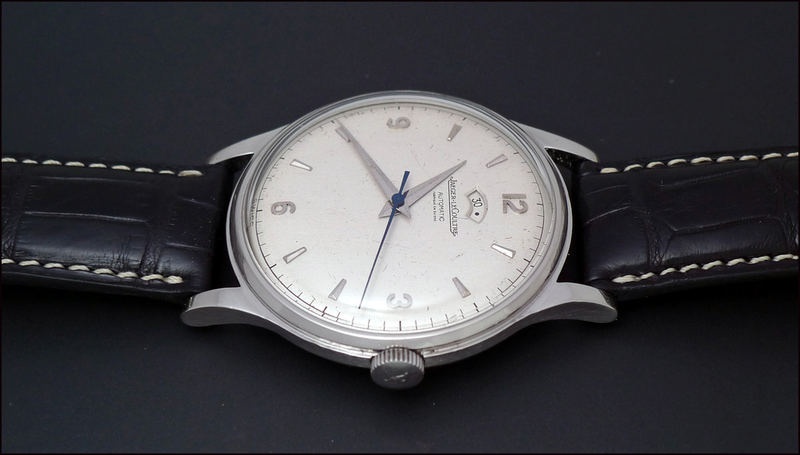
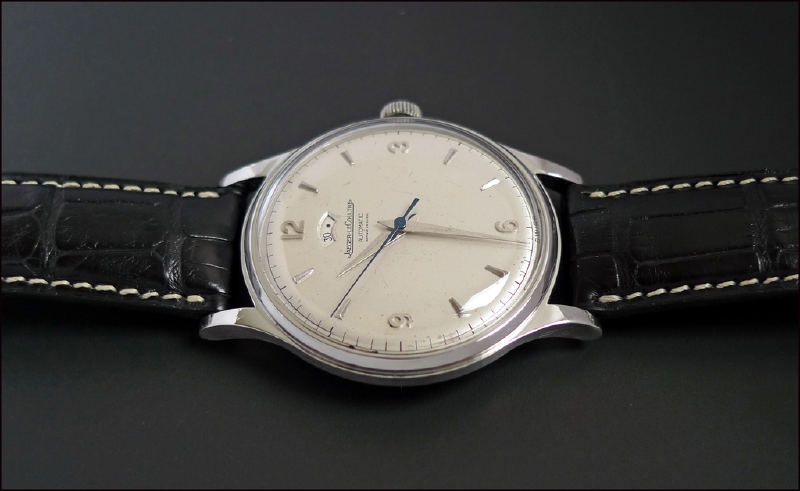
The screw in case back is bombed, as it you will see here: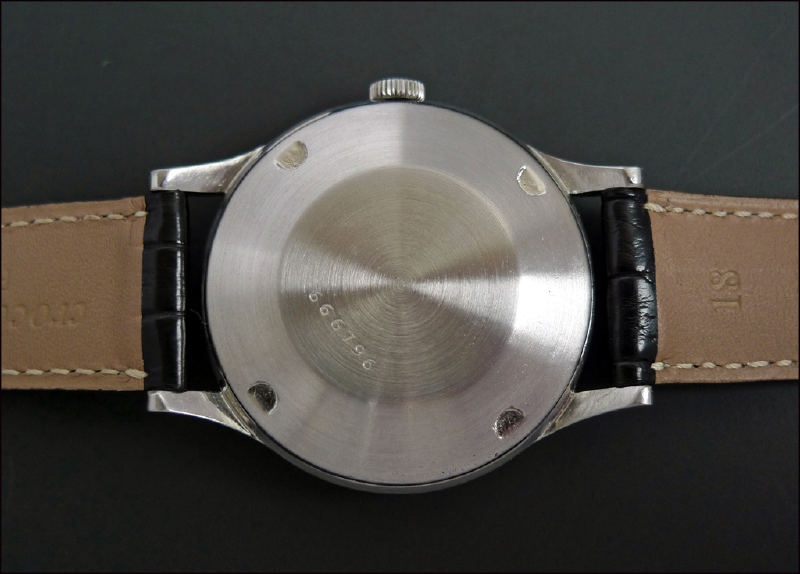
And it is signed " LeCoultre " inside: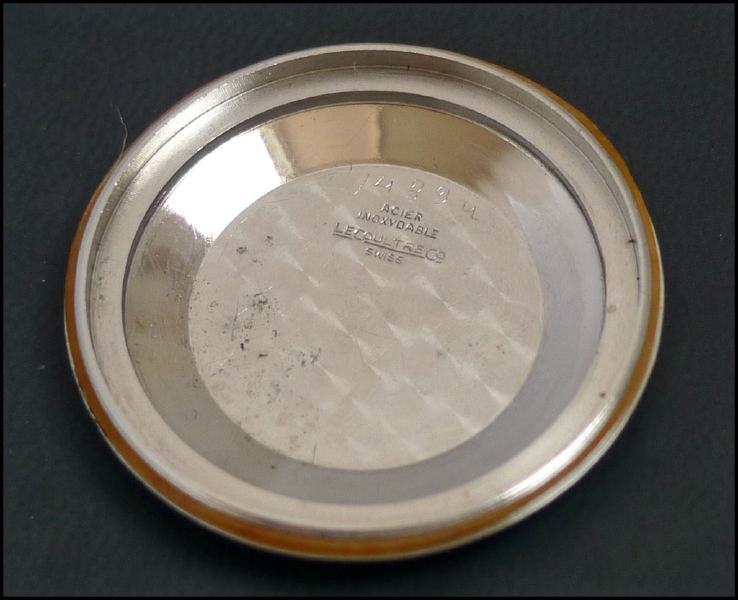
To give you an idea of its " allure ", I managed to take some pics of the Powermatic side by side with the " Sister " Futurematic, which looks a bit smaller with its 36 mm case: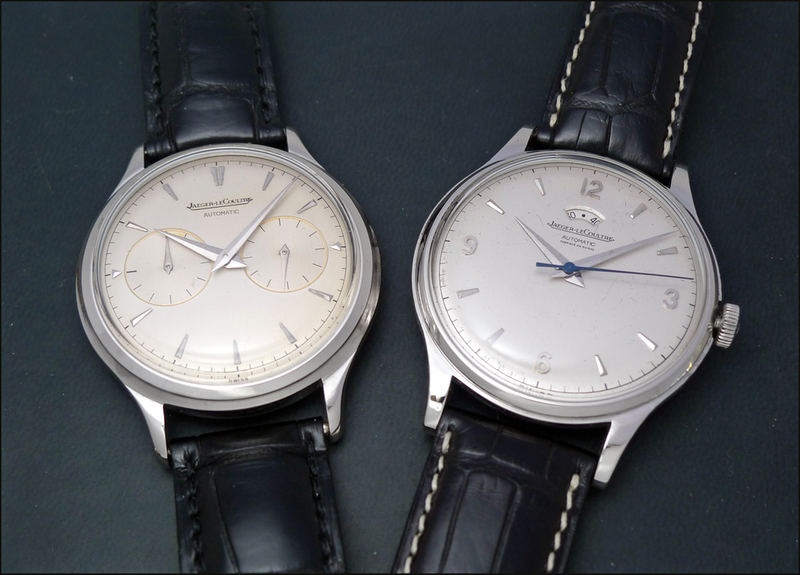
And here, with a third great automatic watch from " La Grande Maison ", the Chronometer Géomatic, " for the man of Action ":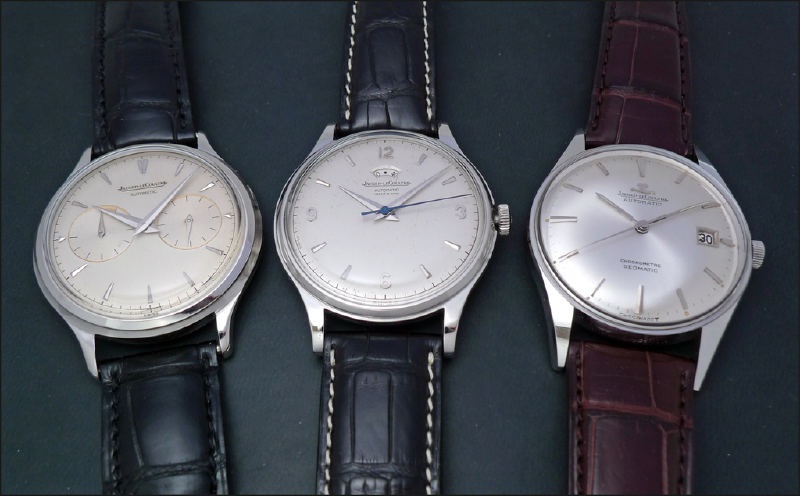
On the wrist, the Powermatic has a nice presence, and really looks bigger than it is, in reality: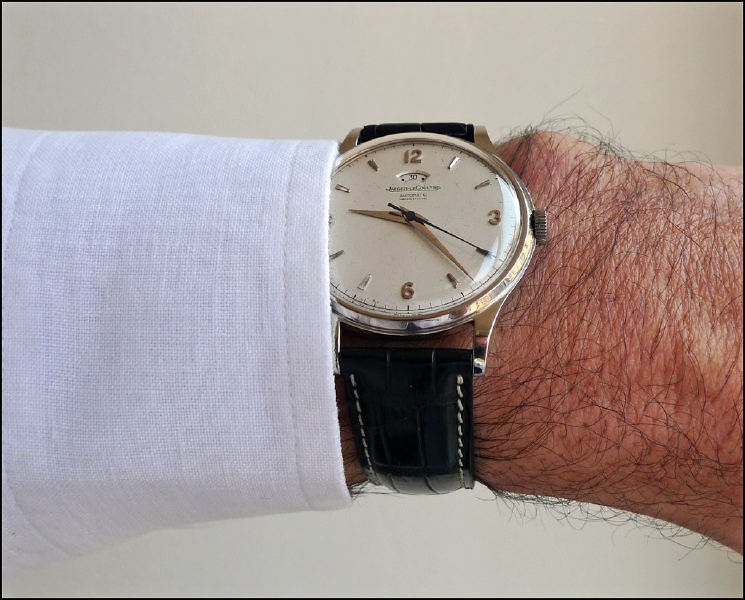
Indeed, a watch to consider if you want to add a dressy Vintage Automatic in your collection.
It does have this small touch of originality, and in the Jumbo configuration coming with these straight lugs, it has an undisputable elegance.
Now it would be as funny as interesting to try to dind the link with JLC's current offer...
Do you get it?
For those who always wondered what was the ancester of the ... Master Reserve De Marche... ( Thanks to zsolt for these superb photos )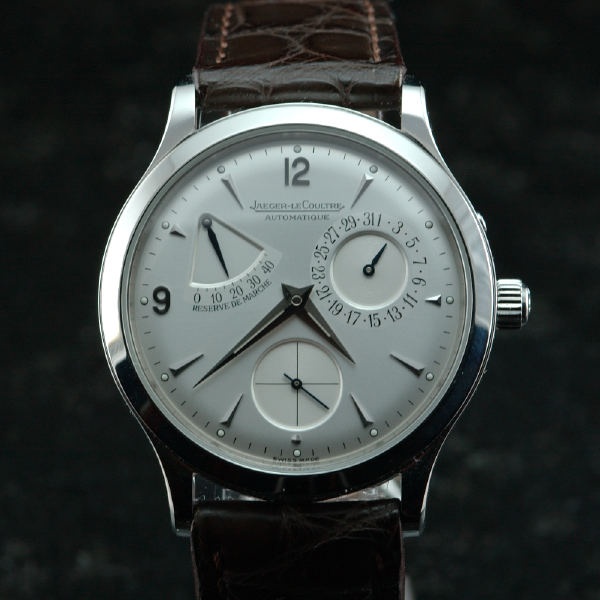
Of course, the dial has been deeply redesigned, but the spirit is here, and the RDM keeps this Vintage look, too: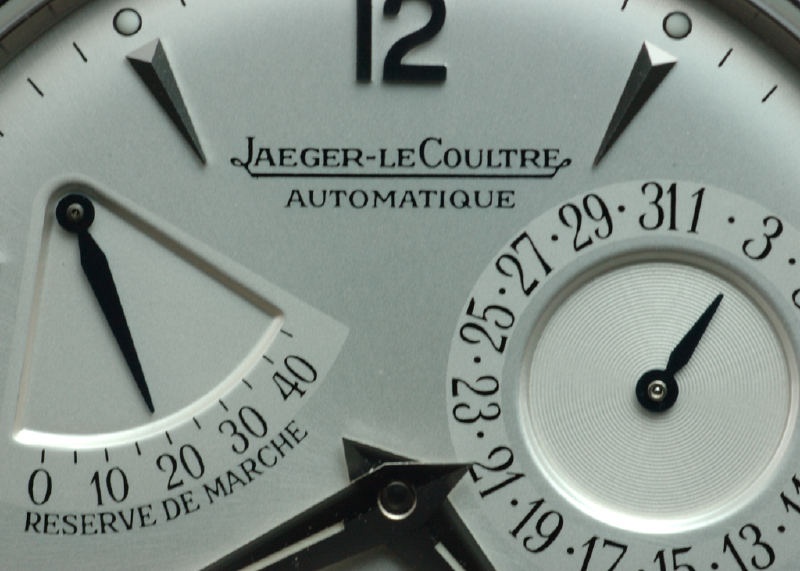
A 37 mm case, same shaped indexes, heated blue Dauphine hands, silver dial, the link is obvious.
As for the movement, there is no bumper anymore, of course, but a modern automatic movement, the Cal 928, with the up to date technologies ( ceramic ball bearings, for example ) providong, in both cases a power reserve of ...40 hours.
So, do you need a ( real ) watch?
Best to All.
Nicolas

Thank you so much . I never even knew this 37mm beauty existed

A 37 mm stainless steel case is not easy to find, but impossible is not english! :)
Thanks for your comments, my friend.
Best,
Nicolas

Thx for the review Nico. A very nice watch. Simple with a lot of presence. [nt]
And not very well known, which adds to its charm, pleasure and interest, IMO. Thanks!

En effet, j´ai déja assez de montres, mais cette montre là ...
Thanks for your mouth-watering post which again made me feel I am living in the wrong era: watch-wise I am a 50´s and 60´s person.
Your shot of the three JLC automatic watches is breathtaking, each of the three watches is stunning. My sincere congratulations to their owner!
Best regards
anaesdoc
The Futurematic, Geomatic and Powermatic are all mine.
I am the lucky owner of them.
I just have to update my post on Vintage JLC automatic watches, you will see, it is even more spectacular.

Best, my friend, and thanks for viewing.
Nicolas

Bravo!!!
Thank you for present this beauty.
Did a research and it seems that JLC was, again, the first-ever to have this power reserve indicator on a commercial product.
Breguet had one in 1933 but was one of a kind prototype.
Cheers
NIlo
Very nice review of this unknown model

by master "Loupe à l'Oeil"


Development indicator device for the mainspring winding watch...
Nilo,
Indeed, JLC have many "first" - but this time I suspect that it was a joint venture together with Zodiac.
Patent - filed 1948, granted 1952:


Here is an article about the Power reserve indicator function from 1949:


Best, my friend
Blomman
This was a point I was not very sure of, indeed.
It was a superb era, when JLC released so many interesting and fine watches!
Best, Nilo, and thanks for answering.
Nicolas
Some additional info...
Thank you, Nicolas for a great review!
The Powermatic is a beautiful watch - especially the Jumbo size!
As you stated in the review - it started with the Cal 476.
Here is the movement specification for the Cal 476 and 481 - as you can see the Cal 481 share the base movement from Cal 476.


The resemblance is also shown on the case, dial and hands of the early Powermatic compared with your Cal 476.

Agian, thank you, my friend - for a great review!
Best
Blomman
You just made me think that I have to " pressure " my watchmaker on the 476.
I miss this one a lot.
Thanks for your kind words, my friend.
I find the Automatic watches from JLC to be very interesting, and developped a small trip into this thema.
Will show you....
Best!
Nicolas

I wonder..
-MW
Well, I didn't look for the correct crown, till now, but I will, then I'll know. :)))
Thank, you, my friend.
Best,
Nicolas


Powerful review!
Thank you for your review that highlights the mechanical, historical and aestetic interest of this watch as it deserves.
I was wearing my Powermatic recently and it confirmed that the window at 12 is a perfect solution to display the power reserve indicator without overwhelming the dial.
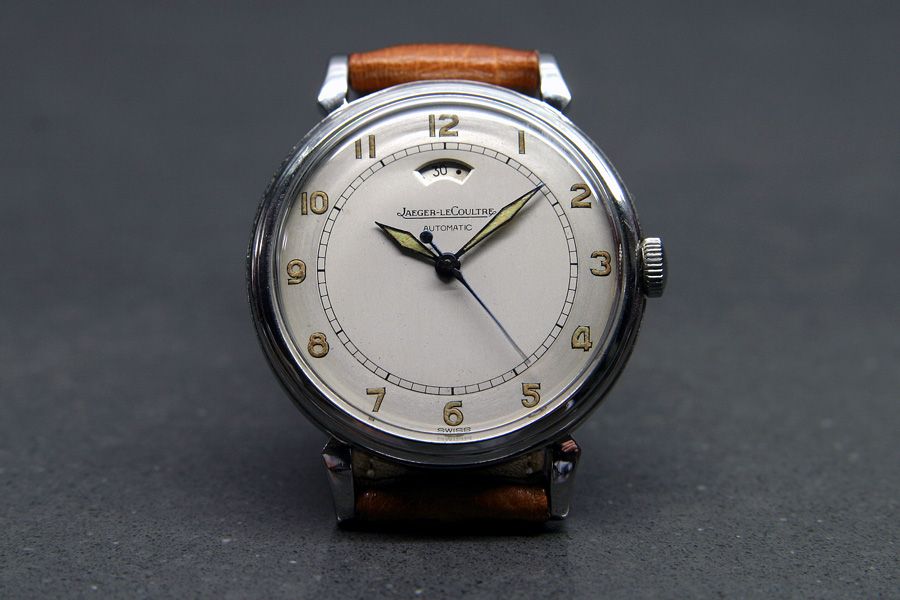
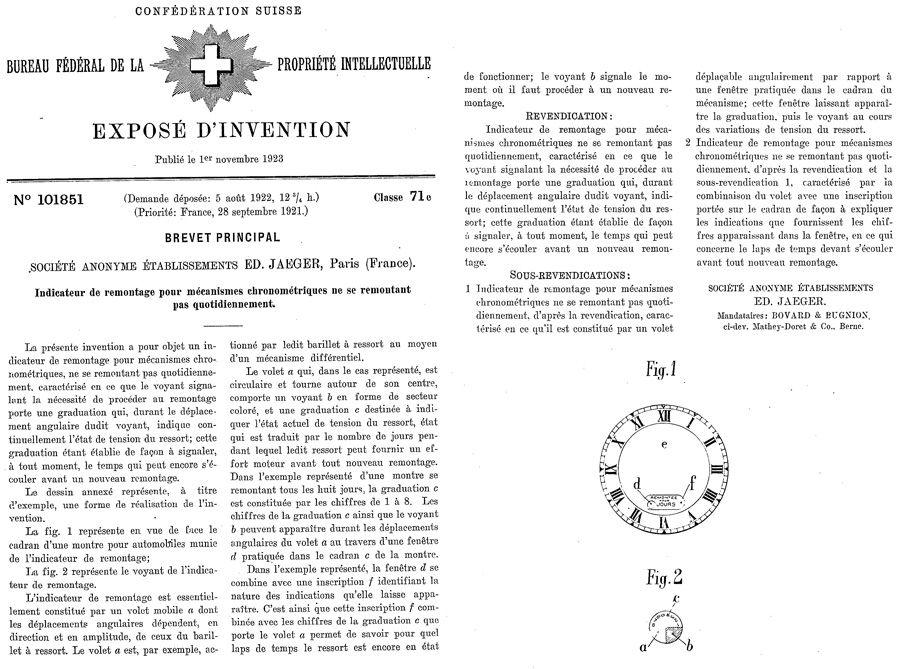
It is also important to notice that Jaeger was already using a similar window indicator for displaying the power reserve on its car clock in the 1920s.
Here is a scan of the patent that was published in 1923 by Jaeger.
Kind regards
Thanks for adding your beauty to the edifice, Marv.
Your dial is mint!
And thanks for the Brevet, it was an important information I missed.
Best,
Nicolas

Like others..
never knew about the Powermatics!
Thank you Nicolas!
I find the PR very discreet and well done for a vintage style piece. I have always thought that the PR along with the alarm are the best complications.
And the larger 37mm is great for today's wearer. This maybe my first vintage hunt!
Any tips on where to begin?
All the collectors markets, my friend.
It is a long hunt before finiding a jumbo Powermatic.
But whic knows?
I will let you know if I ever find or see one.
All the best, and thanks for your kind words.
Nicolas

Great review
Thank you, JML.
I think you are right to hunt this reference. much more underated than the Futurematic, but far from being an uninteresting second choice!
And in 37 mm, the case is really something.
The problem is that they are quite hard to find...
Best, my friend.
Nicolas