
Now that everyone has seen the new Grand Prix range in all its glory
how about a little in depth analysis of the design elements?
The colors of the dial are what immediately capture the eyes of most observers -

Why red? Why yellow?
Here are a few reasons:


"A Purist does not believe in gilt by association. Respect, AND disdain, have to be earned..."
The Bezel
The inspiration for the bezel design is obvious to any high performance car enthusiast:


Modern ventilated disc brakes are a thing of beauty to gear heads and motor heads...
The "bezel is a two piece design, with a forged carbon upper part and a lower ring in shimmering black ceramics. Offering a perfect example of the sophisticated design of this collection, the bezels are composed of two openworked and nested rings. The screws extend slightly beyond the bezel surface and are thus set off to their best advantage. "


"A Purist does not believe in gilt by association. Respect, AND disdain, have to be earned..."
Is this Calibre: 3126/3840 selfwinding...
...the same as that in all the other Offshores?
If it is (and I believe it is) I think that is the difference between this watch and the cars you feature in those photographs. Ferraris, Lambos...all have motors inside which are as impecable and advanced technically as the rest of the car itself. That does not happen in the Offshores. I am sorry, but I cannot understand it.
If I am wrong, please correct me.
The movement is basically the same as in
The base movement is NOT the same as the original Offshore chronographs which used the 2126/2226/2326 base, and the 3840 chrono module is a revised and updated evolution of the earlier chrono module.
As I understand it, being a 40 year fan of Lamborghini and Ferrari, the Diablo and Murci engine are constant evolutions of a GREAT engine developed and manufactured by Lamborghini (actually, Bizzarini UNDER CONTRACT to Lamborghini, so it it is in house...or isn't it?!?) Since the early 1960's.
So sorry, I'm not sure I understand the last part of your point?
Is this the old in house vs not in house diatribe?
Or is it the just as old and still "unanswered" (personally, it remains unanswered because there IS no answer) debate between integrated and modular complications?
(Believe me, I understand the arguments between integrated and modular design adherents, and their respective advantages and disadvantages)
I'm curious and looking forward to your clarification; I'm always up for learning something new!
Cheers, and thanks in advance!
TM
It is the old debate...
...between integrated and modular complications. That debate may be unanswered, as you say.
Or it just may be that you don't like the answer out there... ;-)
I'd love to read "the answer"
Hi, Sanro,
I am always open to be "enlightened."
I hate "dogma" -
"ceramic is the perfect bezel material" - BS. Anyone who has ever hit a bezel hard enough against another hard surface, worse a POINTED hard surface, will scream in pain as their "impervious" ceramic bezel cracks or shatters. So it resisted scratches better than metal; I'd rather have scratches than cracks. (yeah, yeah, any incident that would damage a ceramic bezel will also damage a metal bezel. Of course; how "repairable" each material is given a specific incident and how preferable that is, is up to the individual owner.)
It also does not "polish" as beautifully and as varied as metal, though with new machining techniques, some pioneered by AP, this limitation might change in the future.
"integrated designs are superior" - uh huh. what about serviceability? What about upgradeability?
"modular designs are superior" - sorry, not necessarily either. There are unavoidable construction issues and weaknesses (more "coupling" issues; almost unavoidable additional thickness due to the modular "carrier"; etc)
So what "answer out there" are you referring to?
Just in case you don't know, I am very familiar with the "engineering elegance" argument for integrated designs. So how many "integrated designs" have you worked on, and had to pull your hair out, trying to upgrade/evolve? How many troublesome integrated designs have you worked on that, if it were modular, would have offered an alternative fix of just swapping out the defective modular functions?
So for me, given my admittedly limited knowledge and limited experience, I still have not heard any convincing and compelling "answers" that unequivocably conclude one is always and forever superior to the other.
Please enlighten me.
Thanks in advance,
TM
Just to be clear -
intellectually and "in the abstract" I prefer the "engineering elegance" of integrated designs - purpose built, specialized.
Practically I see very well and respect the "practical elegance" of modular designs.
To say one is "superior" to the other in all situations and circumstances is about as ridiculous as saying that a Miura or Boxer is superior to a Ford Kingswood Estate station wagon.
Horses for courses...everyone has their priorities, for which there are more and less appropriate solutions.
TM
The Crown
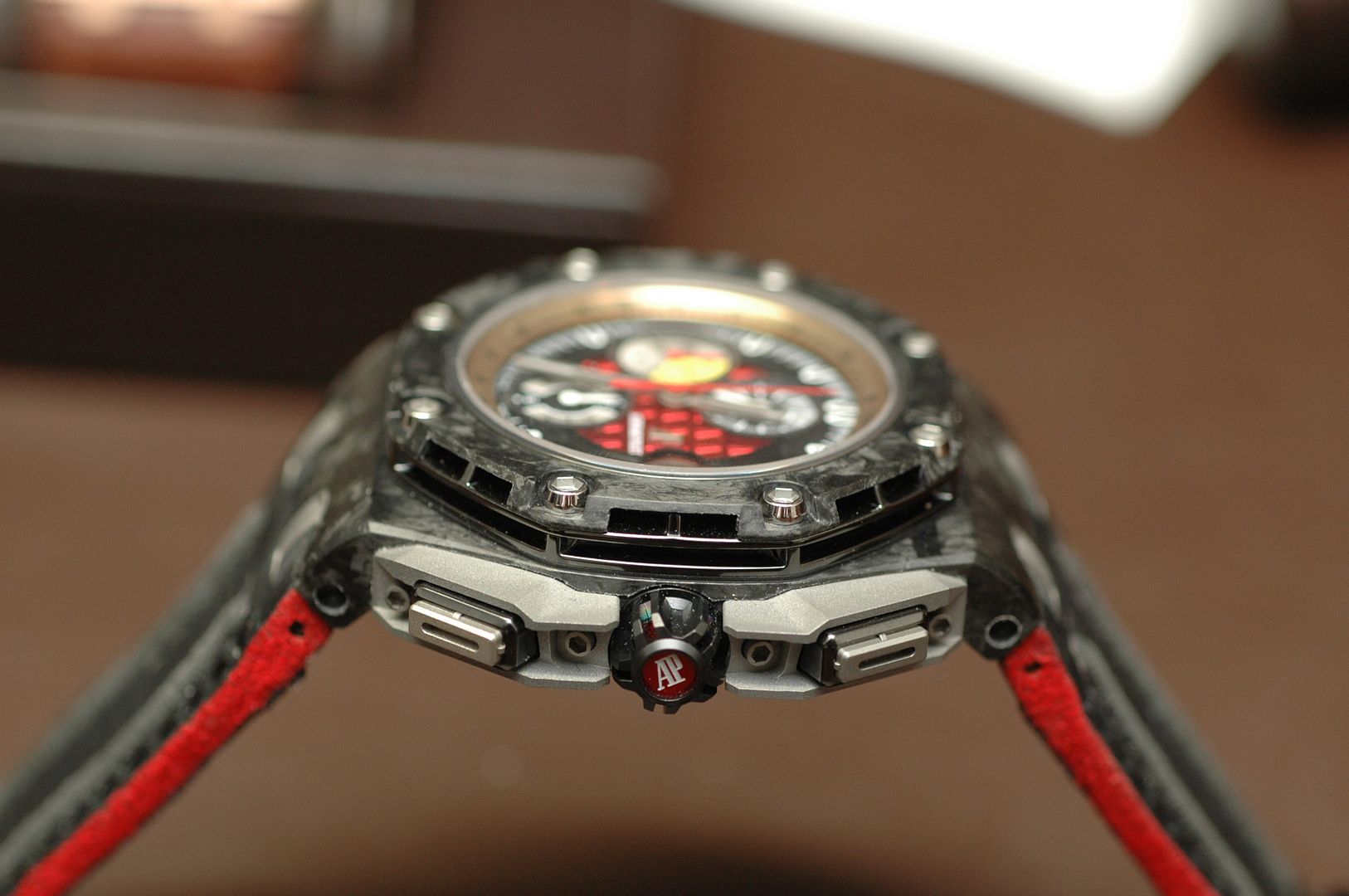
"The crown evokes a gear" with a "red accent that appears on the crown adorned with an eloxed aluminium cartridge. The crown deserves a closer look due to its sophisticated edging and its openworked design providing glimpses of red a colour that also appears on the side of the alcantara strap. "
A picture is worth a thousand words...


Holinger sequential transmission gears from a Lamborghini Diablo, courtesy of Holinger AU

Holinger transmission gears and shafts for Lamborghini - straight cut, ground finish - courtesy of Holinger and Developro

Holinger transmission shafts for Lamborghini - courtesy of Holinger and Developro

Ferrari 512BB Boxer transmission gear, courtesy of Ferrari Craft
"A Purist does not believe in gilt by association. Respect, AND disdain, have to be earned..."

Australian engineering...
The Dial, part 1
There is a lot going on; no doubt. Does it all come together as an integrated whole, or do the individual elements clash, resulting in a whole that is less than the sum of its parts?
That's what's great about art and design - everyone can decide for themselves!
And to those taste dictators who shout their dogma about "design rules" and "good designs MUST..." I say to you, BAH HUMBUG! If someone likes it, connects with it, isn't that the most important thing?
(which is not to say that good taste can be cultivated and developed and evolved over time and experience...)
I seem to remember much indignant pffuffling from "the establishment" when Dali or Picasso first showed their more daring and rule breaking works...

"The dial counters evoke dashboard instruments"
Ferrari F430

Ferrari 599 with custom red insert

Porsche 997

proposed Ferrari 458

Audemars Piguet Grand Prix, rose gold
"A Purist does not believe in gilt by association. Respect, AND disdain, have to be earned..."
The Dial, part 2
"the red dial a central eloxed aluminium plate adorned with the Méga Tapisserie motif characteristic of the Royal Oak Offshore line.
The pattern has however been specially revisited for this limited edition by means of a negative-printed design that creates a depth effect and evokes the cooling scoops on a car.


The Dial, part 3
"The floating flange stands out because of its bronze colour reminiscent of the magnesium alloy wheel rims on a racing car."
The flange ring is indeed a standout; what is so interesting about it, besides the unusual color - it almost seems a bronze gold - is that the effect plays tricks on the eyes. Under certain angles and lighting, it appears radiused outward, when in fact it is curved down/inward.

The fonts used for the counter at 6 is also very "tech" - they are reminiscent of the numeral fonts generated by old school LEDs which generate characters based on straight and perpendicular lines (except for the 1 in the 10...
A case for negative space...
and forged carbon:
I had a chance to speak with the design team as recently as October (and several times before that) on recent design "priorities."
They mentioned that they really like to play with "negative space" these days. "Why"
"Because it is harder to do and it is new, fresh, and fun."
Well, no question they used "negative space" to good effect in the Grand Prix.
Besides the 3 dimensionality and shadowing the dropped and sloped clous de paris pattern gives to the dial -
It is also used for interesting effect on the case -
How many people noticed the detail on the case, lower left side just below and to the left of the bezel?

The effect appears again on the movement rotor...

And...how many caught these little details?
"the four scoops at 1.30, 4.30, 7.30 and 10.30, echoing the studs which pick up the same theme; and the three counters with a raised rim that is blackened inside and polished on top."
Forged carbon has definitely had its share of questions and controvery and naysayers. Of course, like any cool material, it also has its fan boys who feel this material can single handedly bring world peace and end hunger.
As usual, the truth is somewhere in between.
I remember when the material was first used for a timepiece case; ThePuristS had the worldwide exclusive preview and launch of the Alinghi Team Full Carbon. I thought it was cool then, and I still think it is cool now.
But I also remember the comments about how it appeared "plasticky."
As we would expect from AP, they have continuously tweaked the material, and by playing with the composite and ratio of binder to carbon fiber, it appears even more bada$$ today than when it first appeared a few years ago.
Is it hard? Define hard. It will sheer if nicked against a sharp edge with very high impact. And it can scratch if impacted hard enough with a sharp enough or pointed enough surface, but interestingly, the appearance of the material "hides" scratches very well. You have to see it in person to understand just how well it does this.
But hey, is ceramic impossible to scratch? Depending on the composition of the ceramic and how it's formed, yes, it can. It can also CRACK, much more easily than forged carbon, due to its brittleness, a function of hardness.
Can it forged carbon snap? Yes, we proved that in Hong Kong a few years ago at a PuristS AP get-together.
Can it be refinished? As far as I know, no. But AP is committed to the material and so for the foreseeable future AP will simply replace the forged carbon part as necessary, and I am sure at some point a process will be found to refinish without replacement.
Clever combinations of forged carbon"
Forged carbon was deliberately chosen for this collection. This ultra-light and resistant material is exclusively developed by Audemars Piguet, from the manufacturing method through to the related tools. The sophisticated shapes of the Royal Oak Offshore are achieved thanks to an appropriate mould.
A set of threaded carbon filaments is placed inside this mould. This wire measuring just one millimetre in diameter is itself composed of several thousand 7-micron carbon fibres held together by a resin wire. The case middle of the Royal Oak Offshore Grand Prix calls for a set of filaments totalling 12.5 grams. Placed end to end, these filaments are equivalent to 22.2 metres of carbon (sic) wire and 99.7 km of carbon fibres!(sic)
The mould is then compressed at high temperature at pressures of over 300 kilos per square centimetre. This process results in a material composed of 76% carbon and only 24% polyamide.
Audemars Piguet displays the full force of its expertise in the machining process. The inside of the case and the correction of the various drilled holes can thus be meticulously finished. The result is a shimmering effect and a silky feel, clear-cut edges and a sturdy yet ultra-light case-middle: in its forged carbon version, the Royal Oak Ofshore Grand Prix weighs a mere 120 grams! Ceramics, blackened or beadblasted titanium, eloxed aluminium, 950 platinum and pink gold all contribute to this stunning combination of sophisticated materials. "
This last comment about machining is very critical. This has certainly improved since the Alinghi Team All Carbon (ATAC) - look at the complex details of the bezel; look at the fine edges and transitions, the smoothness of the curvature on the bezel screw head surrounds. This definitely leads me to believe that refinishing forged carbon parts is not far away, if needed.

Really looking forward to seeing this piece in person!
-MW

I caught that detail.
Interesting point, Michael.
What do you think, as a designer yourself, of the other elements and their inspiration?
Cheers,
TM
I am very impressed in those regards.
The Grand Prix might not have drivers checking their times as they drive like Ernesto can on board Alinghi, but nonetheless the inspirations are evident. I am still analyzing to be truthful. I like all three variants. The forged carbon piece grabs me the most. The RG version looks so amazing in the wrist shots, and the (more) monochromatic dial is very pleasing. The blue on the platinum pairs so well with the silver tach.
Back to the details, I have studied the lugs and plots, the case, the strap, the bezel, the dial details. When you think about it, how often is a new and exciting watch design limited to the dial, strap, and maybe choice of materials? Seems to me AP continues to set the trend. For the past few years, the introduction of new materials has dominated the landscape. Leave it to AP to take it to the next level, detailing every aspect of the piece.
The watch is likely not intended for all tastes, but I believe, like the Alinghi, should be applauded for its design and execution.
Thanks, Michael, interesting comments.
great food for thought, and I agree, AP wisely does not design "for everyone."
Thanks,
TM
My pleasure, sorry for my recent silence...
Just been crazy busy with a family event and my slow moving remodel. I'm quite impressed with the new offerings, specifically the new skeletal Royal Oaks. The Diver is a fantastic sports watch that should be a fit with all AP fans.
Thomas, thanks for all the reports and information. Always top notch information


FCB
the forged carbon fibre has improved since the early days of the TA. is the GP's forged carbon any different from my bumblebee??
btw, very insightful...the relation between car n watch. more often then not, one just think its some marketing gimmick. in your opinion, does the likesof Richard Milles on the higher end and the BRMs on the lower dollar end provide similar or close to levels of car/watch inspiration as the AP?
AP is constantly studying ways to improve...
"btw, very insightful...the relation between car n watch. more often then not, one just think its some marketing gimmick. in your opinion, does the likesof Richard Milles on the higher end and the BRMs on the lower dollar end provide similar or close to levels of car/watch inspiration as the AP?"
I do see the inspirations from high performance cars on the RM and BRM as well. Whether something is "marketing gimmick" or not, for me, depends on sincerity and a priori motivations.
"What can we do to get people to buy this?
yacht racing/car racing/chicken racing"
is very different to
"we love car racing; we support it; what kind of design can we do to pay hommage to car racing/yacht racing"
It all goes back to intention and integrity.
Unfortunately, we can't yet read other people's minds, sadly.
TM
totful
sadly, you are talking to a RM11 and a BRM 54 owner. for APROOs, now only bumblebee and las vegas. also have a Maserati millinery.
i was once easily excited by car inspired or motor brand related, but it got to a stage whereby even the slightest motor sports inspired feature is uphighlighted and constantly harped upon.
truth be told, when i first saw the AP GP, i was thinking...my goodness...vulgar and colourful, other then the material which is used in motorsports, and dial layout looking reasonably like a dashboard instrumentation...everything else is at best tedious.....until i stumbled upon your post. make me take a step back and rethink my position.
thanks for the pictorial comparison...one of the better posts i have read in recent memory.
why sadly?
Hi,
Nice collection, nice pieces. I know Richard Mille himself is seriously into cars and car racing, so it's not just pure money and profit driven for RM.
I believe BRM, from what I've heard, is same.
I understand the temptation towards cynicism; I've experienced the same many times. But hopefully it is just a passing cynicism.
Thanks for your kind words.
TM
After seeing the different metal in real life...
This is a very personal preference thing.
The next day I was shown the all carbon.
"Now that's what I'm talking about."
While I feel the same way about the Grand Prix, the design is a little less "radical" than the Alinghi Team vis a vis the classic Offshore so I find the RG and FC versions equally alluring; as a purist, I might lean towards the all FC version simply because of the weight.
But sometimes, even Ferrari and Lamborghini add weight to a model for reasons other than sheer performance, so...
Cheers,
TM

Thank you for this series...
...of great posts about the new Grand Prix, TM! I have an abiding respect for AP, and am very drawn to the RO in particular. While the Grand Prix is perhaps too brutal and testosterone-filled for me, those macro shots reveal an artful watch with a purposeful design.
Thanks for sharing all your thoughts about this piece with us. I really enjoyed learning more about it.
Cheers,
Daos
Ah, Forged Carbon...
Thomas,
I'm not going to repeat my opinion on the material technology side of that substance, but this: "The result is a shimmering effect and a silky feel, clear-cut edges and a sturdy yet ultra-light case-middle" is a good enough reason for me (especially as it avoids the Marketing-Dept-attempts-at-engineering style justifications).
Not sure about the refinishing of the Carbon. It'd be extremely difficult to get the edges and surface finish once you've cut into the fibres themselves. A big, fast cutting mill might do it, but that's not something a service centre is likely to have. And if you send it back to AP, I'd guess they'd swap it out over setting up a machine...remains to be seen.
I can completely understand your enthusiasm for this watch.
Ben
A case for cold fusion...
I recall a recent, somewhat one sided exchange on the internet about "complicated cases."
If ever a watch case could be called "complicated" this is it.
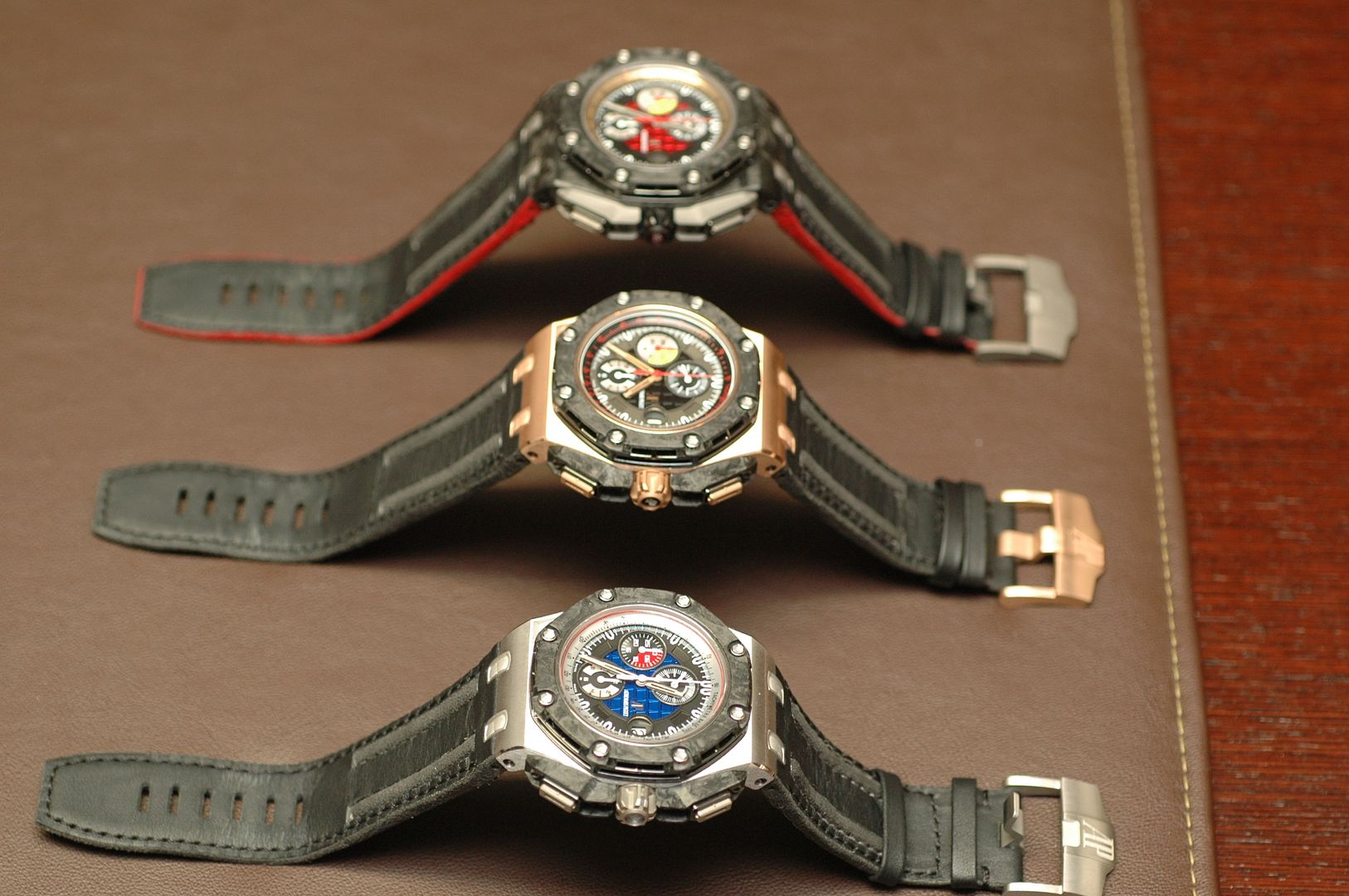
As is well known by now, the Grand Prix is available in three basic materials (even though there are other important materials used throughout the three variants such as blasted titanium; ceramic; et al) -
Carbon Forge;
Pink Gold;
Platinum

The "case in pink gold, a noble material, makes a striking contrast with the forged carbon and black ceramic bezel, as well as with the left side of the case middle and its forged carbon element designed like a ventilation duct."

"It also contrasts with the carbon pushpiece guards, which further exemplify the meticulous detailing on this model. Instead of being straightforward rectangles, the latter feature clean-cut high-tech edges and are applied to the case by four visible screws as well as hollowed on the side so as to house the pushpieces which are themselves composed of two parts: a black polished ceramic base and a pink gold contact surface. "

The use of bead-blasted titanium for the formed and shaped pusher guards is a fantastic high tech hi-mech visual feast, to these jaded old eyes.
Does it all work? Do the parts all come together to form a whole greater than the sum of the parts?
That is up to each individual reader, but I can tell you this - if I had one of these:

I'd be one of the first in line for one of these
ps: wondering what inspired these?

maybe this

or this


Incredibly stunning.
The amount of work on detail on this watch leaves me speechless. Thomas, thanks so much for sharing all the information and of course great pics.