
Your thoughts, please? Integrated vs modular complications
Hi,
One of the perennial "battles" among watch enthusiasts; indeed, among mechanical design enthusiasts of many categories - complex mechanical systems like deep sea explorer vehicles; multilevel complex electronics; even car mechanics and electronic systems; aircraft avionics; et al - is the design philosophy and "engineering elegance" behind integrated vs modular designs.
Some "real world" engineers don't like to get involved in the discussion at all, of course; for them, it is "horses for course" and the design path is strictly driven by functional need and performance specs, which include not only "performance" as we typically think of it - horsepower, torque, "accuracy" and running rate reliability; balance amplitude and stability; etc etc etc - but also serviceability and upgradeability.
In the world of watches, the engineering issue is basically - the essential timekeeping functions are "one unit" and for the most part "integrated" - the going train, the regulatory organs/escapement - hairspring, balance; and the power source (mainspring)
Petite (little) complications like date, center seconds, even simple calendars like day and month, or moonphase, are typically "integrated" as well.
Going up the complication scale, chronographs used to be, in the "golden age" of watchmaking, mostly integrated. In another words, they were purpose build from scratch, even down to the basic timekeeping components, as a chronograph.
Going up to grand complications like repeaters, these can be modular (IWC - a repeater module, attached to a pre-existing base movement) or integrated, like the classical JLC, VC/JLC, LeCoultre, or Audemars movements. (sidebar - there can be some grey area on "integrated" repeaters - some purists could argue that the VC/JLC repeaters are not fully integrated as it is a Dubois Depraz repeater mechanism built onto a JLC base movement, but I think most would agree that it is more integrated than modular. For the purpose of this discussion, I think it only practical to define modular design as "a design based on modules which are designed and can be integrated onto another module or base in whole, and can be removed in whole")
Thus, the AP Grand Comp is a modular design -
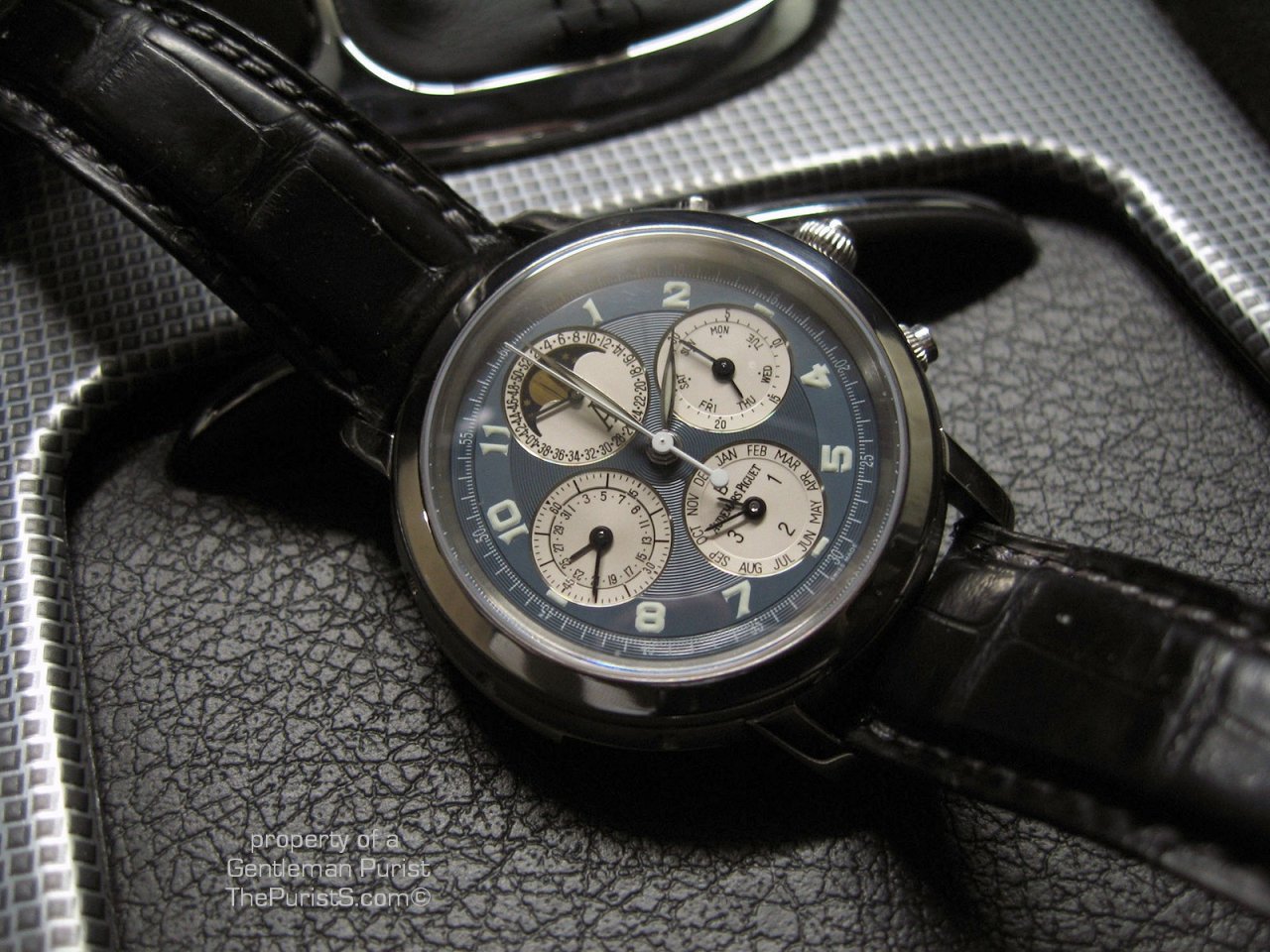
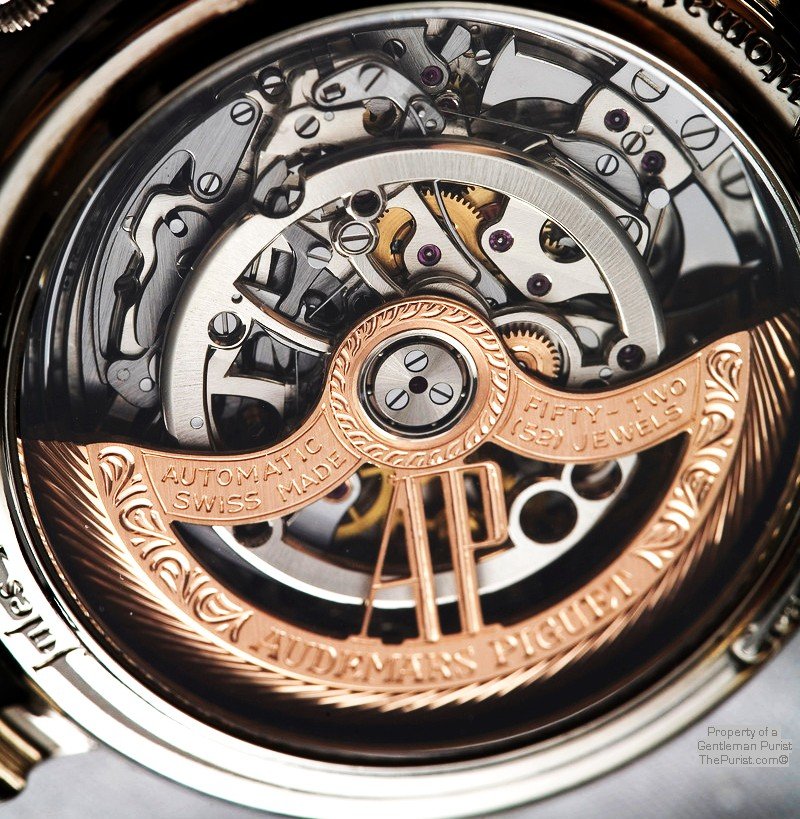
while the Petite et Grande Sonnerie is an integrated design
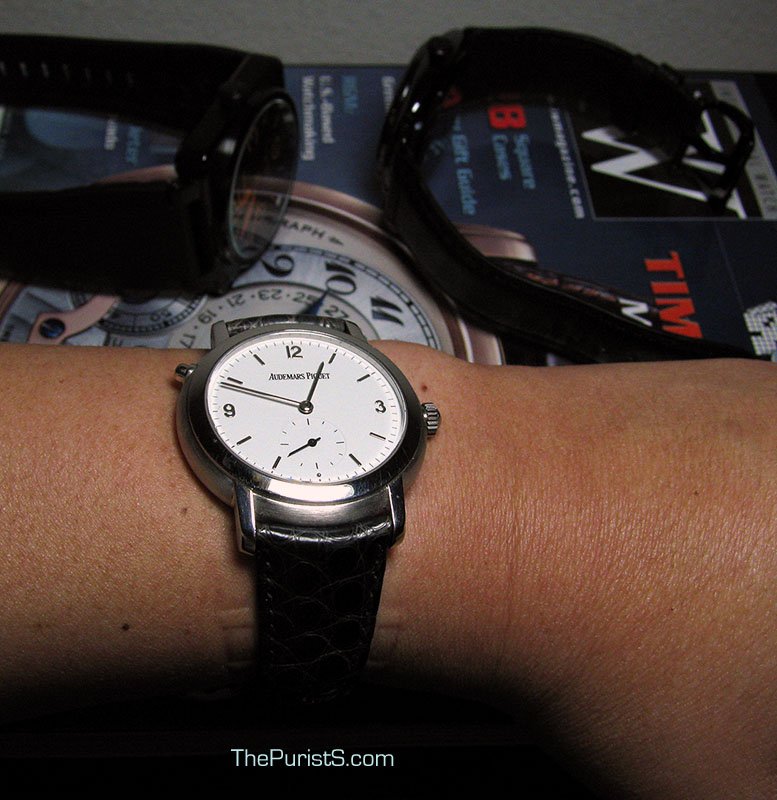
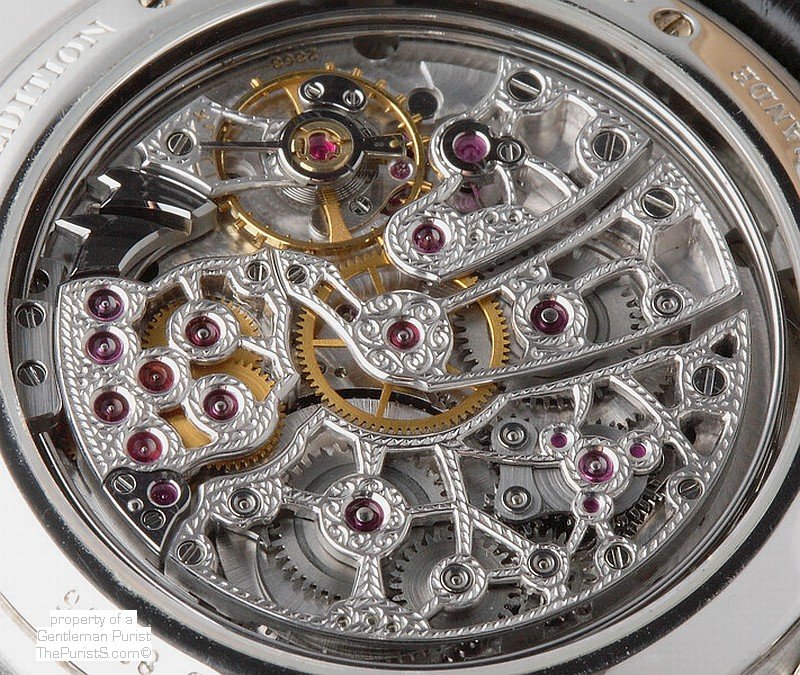
I have heard quite a few arguments for both camps, and I myself have my own opinions about which I prefer.
What I find very interesting is that, especially in the case of the Offshore Chronograph, which is an integrated design - 2326 or 3126 base, 2840 or 3840 chrono module - the two schools are not only very strident, they actually take the whole discussion to the level of religion and dogma.
"The Offshore chronograph is lesser/crap because it is integrated."
"The Offshore chronograph is great because it is fine, yet still relatively easy to service and upgrade because of its modular design - in the worst case, remove the bad module and replace."
There have been long flames and even some peudo-intellectual "analysis" and conclusions on the internet about modular chronos, and specifically the Offshore chrono - "you can identify a modular chrono by the pushers and the crown not being in the same plane."
Most of the time, yes.
So?
Maybe my "So?" is a bit too deliberately flippant, of course; a poorly integrated module to its base can result in coupling issues, and have lousy tactile feel or even unreliability in the activation of its pushers, NEITHER of which is a problem with the Offshore, by the way.
This subject has come up again recently, in the thread about the Grand Prix and its indepth design analysis and inspirations. (case, dial, movement rotor - it was about design, not about engineering, by the way, as is the model itself, and no one every claimed otherwise, as far as I remember.)
I would love to read your thoughts - which, if either, do you prefer - modular, or integrated, movements and complications, and why?
And if you don't care, either way, please feel free to share that too!
Thanks,
TM
case by case basis for me
then again it's a nice feeling when a movement is a "true" chronograph, designed to be that and nothing else... but its nothing more than a feeling to me... a good design is a good design, and vice versa... its only above a certain pricelevel I would carefully examine and care about whether its modular or not... AP watches are not in my pricebracket so i will never have that worry with them, but I have no reason to believe AP would release anything sub par...
my 2c
chris
Teleological vs. Naturalistic Horology
Thomas,
I consider the concerns about integrated vs. modular similar to the concerns about "in-house" vs. outsourced. Neither issue has any relevance to me as a buyer except as these issues may relate to purchase cost, maintenance and repair cost, resale value, and--truth be told--perceived status. The cost issues are real but hidden among many other variables that affect pricing. The resale value and perceived status issues are interrelated and very much a function of the attitudes and opinions of those social groups who buy used watches and who dispense watch status rewards. I would expect those who have invested in the manufacturing, distribution, sale, or ownership of integrated, modular, in-house, or outsourced pieces to be biased, however, gently, in the direction of praising the attirbutes in which they have a stake and bashing the attirbutes in which they do not have a stake. (Don't humans do the same thing with respect to all status hierarchies, such as Ivy League vs. Big Ten, French vs. Napa Valley wine, German vs. domestic beer, imported vs. domestic cars, etc.?)
Another perspective that I can imagine but do not embrace is that integrated is superior by virtue of its greater purity of purpose, in that the thing is created specifically for this limited and ulitmate purpose. The idea of "purpose" in the universe has occupied countless minds, even some of the best minds, throughout history, and it seems to give comfort to many to think of things or events or people or life itself as having been created and designed for some ultimate and perhaps discernible purpose. When applied to watch mechnics, we could divide ourselves into two camps:
(1) Teleological horology, which attributes superiority to integrated design and in-house manufacturing.
(2) Naturalistic horology, in which the appearance and function of the watch are to be judged only in accordance with the purposes of the owner.
As a naturalist, all of this seems to me to boil down to buying what one likes and hoping it works most of the time without too much trouble or expense. I care less about the purpose of the creators or the ownership of their suppliers than I do about the watch itself and the fact that it makes me smile.
Park

Honestly Thomas, I don't care, as long as it is well-made
I do, however, care a lot about the debate regarding "in-house manufacturing" and "outsourced components". To me, that relates directly to the purity of the piece.
Jon (Z3)

I don't get worked up about stuff like this, I guess.
I'd like a watch that works well -- keeps good time, functions as intended, and isn't going to spend as much time "in the shop" as on my wrist.
As long as the watch is attractive to me, I could care less what anyone else thinks.
Maybe I'm just a rube, but this is what matters to me.
Cheers,
Daos

Same here. As long as it works well, it doesn't really matter that much to me. [nt]

For folks interested in the broader topic of integrality vs. modularity...
Hey -- now there's a post title guaranteed to cure insomnia right there!
Seriously, though, for those who are interested in this topic I strongly recommend the research and writing of Clayton Christensen, the HBS professor who is best known for his work on disruptive technologies and invention of the term "the innovator's dilemma" but who has done some wonderful research on the topic of modularity.
Clay suggests that integrality (as a Purist I'll use his "correct" term rather than "integration," which to him refers to the assembly of modules into a whole) is, in the early days of many technology (or business) systems, the only approach that can yield the performance needed to meet minimum market requirements. When there is no solution that is "good enough," taking an approach akin to carving the entire system from a single block of stone has the highest potential of squeezing out the last bits of performance that are needed to get over the line. Think here of early personal computers, in which every piece was designed to mesh with every other piece.
Over time, as systems move up an improvement trajectory (think here of an experience curve), the fully integral systems get to a point at which they not only meet, but exceed mainstream market requirements. At this point, other dimensions of "performance" begin to become both important and possible to various market segments. Some folks want lower cost, others want design flexibility, the ability to repair one element without tearing out hard-wired connections to other ones and so on. What happens is the advent of "plug and play" approaches, for instance, where you can get any of a variety of hard drive sizes, processor speeds, displays, graphic cards, and so on -- because the performance of individual modules is so good, the performance losses associated with the introduction of interfaces still don't pull the performance of the total system below mainstream market requirements, and various parts of the market value the new performance attributes (e.g., customization, cost, ease of repair) more than the ability of more and more refined integral systems to deliver marginally improved performance on the original performance attributes.
A critical point in all of this is that in a modular system, it's not just the quality of the modules that matters. In fact, in many systems the quality of the interfaces is actually much more important, and poor interface placement or design, not the performance of the modules, is the limiting factor on performance. Many a design has met market failure because the interfaces were put in the wrong place. One way of thinking about this is in terms of "thick book" and "thin book" interfaces -- whenever possible, you want an interface in which the "instruction book" of rules and procedures for what goes on at the interface is a few lines on a page, not an encyclopedia. To me the JLC Tryptique is a great example of this -- the QP complication in the back plate of the watch is actuated by a single pin connector, not by 5 or 6 levers or cogs -- that interface is both very clever and in the right place!
So what does this mean for watch design? If watches are analogous to the many other systems that Clay has studied (an important disclaimer!), then we would expect that ultimate performance (akin to the "purity of purpose" comments by others) would in fact be higher with an integral design rather than a modular one, no matter how slick the interfaces are. At the limit, you might be able to design the interfaces to be so perfect that there are no "frictional losses" in the system -- but then you've pretty much turned it into an integral system.
If, however, ultimate performance on the original set of criteria is, to you, less important than other performance attributes such as cost, design flexibility, ease of repair, and so on, then modular designs are just fine -- as long as the modules are "good enough" and the interfaces work!
Last thought -- much of the above might lead one to conclude (if you're still reading!) that systems inevitably migrate from being integral in their early days to being modular as they mature. However, what happens more than you think is that a whole new wave of market expectations comes on the scene, and the existing modular designs cannot be made "good enough" to meet the need -- so there's a resulting new wave of integral designs created to get base performance up to the minimum spec.
Clay eventually links all of this back to his theory of business/technology disruption -- but that's perhaps a discourse for another time! Hope that this info was of some interest.
Best,
Gary G
Interesting analogy to Clayton's work
Thanks for an interesting read!
I think it mainly talks mainly about new innovations and new paradigms, where the requirement of the market, as well as the performance of the new innovation, are not always certain...
In our case (for example, in the case of chronograph movement), we are talking about something that has been invented and even perfected long time ago. It's currently being produced in both integral and modular fashion, the market requirement has been long established (i.e. time-keeping, reliability, etc), and the performances for the end consumer have been very similar for both versions.
Hence, performance and uncertain market requirement, as described by Clayton, are no longer the issue.
I think we are just talking about "softer aspects", such as purity of design, ease of service, and the related aspects that are much more philosophical.=)
Curious as to what you think about that.
Jon (Z3)
Good points, Jon
I reached some similar conclusions in my overnight reflections on this topic. Basically, even the responses so far to this thread suggest that when it comes to the "basic" chronograph, performance of both integral and modular solutions exceeds the mainstream market requirements. I actually seems that both kinds of designs also exceed the performance requirements of picky folks like the PuristS!
That said, I think that Clayton's principles still apply. I, for one, find it useful to be able to understand the paragraph that I just wrote above in terms of a conceptual construct (that of meeting or exceeding mainstream market requirements as a key driver of modularity or integrality). In addition, I started thinking about the JLC Duometre, for instance. It goes beyond the "basic" chrono requirements with its claim that it reduces the drag of the complication on the base movement, thereby making the timepiece more accurate whether the chrono is running or not. It also has additional complications such as the 1/6 seconds running display.
My initial thought was to characterize the Duometre as an integral design -- improving on specific and fixed performance dimensions through a "carved from a single block" approach -- but I was confounded by the emergence of the moon phase Duometre based on the same "double wing" design. I'm not certain whether the majority of the new caliber is identical to that of the Duometre chrono, but let's say that it is -- in this case I'd characterize what's going on as an improvement in the interface between two highly integral modules. To be more specific, it seems that JLC has linked together two separate movements through the extremely simple (and low-energy-drain) mechanism of the stop-seconds display, with a power supply on each side removing the "thick book" requirement that the power for the complication flow through the interface. The chrono or moon phase complications themselves, however, are highly integral in nature -- although within an overall modular architecture.
To me the dual wing design (if I understand it correctly) is further testimony to JLC's ability to pick exactly the right spot to locate its interfaces, and to make those interfaces as simple as possible, thereby making a modular architecture work almost as well as a fully integral one (and at the same time allowing a number of variations on the basic dual wing design via various complications).
To come full circle, I agree with you that in areas that have been "perfected" a long time ago, and in which modular designs exceed market requirements for core performance, the choice of modular vs. integral becomes a matter of personal taste and individual definition of "purity" of design (vacuum tube pre-amps come to mind here...). Still, I very much like having explanatory frameworks like Clay's that probe behind the surface of things to allow us to understand why, for instance, many of the PuristS polled so far seem fairly indifferent to integral vs. modular or why the Duometre design improves performance on certain dimensions without resorting to a fully integral approach.
Perhaps enough on this topic from me for now! Thanks for your interest in the topic and for asking my views.
Best,
Gary
OK, one more quick thought
Sometimes for me modularity is a good thing -- for instance, on the AP EOT, if I understand correctly the wonderful complications are all mounted atop the splendid 2120 ultra-thin automatic base movement. (I could be wrong here, in which case I will happily stand corrected!).
For me it's almost like getting two great movements for the price of one -- the 2120 is so acclaimed that it's a treat to have, and the EOT stack on top is, to me, a marvel as well.
And (perhaps unlike with chronos for some people?) given that the interface is simply about the transfer of power, I find it difficult to believe that there's any substantial performance loss relative to a fully integral design.
All for now,
Gary
Hi Gary, points well taken!
I also appreciate Clay's views. I guess that's why there hasn't been too much complaints regarding the modular movements=)
Thanks for your opinion, I found it enjoyable.
Jon (Z3)
Excellent comments and references, Gary, thanks!
I really enjoyed this sub-thread and appreciate you taking the time to share it.
Thanks!
TM
My pleasure, Thomas!
It's great when the occasional opportunity presents itself for me to share ideas on a topic where I actually have some knowledge! Thanks for your note -- I'm very pleased that you liked the ideas.
Best,
Gary

Quality is the key.
Just don't ask me to define quality.
Best,
Jed

As long as it is a AP.....
Either works for me. I must admit the Sonnerie is the most striking (no pun intended) watch I have ever seen.
At the end of the day it is about quality of the product and customer service after the sale.
Personally I prefer dedicated chrono, dedicated perpetual, dedicated repeater
+1
My choice too.
Of course a "well mixed cocktail" can be a fantastic machine. But ceteris paribus, a well designed and executed dedicated chrono beats the well designed and executed cocktail...for me.

Either one is fine by me...
Regards,
ED-209
Both
Totally understand the attraction of modular however, from a commercial business viewpoint.
And of course in for the after sales service watchmaker, modular makes ones lifes much much easier... ;-)