Chopard Manufacture Visit Part 2(b) - Visit to the Independent Fleurier Quality Foundation
Fleurier is really tranquil and the air is really fresh!
The view from the top of Chapeau de Napoleon is breathtaking. It is cooler too.
Chapeau de Napoleon is a hotel-cum-restaurant was built around 1894 and situated 960m
above sea level overseeing the whole valley.
The place was name as Chapeau de Napoleon as from the foothill, it looks like the famous
crooked hat of the Emperor of the French, Napoléon Bonaparte.

Here a look from one of the Chopard labs ... any resemblance of the hat?
Now the views (from the opposite end) while waiting for the food ....

Can you spot Chopard Manufacture?

Here's ...

An even closer view..

A view on the right side

Entrance to Chapeau de Napoleon


The interior... Patrick helping himself to a healthy salad.

The kitchen, the bar-counter and some inspirational Green Fairies


Our lunches ...


We were done in less than an hour replenishing energy...

Does it look like the painting?

Driving away ...

Descending ...

Chopard Manufacture, the building view from another side of the road. A building of two eras.

During lunch time, the town was still peaceful. Only a handful of cars ...

Patrick said this building is our next destination, a hotel?? ... before that to another nice place...
After a couple of minute drive, we arrived ...

The venue, Rue du Temple 1, was used for the celebration of L.U.C's 10th anniversary in 2006. It belongs to Chopard.

It was really nice huge place ... could be a new venue for the "Chopard Technologies", the R & D department.
Initial thoughts from Mr. Karl Friedrich Scheufele, this location is more suitable for the R&D related work. The tranquility
environment is conducive for the team to think and focus.

Walk one big round ...


Patrick standing beside the work of the renowned Belgian artist, Jean-Michel Folon .

A Cadran Solaire circa 1808.
We left after 15 minutes ....
Now to the Fondation Qualité Fleurier (Fleurier Quality Foundation or for short 'FQF') ...

The building FQF is housed ...

The plaque on the house beside FQF building... what's the significance?

It was the house of Mr.Charles-Edouard Guillaume. One of the most important people in the horological world.
A physicist and a Nobel Prize winner in 1920. He discovered the nickel-steel alloys, invar and elinvar which has low thermal expansion properties (used for making of spirals/hairsprings) that enable the making of more accurate and stable mechanical timepieces. This was before Nivarox.
For mechanical watch-lovers, we must know this gentleman.
Please click here to know more about Mr Charles-Edouard Guillaume.

The Fondation Qualité Fleurier plaque with the launched date.
Fondation Qualité Fleurier was founded in year 5 June 2001 by the Chopard, Parmigiani Fleurier and
Bovet Fleurier brands, as well as the Vaucher Manufacture Fleurier.

Housed inside this building....the signage is on the ceiling!

Patrick leading the way....

Entering the FQF Test Centre...
A short note about Fleurier Quality Foundation (FQF) Haute Horlogerie Quality Ceritification.
To be able to attain the FQF certification,
- The movement must be COSC-certified
- The movement must have passed the CHRONOFIABLE test
- The movement must attain an exclusive aesthetic quality of finish
- The running of the finished watch must pass the FLEURITEST machine in its final form
(movement encased) and after the 24-hour operational test on the
Fleuritest machine, the precision of the watch must fall within the
range of 0 to +5 seconds per day.
Once quoted by Philippe Dufour (in the August 25, 2006 The Business Times-Singapore) :
"... the most serious one is the Fleurier seal, it is the most logical quality stamp, it tests the watch and not just the movement alone."
This certification is not location-centric per the Geneva Seal. The certification is open to any Swiss or European brands. To summarize, it is a certification which not only certifies the aesthetic quality but also the logical functional of a high horology time-piece as worn on the wrist.
For more information about FQF, please visit (www.fleurier-quality.com)

A gentleman in lab-coat surrounded by the 3 machines... it is the Fleuritest machines!
A look at the FQF test centre ...

3 Fleuritest Machines ...

A look at the opposite end of the room...looking towards the meeting room.

Mr Oliver Wieers, the person-in-charge of the FQF Test Centre.

So what does the Fleuritest machine do?
The Fleuritest machine simulates the movement of a human being for 24 hours. It is scientifically known as the nycthemeral cycle, alternating between active, extremely active and calmer phases. The movement that the machine is simulating, is shown on the left windows of the monitor.
Below is the list of realistic programmed motions simulated by the machine over 24 hours :


Machine about to start...

The watch-heads were already loaded onto the machine (will show more later).
From the screen, the machine is simulating the wearing of clothes.
On the bottom right corner, the watch under test was shown. The machine vision system will capture the timing at regular
interval programmed and then compute the variations in rate.

A picture of the Fleuritest machine.
On the wall is the picture of the L.U.C Qualite Fleurier caseback with the FQF logo.
(If you are interested to see more of the L.U.C QF Ref: 161896, please click here )

Now it the machine was simulating a person exercising ...


Very thorough report. Thanks Kong!
When I visited Fleurier, I think the Foundation was closed for the weekend.


postcard perfect location
FQ test is high standard test.
Kong,
It is interesting to find out that if we randomly select the watches from PP, VC, AP, Breguet and other high end brands for FQ test, how many of them will be able to pass the test.
Regards
Ling
very interesting, but slightly confusing for me. questions below
is this only for Chopard watches or open to any swiss or european made watch?
if it is open to any then is it similar to geneva seal quality, but not confined to watches made in geneva?
it looks fascinating, but i was a bit confused as all the staff are LUC by the looks of things.
thanks Kong for another great review. the beef looked very lean and rare, but with only french fries on the side, not healthy.
best
Graham
But the fries were good :-)
Answers to your questions:
As mentioned in my post, the FQF certification is opened to any Swiss or European brands.
It is more than Geneva Seal which focuses on aesthetic. The FQF is a combination of aesthetic and technicality-cum-functionality.
I think you are referring most of the pictures are from L.U.C. Reason is, it is seriously not easy to pass the Fleuritest. So far only L.U.C manufactures the most FQF certified pieces.
Kong
Kong, I am not trying to create trouble.
Will FQF accept watches from private collector to go through the Flueritest?
If yes, I am interested to pick some of my watches to FQF for my own satisfaction.
It would be interesting to see the results.
Regards
Ling
From definition ...
(1) before the Fleuritest, COSC and Chronofiable tests must be done and the certification must be shown. Next is the aesthetic aspects, the watch must be stripped down to component-level for visual examination.
(2) cost involved .... the brand supposedly to pay an annual fee of CHF10,000 per year regardless of quantity to be tested. The individual charge per piece is not significant at CHF 45.
(3) A single piece or a few pieces of one brand and a specific model is not a good representation. Will be unfair for the brand/s which the private collector/s send in to test and the unfavorable results will cause potential issues.
From the above, it is very unlikely FQF will accept non-brand for the Fleuritest.
You could try to simulate after matching your watch with the atomic clock (online) by following the activities
Kong

FQF Clarification
Graham,
In a previous inteview with Mr KFS, the FQF was described and the founding committee. click here
The only LUC staff in Kong's photos was Mr Wehrli. The others were either restaurant or FQF personnel.
Regards,
MTF
On Qualite Fleurier
IW: Since the establishment of the Qualite Fleurier and initial issue of watches by Chopard, Bovet and Parmigiani, we have not heard much about the QF mark. What do you think of the penetration of the QF mark in the market place?
KFS: There are two things:
First, the bar is pretty high, if not, very high. It prevents the companies from producing too many watches with the QF mark. Every cased watch is tested and takes a longer and finite time. The testing equipment could handle more pieces but not too many more. So, we have to go back to the drawing board in one or two cases. We are working on a new QF movement.
Secondly, as QF an independent organisation, it should communicate independently and not through the founding brands. I was insisting that we should do more to promote QF. When you are alone – decisions are made easily; when you are two parties – it's a little more difficult; when you are three…
IW: Can anybody submit watches for testing at QF?
KFS: Yes – we have had interest from other companies asking for information.
IW: I was thinking more of a consumer mass testing of many brands using the QF as a benchmark. Is there anything in the rules to prevent this, in theory?
KFS: The regulations did not really foresee this question about consumer testing. To apply as a manufacturer, you have to fulfil two criteria – the movements that you present have a cost and the finishing has to reach QF standards. An independent institute does the crash testing. Theoretically, if your watches went through all these, they could proceed to QF testing.
IW: Theoretically, such a consumer test could be an independent assessment not only of watch brands but also of the QF test itself, especially if watches with the Geneva Seal were included as positive controls.
KFS: I agree – that could be interesting. By the way, the COSC has decided to change their rules as of 2009. Rather than just testing the base movement, if you are adding complication modules (chronograph, calendar etc), you must present the whole assembled movement for testing. It is not quite testing of cased-up watches but still a revolution; I'm glad that QF inspired them. The number of chronometers may drop in 2009 because the standards will be higher and for example, if you test a perpetual calendar for chronometry, the results will not be favourable for a COSC rating.
IW: How has QF affected Chopard processes?
KFS: QF is a long-term project. It has helped us in the development of new movements, testing equipment and attention to details. Those improvements alone are enough to say that QF is an excellent thing.
IW: QF standard includes a very small chronometry window (0 to +5s/day) and a 24-h impact torture test. What have you actually modified on the L.U.C. 9.96 movement that sets it apart from the "usual" L.U.C. 1.96 movement to survive the impacts and still deliver such precision?
KFS: This demonstrates what I said earlier; we had to improve on our anti-shock mechanisms because we realised that we had to pass the QF tests. That alone has convinced us to keep up the QF Initiative and we are planning to increase the number of watches submitted; in fact, Chopard will make the most watches of QF standard in the world.
IW: Watch collectors already know that COSC is not a real world test of chronometry as only the movement (and modules after 2009) is tested; Philippe Dufour has commented that QF is a way forward to test watches. What are your impressions?
KFS: It is as close to real-life testing as we can get and it's like taking a car for a test-drive rather than just an engine test on a dynamometer.
thanx MTF, i think i...
now.

Now I really want to go visit Chopard!
Thanks again for another great report and pic!
-MW

PuristSPro Chopard visit?? Would be totally...
I'm shouting: A PURISTSPRO VISIT TO CHOPARD WOULD BE AWESOME!!!
Passport in hand, ready to go, just say "when" ...
Have a great weekend,
ED-209

Interesting. And a question.
Why does the FQF ban plastic from movements? It seems a completely arbitrary material to ban. Just as "avante-garde" materials are ill-defined.
So polyester is banned, but if you mix some unnecessary chopped strands of graphite fibres into it, it's OK?
BDLJ... that's a good question!
As for the second part, does composite qualify as 'avant-garde' ... I will have to ask.
Kong
About the materials again ....
I checked the official document again, the material definition is more exact (see highlight).
Seems like the brochure has extra stuff. Will write to them and see if FQF replies.
Kong


Is that a...
Is that a Mille Miglia sending in for a Fleurier seal?

1. Other than the 9.96 QF, are there other LUCs with the Fleurier Seal?
2. Does Chopard plan to Fleurier Sealed all their LUCs in the futrure?
3. Can a watch have BOTH the Geneva (movement) and the Fleurier seals?
Thanks Kong again for the excellent tour.
Pat
Hi Pat...to answer your 3 questions ...
2. I doubt so. Firstly, though it is a logical test and beneficial to the owners, it is difficult to pass the tests. And not many know about this certification versus the Geneva Seal. So for the perception of the prestige factor, FQF will need more work.
There are also news that COSC could be revising the standards too. Too early to say.
3. Of course it can
.... however from business point of view, it is always the path of least resistance.However, a watch which pass FQF, should be able to qualify for Geneva Seal too, as the aesthetic criterias for FQF, it is very stringent too.
Hope that answer some of your queries. Thanks for reading.
Kong

great report on the Chopard visit...
Regards,
ED-209

Thanks, Kong!
Another extremely interesting article from your trip to Chopard. So, now that you've seen what a watch goes through in order to obtain the Fleurier seal, do you feel more motivated to make your next purchase a timepiece that has achieved this distinction?
Thanks again for a great article and some fantastic photos! I want to go on a European vacation now!
Daos
Ha... then you may consider going soon ...

thanks very much Kong, great report again, hope the part 2(c) and more are coming soon. [nt]

Thank you, Kong, for this marvellous report!

FQF tour...
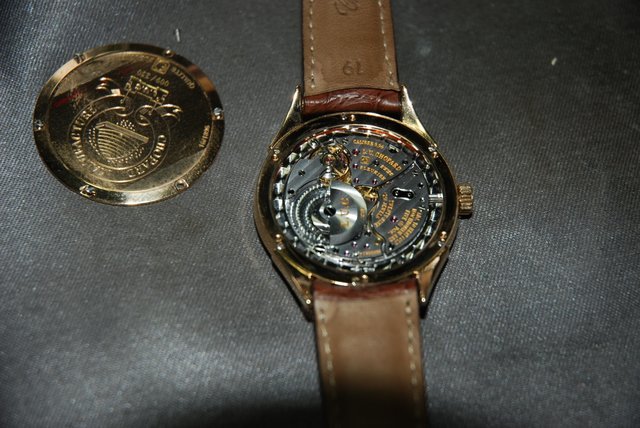
Thank you again for the lovely photos of the FQF. Here is my contribution:
Best,
MSB
