Comments:


Celebrating Time-Honoured Crafts 2 - The ElectroPlater
The electroplating workshop looks very much like an alchemist’s
laboratory. Its function is to change brass into gold… or something
similar. It actually works by in using electrolytic processes to apply
layers of metal to parts that are out of metal themselves in order to
protect and embellish them. An electroplating workshop is therefore
first and foremost a set of liquid vats serving as containers for
coating, washing and rinsing.

The parts arrive there from the decoration workshops of Chopard Manufacture in Fleurier, where the L.U.C watches are made. They have been treated to a wide range of finishes including bevelling, circular graining, hand drawing, Côtes de Genève and engraving. Some of them – such as the tourbillon bridge – have been the object of many hours of craftsmanship, and their cost price is so high that their handling and treatment call for extreme care. Therfore meaning the electroplating specialist cannot afford to make any mistakes.

The parts are mostly in brass, a metal that tends to oxidise over time or simply by being touched. They will thus need to be protected by a stainless metal, which is why gold and rhodium are ideal because of their air resistance.
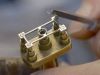
To begin the cycle, the plates and bridges are first hung onto cone-shaped current-conducting racks. These funny-looking “Christmas trees” are first immersed in solutions designed to eliminate any traces of grease, starting with a grease-moving solution reinforced by ultrasound waves, followed by a simple soapy water bath, and then an electrolytic bubble bath.

The electrolytical baths are conducted at a voltage of 7 to 10 volts, whereas the amperage and the duration are both determined by the total surface area to be treated. Between each immersion, the components are rinsed in clear water and then in purified water – meaning water from which all mineral salts have been removed. Once this washing process is completed, the parts are soaked in an electrolytic “activation” bath, an extremely acid solution (with a 0 pH) intended to neutralise any trace of soap and to “activate” their surface, meaning to make it more robust to receive and retain a layer of metal.
The first “plating” bath is designed to deposit a layer of nickel that serves as an additional barrier against corrosion and also to facilitate the adherence of the finishing layer. Next come the colouring baths as such, in which four gold colours – 5N, 4N, 3N, 2N – and two rhodium colours – white and black – are available. In quantitative terms, these metallic deposits are only “flashes” a few tenths of a micron thick, but they will give the part its final colour.

Once this stage is complete, a last degreasing and a final “activation” operation is performed. After being rinsed in pure water and dried, the parts have acquired their definitive appearance and are ready to be sent to the workshop of the watchmaker who will assemble them.
電鍍工坊如同煉金術士的煉金室。作用是把黃銅煉成黃金,或諸如此類……電鍍是以電解的方式使金屬層沉積在金屬工件表面,從而 對其起保護和美化作用。電鍍工坊因此由一系列的液體池組成,包括沉積池、沖洗池和漂洗池。電鍍工坊處理的成品來自蕭邦製錶廠設在Fleurier的裝飾工 坊,L.U.C.概念錶即出於此處。腕錶在裝飾工坊進行一系列的精細加工處理:倒角、圓形磨飾、拉絲、日內瓦波紋裝飾、以及鐫刻。有些工序要耗費許多個小 時的手工,如陀飛輪的夾橋,這些加工操作與處理極致精細繁複,它們的成本也相應高昂。電鍍塗層工序不允許有任何失誤。電鍍工件主要由黃銅組成,而黃銅會隨 著時間的推移或者手指的接觸發生氧化。因此需要塗上抗氧化金屬層保護,抗氧化層的理想選擇是性質恒久不變的黃金或銠金屬。
電鍍處理前,腕 錶主夾板和其他夾橋部件一起被固定在一種錐形導電支架。掛滿夾板和夾橋的支架就如一棵聖誕樹,首先把「聖誕樹」放入處理液裡面去除油脂,然後通過超聲波再 次強力去油脂,去油脂後漂洗,然後再作電解處理。電解溶液的電壓為7伏至10伏之間,電流強度小於1安培,電解時間視處理工件的表面積而定。每次浸泡沉積 之前都應分別用清水和純淨水沖洗工件,純淨水就是不含任何礦物質的水。沖洗完畢,把工件浸入電解「活化」池,即強酸處理液,液體pH值為零,其目的是為了 中和漂洗劑,「活化」工件表面,使之更有效地吸附金屬塗層。第一個「沉積槽」,用於鎳金屬塗層,這是一個額外防護抗腐蝕層,同時還利於表面層的有效依附。 隨後把工件浸入「彩池」,池裡共有四色黃金:5N、4N、3N、2N,以及兩種顏色的銠金屬:白色和黑色可供選擇。就數量而言,這些金屬層如同「腮紅」僅 有十分之幾個微米的厚度,但賦予工件最終的色澤。沉積完畢後,最後一次去油脂,最後一次「活化」處理。處理完畢,再次用純淨水沖洗,而後晾乾,至此工件的 表面處理全部完成,可以送交製錶工坊進行組裝了。
This message has been edited by Kong on 2011-06-08 00:46:34
The parts arrive there from the decoration workshops of Chopard Manufacture in Fleurier, where the L.U.C watches are made. They have been treated to a wide range of finishes including bevelling, circular graining, hand drawing, Côtes de Genève and engraving. Some of them – such as the tourbillon bridge – have been the object of many hours of craftsmanship, and their cost price is so high that their handling and treatment call for extreme care. Therfore meaning the electroplating specialist cannot afford to make any mistakes.
The parts are mostly in brass, a metal that tends to oxidise over time or simply by being touched. They will thus need to be protected by a stainless metal, which is why gold and rhodium are ideal because of their air resistance.
To begin the cycle, the plates and bridges are first hung onto cone-shaped current-conducting racks. These funny-looking “Christmas trees” are first immersed in solutions designed to eliminate any traces of grease, starting with a grease-moving solution reinforced by ultrasound waves, followed by a simple soapy water bath, and then an electrolytic bubble bath.
The electrolytical baths are conducted at a voltage of 7 to 10 volts, whereas the amperage and the duration are both determined by the total surface area to be treated. Between each immersion, the components are rinsed in clear water and then in purified water – meaning water from which all mineral salts have been removed. Once this washing process is completed, the parts are soaked in an electrolytic “activation” bath, an extremely acid solution (with a 0 pH) intended to neutralise any trace of soap and to “activate” their surface, meaning to make it more robust to receive and retain a layer of metal.
The first “plating” bath is designed to deposit a layer of nickel that serves as an additional barrier against corrosion and also to facilitate the adherence of the finishing layer. Next come the colouring baths as such, in which four gold colours – 5N, 4N, 3N, 2N – and two rhodium colours – white and black – are available. In quantitative terms, these metallic deposits are only “flashes” a few tenths of a micron thick, but they will give the part its final colour.
Once this stage is complete, a last degreasing and a final “activation” operation is performed. After being rinsed in pure water and dried, the parts have acquired their definitive appearance and are ready to be sent to the workshop of the watchmaker who will assemble them.
蕭邦電鍍工坊
電鍍工坊如同煉金術士的煉金室。作用是把黃銅煉成黃金,或諸如此類……電鍍是以電解的方式使金屬層沉積在金屬工件表面,從而 對其起保護和美化作用。電鍍工坊因此由一系列的液體池組成,包括沉積池、沖洗池和漂洗池。電鍍工坊處理的成品來自蕭邦製錶廠設在Fleurier的裝飾工 坊,L.U.C.概念錶即出於此處。腕錶在裝飾工坊進行一系列的精細加工處理:倒角、圓形磨飾、拉絲、日內瓦波紋裝飾、以及鐫刻。有些工序要耗費許多個小 時的手工,如陀飛輪的夾橋,這些加工操作與處理極致精細繁複,它們的成本也相應高昂。電鍍塗層工序不允許有任何失誤。電鍍工件主要由黃銅組成,而黃銅會隨 著時間的推移或者手指的接觸發生氧化。因此需要塗上抗氧化金屬層保護,抗氧化層的理想選擇是性質恒久不變的黃金或銠金屬。
電鍍處理前,腕 錶主夾板和其他夾橋部件一起被固定在一種錐形導電支架。掛滿夾板和夾橋的支架就如一棵聖誕樹,首先把「聖誕樹」放入處理液裡面去除油脂,然後通過超聲波再 次強力去油脂,去油脂後漂洗,然後再作電解處理。電解溶液的電壓為7伏至10伏之間,電流強度小於1安培,電解時間視處理工件的表面積而定。每次浸泡沉積 之前都應分別用清水和純淨水沖洗工件,純淨水就是不含任何礦物質的水。沖洗完畢,把工件浸入電解「活化」池,即強酸處理液,液體pH值為零,其目的是為了 中和漂洗劑,「活化」工件表面,使之更有效地吸附金屬塗層。第一個「沉積槽」,用於鎳金屬塗層,這是一個額外防護抗腐蝕層,同時還利於表面層的有效依附。 隨後把工件浸入「彩池」,池裡共有四色黃金:5N、4N、3N、2N,以及兩種顏色的銠金屬:白色和黑色可供選擇。就數量而言,這些金屬層如同「腮紅」僅 有十分之幾個微米的厚度,但賦予工件最終的色澤。沉積完畢後,最後一次去油脂,最後一次「活化」處理。處理完畢,再次用純淨水沖洗,而後晾乾,至此工件的 表面處理全部完成,可以送交製錶工坊進行組裝了。
This message has been edited by Kong on 2011-06-08 00:46:34
And hear i thought the only liquid into which a watch was immersed...
was either beer or champagne (see nico's JLCs and PAMs...)
Intriguing--so many different crafts involved in the creation of a watch
thanks for the report
J
(see nico's JLCs and PAMs...)Intriguing--so many different crafts involved in the creation of a watch
thanks for the report
J
Tks for the tutorial
It's indeed v informative and educational.
Electroplating is not as simple as it sounds, so many steps and care needed.
tks Kong for this.
Electroplating is not as simple as it sounds, so many steps and care needed.
tks Kong for this.