
Baselworld 2010: Hamilton
Baselworld 2010: Hamilton
By Melvyn Teillol-Foo

Hamilton Pulsomatic

Evolution

The producer of the world’s first digital watch makes this technology automatic.
2010 marks the fortieth birthday of the world’s first digital watch – The Pulsar – made by Hamilton. The American brand is celebrating with the new Hamilton Pulsomatic, a digital timepiece with Swiss craftsmanship in the form of an automatic movement.

The brushed stainless steel case resembles a space-age, Jetsons-style TV set from the front, while a ridged effect on the sides and crown is contemporary. A sleek black screen reminds me of the black & white TV of my childhood.

The liquid crystal display on the Hamilton Pulsomatic is powered by a Swiss automatic movement H1970. Fully charged the watch has a power reserve of 82 days. The scratch-resistant sapphire crystal and water resistance to a depth of 50 meters is practical. You get a choice of rubber strap as an alternative to a more classical stainless steel bracelet.

Khaki X-Landing


The Khaki X-Landing takes a nostalgic journey back early aviation with a feature for measuring the top of descent (TOD). The TOD marks the transition from the cruise phase of a flight to the descent phase. Pilot wearers simply mark the aircraft’s cruising altitude in feet at the 9 o’clock position, using the crown located at 10 o’clock. Integrating a standard descent angle of 3°, the Khaki X-Landing then reveals the number of nautical miles before the final destination that marks the start of the optimal descent in a small, dedicated window.
Pilots also get a GMT chronograph, with design touches reflecting the materials and structures of the early metal planes. The language of aviation continues on the bezel’s surface where 24 different time zones are printed. On one model these are represented by place names, on the other by military alphabet terms - alpha, bravo charlie....
Conclusion:
Hamilton used to make ‘cool’ watches from when they were railway timekeepers, through the iconic Ventura electric and Pulsar LED phases. Then, they went ‘off the boil’. Recently, they discovered that their most valuable asset is their history. By updating their old models to contemporary form and function, they may be on the rise again.
Baselworld 2010: Harry Winston 2ND EDN
Baselworld 2010: Harry Winston Rare Timepieces
By Melvyn Teillol-Foo
Additional material in 2nd Edition by Don Corson
The first thing to note is the name change from Harry Winston Rare Timepieces to Harry Winston SA.

[Apologies - Camera Failure Alert; Press Photos were also used]
Harry Winston (HW) has had a tough time recently. After the halcyon days of the early Opus series, despite the non-appearance of Opus 3, they still had a positive report card. The ship lost a couple of captains through heavy seas. Then, we had a series of indulgent failures that did not make the grade as ‘great works’. Opus 7 was incomprehensible, Opus 8 was comedic, and Opus 9 was preposterous. The paradox of human nature is such that the adverse comments may have increased sales!
But the good news, dear PuristS, is that the Harry Winston Opus is back; a simple vision, well thought out, and executed expediently for delivery.
OPUS X – The Shape of Time


Created in collaboration with Jean-Francois Mojon, Opus X illustrates the shape of time, through an innovative movement. The whole time display is mounted on a rotating platform, but where the orientation of the dials remains intact. Based on a planetary gear train system, the unique movement is designed to tell time through continuous rotation and circular motions. It may be out of the ordinary but not incomprehensible.


The mechanical hand-wound movement features individual indicators for hours, minutes, and seconds each individually mounted on a rotating platform, along with a twenty-four hour second time zone indicated in the periphery. The three-day power reserve also functions as a planetary gear train. The rounded sapphire crystal is attached directly to the case without a bezel, allowing a full view of the dial. Opus X is a limited edition of 100 pieces.

The Watchmaker

Jean-François was introduced to the watch making trade through his father, who worked in the technical watch business. After earning his diploma in engineering and micro-technology in Le Locle, Mojon joined the industry working on R&D of movements and new complications for several brands, including Swatch Group and IWC. In 2005, he began his own company, Chronode SA, specializing in high complication movements, the company is based in Le Locle.


PROJECT Z6 – The Sound of Time

Project Z pieces are made with Zalium, a zirconium-based alloy. Project Z6 introduces a new complication to Harry Winston’s timepiece offering – a hand-wound, 24-hour alarm clock movement. Developed specifically for Z6 and exclusive to Harry Winston, the movement is engineered to optimize performance, with integrated function and complication.


Designed to be seen as well as heard, the alarm clock features a visible hammer fixed to the case to be seen during the ringing of the alarm. The ‘excentered’ dial features two overlapping disks displaying the primary time and the alarm clock, each with separate day and night indicators.

A limited edition of 300 pieces, Project Z6 is available with two dial options: 250 with anthracite dial available at authorized dealers and 50 with silver dial exclusive to Harry Winston salons.

Regular anthracite dial

Boutique silver dial
Harry Winston Avenue Squared A² Men


Conclusion:
We have some hope that Harry Winston is heading back onto the PuristS’ radar.
The Opus is back. This bodes watch-ing for a bit…..
ADDITIONAL MATERIAL BY DON CORSON
Now we are up to an anniversery, it is time for the Opus10.
This year the man behind the Opus is Jean-François Mojon the head of Chronode in Le Locle, one of the many companies working in the shadows on the conception and production of high-end watches.
The Opus10 is not the fall-over, WOW!! type watch, it works more on the poetic level, despite its big dimensions.
3 dials float and turn in a cluster like a rose branch with multiple flowers. Through a differential mechanism as they turn the dials still remain correctly oriented. The 3 dials are the hours, minutes and seconds. A second time zone is shown by a hand carried by the cluster showing a 24 hour scale, the cluster turning once a day.
To add to the peotic effect, the sub-dials are all at a small angle to the plane of the dial. (Imagine trying to assembly that and never slip with your screwdriver!!)
End the words, here the pictures.


Also new this year the Z6. This alarm watch has a very pleasant chime to wake you.


At the comment that I was missing any hint of Harry Winston's signature products I got to see these Lady Z watches. Note the subtle differences. 


This message has been edited by AnthonyTsai on 2010-04-21 21:09:38
This message has been edited by MTF on 2010-05-01 10:28:20
uniqe
time pieces , i view th opus X as a shot of new blood for HW.
Thanks MTF.
Faisal
Baselworld 2010: Hermès
Baselworld 2010: Hermès
By Melvyn Teillol-Foo
You read it here first: Hermès is on the brink of better things in haute horlogerie!

It has been a mystery to PuristS why Hermès has not broken through in luxury watches. They have so many things in their favour already:
A well recognised luxury brand.
More than 170 years design experience.
Glamorous and affluent clientele.
Nearly 4 decades in watch sales.
Adequate finances.
25% stake in Vaucher Manufacture Fleurier.
Methinks they needed a management team that knows the watch business but they have that now.... with recent hiring, so we are hopeful. Here are a few examples of what they can do with ‘pieces exceptional’ that bodes well for when they get their own movement up and running.
Arceau Cheval de Légende

Dial enamelled using the paillonné technique and reflecting the silk square design by Benoît-Pierre Émery; Piece Unique.
Cape Cod Quadrige


Miniature painting, grand feu enamelled using the cloisonné technique Inspired by the “Quadrige” Hermès silk square by Benoît-Pierre Émery; Piece Unique.
Arceau Pocket Duc attelé

Natural white mother-of-pearl, hand-engraved and depictinga detail from a drawing by Alfred de Dreux; Piece Unique.
Cape Cod Tourbillon

Mechanical hand-wound Tourbillon movement Hermès Calibre H 8930 VMF
Tonneau-shaped, 29.3 x 23.6 mm (13 x 10.5 lignes) 5.5 mm thick
21,600 vibrations per hour (3Hz)
7-day power reserve thanks to a series-coupled twin barrel
237 parts including 30 jewels
Hand-chamfered and polished bridges and mechanisms
Exclusive Hermès decorative motif (sprinkling of “H”s)
The Tourbillon consists of a 11.1 mm mobile cage that does two revolutions per minute. The escape-wheel pinion rotates around the fixed seconds’ wheel.
Arceau Squelette Sellier


Grand feu enamelled white gold cloisonné enamelled numerals
Blued 750 (18ct) white gold hands
Mechanical self-winding Hermès Calibre H 1928, skeleton-worked
25.6 mm in diameter (11.5 lignes); 3.5 mm thick
28,800 vibrations per hour (4Hz)
55-hour power reserve; series-coupled twin barrel
200 parts including 32 jewels
Hand-chamfered and polished bridges and mechanisms
Hand engraving on the movement bridges evokes the braiding and saddle stitching performed by the Hermès leather artisans.
Conclusion:
We’re keeping a watch-ing brief on Hermès as we suspect that they are on the brink of good things for PuristS and watch lovers.
Baselworld 2010: Hublot
Baselworld 2010: Hublot
Including an Interview with CEO J-C Biver on the BNB Concept Affair
By Melvyn Teillol-Foo

Evolution of Hublot
Baselworld 2010
Hublot may find it difficult creating buzz with their ‘novelties’ at Baselworld because they make so many ‘limited edition’ variations throughout the year; people worried that there may be no surprise in Basel.

Hublot followed Audemars Piguet as Alinghi sailing team sponsor but the failure of the Swiss team to retain the America’s Cup threw a floater in the bilge tank for Hublot. But Mr Biver managed to recover some places on the grid by closing the deal as Official Watchmaker of Formula 1™ and will produce a range of limited edition Formula 1™ watches to exploit the additional designation ‘Hublot - The Official Watch of Formula 1™’.
Hublot is following in the tyre tracks of Audemars Piguet that has many racing drivers associated with Royal Oak and Offshore watches viz. Montoya, Barrichello, Trulli and a few others who wear AP but cannot be named because they are sponsored by other brands.

It was a marketing masterstroke by Hublot to be named Official Watchmaker of Formula 1™ that is reminiscent of the play by Jack Heure in the 1960s; although Heure also had the technology to be official timekeeper in sports events.
Scandal
Another backroom chat topic was about the way that Hublot took over the management of one of their suppliers – the bankrupt BNB Concept. Will we now see gravity defying, multi-axis tourbillon, minute-repeaters in a Big Bang case?
Biver on the BNB Concept Bankruptcy
On some 'Other' or 'French' websites' discussion fora, it was alleged that, somehow, by being the first and biggest customer of BNB Concept or the largest debtor, Hublot had engineered the demise and acquired the assets cheaply. I put this to Mr Biver during our meeting; you can imagine that he 'blew the roof' and proceeded to search his files for contemporaneous accounting notes, which he immediately forwarded as e-mail from his laptop to mine, as we spoke. Real-time reporting indeed!
During 2009, BNB’s uncollected accounts receivables grew to SFr 10M, owed by about 15 clients. The biggest unpaid account was SFr 1.6M and the smallest SFr 50,000.
For Hublot on 31 Dec 2009: BNB Debt was SFr 555,404; Advanced Deposit to BNB was SFr 129,501; thus Hublot Nett Debt to BNB was only SFr 423,903.
Days before BNB bankruptcy filing, Hublot bought the entire inventory of Hublot finished and unfinished movements, including spare parts, for SFr 2.8M. At liquidation, BNB had 97 employees but its liabilities still exceeded SFr 30M. The small amount of SFr 424,000 owed by Hublot seems insignificant compare with the BNB total debt of SFr 30 Million.
After the liquidation order was issued, Hublot stepped in to acquire a large part of BNB’s machinery and hired former CEO, Mr. Matthias Buttet as technical director and chief executive of a new entity, Confrérie Horlogère Hublot, along with 29 of BNB’s former employees. Of the 30 former employees offered jobs, only one declined to join Hublot with Mr. Buttet.
2010 Novelties
I asked Mr Biver what was the one product he wanted to highlight at Baselworld 2010. He chose the UNICO movement.
The King Power UNICO features the first chronograph movement produced entirely in-house by Hublot. For Mr Biver, this is symbolic of the brand's progress towards verticalisation. In watchmaking circles, a new, in-house, flyback chronograph is more satisfying to develop than even a tourbillon.

UNICO movement


Since early 2009, Hublot has incorporated various production stages into the manufacture. This has enabled Hublot to produce the UNICO chronograph, which was developed exclusively by its own R&D Department. The machining workshop produces bridges, main plates and various steel components, which are assembled by production watchmakers. A special feature of this flyback chronograph is the position of its mechanism and the famous "column wheel" on the dial side rather than the usual back side of the watch.

However, one of the main innovations is the retractable platform escapement, on which the watch owner's initials can be engraved by special request. This subtle and ingenious feature facilitates servicing and maintenance of the movement while allowing the timepiece to be personalised. The escapement (escape wheel and pallet fork) is made from silicon, a light, durable and technologically advanced material which resists wear and guarantees more accurate operation.
The future?


Conclusion:
This brief sketch is just to capture a flavour of Hublot for our community. With the fiscal backing of the LVMH group and having accelerated their movement production capability with ex-BNB resources, it will be interesting to keep a watch-ful eye on Hublot to see what they bring to watch lovers and PuristS across the world.
We leave Mr Biver multi-tasking as usual. During the course of our chat, he managed to finish a live radio interview by mobile phone and shouted at someone about a real-estate deal, whilst taking a resume from a Chinese watchmaker looking for a job! 
By the way, that is the best cheese in Switzerland!

Hublot is epxanding
would love to see where they will be heading with the acuestion of EX-BNB as well.
Thanks.
Faisal
Baselworld 2010: Linde Werdelin
by Marcus Hanke
Linde Werdelin, the small Danish sports watch brand, continued its cooperation with independent artists, 2010 once again with AHCI-Veteran Svend Andersen. Instead of re-vamping a rare vintage movement, like last year, Anderson now modified the nice Frédéric Piguet FP 1150 automatic movement. He replaced the date wheel with a moonphase mechanism. This might not be that spectacular, but LW’s execution certainly is: The whole moonphase ring is covered with white SuperLuminova C1. On top of theat, a black silk-print produces photo-realistic depictions of seven different moon phases, which are shining in the dark. A small dot, also luminous, serves as reference point, so it is easily possible to read the current moon phase at night.


The "Oktopus Moonphase", which is limited to 29 pieces, is made from titanium, dimensioned 46 by 49mm, but appears smaller on the wrist, due to the ergonomic shape. The revolving bezel is made from 18k pink gold.
More interesting from the outward appearence is Linde Werdelin’s second co-operation with an artist: the "Oktopus Tattoo". Denmark’s most famous tattoo artist, Henning Jensen, delivered an intricate design of an octopus, which is engraved onto the watch’s caseback, while its flanks and shoulders are covered with matching ornaments. The engraving was executed by laser, since a hand engraving would have caused too much loss of the tiny details.


The orange-pink SuperLuminova on hands and markers is matching the colour of the stitching on the alligator strap; or better should be matching. Since the watch shown still had a prototype dial, this feature was lacking perfection.
The stainless steel Oktopus Tattoo is limited to 88 pieces, and a corresponding edition of 88 “Reef” diving computer modules, engraved with matching ornaments, is available.
Regarding the “Reef”, it is worth stating that Linde Werdelin’s own software engineering bureau is curently applying the last touches to the newest version of the “Reef” software, just in time for this year’s diving season. Hopefully, brushing up the software of the “Rock” module will be the next step.
The "Spidolite" with the skeletonized case is now also offered in 18k pink gold. The choice of material clearly inicates that saving weight was not the primary intention this time. That the watch looks nice, though, is a satisfactory reason.


By the way, LW issued a nice catalogue of the novelties this year: A well-sketched comic book, telling the story about a hunt for five powerful microchips, serves to present the new watches. However, only the initial part of the story is told, we have to wait until next year to learn how the story unfolds ...
EDITOR'S NOTE
Linde Werdelin is an unusual brand to be appreciated by PuristS but we have some pedantic reasons for doing so. Until now, they have been a purist's watch with a clear mission and unique selling point. An ultimate amalgam of tool watch with modular interchangeability. This year, they added a few 'arty' bits and we are not so sure about how that fits with their purity rating, to date.
On another note, the skeletonised dial on the Spidolite seemed a nice idea but in doing so, LW has exposed themselves to criticism about the movement finishing on the dial side that can now be seen. We are not asking for haute horlogerie 'black polish' finishing but to have rough burrs and manufacturing marks still present is probably not acceptable. It was OK as long as it was hidden behind the dial but if you are going to expose yourself, it should be a little better.
Melvyn Teillol-Foo
Baselworld 2010: Longines
Baselworld 2010: Longines
By Melvyn Teillol-Foo
[Apologies: Camera Failure Alert. Some press photos had to be used]
The Longines Column-Wheel Chronograph
In 2009, Longines launched a watch fitted with an exclusive, self-winding chronograph movement with a column wheel. Since then, Longines has identified new uses for the calibre and proudly announced that they mandated and paid ETA to develop this brand-new exclusive movement. Under the name of The Longines Column-Wheel Chronograph, these latest models represent the Longines history of sports timekeeping.

The L688.2 movement is a self-winding calibre with a diameter of 30 mm and a height of 7.90 mm. The column wheel was designed by ETA engineers to require only the finest touch to start and stop the mechanism and to reset the hands at zero. The blued steel column wheel is eye catching.
The Longines Column-Wheel Chronograph (L2.742.4.76.2 / L2.742.8.76.x)


The Longines Column-Wheel Chronograph uses traditional, elegant lines that are reminiscent of the timepieces from the 20th century. In a 39mm diameter stainless steel or rose gold case that houses the L688.2 calibre; the movement can be admired through the transparent sapphire back cover. With its dauphine-style, rose hands mounted on a silvered dial featuring 8 hour symbols, The Longines Column-Wheel Chronograph also shows the date and has a small seconds at 9 o’clock, a dragging 30-minute counter at 3 o’clock and a dragging 12-hour counter at 6 o’clock. The watch is on a dark brown alligator strap.
The Longines Column-Wheel Chronograph (L2.733.4.72.x / L2.733.8.72.x)


The second model of The Longines Column-Wheel Chronograph, confusingly has the same name but a different sleek style. The differences are the case and rhodium-plated hands on a silvered dial featuring 13 hour symbols.
The Longines Column-Wheel Sports Chronograph


Finally, the design of the third model focuses on the particular performance of the L688.2 in a more robust, sporty timepiece of 41 mm diameter stainless steel case with a screw-in, transparent back cover. This model – designed specifically for performance – has a steel or black or grey ceramic bezel that surrounds a silvered, black lacquered or brushed grey sunburst dial. It is available on a choice of bracelets: stainless steel or stainless steel with central links in black or grey ceramic, or on a rubber strap.


Longines PrimaLuna Collection

I can't show you the Longines PrimaLuna Thousand and One Nights with diamonds that light up the dial because my camera broke! It was THAT sparkling; seriously, here is a non-bling version.
The Longines PrimaLuna models in steel and rose gold are available in three sizes (23 mm, 26.50 mm and 30 mm) and house either a quartz movement or a self-winding mechanical movement.
I just looked at the mechanical version.
Longines Lindbergh’s Atlantic Voyage Watch 

Longines is re-issuing this exceptional timepiece, known as the Longines Lindbergh’s Atlantic Voyage Watch, as a tribute to the historical feat achieved by this pioneer of the skies. This mechanical wrist chronograph has a diameter of 47.50 mm and a self-winding movement. Just like the original model, it has small seconds at 9 o’clock and a 30-minute counter at 3 o’clock. The time and time measurements are displayed using hands of blued steel on a silvered dial with a white surround and the watch has a tachymeter for measuring speeds of up to 500 kph.

The model has a sapphire glass and a solid case back that protects a transparent back cover through which the workings of the movement can be admired. The watch is mounted on a genuine brown alligator strap. The new versions are in either steel or rose gold.
I used to have a re-issued WEEMS model from Longines but never wore it; so it eventually ran away from home.


Baselworld 2010: Max Buser & Friends
Baselworld 2010: Max Buser & Friends
By Melvyn Teillol-Foo
Max Buser & Friends also showed at Baselworld despite showing at SIHH earlier in the year.
So, there was nothing new to see except a teaser movement part for MB&F 4. Maybe its another spaceship? Twin thrusters like the Millenium Falcon......


I quite like the sapphire cased HM2
Here is another sort of teaser series…..


Baselworld 2010: H. Moser
Baselworld 2010: H. Moser
By Don Corson
Moser's new product this year is the "Perpetual Moonphase". Perpetual, not because it also includes a perpetual calendar, but because the moonphase indication is particularly accurate having a 1 day error only after more than 1000 years. The small indication under the hands indicates AM/PM to allow accurate setting of the moonphase, it is not a month indicator as has been rumoured in some places.


Note the typically style "Moser" Geneva stripes in 2 widths. The ring indication on the back is the power reserve, which is, hoever, not correctly mounted on the prototypes they had in Basel. The red triangle will be over the engraved 7 ... 1 showing the days of power reserve.
Annother novelty at the BAsel fair is the Mayu Marrone with a chesnut colored dial. This is available in both rose gold and white gold cases.


What a handsome watch!
EDITOR'S NOTE
As usual, Moser ideas and solutions are elegant and look simple but their execution and delivery has been suspect, with long waiting time. I really like their products....if you can get hold of one!
Baselworld 2010: Rainer Nienaber
Baselworld 2010: Rainer Nienaber
By Don Corson
AHCI member Rainer Nienaber has made many watches using retrograde displays over the years.
His newest model is now, just to mix us up a little, anterograde.
The hand doesn't spring backward, but springs forward.
If it didn't have the second hand this would be a one hand watch, it has no minutes hand. When the hand gets to 9:00 it jumps forward over the seconds hand and continues on its way.
One of the neatest watches of the show IMHO
Retro 2
Trio Retrograd 3
Tri-Retrograde
Retro 2 bicolor
Trio Retrograde 2
Trio Retrograd 1
Regulator version 2
Regulator version 2 bicolor
Regulator, note that most "regulator" wristwatches have the seconds at the bottom as on most small second watches. For this watch Rainer has recreated a real pendulum face where the seconds hand is at the top. 
For those of you who need to be challenged to be happy. A decimal watch, 1 day is 20 hours (2x 10 hours) and each hour has 100 minutes. Figure it out !
EDITOR'S NOTE
Quirky German collection; perfect for some PuristS with a sense of Teutonic humour.
Melvyn Teillol-Foo
Baselworld 2010: Omega
by Marcus Hanke
Omega created some puzzlement, less by a technological innovation, but rather by its recent price increase, which became active in March. Not only customers and enthusiasts, but even sales representatives showed some signs of worry at the sight of the new price lists. While the majority of watch brands took the recent financial crisis (that had strongly hit the Swiss watch industry, with the Swatch Group being no exception) as a cause for not increasing its prices, with many companies even substantially reducing the prices of its introduction pieces, Omega hurries forward on the path towards the market's luxury class.
It seems the times when Omega was seen as a perfect brand to introduce novices into the realm of fine watches, are over now. Even the basic Speedmaster Professional, with hesalite crystal and the simple Lémania manual-winding movement (without any indigenous escapement technology) is now a watch that young enthusiasts really have to save money for. Buying it "on the way home" is an experience of the past, it seems.
However, we should remember that in former times, Omega was a true luxury brand. It was something special to own an Omega, it was the dream of many people to be able to afford one. Somewhen, and despite many proofs of horological excellence, the brand acquired an image of being inexpensive and mass-produced, a watch that "everybody" had, mostly at the very beginning of his or her passion for watches; being replaced rather quickly by "really fine watches".
Consequently, Omega's pursued course towards its old luxuriousness, including the price increases, is but a logical step to place the brand where it had been for so long. Yet one could argue that the timing of the most recent price decision was bad ...
However, let's not talk about prices, but about the watches:
The first piece shown is the "Constellation Double Eagle" with four counters, that had originally been made for a special series dedicated to the Olympic games. It is available in pink gold and stainless steel. What fascinates me is the seven days-counter of the chronograph mechanism, that is an absolutely unique feature.


Very nice is the large hand-winding Aqua-Terra in the Railmaster case.


The Lady's Aqua-Terra is clearly competing the various Rolex watches for ladies, but in my opinion appears more elegant, while succeeding in keeping that typical sportive expression.


Impressive for me is the Speedmaster automatic chronograph for ladies, of course with the co-axial escapement. That one looks really hot with white dial and white bezel, but also very "professional" in the black faced variant.


An immediate success at the fair was the bi-colour vaiant with diamond bezel. You don't have to be a lady to appreciate its aestetics!

New dial variants are the AquaTerra chronograph with white dial ...

... the mighty "Ploprof" with white dial and white bezel (looks a bit weird at first sight, but this is the effect of the white rubber strap. Add the highly attractive steel mesh bracelet, or a black strap, and you have a true men's watch again!) ...

... and the Speedmaster Moonphase with aventurine dial. Oh, what a beauty! The glitter and sparkle of the mineral particles within the aventurine adds the impression of a starry night sky. Unfortunately, this dial makes the watch really expensive!


My personal Omega highlight is this year's limited edition Speedmaster. Oh yes, I can see you grinning! One cannot dare to state that Omega's Speedmaster editions are really limited. Well, each of the editions might be limited, but the number of editions overall is not. I think that limited editions should be an exception, not the rule. There are other brands shelling out limited editions like machine gun projectiles, and these are also not taken seriously anymore by the collectors.
However, this year is different: It is the edition's cause. I still remember that remarkable docking maneuvre between an Apollo spaceship and its Soviet counterpart, the Sojuz, in 1975. Having grown up in the Cold War, in a small, neutral country that was squeezed directly between the military arsenals of NATO and Warsaw Treaty, this event was a flash of hope that peace between the super powers could be more than a fragile phrase issued at public speeches only.
Omega's tribute to this milestone rendezvous is more than worthy: The Speedmaster's dial is made from a meteorite, found in Namibia. While the three subcounters were left untreated and show the meteorite's natural structure and colour, the rest of the dial was oxidised, thus becoming near-black.


The caseback shows the docking scene, also held in black and natural steel. This is clearly the only limited edition Speedy that I wished to own myself.
When the DeVille "Hour Vision" was presented, it was an immediate success. Some, however, considered the saphhire window in the case side, and the many frame and stripe features on the dial a bit too busy. For them, Omega now offers a "clean" DeVille: a real beauty!


The attractive "Doctor's chronograph" is released in the museum collection.


The watch is well-known, but the bracelet is new: the attractive steel-mesh bracelet gives a nice vintage touch to sports watches.

The face-lifted "Broad Arrow" chronograph is attractive, but its dials alos appears a lot more busy than the original one. And, of course, it is a lot more expensive ...


Editor's Note
The absolutely most important Omega offering this year for me is the 7-day counting chronograph in the 'Constellation Double Eagle'. This is what chronograph collectors have wanted for years. Even accepting that original chrono-graphs and chrono-scopes were designed for sports such as horse racing, where most races finish within the paltry 30-min register, we still prefered the 12 hour tri-compax style chronographs. Even if only one sub-dial is offered, we would opt for the 45-min (football) or the 60-min counters. The only problem is reassurance that there is 7-days of power reserve or adequate winding capacity.
I would tend to agree with my esteemed colleague, Marcus, that the price hike by Omega is a marketing stroke of genius to capitalise on their position as No 1 in China for brand recognition and sales. Mr Hayek Sr is a very smart man and from his experience with Breguet, he may be saying, "Let them eat cake!"
Melvyn Teillol-Foo

The mystery of the new Seamasters is now solved . . .
. . . as well as the reason for current shortage of Railmaster XXLs. I was hoping that these new models were in the 36 mm range - boy, was I ever wrong! Question regarding the aventurine dialed Speedmaster: did the case seem larger than usual for a Professional? The reason I ask is that the subdials seem smaller in proportion to the dial than normal. Terrific photos and observant commentary - thanks, Marcus and Melvyn. Best regards, Art This message has been edited by Dr No on 2010-04-07 09:24:59
Baselworld 2010: Patek Philippe Chronographs
Baselworld 2010: Patek Philippe Chronographs
By Jerome Berder
I know you've all long waited to see these pictures. The Patek Philippe 5070 has been a probable favourite for many years. Here comes the time of the new Patek Philippe 5170.
The real news is that this new very classical two counter chronograph doesn't come alone. You'll see a bit later several other choices that will tempt you.
The true news is that you'll keep coming back on the 5170!

Patek Philippe 5170J
The new Patek Philippe 5170J is a 39mm Calatrava style cased with a moderate thickness of only 10.90mm.
The style of the case and dial is not the major difference with the now gone 5070. The most interesting part is the new calibre that we already saw last fall in the Ladies First chronograph reference 7071. This still new chronograph calibre is the first "simple" manual wind chronograph calibre by Patek Philippe and for a first they did it more than well!

New reference 5170 and its calibre CH 29-535 PS
You may want to have a look at what I wrote in November about the reference 7071 and the calibre CH 29-535 PS:
We can all appreciate what is offered by the new calibre and in the mean time consider it as a perfect complement to the CH 27-70 PS of the 5070.

Better than ever
The very functional performances of a modern automatic chronograph calibre like the one of the 5960 are very appealing and hard to beat on an every day basis.
On the contrary the "old" charm of a manual wind two counter chronograph calibre is comparably appealing, for different reasons.
One of these reasons is the apparent complexity of the numerous parts' dance. Operating the chronograph functions becomes a real pleasure while looking at the back.

Hammers are pressing the hearts, the counters are reset
Furthermore a manual wind chronograph calibre is a better support to show the best finish and the most refined architecture of bridges and levers.
This CH 29-535 PS is an excellent example of such aesthetical virtues.

The chronograph wheels are engaged, the counting has started
We could wonder why such manual wind chronograph calibres have become so rare? Is it because we're not so many to appreciate them or because they would be more difficult to craft than their automatic counterparts? I honestly have no answer!

The chronograph wheels are no longer engaged but the counters are not reset
The classic style of the chronograph seems to be a quite relevant nest for the classic calibre. The traditional cold-forming process used to create this case produces an ever lasting result that may make us hold our breath for years.

The first pulsometre Patek Philippe chronograph in a long while
We've not discussed that aspect yet but the new 5170 is announced only in yellow gold so far. Of course it will certainly be issued in other colours some day. You may be interested in the picture below as it looks strangely pink? As I should be discovering the real thing while you read these words, I may have an answer soon.

Strangely that watch looks pink but don't dream
I'm not a yellow gold watch amateur but until I try this watch I have to say that I have the impression that I could wear it even in this colour. The overall look is really perfectly executed and this calibre is just so……well you know!

Inspired from a classic Calatrava 96 case
I've said earlier that there were several new chronographs from Patek Philippe this year. Let's have a look at a watch we already know, if not with this new dial.
The 5960P adopts a new matt blue sunburst dial that may please those who loved the 5070P! The dial and hands change but the watch keeps all its other characteristics.

Patek Philippe 5960P and its new matt blue sunburst dial
Then comes the surprise ! We had been long waiting for the 5170 and I'm very happy to see it as it is, but I can say that the most pleasing surprise is the new 5950.
The new Patek Philippe 5950A –yes a steel manual wind chronograph- is the new chronograph of choice for the most discerning collectors. The steel case won't be enough to make it affordable as it offers us a new version of the manual wind split seconds chronograph, using the calibre CHR 27-525 PS of the 5959. The 5950 is seemingly a 39mm cased watch that will please all who were stopped by the very small case of the 5959.
The cushion shaped case and the finely decorated dial will make this watch a true treasure!

Patek Philippe 5950A
The new marvel is obviously inspired by the two cushion shaped vintage chronographs that were shown last fall at the launch of the Ladies First chronograph.
It will also remind us the 5020!

Patek Philippe cushion-shaped split second chronograph in yellow gold
It is in fact a nice combination of the style of the "simple" one with the complication and rarity of the split second one. Any one ordered it yet?

Patek Philippe cushion-shaped chronograph from 1929 in yellow gold
The next one is probably the proof of the total discontinuation of the ex Lemania based calibre CH 27-70 line and especially the 5004.
Here comes the new split seconds perpetual calendar chronograph. It was certainly more logical for Patek Philippe to add a perpetual calendar to the already existing in-house (and ultra thin) split second chronograph calibre than to work on the base of the new CH 29-535 PS!
The perpetual calendar version offers a more modern dial look, compared to the 5950. I keep my preference for the 5950A, but I can't wait to see the 5951!

Patek Philippe 5951P
Let's finish with two new versions on the base of the real sports chronograph from Patek Philippe. The 5980R on a crocodile strap will add some glamour to sporting activities. The 5N colour of gold is more red than the traditional pink gold and consequently said to be more masculine.
The dark brown to brown dial will add a very warm touch to the heavy case. We know how well it works on the 5167R!

Patek Philippe 5980R
The new charcoal gray to black dial 5980/1A may be a complement to the current blue dial Nautilus. I don't know yet if the blue dial version is replaced or completed.
The white numeral on black background date is particularly nice.

Patek Philippe 5980/1A and its new charcoal gray and black dial
As you may be thinking right now, I can't wait to handle all these new chronographs and all the other new Patek Philippe models that will certainly come with them.
I hope you enjoyed them.
Cheers
Dje
EDITOR'S NOTE
Probably the most cohesive collection at Baselworld 2010 was from Patek Philippe, according to dealers and pundits.The chronographs are just one half of the story.....
Melvyn Teillol-Foo
Baselworld 2010: Thomas Prescher
Baselworld 2010: Thomas Prescher
By Don Corson
Tempusvivendi special edition for Qatar

Perpetual calendar

3-axis Tourbillon

3-axis Tourbillon


Mysterious Automatic 2-axis Tourbillon

Tempusvivendi

Tempusvivendi

Sculptura Una

Sculptura Una

Sculptura Una

Tempusvivendi

Tempusvivendi

Tempusvivendi

Tempusvivendi

2-axis Tourbillon

2-axis Tourbillon

1-axis Tourbillon

EDITOR'S NOTE
Nothing new then?
Melvyn Teillol-Foo
Baselworld 2010: Rado
Baselworld 2010: Rado
By Melvyn Teillol-Foo

Rado is a conundrum in the SWATCH Group portfolio. Founded as movement makers Schlup & Co in 1917, their first watch collection was not until 1957 and branded as RADO. Throughout the 1960s, Rado was the most well advertised brand in Asia together with Mido and Rolex. I can only speak about Asia, where I grew up but I suspect the same marketing was applied in other regions. Their unique selling point was scratch resistance. Rado did this first with the DiaStar hard metal (tungsten carbide) watch and subsequently using a variety of sintered or High Tech ceramics, diamond and lanthanum in their newer product lines.


Rado is somewhat ‘purist’ in its approach, using innovative materials in the pursuit of excellence in one field – scratch-resistance. For example, HT Lanthanum is a combination of sintered lanthanum boride and boron carbide forming one of the hardest substances in existence at 3200 Vickers hardness only exceeded by diamond. Only 200 pieces of the Lantano watch have been made. We can all stop hoping – they have stopped production – I asked!

Most of the watches have quartz movements because the focus is on scratch-resistance and accuracy. The Rado Original lines offer automatic time and split-seconds chronograph movements.

Ceramica Digital Automatic (2nd from left)
Rado’s Ceramica model revolutionized watchmaking in 1989, making its mark with full ceramic. An icon. The legend is now forever digital. With this new model, Rado blends digitalization with an exceptional material. At the front it is digital, with a high-tech time display.
At the back it is mechanical. The digital display is entirely driven by an automatic movement visible through the transparent case back. This exclusive movement is shared only with Hamilton, another SWATCH Group stablemate.
r5.5 White Jubilé

This is the continuation of a partnership of the r5.5 collection between Rado and British designer Jasper Morrison. This new interpretation is supposed to exude sophistication as the white ceramics and diamonds work together.

Other watches in the r5.5 range


Sintra Skeleton Automatic Limited Edition Basel 2010 (111 pieces)


The Sintra collection is firmly established but the new Sintra Skeleton Automatic is the first in this Rado collection to feature this special movement that is custom made for Rado, all in black. The COSC certificated skeleton movement is in a black convex case made from high-tech ceramics.

eSenza Blue Jubilé

The eSenza Blue Jubilé can be distinguished by its refined elliptical form and play of light.
The entire circular dial is adorned with sapphires in varying shades of blue.

Set in a Fibonacci spiral derived from the golden number, they bring a mythical balance to the subtle harmony of blues. On the surface of the dial, time is purely displayed as two silvered hands under the curved, edge-to-edge sapphire crystal with its metallic blue finish. The discreet crown is partially hidden under bracelet.
V10K

Although not a novelty, the V10K has to be highlighted as the quintessence of Rado’s original vision. The synthetic diamond surface achieves a hardness of 10,000 Vickers like natural diamonds. The head and back of the watch, bracelet, crown and push-pieces: are now in high-tech diamond. For the first time, it has a matt finish that stands the test of time. Beneath the diamond coating is a revolutionary ceramic adapted to watchmaking. Its density has been reduced to a minimum, resulting in lightness. The bracelet articulation uses an elastic shape memory alloy core. All of the metal components in the watch’s interior are in titanium. The sapphire crystal construction is faceted and slopes away to the edge of the watch. On the dial, the chronograph counters resemble a dashboard. Rado’s vision of the future.
Conclusion:
This brief sketch is just to capture a flavour of Rado for our community. Although not recognised as a haute horlogerie brand, Rado is somewhat ‘purist’ with a niche mission of scratch-resistance through materials science. That deserves a watch-ful eye on them for R&D innovations that could be transplanted to other brands.
Baselworld 2010: Ressence
Baselworld 2010: Ressence
By Don Corson
The watches of Ressence are the work of the industrial designer Benoît Mintiens.
Like other watches coming more from the design than the watchmaking heritage these watches are a fresh breeze on the scene.
With a type of regulator dial, as the minute hand turns, the entire dial with its subdials turns always maintinaing the correct relative positions.
The front and back saphires go around the edges so there is no besel holding them allowing the dial to be almost the full diameter of the case.


EDITOR'S NOTE
Interesting design reminescent of a George Daniels dial but a really thick straight sided case as expected for a newcomer without access to complexed case making.
Melvyn Teillol-Foo

Baselworld 2010: Stepan Sarpaneva
Baselworld 2010: Stepan Sarpaneva
By Don Corson
(Revisons and additional material by Melvyn Teillol-Foo)
Stepan showed 2 new models this year a divers watch and a "one hand" watch.
This divers watch in titanium has the unique featue that the inner besel is turned using the nrmal crown in the intermediate position.


In these pictures it is impossible to read the time on the following watches, in reality it was, however.
The time is shown on a ring which shows through the window at the bottom. There are symbols every 15 minutes along with the hours. If you are into the Sarpaneve moon face, this is your watch.


Korona K1, diamond coated dial in rust


Korona K1, diamond coated dial in black

Korona K1, diamond coated dial in imperial blue

The K3 Harvest Moon


The K3 Red Gold


Two new models from S.U.F. Helsinki.
As you can see these models are starting to take on some of the design elements of the Sarpaneva watches.


EDITOR'S NOTE
Sarpaneva has 'found himself' over the last year as an artist watchmaker rather than a manufacturer.

After a tough year with 'investors' and business relationships that did not work out, Stepan has searched his soul and is almost ready to admit that he had been in denial. No doubt a talented watchmaker who has worked with the best e.g. Piaget and Kari Voutilainen, he may be persuaded to embrace the artistic side that he has suppressed but inherited from his late father Pentti Sarpaneva......
He has decided to reduce his output by doing most things himself, to his timeline and design standards. He revealed some ideas that we cannot publish yet but look really good for a very niche clientele.
We tossed a few ideas about and one of the questions was, "If you had complete freedom to produce any watch design, what would a PuristS Sarpaneva watch look like?"
In a typical Finnish fashion (and Voutilainen is the same!), he asked the question back: What would PuristS want to see in a Sarpaneva Art Timepiece?
So, dear PuristS.....we need suggestions. You never know: we may make one if there is interest......
Would it be steel or precious metal?
Round or other shapes?
Moon face or not?
Would you want the moon to finally smile?
Regards,
Melvyn Teillol-Foo


This message has been edited by MTF on 2010-04-04 10:24:40
astonishing
to see the brand and the founder ,artsit, watch maker stepan standing tall facing the winds of hard times.
keep up the good work stepan.
Faisal
Baselworld 2010: Saskia maaike Bouvier
Baselworld 2010: Saskia maaike Bouvier
By Don Corson
An AHCI candidate, Saskia maaike Bouvier announces her complicated watches from a woman for women.
Her professional education is as a watchmaker which she then completed as a watch designer (mechanical design).
As an independent designer she has been designing complications for the major brands for the last 6 years.
This year she announces her first collection at the AHCI stand.
These watches are summer and winter time watches. Summer time on the upper dial and winter time on the lower dial.

The complication module itself is seen through the dial. The wheels for summer time decorated with flowers, those for winter time with snowflakes. The bridges take the form of trees.

The sapphire dials are laser engraved and them colored by hand.


Note the engraving on the wheels for summer and winter.

Saskia maaike herself was wearing this watch with a black PVD case.

Note the wonderful two color bands she is using.
This is just a first model, further complications destined for women will be coming in the future. I am looking forward to seeing more of these refreshing watches.

EDITOR'S NOTE
There's a different take on artistic watchmaking; bodes well for the future.
Melvyn Teillol-Foo
Baselworld 2010: Seiko
Baselworld 2010: Seiko
By Tony Axelzon
Here are Seiko pictures from the Baselfair 2010.
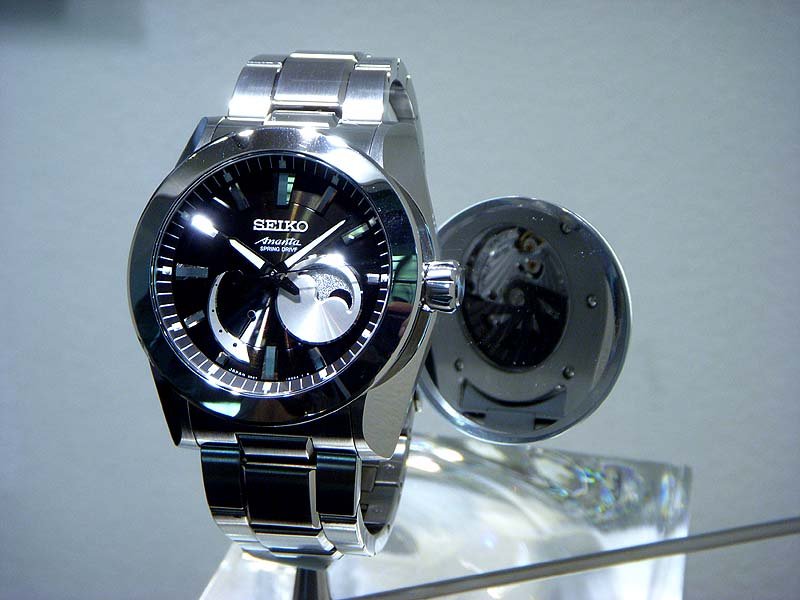
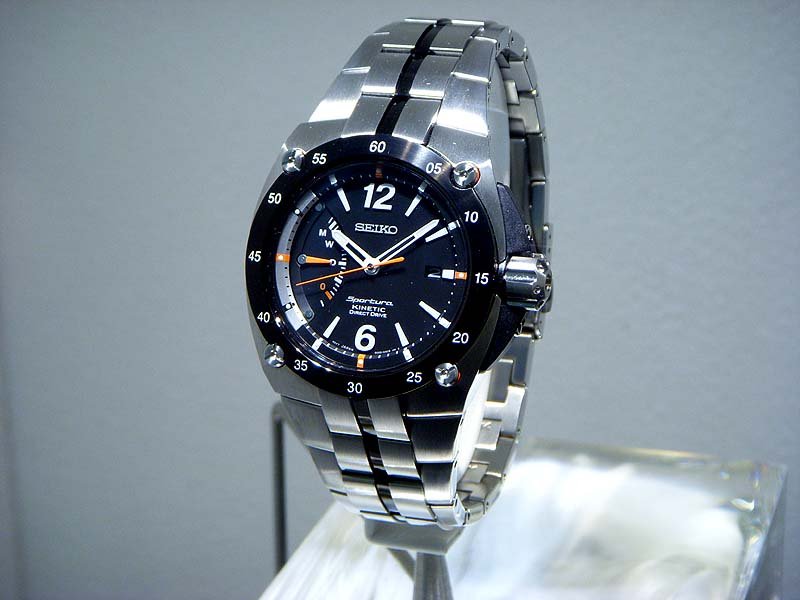
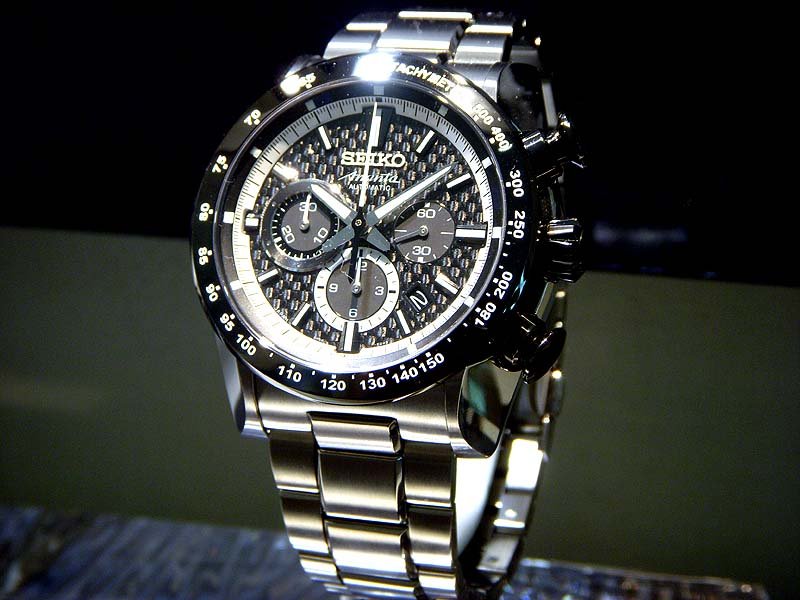
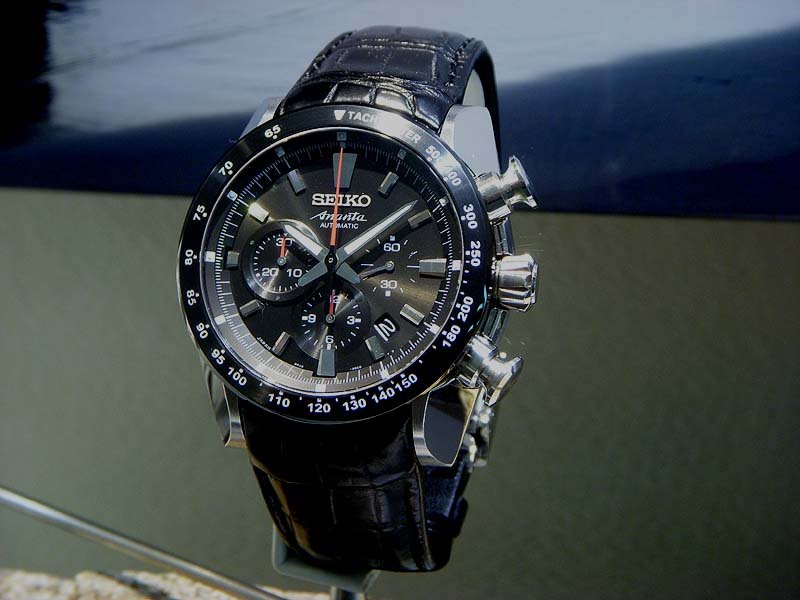
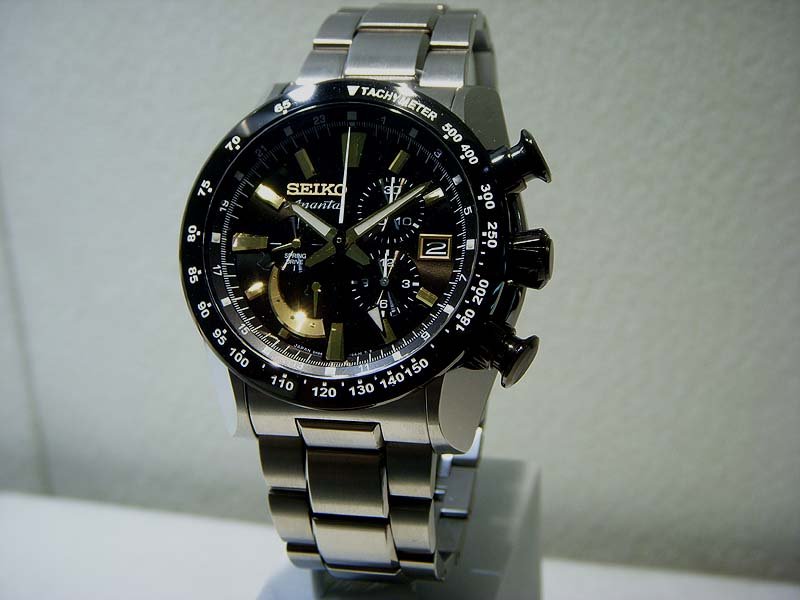
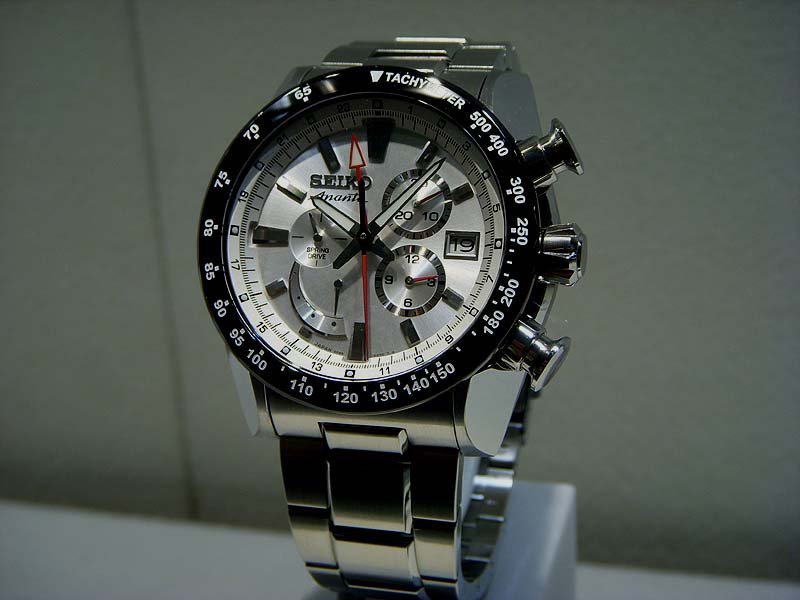
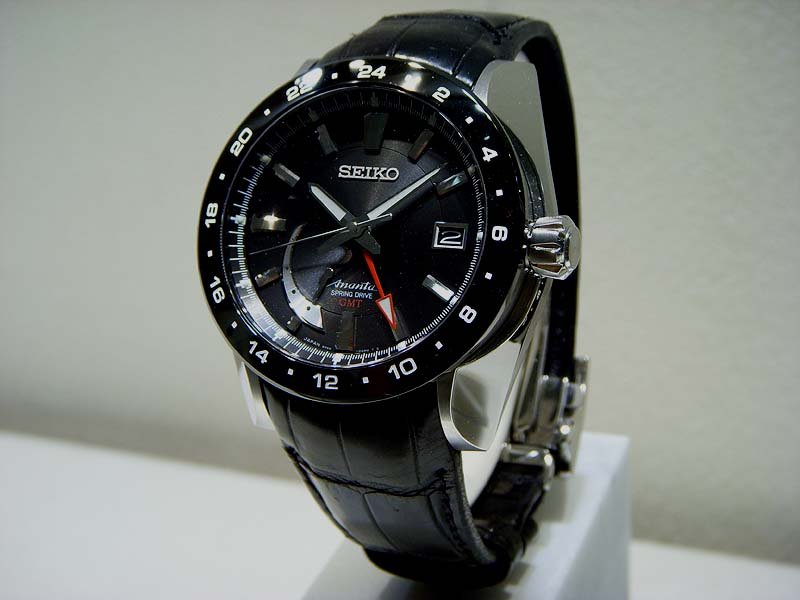
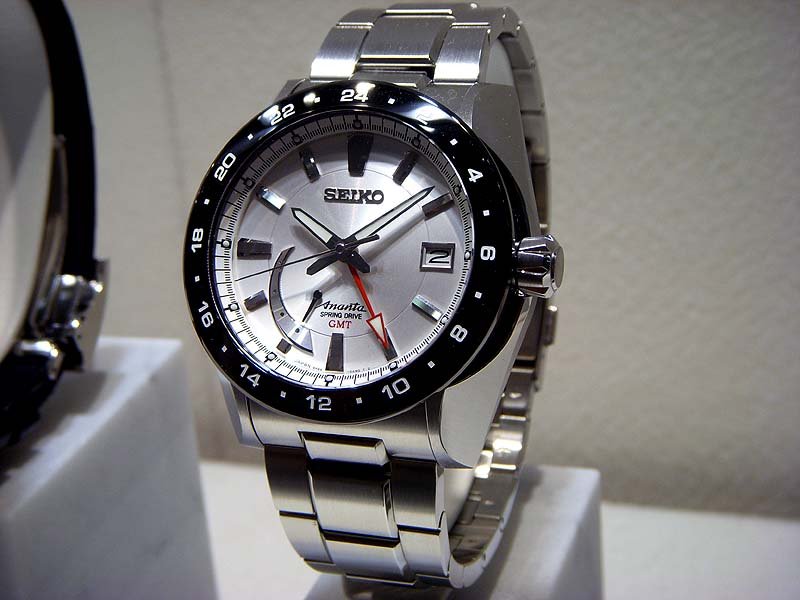
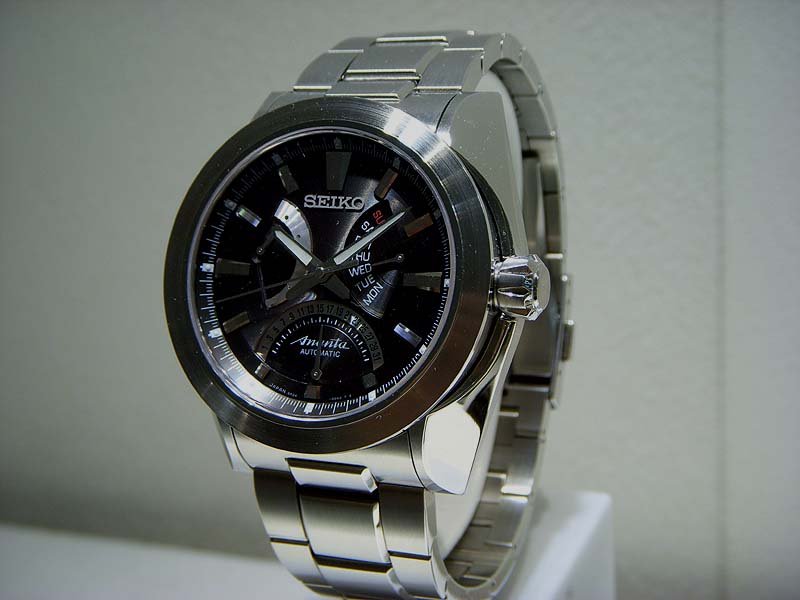
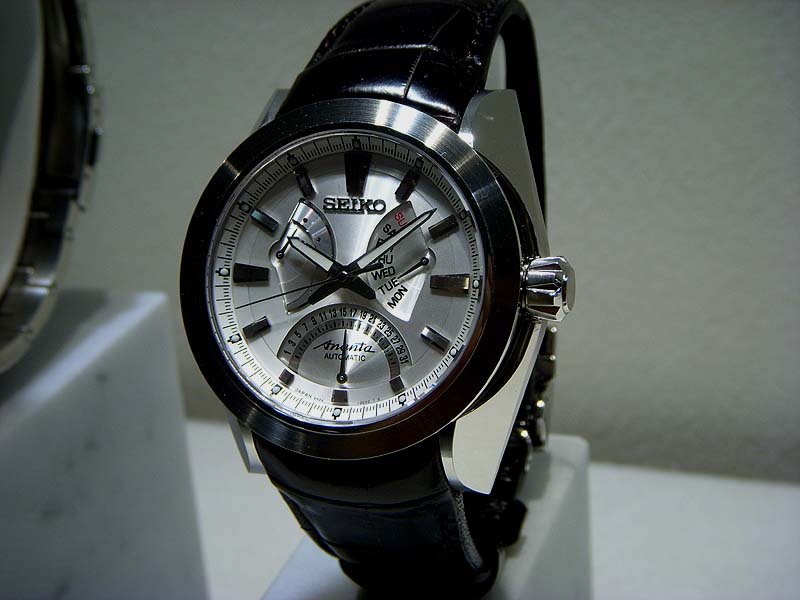
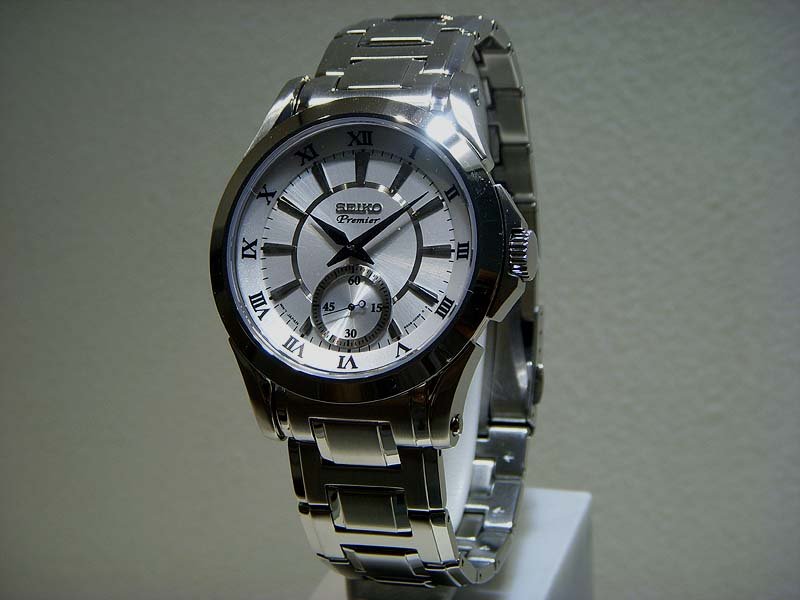
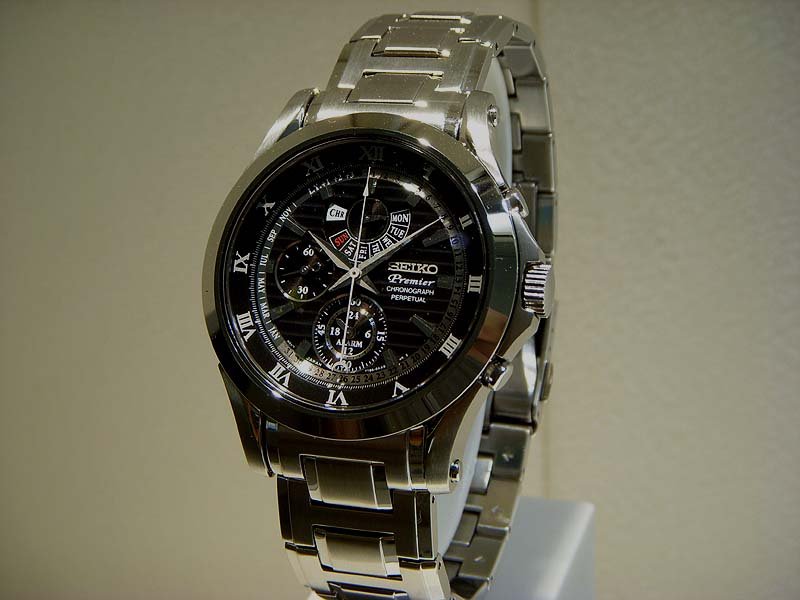
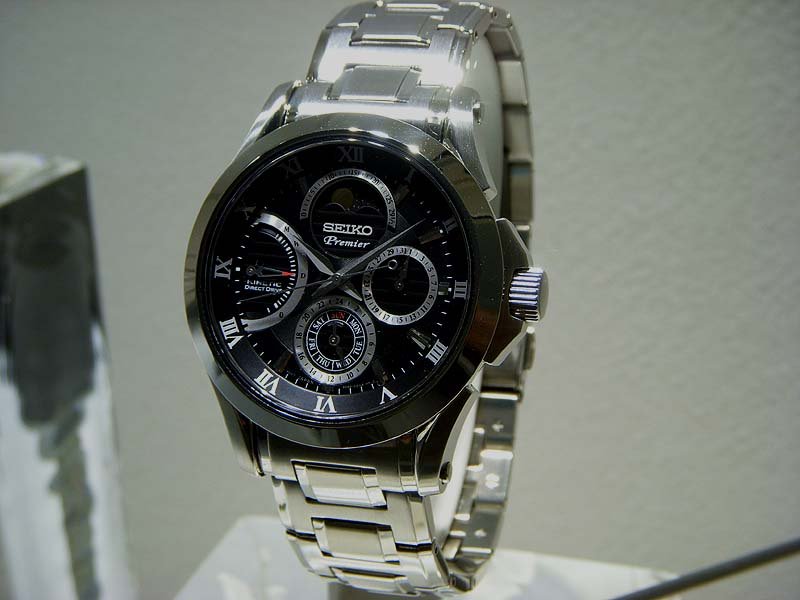
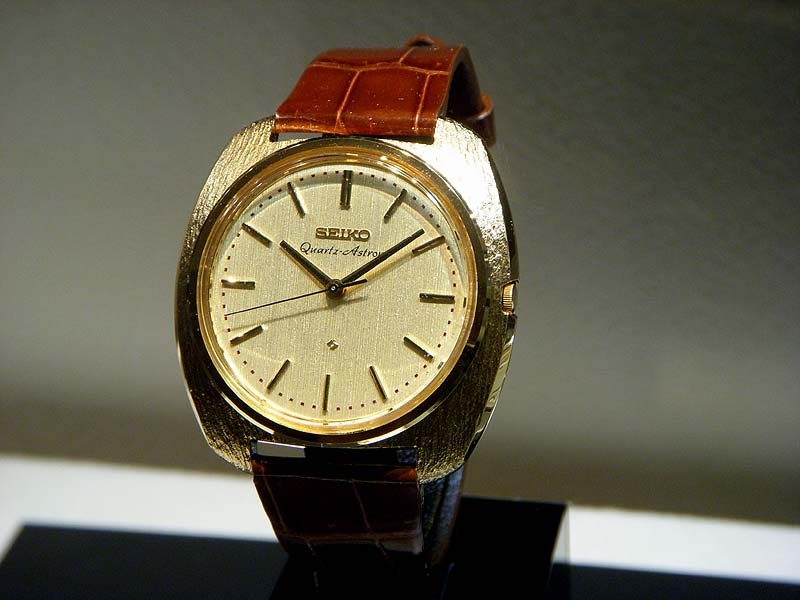
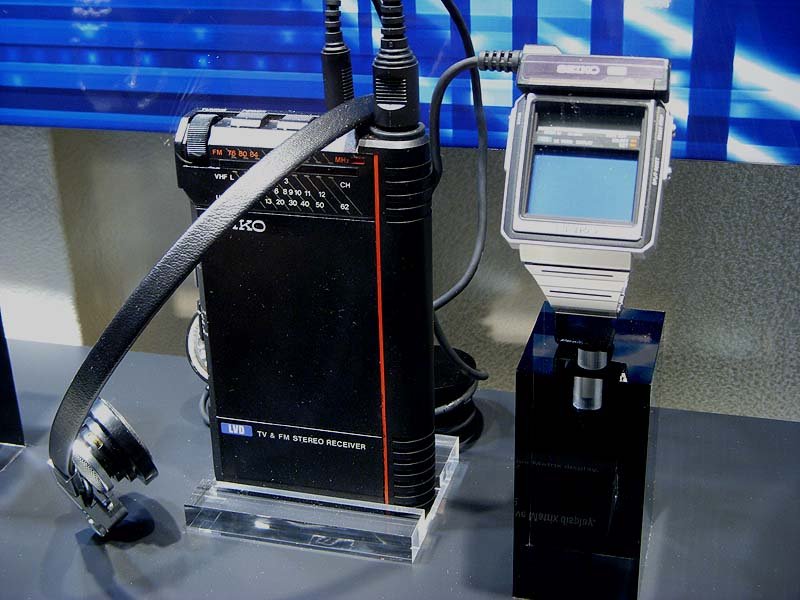
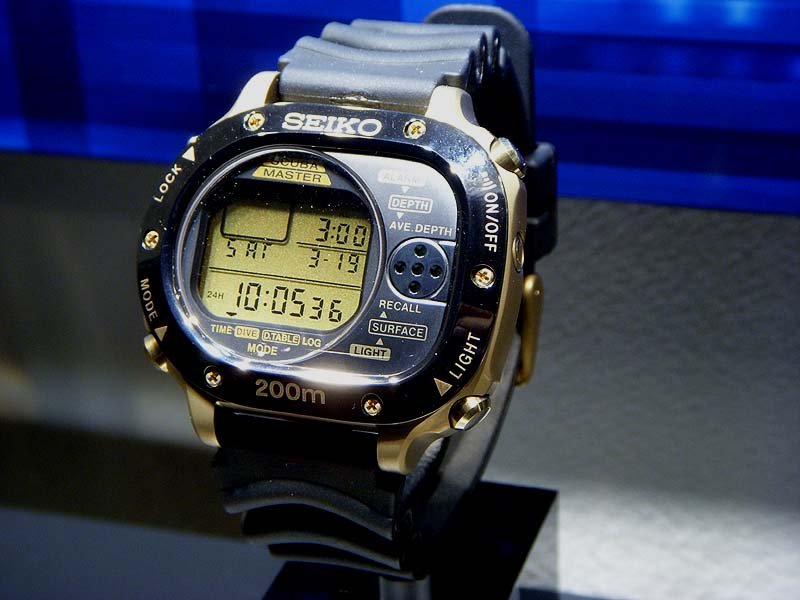
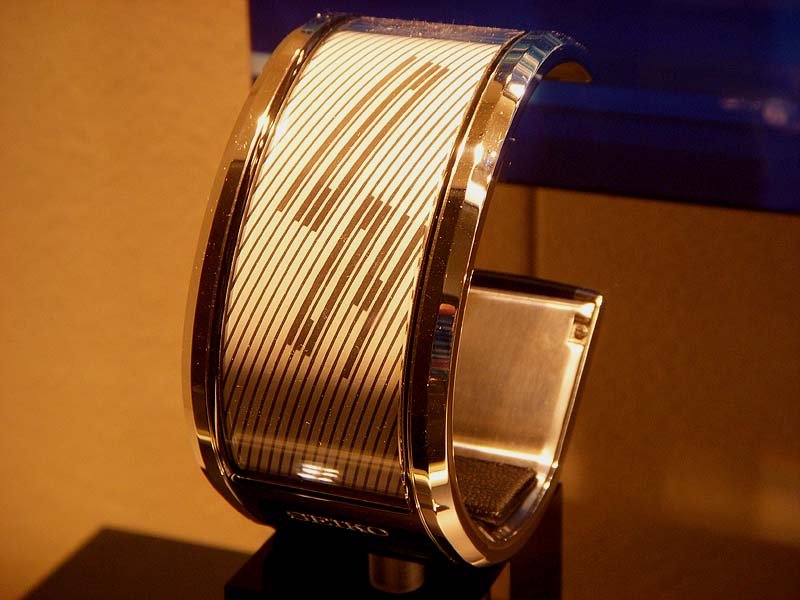
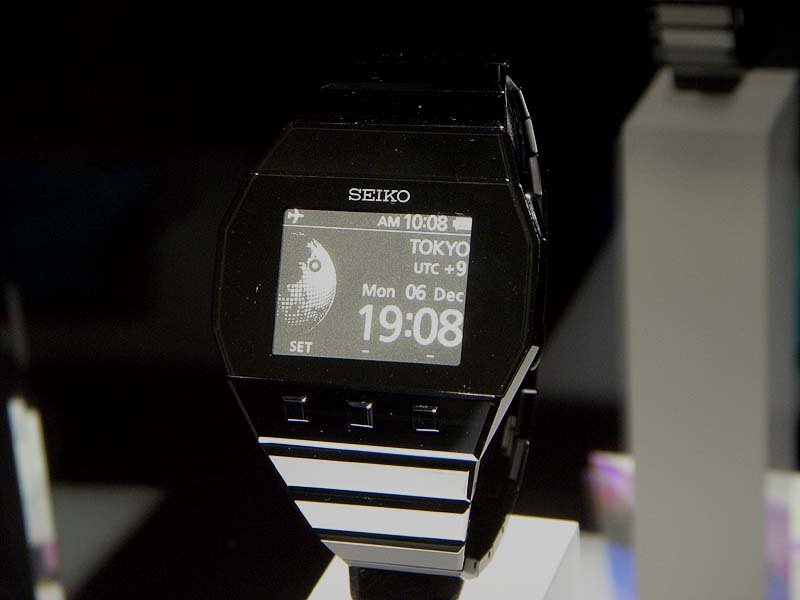
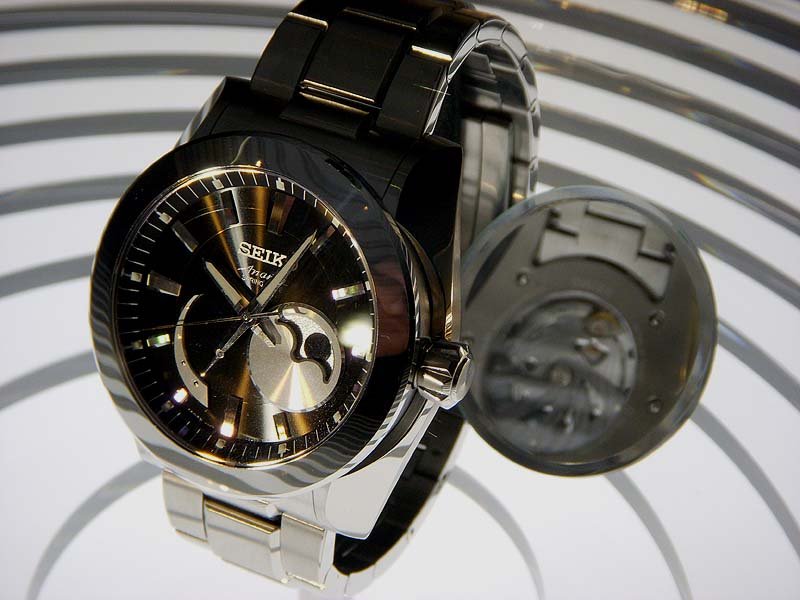
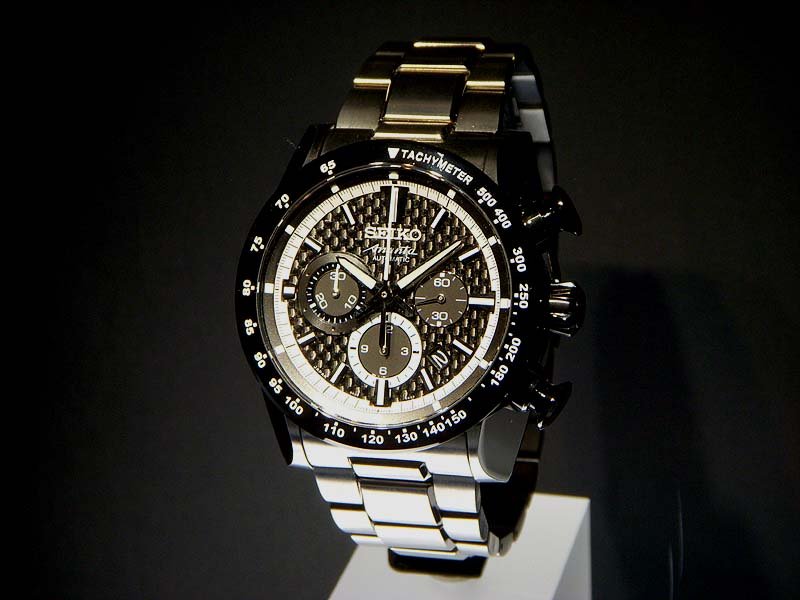
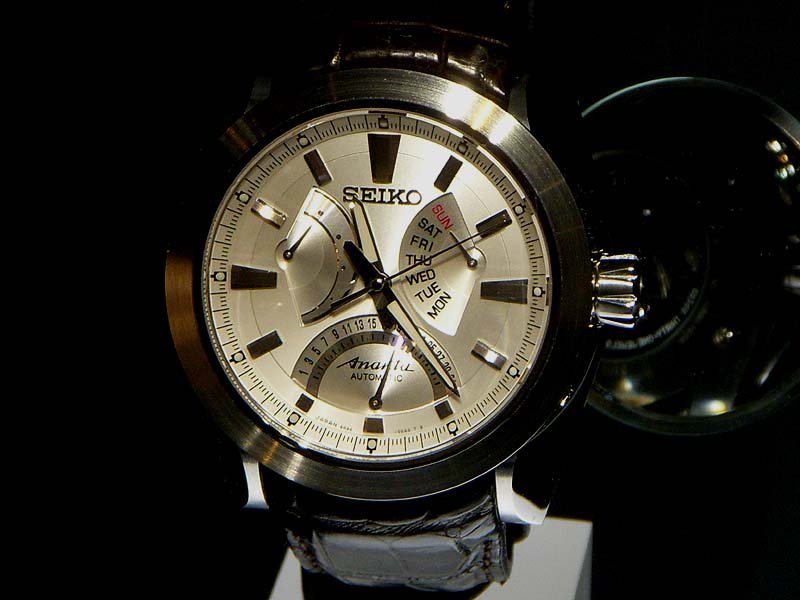
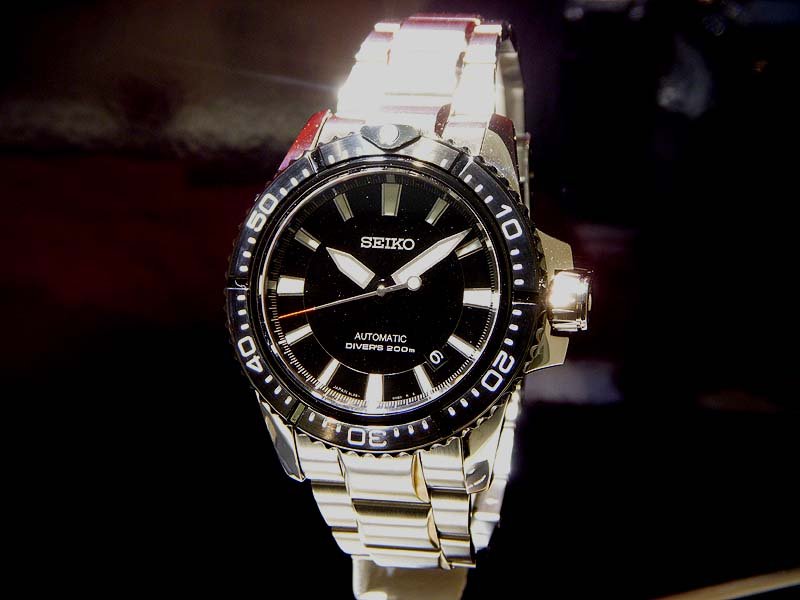
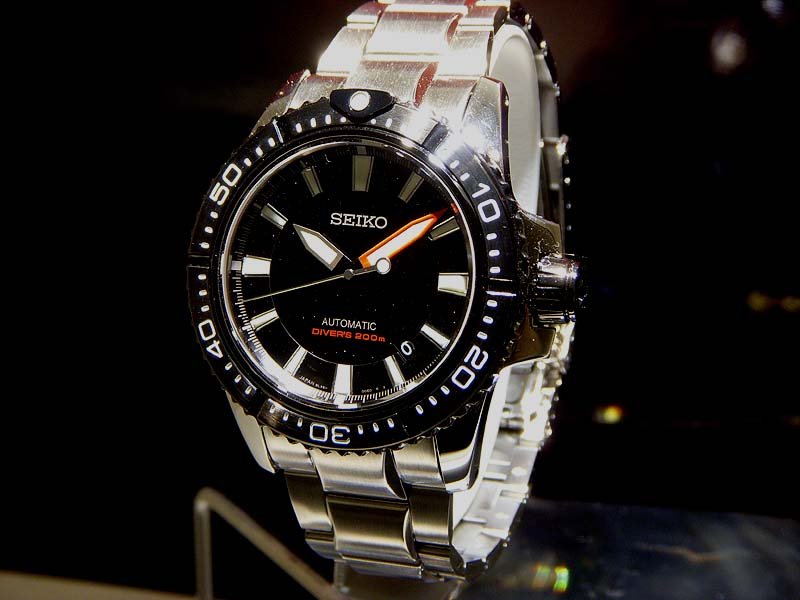
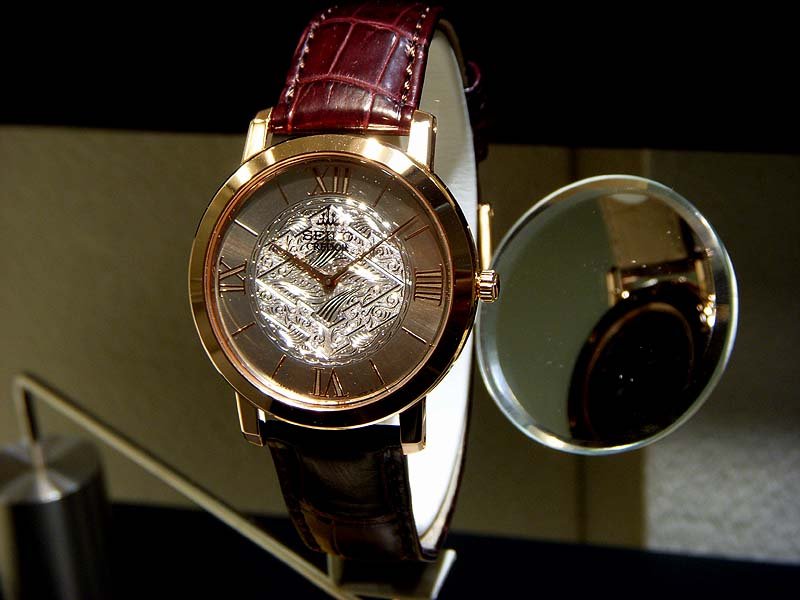
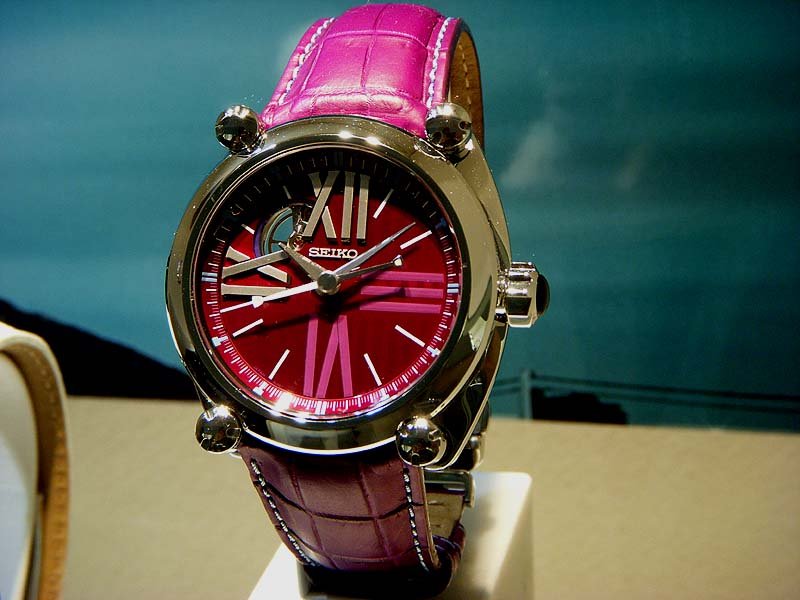
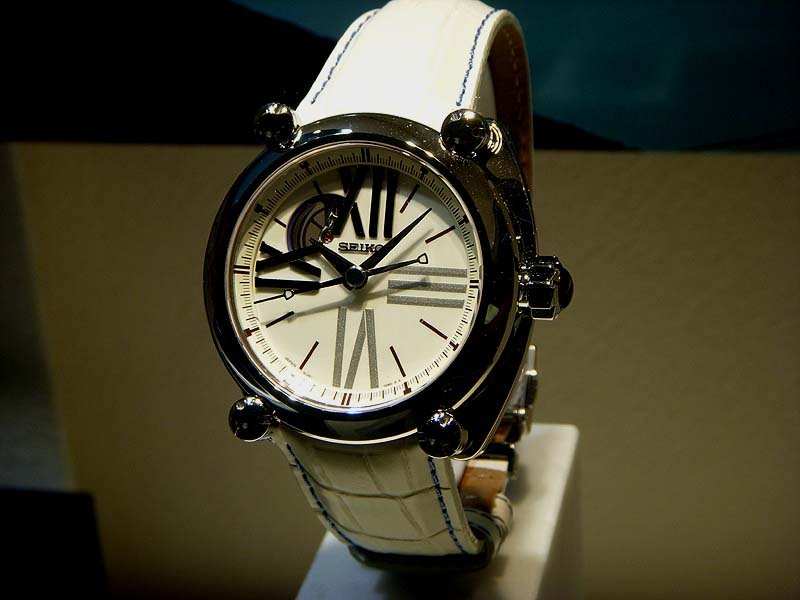
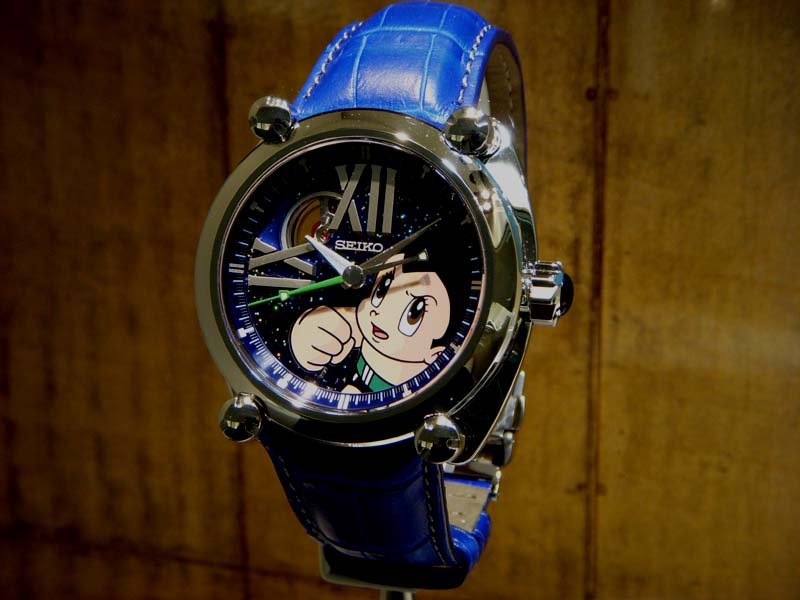
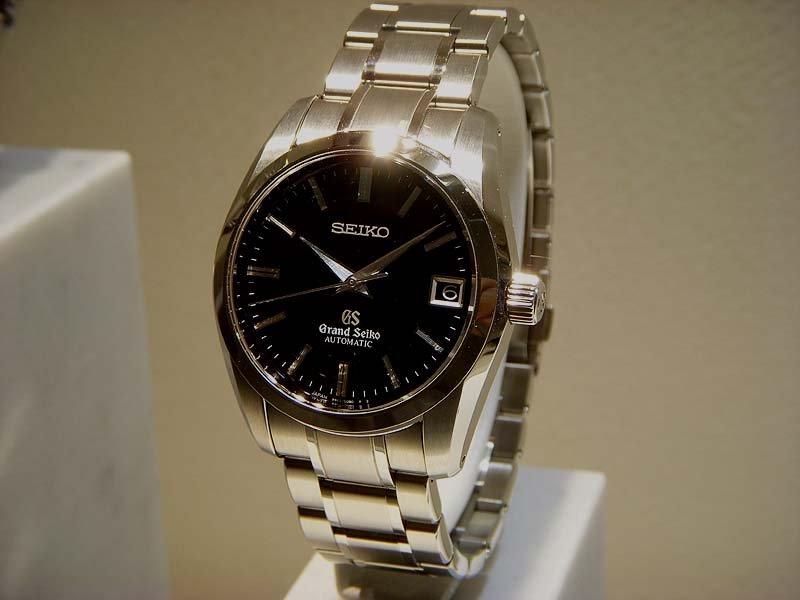
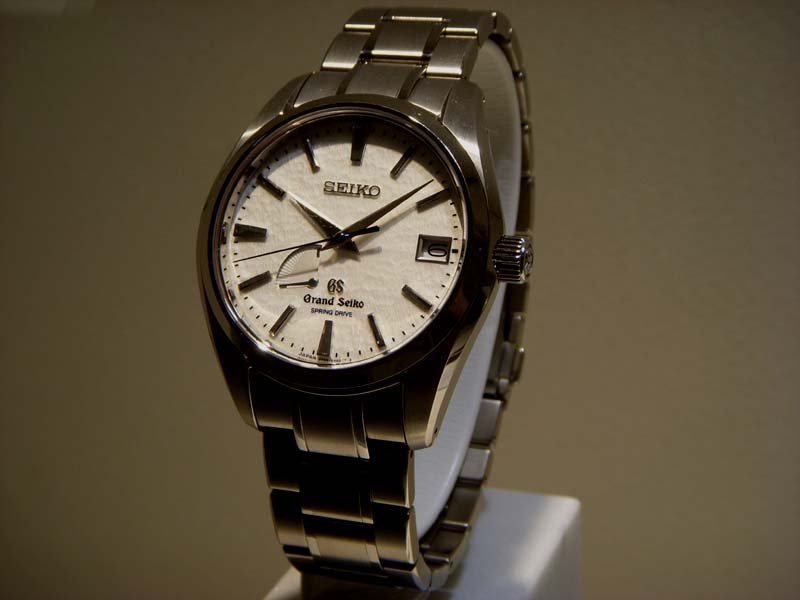
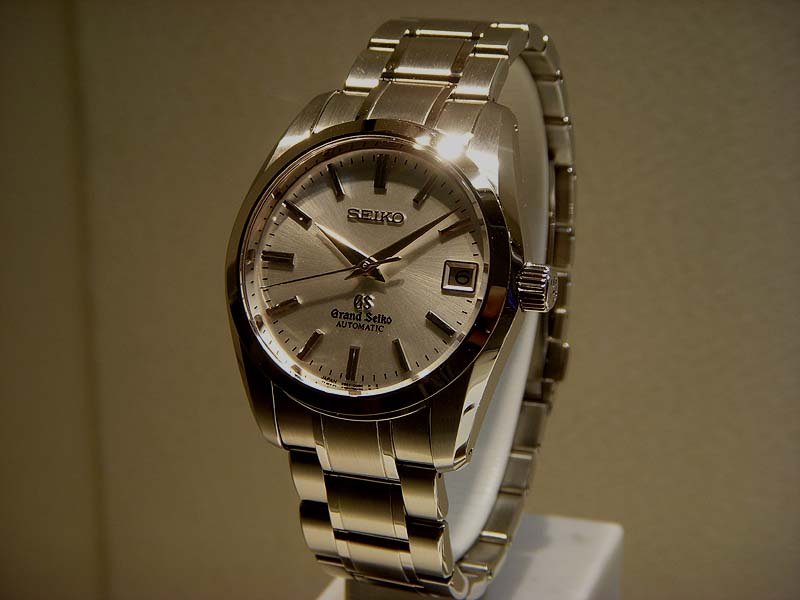
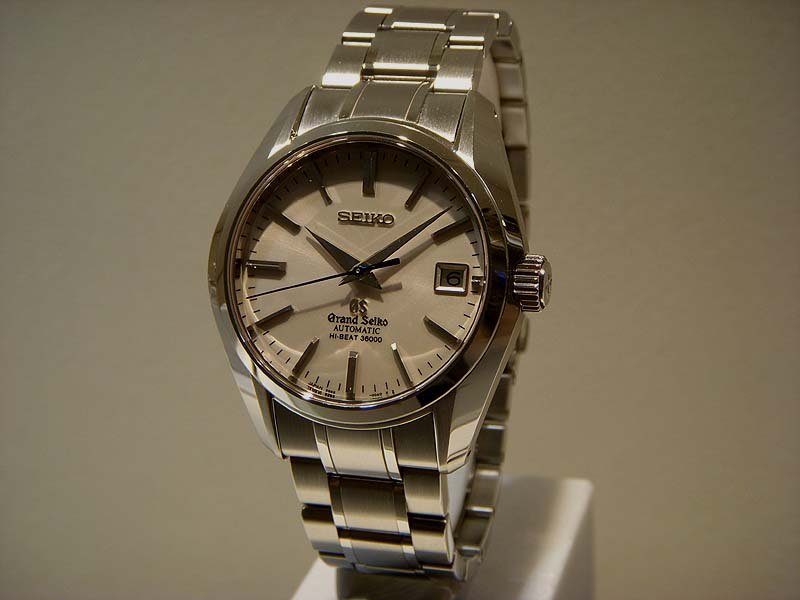
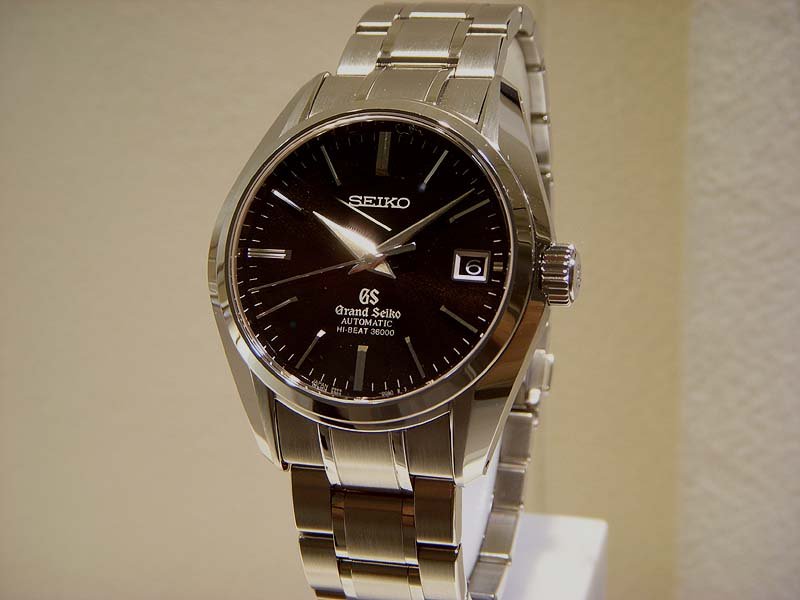
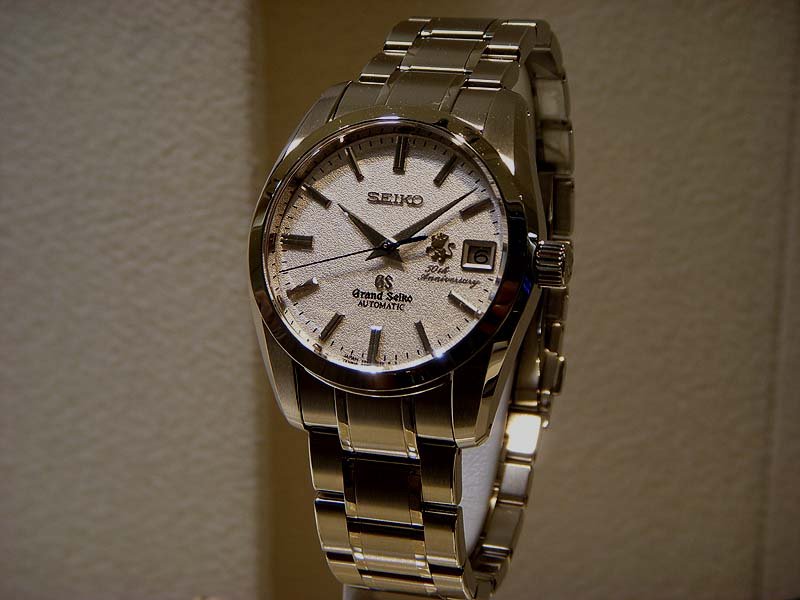
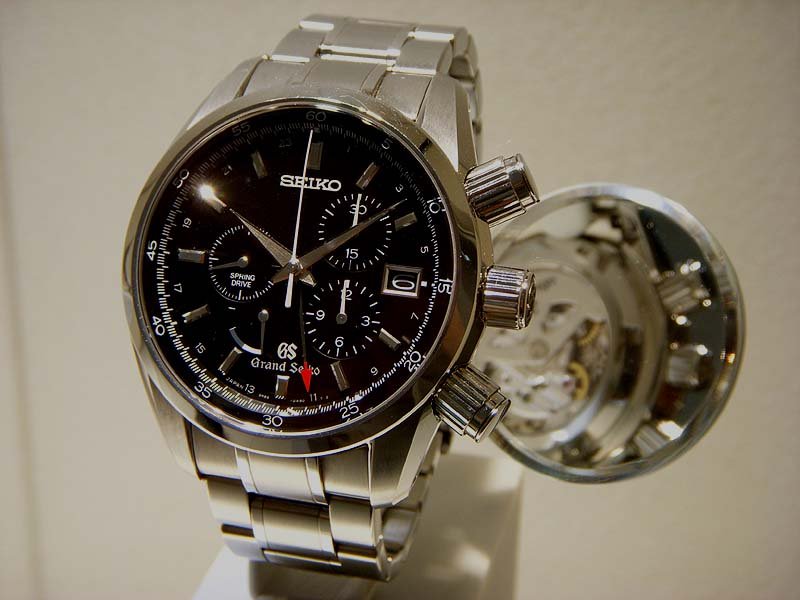
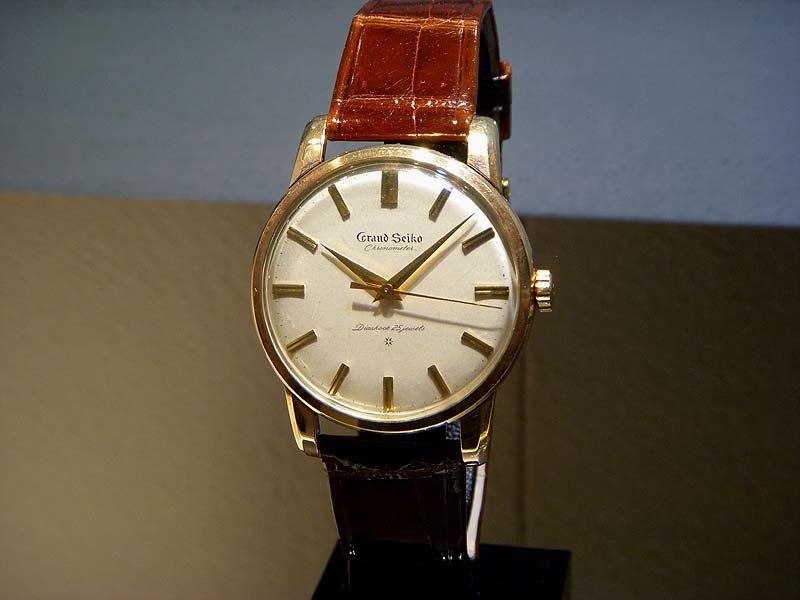
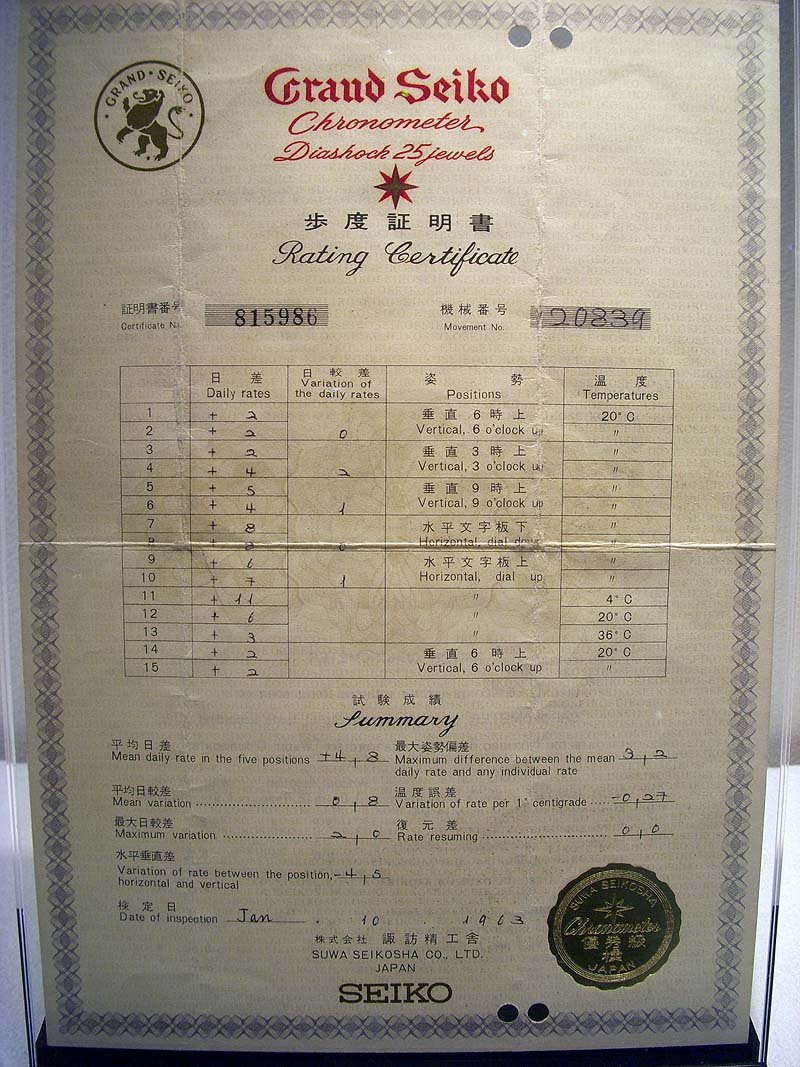
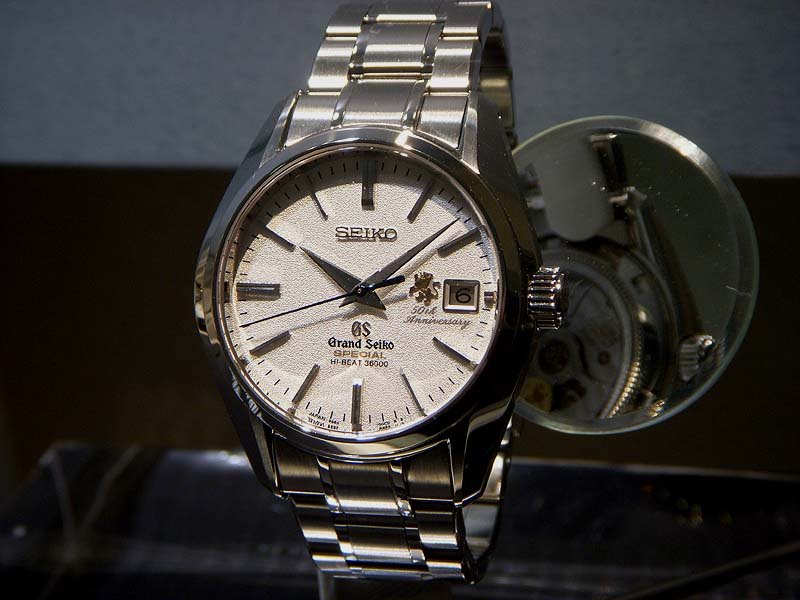
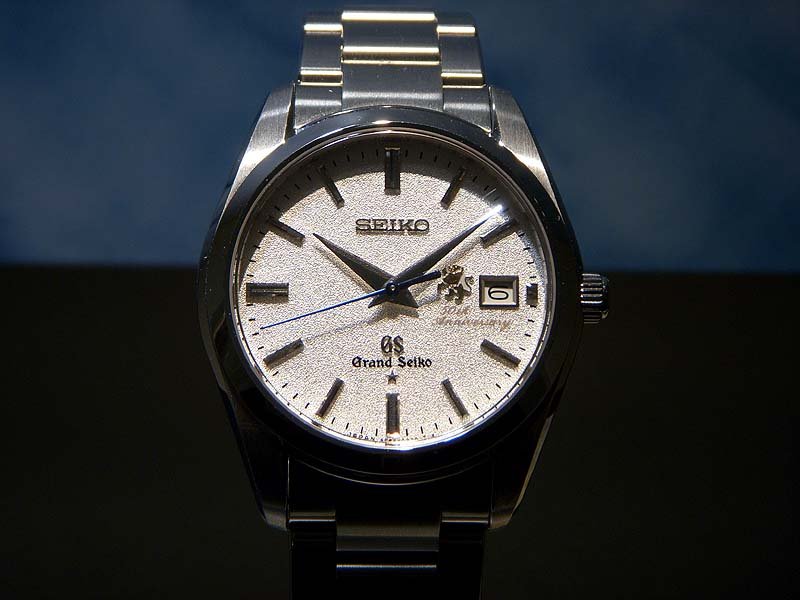
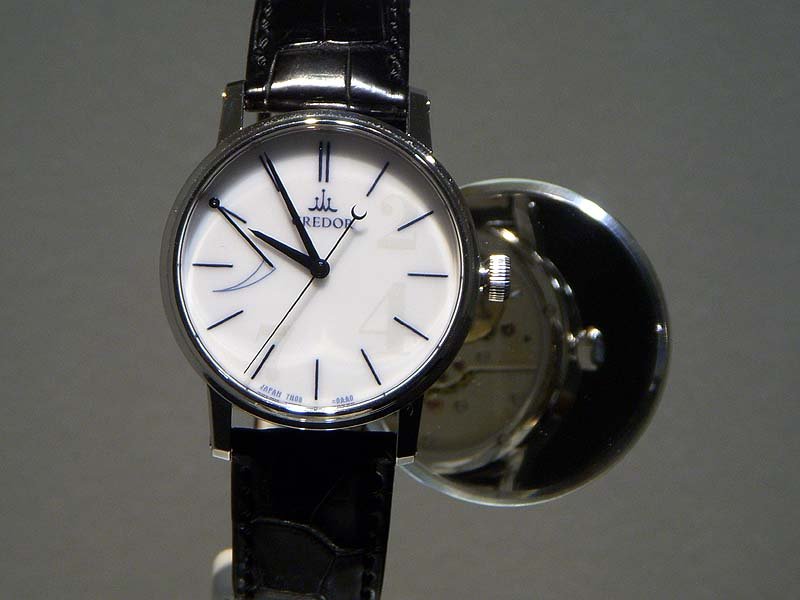
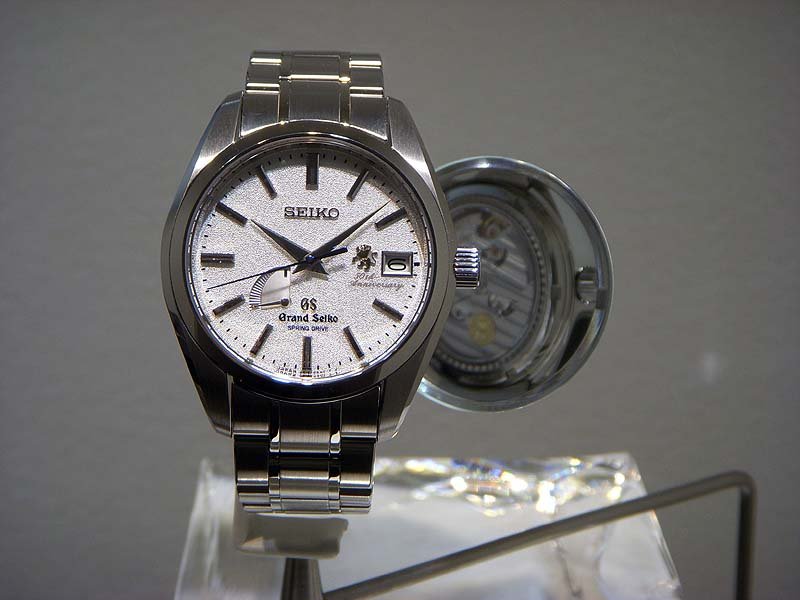
Tony
EDITOR'S NOTE
Seiko has a following amongst PuristS, especially the Grand Seiko and recently, Ananta range that was covered last year by our moderator Andrew H.
This year, Seiko was totally unresponsive to e-mails to Japan and USA HQ. We cannot report from the horse's mouth if the horse runs away! 
Thanks to TonyA for these window shots.
Melvyn Teillol-Foo
This message has been edited by MTF on 2010-04-05 09:33:18Nice to see the SBGH005 on display . . .
Baselworld 2010: Alain Silberstein
Baselworld 2010: Alain Silberstein
By Melvyn Teillol-Foo

Our Gallic friend Alain was orderly in his layout of watches to show.

I thought it was one of his more outrageous collections in years.
The tattoo theme was really cool and unique.


Alain preferred the SteamPunk version.

Note that the chronograph seconds hand has an ingenious ‘vernier scale’ to read the 1/8th divisions of each second.

Silberstein the Tiger

For the Year of the Tiger, there is an unusual model with arches for lugs and a stylised tiger jaws.


The One-Hand watch has only 48 divisions so each division is 15-minute resolution. This takes time-blasé further than the original Pikto that had 5-minute divisions! I guess Tiger-Year people just don’t care in their special year. Even if you are born under the other 11 Chinese Zodiac signs, this watch should be a must-have for Silberstein fans.

Clasp action sequence......


Conclusion
The whole 2010 collection looks like a winner.
My prediction is that the clear favourites will be the SteamPunk and Tiger.

Baselworld 2010: Peter Speake-Marin
Baselworld 2010: Peter Speake-Marin
By Don Corson
Peter Speake-Marin was focusing on his new SM2 movement and the watches using it this year.
Here some bridges showing the high level of finishing.


Before and after finishing

The main plate with the barrel and anchor bridge.


EDITOR'S NOTE
Peter has takn it a notch up since he started making his own movement. Look at the finish.
I could not meet Peter at Baselworld 2010 because he dashed away half way through the fair; apparently this watchmaker has been busy making other things!
Relax folks; the Speake-Marin legacy is safe for the next generation...........
Melvyn Teillol-Foo
high finishing
an elegant watch brand, with clean and elegant finish hard to match by independents on their own, but peter broke the rule.
Thanks.
Faisal
Baselworld 2010: Armin Strom
Baselworld 2010: Armin Strom
By Don Corson
At Armin Strom I was most curious to see the new complete watches to go with the new 8 day caliber introduced in January 2010.
This caliber is unique in that the ratchet wheels are on the dial side giving a very special look to the caliber and interesting possibilities for an open dial. As can be seen this is a manuel wind double barrel movement which together with the slow beat rate of 18000A/h allows for the 8 day autonomy.
I was not disappointed and find these new models to very very attractive sporty watches.

The balance spring with Breguet end curve is free sprung, the balance is regulated with inertia screws.


The watch models using this new movement are, as the existing regulator models, namd after the ancient elements, Air, Earth, Fire and Water. This is the model Earth with a black PVD plated stainless steel case.


The model Fire is in 18k rose gold


Note the "Fire" engraving


The model Water has a polished stainless steel case.


The model Air has a titanium case


Oops, this is the engraving for the model Water.

Following some members of the Armin Strom Blue Chip collection


Here we see the movement of the Armin Strom Regulator watches.


EDITOR'S NOTE
Armin Strom continues to interest PuristS with a cohesive collecton based on the 4 ancinent elements. They areno longer just fancy engraving and skeletonisation but also intersting mechanically with the new 8-day going movement.
Melvyn Teillol-Foo
Baselworld 2010: TAG-Heuer
Baselworld 2010: TAG-Heuer
By Melvyn Teillol-Foo
[Press release material reproduced for technical references]

THE PARTY

We were intrigued to be invited to the TAG-Heuer Cocktail Reception at the VoltaHalle, which appeared to be a defunct power station on the outskirts of Basel.

Even more intriguing were these Tesla Roadsters parked in an alley behind the venue.

Jack Heuer welcomed us to the 150th anniversary party.

CEO Jean-Christophe Babin had an interesting watch on.....
Babin introduced Elon Musk, founder of Tesla Motors, who drove a car on stage (silently). Musk sold his first company Zip2 to AltaVista for US$307 million in cash and US$34 million in stock options, aged 28 years.
Three years later his 2nd company PayPal was sold to eBay for US$1.5 billion in stock.
His 3rd company SpaceX was awarded a $1.6 billion NASA contract for 12 flights of their Falcon 9 rocket and Dragon spacecraft to the International Space Station, replacing the Space Shuttle after it retires in 2010. In his spare time, he also managed to co-found the electric car company.
The choice of party venue at VoltaHalle seemed quite logical.........Volta was an early resercher in electricity.
This was the start of a 15 city world tour celebrating 150 years of the Heuer part of TAG-Heuer and also promote Green Technology.
Then, Messrs. Babin and Musk introduced a buddy from California who championed Green Technology and the reason for all the heavy security became clear…..


DeCaprio spoke about Green issues and how some companies and countries (or even US states like California) have "got it" i.e. got the message. He then asked Mr Babin to explain the new watch being presented as a Concept that evening. This was before the offical launch the next day at Baselworld 2010.

Prototype


Circe de Soleil entertained


TAG Heuer Chronograph Prowess
TAG Heuer has an enviable history of chronographs and the mastery of tiniest fractions of time. Arguably, it is the unrivalled leader in high-end chronographs; examples being the 1/100th-of-a-second Mikrograph stopwatch in 1916 to the 2006 Geneva Watchmaking Grand Prix winning Calibre 360, the first mechanical wrist chronograph to beat 360,000/hour. Today, TAG Heuer has an unparalleled line-up of 7 mechanical chronograph movements (Calibre 11 and 12 developed with Dubois-Depraz, Calibre 16 and 17 from ETA, new in-house Calibre 1887, Calibre 36 developed with Zenith, and Calibre 360).


Cal 1887
Unveiled at the McLaren Technology Centre in December 2009, the Calibre 1887 was launched as a commercial product in an all-new Carrera chronograph at Baselworld 2010. The Calibre 1887 is a modern column wheel/oscillating pinion integrated chronograph movement platform. It is developed from intellectual property elements acquired from Seiko Instruments Inc (SII), which designed and patented it as TC78 in 1997/99. Having acquired the intellectual property rights from SII, TAG Heuer has devoted the last 3 years re-engineering and redeveloping key components like the assortment bridge and the main plate, and adding major technical features such as an eccentric adjustment screw to the oscillating pinion (patented first by Edouard Heuer in 1887). TAG Heuer also partnered with 22 premium component makers (21 of them in Switzerland) to redevelop other major components such as the assortment, shock absorbers and raquetterie. Final assembly takes place in a totally new, dedicated TAG Heuer workshop in La Chaux-de-Fonds.

The oscillating pinion, patented in 1887 by Edouard Heuer, works in tandem with the column wheel, in much the same way as an automobile transmission. The column wheel, which coordinates the start, stop and return-to-zero functions of the chronograph hand, functions like a gearbox. The smoothness and precision of its super-soft click start is a recognized element of high-end watchmaking excellence. The oscillating pinion works like a clutch. The optimized version in the Calibre 1887 enables the chronograph to start in less than 2/1,000th of a second. The Calibre 1887 is also equipped with a High Efficiency Rewinding (HER) system, acknowledged by watch experts as the world’s most efficient rewinding device because of its bidirectional automatic structure, which delivers 30% more efficiency than the traditional inversor system used in most Swiss chronographs. The HER is also famous for its superior reliability and sturdiness.
BIG NEWS
The really big news for their 150th anniversary was introduced in headlines: TAG HEUER R&D OBJECTIVES IN THE 3RD MILLENNIUM: TO PROGRESSIVELY RE-INVENT THE THREE ELEMENTARY PRINCIPLES OF WATCHMAKING — ENERGY, TRANSMISSION AND REGULATION
Like most machines, a mechanical watch movement involves four basic operations: energy is generated, stored, transmitted and regulated. For centuries, these constants of mechanical watchmaking have been performed by three complementary blocks: a power storage system with cylindrical barrel, a transmission system with pinions and gears, and a regulation system with balance wheel, spiral hairspring and escapement.
With the TAG Heuer Monaco V4 Concept Watch, TAG Heuer substituted the traditional pinion and gear transmission with a belt-driven mechanical transmission. An award-winning BaselWorld concept watch in 2004, the Monaco V4 became a commercial reality at the end of 2009, when it was successfully launched in limited edition of 150 “Haute Horlogerie” pieces.
To mark its 150th anniversary, TAG Heuer introduced the TAG Heuer Pendulum Concept, the first-ever mechanical movement without hairspring.
Since the creation of the Galileo-inspired hairspring by Christiaan Huygens in 1675, the regulating organ of all mechanical watches has been based on a balance wheel and spiral-shaped torsion hairspring system. A coiled strip of fine metal alloy, the hairspring provides the torque necessary for the balance wheel to oscillate and regulate its frequency. Over the centuries, it has been significantly modified and improved. Charles-Edouard Guillaume (1861-1938), the son of a Swiss watchmaker, discovered new alloys (Invar and Elinvar) that significantly reduced the metal spring’s thermal sensitivity. Guillaume won the Nobel Prize for Physics for this invention in 1920.
With the challenge of temperature diminished by Guillaume’s alloys, the spiral hairspring regulation system came to dominate mechanical movement design. However, the mechanical hairspring has three serious design limitations: a mass that makes it sensitive to gravity and deforms its geometry; a material that makes it sensitive to thermal expansion; and a divergence between its geometric centre and its centre of mass. These may cause isochronal issues that can be technically and physically improved but never completely eliminated.
Overcoming the design limitations inherent in the traditional regulation system by eliminating the need for a spiral hairspring was the first challenge TAG Heuer set for itself. The second was keeping the movement 100% mechanical: conventional watchmaking wisdom has always held that a mechanical watch without spiral hairspring would necessarily require another energy source for its regulation.

In the TAG Heuer Pendulum Concept, the traditional hairspring is replaced by an “invisible” or virtual spring derived from magnets. The complete device forms a harmonic oscillator. The magnetic field, generated by means of 4 high-performance magnets and controlled in 3D through complex geometric calculations, provides the linear restoring torque necessary for the alternative oscillations of the balance wheel. The oscillating period of the TAG Heuer Pendulum Concept is resistant to changes from perturbing forces, which is what makes it an exceptionally good timekeeping device. The movement built with this revolutionary oscillator is fully mechanical and does not contain any electronics or driven actuators. The magnets generate a constant field over decades.
TAG Heuer Pendulum Concept, the world’s first oscillator in a mechanical movement without hairspring, beats at 43,200/hour (6 Hertz) for high frequency and ultimate precision. It requires no additional components and is based on physical magnetic properties. It gets its name from an earlier Huygens creation — the pendulum clock of 1657.
TAG HEUER PENDULUM CONCEPT
The TAG Heuer Pendulum Concept not only overturns 3 centuries of conventional watchmaking tradition, it also represents in and of itself an enormous technological leap forward. In a classical spiral hairspring system, the effect of gravity due to mass is a dominant issue. With the TAG Heuer Pendulum Concept, the problem no longer even exists. There is no loss of amplitude and the movement’s frequency can be modulated on a very large spectrum of frequency without overburdening the power supply. The result is a significant increase in precision (division of time) and performance (frequency accuracy and stability).
The TAG Heuer Pendulum Concept is the first-ever magnetic oscillator without hairspring capable of providing a restoring torque comparable to that of a hairspring: the basic principle of the Swiss anchor escapement is therefore unchanged, but the absence of mass and therefore inertia allows for much larger frequencies. Theoretical precision is significantly higher as it is possible to oscillate at small angles (the elementary principle of oscillator accuracy) without altering the return torque and, especially important, without causing geometric deformations.

TAG HEUER PENDULUM CONCEPT PROJECT: 5 YEARS OF R&D EFFORT
The TAG Heuer Pendulum Concept project involved in-house TAG Heuer R&D engineers and watchmakers working in an extensive research partnership with microsystems research experts at the Integrated Actuators Laboratory (LAI), part of the Microtechnics Institute of the Swiss Federal Institute of Technology in Lausanne (EPFL).
Starting from scratch has required advanced digital simulation coupled with physical analysis (mechanics, magnetism and thermal behaviour). It took TAG Heuer’s R&D team 3 years of intensive digital 3D simulation research to precisely orient the TAG Heuer Pendulum Concept’s virtual magnetic spring. An old adversary still remains: the magnets are sensitive to temperature. The challenge facing TAG Heuer now is to discover the magnetic equivalent of invar-elinvar: to, in a sense, add Charles Edouard Guillaume’s accomplishments to those of Christiaan Huygens. Once addressed, the TAG Heuer Pendulum Concept will no longer be a concept but a new milestone in mechanical regulator technology. As with the V4, this may take years, but TAG Heuer is committed to taking on the challenge and pursuing the epic Pendulum adventure.
TAG Heuer does not claim that the Pendulum Concept will take the place of traditional, high-quality Swiss hairsprings in mainstream mechanical movements, but rather offer a “Haute Horlogerie” alternative, which could lead to high-end limited editions in the future, as was the case with the Monaco V4’s movement transmission innovations.
TAG HEUER GRAND CARRERA PENDULUM CONCEPT

The TAG Heuer Grand Carrera Pendulum Concept opens a promising new era in watchmaking, with potentially powerful new movements precise to ever-smaller fractions of time. The effect on future watches and chronographs design and function may be huge — and TAG Heuer once again leads the way even though it will take years before it will become a commercial realty. Patents have been filed and are pending.
Conclusion:
I confess to being one of the more outspoken skeptics of the V4 concept and the long wait for execution only served to stiffen my belief. However, I can also admit that the Pendulum Concept really blew my mind because it works and from a simple idea. It may take time to develop but the concept is admirable. If Guillaume won the Nobel Prize for cobbling together a couple of metal alloys, then Tag-Heuer should win the 2020 Nobel Prize for Physics for the Pendulum Concept.