
SIHH 2011: A comprehensive PuristSPro Report on SIHH 2011
I present my comprehensive report on SIHH 2011 in Geneva. It covers 20 brands including nearly all the brands inside SIHH and a few notable brands outside of the fair.
This year I tried to condense the report a little, as I received feedback that last year’s was unwieldy. Aiming for quality over quantity this year, the 2011 edition of my report has only 523 photos and just under 10,000 words.
I cover approximately 80% of the novelties presented, those missing were either unavailable or I just plain forgot to photograph them. Also, watches still under embargo that were presented to me are also naturally omitted.
All text and photographs in this report are mine and so are all errors. Feedback and preferably lavish praise can be emailed to me by clicking here .
- SJX

This message has been edited by SJX on 2011-02-01 05:39:25 This message has been edited by MTF on 2011-02-22 02:59:20 This message has been edited by AnthonyTsai on 2011-03-21 13:16:13
*** SIHH 2011: A. Lange & Söhne ***
2011 is a year of the small and focused collection for Lange. At one end of the spectrum, the entire Saxonia range was revised with four new models joining the range. Like the Saxonia Annual Calendar of 2010, the new Saxonia models this year are commercially minded and clearly aimed at filling holes in the product range.
Two key design elements of the new Saxonia watches are the minute track and sloped dial flange.

The slimmest of the additions is Saxonia Thin, available only in rose gold. At 40 mm and 5.9 mm high, its dimensions are not what one usually associates with Lange. The movement has exposed barrel ratchet and transmission wheel for slimness.


Also hand-wound is the entry level Saxonia which is a modest 37 mm in diameter. Inside sits the calibre 941.1 from the old 1815. This is available in three colours of gold.


Slightly larger is the Saxonia Automatik at 38.5 mm. Though at first glance this is reminiscent of the Lange Daymatic movement because of the rotor, there are differences. As a lower priced watch the movement has a gold-plated centre section of the rotor with a platinum outer mass. And the movement is less elaborate in other ways like the lack of jewels in screwed gold chatons for instance. While still lavishly decorated by most standards, this is the most frugal looking Lange movement in my mind.


Built on the same base movement as the Automatik is the Saxonia Dual Time. This is a straightforward dual time zone watch with the home time hand in blue steel and the day/night indicator at 12 o’clock. When not needed the home time hand can be hidden under the local time hour hand. And the buttons on the case advance the local time hand forwards or backwards in one hour intervals. Like the Saxonia Automatik this is only in rose or white gold.


The final addition to the Saxonia range is the hand-wound Little Saxonia for ladies. These are available in three colours of gold, with diamond bezels and guilloche mother-of-pearl dials.


Now on to the complications, starting with the Richard Lange Tourbillon Pour le Mérite that was previewed before SIHH. It is an impressive watch, whether you like the design or not.

Based on a vintage regulator pocket watch, this watch combines two developments from past Lange tourbillon watches: the chain-and-fusee and the hack seconds tourbillon. In addition it has an hours disc that jumps at six o’clock to bridge the hour track from eight to ten, before jumping back at 12 o’clock. This gives an unimpeded view of the tourbillon from 12 to six.
Hours disc retracted

And extended


Compare this with the movement of the first Pour le Mérite tourbillon and you will see more openings exposing more of the movement. This continues a trend for Lange I have discerned in recent years, the desire to expose more of the movement, both on the front and the back.


The new Richard Lange will be a limited edition of 100 pieces in platinum and regular production in rose gold.
The last complication from Lange might very well be a prelude to a more complicated striking watch later on. The Zeitwerk Striking Time is a jumping hour with quarter striking mechanism – a high tone on the quarters and a low tone on the hour.

Based on the Zeitwerk movement with the addition of the striking mechanism to the top of the movement, the hammers are visible on the dial while the gongs sit in the void between the dial and the case. Combined with the jumping hours, there is a flurry of activity on the dial at the top of the hour.


Though it does not seem that much larger than the original Zeitwerk, this is 2 mm bigger at 44.2 mm.


In platinum with a silver dial this is limited to 100 pieces while the white gold with black dial is regular production.
- SJX
This message has been edited by SJX on 2011-01-30 06:11:41 This message has been edited by AnthonyTsai on 2011-01-30 16:16:08
Is the Zeitwerk Striking Hour featured here a prototype?
Again, like I pointed out last year, the minute disc is NOT aligned...again.
Best, Horo


Of course, everybody who attended the SIHH saw it and heard it.
alang.watchprosite.com
Fr.Xavier
This message has been edited by foversta on 2011-01-30 10:16:04
*** SIHH 2011: Audemars Piguet ***
AP unveiled a collection that comprised mainly additions to the Jules Audemars and Royal Oak lines, along with several new Millenary, including the 4101 which was a crowd favourite.
Starting with the simplest, the Jules Audemars Selfwinding. Measuring 39 mm in pink or white gold, with several dials available as well as the option of a diamond bezel, this contains the in-house cal. 3120.


Another new JA Is the Extra-Thin with the cal. 2120 in white gold. This is 41 mm and only 6.7 mm high.


Ladies get the JA Small Seconds in white or pink gold, with or without diamond bezel.

Several complications were also introduced, starting with the Dual Time, also in two colours of gold.


Only in pink gold is the JA Moon Phase Calendar.

And lastly the JA Tourbillon with oversized date. None of the JA watches introduced are revolutionary but as the common refrain heard during the fair goes: “probably for the Chinese market”.


The Royal Oak Offshore Chronograph has evolved yet further. Sporting design elements from various Royal Oak chronographs that have come before, the new model is 44 mm in diameter and available in pink gold, steel or forged carbon, with ceramic bezel. Inside beats an in-house movement based on the 3120, visible through the display back.


The crown guards and pushers are especially prominent and give the watch an aggressive stance which is somewhat contrasted by the clean dial.


For those with a bigger pocket book but similarly sized wrist, the new Offshore Tourbillon Chronograph is also 44 mm. Turn it over and you get the unexpected.


The cal. 2897 has a peripheral winding mass, while the design of the movement – look at the bridges, levers and barrel ratchet – takes after vintage pocket watches. But it is finished in steel and rhodium-plate, instead of the gilt finish of antique movements.

This movement is almost incongruous with the design of the watch but as a whole tit is a sophisticated and good looking piece. Along with the Millenary 4101 further below this is one of the highlights of the AP range.
The second complicated Royal Oak presented was the Royal Oak Concept CS 1. Looking much sleeker and unadorned than its predecessors this features a second time zone indicator at three. The bezel is ceramic (I did a bad job of wiping it down as you can see from the pictures) but I cannot recall what the case material is and can’t find anything in the press notes, probably titanium?


But the watches above are clearly for shrinking violets. For larger personalities AP has introduced the Royal Oak Offshore Arnold Schwarzenegger The Legacy. Though the Governator’s legacy is still fairly mixed, this watch makes itself absolutely clear.


In ceramic and rose gold, the watch is 48 mm with bridges bolted to the sides to make it look bigger. But note the ceramic case and bezel which are beautifully brushed and polished with bevelled edges like a regular metal Royal Oak case – an unusual and praiseworthy feat. I expect more ceramic cases with this level of finishing next year.


Last is the Millenary 4101 which was the favourite of many. The cal. 4101 is an automatic movement that has been designed entirely for aesthetic effect, with large exposed bridges on the dial side with secured by big screws, and an escapement that is pushed towards the perimeter of the baseplate.


At 47 by 42 mm it is not a small watch, the oval shape makes it eminently wearable. This is available in steel or rose gold, and the steel version is especially striking.


The 4101 is more of an exercise in aesthetics than technique but it is a well executed idea.
- SJX
This message has been edited by SJX on 2011-01-30 06:34:46 This message has been edited by AnthonyTsai on 2011-01-30 16:16:26
The millenary is a very attractive watch
Is it a regular production or a LE? If available, could you tell us the retail price for the steel and gold models? Thanks,
Stewart
It is not an LE
Retail for the steel will likely be in the region of USD22-24k. That is a very rough estimate.
- SJX
*** SIHH 2011: Baume & Mercier ***
Baume et Mercier came along with Piaget when the latter was bought by Vendome, and then B&M became the forgotten step child living under the stairs. But in 2011 B&M was one of the highlights of SIHH. Not because of the watches themselves, which were attractive but still ordinary, but because the brand has been revamped.
The second of the brands overseen by IWC CEO Georges Kern (the first being Roger Dubuis, another turnaround story), B&M now has more coherent brand identity – beaches and the Hamptons – which will be in advertising everywhere soon, along with a tighter and improved watch line.
Though B&M watches are still made for an accessible price point, the quality has improved, most notably with the case finish.
The highlight of the 2011 collection is the Capeland range of chronographs. At the top of the line sit a pair of retro-inspired chronographs with La Joux-Perret modified 7750 flyback movements.


In gold or steel, these are 44 mm with domed sapphire crystal. Its size gives it more punch than this genre of telemetric-tachymetric dial normally possesses.


Though the date window gets in the way of the very well coordinated vintage look, this design is a winner, especially in steel with the blue hands. This is a watch that people will remember, quite a contrast from past B&M watches which no one could remember, ever.
At the entry level the Capeland chronograph is available in a range of colours and leather straps with stitching accents. Not extraordinary but nice looking with well made dials and cases (well executed contrasting brushed and polished finishes) making them excellent choices for this price point.


B&M also introduced a new Linea for ladies. These feature a clever clasp on the case allowing the bracelet or strap to be unlocked and swapped easily. Aside from that, however, I find them boring.


The Capeland chronograph is a leap forward compared to previous B&M for men, while the Linea is a mere step. Nevertheless B&M is finally going somewhere, after going nowhere for a very long time.
- SJX
This message has been edited by SJX on 2011-01-30 06:39:15 This message has been edited by AnthonyTsai on 2011-01-30 16:16:40*** SIHH 2011: Cartier ***
Cartier had the largest collection at SIHH, even compared to previous years. In terms of breadth as well as individual complications Cartier presented one of the most impressive collections at the fair.
It’s a long way to the end so we will start with the easy bits. The Calibre de Cartier, launched in 2010 as Cartier’s sporty masculine watch, now has a matching bracelet. Though the bracelet profile echoes the curves of the case, I find it reminiscent of the Rolex Oyster. But regardless of what I think Cartier will still sell very many of these.


But Cartier sells even more Ballon Bleu and one of the notable additions to that range is the Ballon Bleu Extra Flat. Being very slim but 46 mm wide, this seems almost razor sharp. Though not part of the Fine Watchmaking range this is an upper end watch that would have been in the Collection Privee Cartier Paris had it not been discontinued. I believe the movement is a Frederic Piguet calibre. The blue dial version in platinum is limited to 99 pieces.


Also new for 2011 is the Ronde Louix Cartier XL with eccentric seconds at 10 pm, a dead giveaway for the Piaget movement inside. I never liked the 10 o’clock seconds on the Piaget and I still don’t like it here. This is available in several dial variations, including the basic silver-tone guilloche, but for some reason I only have photos of the diamond pave dial.


Cartier presents a slew of jewellery watches each year so we’ll just cover a few highlights. First is a couple from the Cirque de Animalier range: a bird, a lizard and a turtle.


This Panthere watch is particularly fetching.

A Chinese motif secret watch that flips open to reveal the time.


Aside from the Fine Watchmaking range, which will be covered further down, Cartier also beefed up its Metier d’Art collection. As the name suggests, the watches are decorated with a variety of artisanal techniques – enamelling, marquetry and mosaic.
Demonstrating a rarely seen enamelling technique, the Rotonde with bear motif has a dial of plique-à-jour paillonné enamel. Similar in principle to stained glass where the enamel is applied to a skeletonised frame, plique-à-jour paillonné enamel was first used by Cartier in the early 20th century but revived this year for this watch. The graduated tones on the dial are stunning and ethereal.


This Ballon Bleu with monkey motif is decorated with champlevé grand feu and set with diamonds.


Also decorated with the same enamel technique is this Santos 100 with hummingbird motif. Like the monkey Ballon Bleu, this Santos is not to my taste though I respect the craft it embodies.


One of my favourite watches of the fair is the Tortue XL jaguar motif from the Metier d’Art range. Hand-engraved in relief and decorated with champlevé grand feu enamel, this watch makes a radical statement. The detail of the jaguar is amazing – look at the close-ups of its eyes.


More subtle but no less challenging in terms of technique is the Rotonde de Cartier jumping hours with bear in wood marquetry. 38 pieces of wood which have been painstaking cut into shape are pieced together like a Lilliputian puzzle to form the bear’s head. And though it’s only 38 pieces it takes 160 hours to complete.


Another watch whose appearance belies its complexity is the Rotonde with turtle mosaic. The marquetry bear’s head is on an enormous scale compared to this. Formed with 1167 miniscule pieces of semi-precious stone only 0.75 by 0.4 mm wide, the turtle takes 60 hours just to form by hand.


And on to the Fine Watchmaking collection at last. At the very top Cartier presented the Calibre de Cartier Grande Complication, containing a Renaud et Papi chronograph, perpetual calendar and tourbillon movement.


Three other high-end Calibre de Cartier models were also launched. The first is the perpetual calendar with retrograde previously available in the Tortue XL case.


Next is the Calibre de Cartier Multiple Time Zone, one of the most innovative time zone watches I have come across. Home time is shown on the day-night hand in the aperture from four to seven, while local time is shown on the main hands. These are linked to the cities disc on the side of the case which is rotated by a button integrated into the crown guards.


But two features set this watch apart. The first is what Carole Forestier calls a jetlag indicator. Displayed in the window on the upper half of the dial, it shows the difference between the local and home time. Second is summer time which is why the cities disc has two lines. The engraved symbols on the case denote North and South Hemisphere, as well as winter and summer, indicating which line of the city disc to read for the season.

The last Calibre de Cartier complication is the Astrotourbillon in titanium which was previewed at length on the Cartier forum here .
A notable new direction for the Fine Watchmaking collection is the addition of the Pasha case. Two models were presented, the first is a tourbillon with chronograph and eight day power reserve using a Renaud et Papi movement.


The other new Pasha is a skeleton flying tourbillon in 42 mm case. Though it uses almost the same movement as the earlier skeleton tourbillon, I like the looks and proportion of this one.


Using an almost identical movement is the Rotonde skeleton tourbillon which was previously only available in white gold. Now presented in rose gold making it very striking; it will probably look good on a ladies’ wrist.


Skeleton watches are the best seller in the Fine Watchmaking range and the Santos Dumont Skeleton in ADLC titanium case will certainly add to that success. For a conservative house like Cartier this is a radical step which takes the aesthetic of the Fine Watchmaking line in a whole other direction. This is one of the highlights of 2011, both for the watch itself and also for the bold departure from the norm for Cartier.


Also in white gold with baguette diamond-set case.


Notably the Tortue XL perpetual calendar, originally unveiled with an openworked dial, is now available with a silver guilloche dial in the classic Cartier style. This is highly reminiscent of the CPCP range, however, the new Tortue still retains the two level dial characteristic of the Fine Watchmaking collection.


Also in the Rotonde case is Cartier’s flagship complication for 2011, the Astroregulateur. This was a polarising watch based on my discussions with retailers, journalists and collectors at the fair. Opinion was either it is a ridiculous gimmick, or that it is a brilliant innovation. I see it as the latter. This was also previewed on the Cartier forum at length, and that can be seen here .


- SJX
This message has been edited by SJX on 2011-01-30 07:08:56 This message has been edited by AnthonyTsai on 2011-01-30 16:17:05
The Multiple TimeZones....

Bad Cartier Good Cartier Ugly Cartier
SJX,
Bad
I agree that the Calibre de Cartier does not imbue a sense of 'Cartier-ness' like all the other Cartier watch shapes. When one looks at a Tortue, Santos, Rotonde, Tank, Pasha etc etc, one sees 'Cartier' in the balance and aesthetic. Good Grief! Even the Roadster is a Cartier shape! 
But the Calbre de Cartier is off-balanced, skewed and most Oyster-esque. Maybe that is its attraction? It appeals to Rolex fans.
Good
On the other hand, when Cartier do good.....they do very good indeed! The fenestrated Santos-Dumont has always been a favourite of mine and I excuse Cartier for launching 'precious titanium' much like Audemars Piguet and Patek Philippe did with 'precious steel' in the 1970s Royal Oak and Nautilus Furthermore, it has a form of DLC surface protection.
Ugly
Actually, Cartier does NOT do 'ugly'. It is a subjective term and somebody will like it eventually. In general, the House of Cartier is about beauty. But I have to surreptitiously glance at the Calibre de Cartier at this point.......
Thanks for the update from SIHH 2011.
Regards,
MTF
I like ...
cen@jkt
*** De Bethune ***
De Bethune unveiled three new models: the DB10, DB25T and DB28. With silver guilloche dial and blued steel hands, the DB10 is a look back at the first De Bethune models. It is also De Bethune new entry level piece, though it still features the in-house automatic calibre now fitted with an interesting regulator.


The DB25T is a tourbillon with dead seconds. This is a fusion of old and new, there are characteristics clearly inspired by vintage pocket watches (the chapter ring of the dial and the dead seconds), while the tourbillon is De Bethune’s 36,000 bph high-beat tourbillon with silicon cage and escape wheel. The jumping seconds mechanism is under a titanium bridge with a gold escape wheel. This is truly a beautifully executed timepiece.


The third new model is the DB28, essentially a DBS in a new case with the spring-loaded lugs first seen on the Maxichrono. Both long and short versions of the lugs are available to suit differently sized wrists. This features De Bethune’s spherical moonphase and in-house silicon balance disc.


A variant of this model is fitted with blued titanium lugs which are absolutely electric. I am always impressed with what De Bethune has to show – everything is brilliantly conceived and finished – and this year is no exception.


- SJX
This message has been edited by SJX on 2011-01-30 07:15:35 This message has been edited by AnthonyTsai on 2011-01-30 16:17:17 This message has been edited by SJX on 2011-02-01 05:51:37
The Beautiful DeBethunes!
The DB25 is really a Tourbi for the self assured.
As for the DB28, apart from the movable lugs, how different is it from the DBS?
they are really wonderful creations. between DBS and DB28
What are major differences? Is there any material upgrade? Love the electric blue lugs version, goes really well with the electric blue hands.
Best,
Horo

*** Franck Muller ***
Over at Watchland Franck Muller had a lot to show though the highlights for me were a series of tourbillons including one with a 20 mm tourbillon cage.
As usual there were plenty of jewelled watches, including a whopper completely set with baguettes.


FM also showed a new line decorated with crocodile motif which is ill-advised in my opinion.

New case shape which is essentially a Cintree Curvex with hooded lugs.

Various models with Mystery hours.


And now the good stuff, all of them tourbillons. FM deserves more respect than it usually gets for complicated watches like these. The first is a series of skeleton tourbillons in either Cintree Curvex or round cases. All are well finished, especially the Aeternitas tourbillon. The Curvex skeletons are especially attractive.


Aeternitas Tourbillon (below)


Especially interesting is the Giga Tourbillon which features the biggest tourbillon ever made in a wristwatch, with the cage measuring in at 20 mm. In addition, it has a pair of stacked barrels – four barrels in total – that give a whopping ten day power reserve. All of that is packed into a massive case that measures about 60 by 40 mm.


Lastly FM presented a minute repeater with tourbillon. This used a revived vintage ebauche though the tourbillon cage is clearly a Claret. The level of finishing on this is impressive – look at the polished wolf’s teeth on the barrel.


- SJX
This message has been edited by SJX on 2011-01-30 07:24:11 This message has been edited by AnthonyTsai on 2011-01-30 16:20:01Nice job on those movements. I like them.
Not a fan of FM watches, but this year novelties have some nice work done on the movements IMO, and I had to comment it.
Thanks.
Vte

SJX, can you share some details on the escapement of some of the tourbillons?
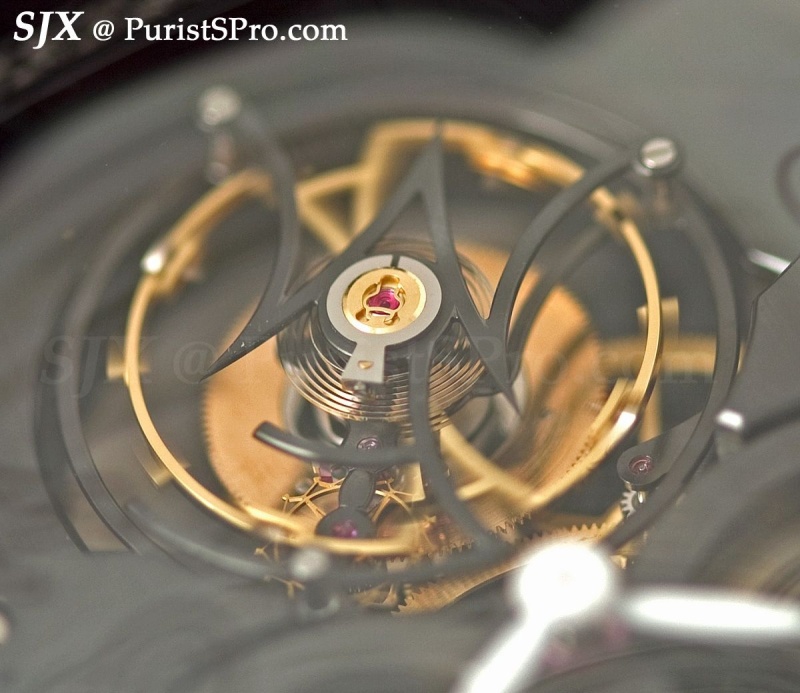
Or am I just fooled by the special spoke design?
Thanks,
Magnus
beautiful Watches
*** SIHH 2011: Girard Perregaux ***
Girard Perregaux presented a fairly small collection this year with all the models being variants of existing models or calibres. As usual the highlights were variations of the GP tourbillon with Three Gold Bridges.
Several new models in the slim, round Vintage 1966 series were unveiled. The first couple are variants of existing models. The chronograph in white gold is now available with a blue dial.

The Vintage 1966 calendar now has a black dial.

And the Vintage 1966 Perpetual Calendar which was actually launched in late 2010 in rose or white gold.

The next is the Vintage 1966 Small Second, available in white or rose gold with a white Grand Feu enamel dial.

An entirely new model in this range is the 1966 Tourbillon. Featuring a tourbillon with a single gold bridge, this one takes after vintage is inspired by vintage pocket watches; notice the hand-engraved case back and domed dial. And it’s limited to 50 pieces in rose gold.


The Three Gold Bridges tourbillon with straight bridges is now available in white gold, and for the first time with an open back, in both the round President and Vintage 1945 case. This is not new but the Three Gold Bridges tourbillon still retains its charm.


The Vintage 1945 case is now available in XXL size of 35 by 36 mm. Available in rose gold or steel, though only the steel version is available with very retro looking applied numerals.


Ladies too can now enjoy the Vintage 1945 in a smaller, elongated case with either an automatic or quartz movement. The automatic is a small, 8 ¾ ’’’ in-house calibre.


Also for the ladies is a new Cat’s Eye Small Second, in white or rose gold with white or blue mother of pearl dial.


And saving the most interesting for last: the ww.tc is now available with a champlevé enamel dial, but turn it over and you see the Three Gold Bridges tourbillon. Notably, GP makes its enamel dials in-house. These will be made to order with any continent specified by the client.


- SJX
This message has been edited by SJX on 2011-01-30 07:32:43 This message has been edited by AnthonyTsai on 2011-01-30 16:17:48 This message has been edited by Dje on 2011-01-31 11:17:25*** SIHH 2011: Greubel Forsey ***
Greubel Forsey showed two new models this year, the Invention Piece 2 and the Double Tourbillon 30° Technique. As is tradition at GF, both are enormously complex watches that are finished to the highest standard throughout. I especially like the stunning frosted finish GF uses to great effect in its watches – the bevelled edges of the frosted bridges are exquisite.


Both the new watches for 2011 are moving away from the original classical GF designs and more towards the distinctive, slightly steampunk look that has now come to characterise GF. Even though both watches share very little common design elements, both are unmistakeably GF creations.
The Double Tourbillon 30° Technique is a double tourbillon – one cage inclined at 30° making one rotation a minute inside another making one rotation every four minutes.

This is a large, hefty and impressive watch with an open space that has been filled with wheels, bridges, gears and screws. Though this is less complicated than the Invention Piece 2 it actually looks more complex due to the design. This was presented last year in rose gold, and this year sees it in platinum.


Taking it a step further is the Invention Piece 2 which is based on the Quadruple Tourbillon though not identical as one of the tourbillons is repositioned.


As the name implies it features a pair of double tourbillons linked by a spherical differential. Each of these tourbillons is like that of the Double Tourbillon 30°: a one minute tourbillon inclined at 30° inside another carriage making one rotation every four minutes. The spherical differential linking the pair of tourbillons ensures each has its own delivery of power and also shows the average time of the two tourbillons.


A few years back I wondered how a brand that makes only tourbillons, and at a tremendously high price, could survive. With its innovative approach and tremendously fine finishing, GF has proven me wrong.
- SJX
This message has been edited by SJX on 2011-01-30 07:39:58 This message has been edited by AnthonyTsai on 2011-01-30 16:18:04*** SIHH 2011: IWC ***
IWC presented a small range this year, with majority of the new models being the revamped Portofino range. For the longest time the Portofino was almost an afterthought but now it has turned serious.
The flagship of the new Portofino line is the Hand-Wound Eight Days. Featuring a new in-house calibre based on the cal. 5000 8 day automatic, this 46 mm watch is practical minded and displays the power reserve and date.


Its size and shape remind me of the classic ref. 5251 moon phase though this is clearly a watch from a different era.
Also new is the Portofino Dual Time. Like the 8 days Portofino this too is large at 45 mm and similarly useful with a second time zone function and date. The movement is automatic with a three day power reserve.


Both this and the 8 day hand-wind are available in steel or rose gold, and are both fitted with beautifully antiqued straps lined in orange provided by shoemaker Santoni. This is not something one would normally associate with a technical brand like IWC but Georges Kern is a snappy dresser so it’s not difficult to imagine why this came about. And given the Portofino line is meant to evoke images of Italy, these Santoni straps suit the ideal.


The rest of the Portofino family has been updated though they remain similar to their predecessors. The Portofino chronograph is now 42 mm while the Portofino automatic is 40 mm. Both are available with silver or black dials but the chronograph is only in steel while the automatic is also available in rose gold.


Notably both are available on a Milanese mesh bracelet. Unlike the mesh bracelets widely sold online which often have substandard clasps, these bracelets are fitted with suitably high quality and appropriate looking clasps.


The rest of the collection on the other hand is now new but has undergone numerous minor tweaks mainly in terms of subdial colour.
The Ingenieur chronograph for instance now has subdials in the same colour as the dial, instead of contrasting colours as before.


Similarly the Portuguese Hand-Wound has matching seconds dial.


Ditto for the Aquatimer models.


The change of the subdial colours to match the dial give the watches a much more muted and serious look. It works well for the Portuguese but less so for the Aquatimer in my view.
- SJX
This message has been edited by SJX on 2011-01-30 07:48:35 This message has been edited by AnthonyTsai on 2011-01-30 16:18:17 This message has been edited by SJX on 2011-01-31 07:35:34Sorry mate...another disappointing year IMHO for IWC lovers like me
The regig of the Portofino is such a obvious marketing department job that you can literally smell them trying to inject a dose of Dolce Vita that is actually smacking of Artificiosa Vita.
Comeon IWC, reinvent the wheel if you have to, stop mucking around. Espcially when you have a chance like this to reinvent the Portofino range, and instead you reused calibers from existing range...it will just cannibalized your own sales from other range!! And where is the original vision of the sweet life? Go learn something from Vespa, who has revamped their vision of Dolce Vita
At least the Ingeniuer looks good with the slight dial change, and the Portugese still looks handsome and evergreen.
Best, and sighs,
Horo