
Omega Constellations - the famous 100,000
Hi All - here's a question for those far more experienced than me (Desmond please!!).
We know from "A Journey Through Time" (page 199) that Omega submitted 100,000 calibres (5xx) for chronometer testing between 5th October 1964 and 10th Feb 1966 and that they all past with merit - a feat that has never been repeated. These calibres had serial numbers from 24,410,000 to 24,509,999.
OK, I'm with that - I have three of those in my collection. However, doesn't the Omega database itself list 1964 watches as having a serial number 21,xxx,xxx - so why weren't these famous 100,000 marked with a mixture of serials from 21m to 24m?
I understand that you cannot be too exact with serial numbers as there is a +/- 2 year range in reality but I am surprised that in October 1964 they were using 24m serials. Any ideas anyone?
Thanks in advance for any input

Most misunderstand Omega's use of serial numbers
Omega did not, repeat, did not assign serial numbers sequentially.
A sequence of serial numbers were assigned to a calibre for production before manufacture (not for sales and customer service as shipped). Thus, at any point in time, Omega was producing watches from as many different sequences of serial numbers as types of calibres they were producing .
Stated another way, for example, if Omega were only producing 561s (chronometer date), 562s (non-chronometer date), 710 (non-chronometer ultra thin) and 712 (chronometer ultra thin), there would have been Omega calibres being produced from 4 different sequences of serial numbers simultaneously. So, for instance, if the 561/562s were very popular, they might have a sequence of serial numbers much higher than a less popular and less produced calibre. Remember, Omega had been using the sequence of serial numbers for production purposes since the 1890s . . . .
Add to this that I understand Omega produced movements, put them is storage, and then did not use them until later. Thus, a watch produced might not be shipped for several years. This is particularly true for chronometers, which have the additional delay of testing before they can be used.
Perhaps most relevant, is that the Omega serial number charts (supposedly) reflect the first use of a particular series of a million numbers. Some versions of such charts show the most common numbers shipped during a given year, while others include the earliest use of a number as additional data. Omega does not define what the charts are showing very well.
So there is a 16 month time period during which movements were submitted for testing, October 1964 until February 1966. Assume a three month delay for testing and storage before use. Thus the first shipment date of the 24,000,000 numbered watches were unlikely to have been until 1965 or later. The most complete serial number chart I have access to, complied by Ryan Rooney from several sources, is at
It shows the first use of 24 million numbers in 1966. Was it possible Omega had a literal year's worth of chronometer movements in storage so there was a delay of a year from testing until use?
While not directly relevant, within the last year there was an exchange on another watch forum, supposedly confirmed by Omega. As you may know, Omega purchased chronograph movements from Lemania, a sister company (now Manufacture Breguet). Apparently, Omega purchased a supply of calibre 321 movements in 1959, never taking another delivery. Please note I do not know if this is true, but no one immediately contested it.
Omega began using the replacement calibre 861 movements when they ran out of calibre 321. If this tale is true, then Omega stockpiled 10 years worth of calibre 321 movements from Lemania. It suggests that a delay of one year after chronometer testing to begin using chronometer movements is not unreasonable (if the tale is true).
Hope this helps.
Sam
Omega chronometers
Thanks for that Sam,
So, if I understand it correctly, the 100,000 that went through chronometer testing between Oct 64 and Feb 66 could all have been made in 1964 or could have been made during the period Oct 64 to Feb 66 and gone to COSC testing straight from the production line or anything in between??
Best wishes
Made, tested, shipped
Omega doesn't disclose anything about when a watch movement was constructed, and to my knowledge, never has. All you know for sure is that a movement was constructed prior to the shipment date, and if a chronometer, prior to the earlier testing date.
Made:
For the 100,000, they were constructed prior to the date of testing. Exactly when, we don't know. I have never seen discussion of how long after manufacture movements were sent for testing.
Tested:
An independent testing group issued the chronometer certificates with the actual date testing was completed. Recall that chronometer testing takes place on uncased movements, not yet assembled in to a watch. These testing completed dates are the dates Omega is quoting, and ranged from October 1964 to February 1966, if I understand it correctly.
Shipped:
Omega provides, for any watch, an extract from the archives, of the date the watch was shipped from Bienne to the sales agent. If the information in the serial number charts are to be believed, the earliest date a movement with a 24,000,000 serial number (the 100,000 was in this range) was shipped was not until 1966.
Assume this is true, and assume Omega used manufactured and tested movements in serial number order. There was a delay of at least 15 months (October 1964 until January 1966) after testing until the first of the 100,000 were used. The time since actual manufacture would be greater by whatever (unknown) gap there was between manufacture and testing.
Omega's 100,000
Hi Sam,
Thanks for the input. If I understand you correctly, what you are saying is that these movements were probably made well before October 1964 and were shipped en-masse to the testing lab and that it then took until Feb 1966 for the lab to complete the testing of the 100,000 uncased movements. The movements then had to be cased and shipped by Omega. So, actually we have no knowledge of when they were made - they certainly were not made in 1966 as the Omega database suggests - Omega would have just stamped the 24 million serial numbers on the movements prior to testing and probably sometime in 1964 (or maybe even earlier).
I have three of these 100,000 - two are 561s and the other is a 551 - do you know if any other movements were included? I assume that 1964 was too early for 564s.
Again thanks - I appreciate your comments
I need to clarify
"If I understand you correctly, what you are saying is that these movements were probably made well before October 1964 and were shipped en-masse to the testing lab and that it then took until Feb 1966 for the lab to complete the testing of the 100,000 uncased movements. The movements then had to be cased and shipped by Omega. So, actually we have no knowledge of when they were made - they certainly were not made in 1966 as the Omega database suggests - Omega would have just stamped the 24 million serial numbers on the movements prior to testing and probably sometime in 1964 (or maybe even earlier). "
Not exactly. I don't know when ANY Omega watch movements were manufactured, true. However, I doubt that these particular movements were all made "well before" October 1964. I simply don't know and don't have enough information to make an informed speculation.
It seems unreasonable that during the prime of the Swiss watch industry that a testing laboratory would take 15 months to test 100,000 watches . So, that is not what I was saying. Consider that Omega was producing several million watches annually, and a good portion of those were being chronometer tested -- as were a fair number of movements manufactured by others in the watch industry. Rather, I believe Omega sent watches as they were completed in smaller batches and they were tested within a shorter time period. You could be correct, but I believe the remark in Journey Through Time is that certificates were issued throughout the time period .
What I am saying is that:
1) Omega put serial numbers on all watch movements at the time of manufacture, which is unknown and the manufacture date, to my knowledge, never been disclosed to the public on any wide scale.
2) The date of completion of chronometer testing , which is obviously after manufacture, may be known.
3) The date of shipment from Omega to the sales agent and the country of the sales agent is generally available.
We don't know when ANY Omega movement was manufactured. We only know one or both of the two dates above.
I have speculated that if the serial number charts are 100% accurate , it implies that Omega manufactured, tested and stored movements for at least a year prior to use, but I have no idea of any specifics about how much time lay between manufacture and testing.
It appears that the gap from testing to casing and shipment, based on this speculation, was at least 13 months (October 1964, the first testing certificate, until January 1966, the date the first 24,000,000 serial numbers were shipped). I doubt the serial number charts are that accurate, but the point about which I am speculating remains. Omega stored movements for a fairly long time before use, particularly chronometer tested movements.
I have said certain very limited things based on the knowledge available and applying some logic. I have made one speculation based on serial number charts I believe to be less accurate than the speculation implies. I make no claim about any further knowledge of dates of manufacture or periods required for testing.
I need to clarify
"If I understand you correctly, what you are saying is that these movements were probably made well before October 1964 and were shipped en-masse to the testing lab and that it then took until Feb 1966 for the lab to complete the testing of the 100,000 uncased movements. The movements then had to be cased and shipped by Omega. So, actually we have no knowledge of when they were made - they certainly were not made in 1966 as the Omega database suggests - Omega would have just stamped the 24 million serial numbers on the movements prior to testing and probably sometime in 1964 (or maybe even earlier). "
Not exactly. I don't know when ANY Omega watch movements were manufactured, true. However, I doubt that these particular movements were all made "well before" October 1964. I simply don't know and don't have enough information to make an informed speculation.
It seems unreasonable that during the prime of the Swiss watch industry that a testing laboratory would take 15 months to test 100,000 watches . So, that is not what I was saying. Consider that Omega was producing several million watches annually, and a good portion of those were being chronometer tested -- as were a fair number of movements manufactured by others in the watch industry. Rather, I believe Omega sent watches as they were completed in smaller batches and they were tested within a shorter time period. You could be correct, but I believe the remark in Journey Through Time is that certificates were issued throughout the time period .
What I am saying is that:
1) Omega put serial numbers on all watch movements at the time of manufacture, which is unknown and the manufacture date, to my knowledge, never been disclosed to the public on any wide scale.
2) The date of completion of chronometer testing , which is obviously after manufacture, may be known.
3) The date of shipment from Omega to the sales agent and the country of the sales agent is generally available.
We don't know when ANY Omega movement was manufactured. We only know one or both of the two dates above.
I have speculated that if the serial number charts are 100% accurate , it implies that Omega manufactured, tested and stored movements for at least a year prior to use, but I have no idea of any specifics about how much time lay between manufacture and testing.
It appears that the gap from testing to casing and shipment, based on this speculation, was at least 13 months (October 1964, the first testing certificate, until January 1966, the date the first 24,000,000 serial numbers were shipped). I doubt the serial number charts are that accurate, but the point about which I am speculating remains. Omega stored movements for a fairly long time before use, particularly chronometer tested movements.
I have said certain very limited things based on the knowledge available and applying some logic. I have made one speculation based on serial number charts I believe to be less accurate than the speculation implies. I make no claim about any further knowledge of dates of manufacture or periods required for testing.
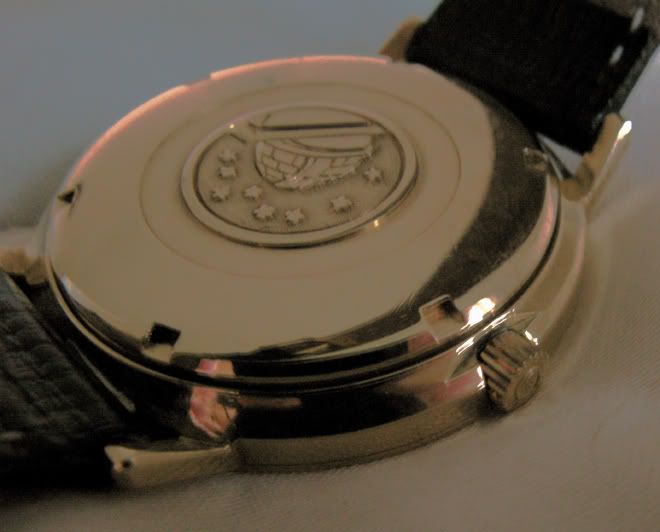
One of my Connies
So, in the case of my gold English-cased Constellation - the case was made by Dennison and hallmarked 'Birmingham' 'Q' (1965), the buckle was made by MWF and hallmarked 'Birmingham' 'R' (1966) and the watch has a serial number of 24,481,xxx (ie one of the famous 100,000).
Therefore, piecing this together - the movement was made probably in 1965 and sent for COSC testing before Feb 1966 (although it may have been made in 1964 and stockpiled). It was then probably stored before being shipped as a bare movement (to avoid import duty?) to England. Dennison's made the case in 1965 (shortly before they went out of business in Feb 1967) and stored it or shipped it to the AD who stored it. In 1966, the AD fitted the movement in the Dennison case and then prior to sale, fitted it with its original strap and with it the gold buckle. Fascinating - I'm going to bore the pants off you aren't I?

BFN
Here are some slightly earlier results.
given that we are talking Omega cal 5xx chronometer certifications, I thought there might be some interest in these results, taken from an earlier 1959 Omega technical guide. Quite remarkable results.

