Comments:


T-dials from my....drawer.
the "interpreters": 5218-201A + 5218-201NM - 5218-207A "Slytech" - PAM001 - 002 - 004 - 009 and 36, not necessarily in that order 


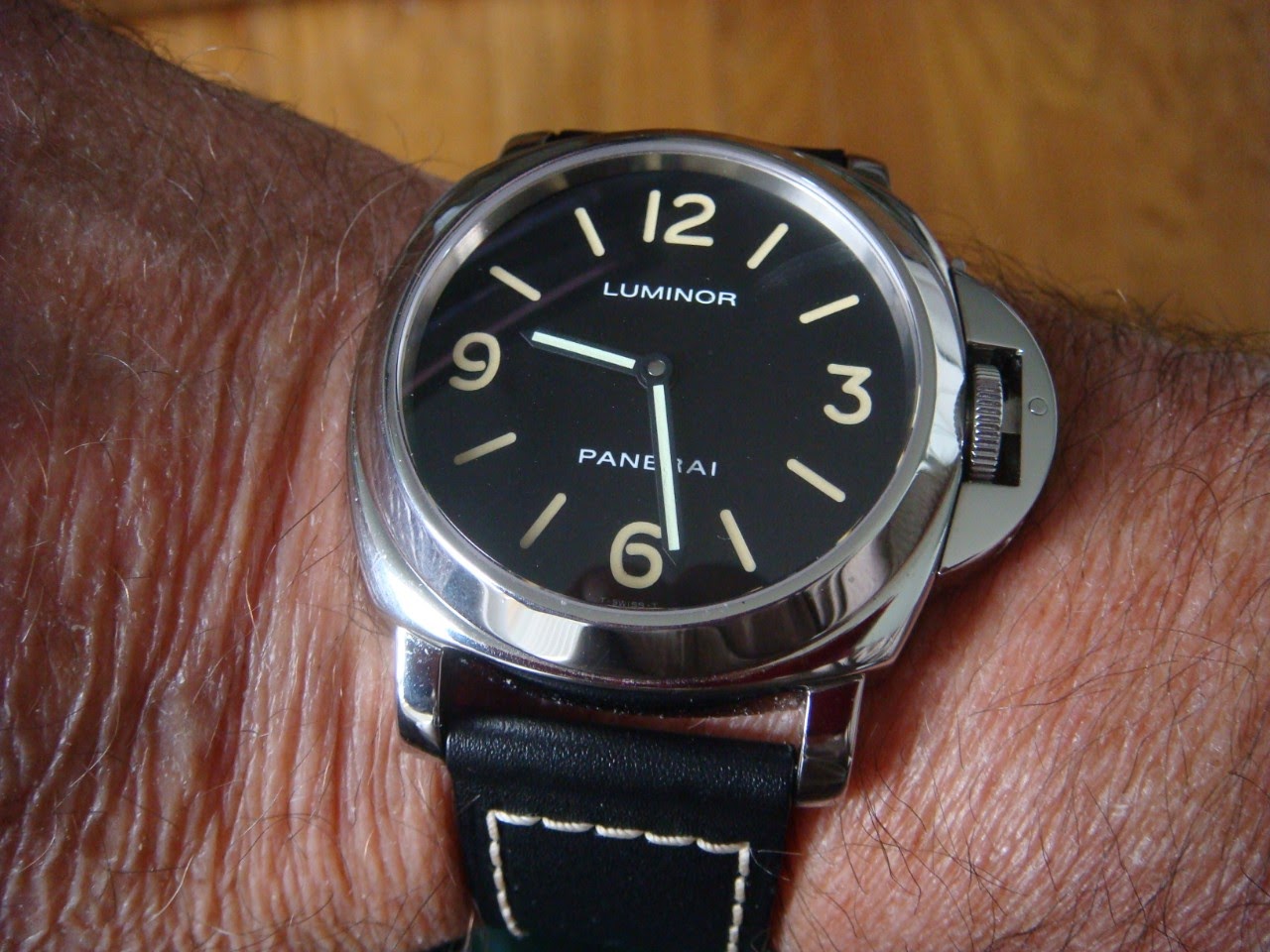


You have good pieces there....
Always wondered the reason why the Tritium of the hands ages differently from the dial. As we have several pieces here , even though they were produced in different years, it's quite obvious the diference . Fabulous dial patina for most of them though...
The difference between the dials and the hands...
has to do with two different manufacturing processes. The hands were industrially manufactured whereby the indices were manually "finished" by Panerai. The tritium was "hand applied/painted" in the grooves in the dial, for the Pre-V and the Pre-A dials. In the A+B models the tritium was inserted in a plastic container (much like a salame) and then applied to the grooves in the dial. The preparation of the tritium mix was done manually creating the "inconsistency" of the mixture and giving way to "oxidation". That's the reason for banning tritium, since tritium is a radio-active material and the exposure to it detrimental to the employees health. Tritium, to be sure, is a low impact radio active material (not like the radium in the original RADIO-MIRS) but still a very harmful material.
Nice reading. very good explanation. This thing with hands vs dial patina does not happen only with Panerai, so probably the members of this forum would love to hear or read this. [nt]
No message body
Tritium still exists and it's still used
if you ever need to re-tritium the dial or hands of your T-dials, you'll discover that, getting the colour "just right" it's not as easy as one thinks lolllll
Great lineup of Panerai Sergio...
Beautiful patina and your straps are a good choice. Perfect 👌
Two of the...
models in the drawer (the 002 and the white one) have custom made Panerai straps with swen-in, original Pre-V-style buckles. I wonder how many know that you can order a custom made strap, in a Panerai boutique
Hi Sergio...
So many great straps available and I’m always impressed by the small artisan makers. Hope that you had a great week.
The 201/A Matching and Non Matching and the 36 are my absolute favorites. Take care of them, my friend. They belong to a bygone era. [nt]
No message body

All the watches have original Panerai straps....
the one on the 009Pre-A it's an OEM, PAV99. I don't remember if it was manufactured by Ormil and Brelli, the two straps suppliers of Panerai at the time. Also, I have asked Panerai what PAV stands for, without any luck, since they also don't have any record. Pre-A models were equipped with PAV straps. BTW the PAV on the 009, if you found one in those prestine conditions, is "indecently" expensive lolllllll