
IWC hammer testing and prototyping the Caliber 5000(the big movt you have) in 1997/8
In theyears when the budgets at the factory went into producing the caliber 5000 series which you now see in your stores.
And I really love this movement for its absolute pursuit of creating a large diameter rotor..into a single barrel...but that's for another story..
One can see the fervour into which the homologation department, a one man show run by Opald...and the team's work with Ranaud and Papi, and Carol Foreistier (way back in 1997), to create a rotor and a suspension system that can take a "reasonable" amount of shock.
Don't forget that the rotor is huge, and the leverage exerted onto the pinion is awesome enough to rip it off the plate.
Hence, you see here, a development, in house, circa 1997, when the suspension arm took on its shape...from a modest solid curve, to a cut and slim curved arm..like a tonearm of an LP player.
Note the silastic insert into the solid gold rim of the weight...this detail is to silence the very slight knock of the rotor against the plates..huge torsional forces make the rotor wobble..microscopically...but attention to detail at IWC in those years were focused to an extreme level to technical excellence.
Enjoy...


The evolution of the arm that holds the rotor took many months of testing by Opald in the basement of the old factory in 1997.
In house shock testing allowed and continues to allow very fine modifications of rotor suspension in this case, and probably in other new designs, very quickly. Discussions can be had immediately after the hammer tests, on the spot, and small changes to the suspension were made...cutting the arm and thining it down.
It just cannot be an exact science..well..at least NOT with the software available in 1997.
Today..a CAD and a simulated design can be done.
However, a caveat...it cannot totall simulate the effect of the lubricants and the effect of assembly (tightness of parts) etc..too many variables.
So..in house tests like these are invaluable if one attempts a REAL new movement like this one, and not a derivative of an existing old one.


See the cut made in the arm?
It allows the arm to "twist" an d bend minutely..very slightly.
Spreading the G forces outwards.


So then..by 1999, an arm that supported the spindle was born!
This allowed the huge rotor to wobble along a new axis, absorbing over 50% of the G forrces that would have ripped the spindle off.
I admired this elegant and simple solution at IWC with Opald in the homologation room, and a team of men..like Denis Zimmerman and his tireless work at the computer with circa 1997 software..solved the problems, and a big rotor was born.
No use of strange metals or alloys needed.
A pure engineering challenge, solved with ingineuity...and on time to release the watch in 2000..no delays...all 2000 pieces.
Look at the detal of the rotor's evolution from 1997 to 1999...


The rare allowances to cosmetics..an engraved rotor.
And the famous gold disc!


Now...to add in a small silastic insert.
At first, there was none. But Gunther Blumlein wore the thing, and didn't like the small and slight "clack" and "clackity" sound, as the rotor wound itself...and so..it was brought back to the homologation lab...and the source of the sound discovered.
And solved.
It is NOT a cheap plastic part! In those days...Blumlein would NOT hear of this..it is a medical grade silastic part. Later..more pics on how parts AGE..even this is tested at IWC..inhouse.

Of course, here you see the work then in 1998, the final rotor is what you get in the stores today.
I look upon the iWC Cal 5 series as a 12 cylinder engine. Big. Tough. Strong.
It may not be "refined" as in an artistic sense...and I wish that more customers would buy the watch as a connoisseur and not as a consumer.
It has great potential to grow as a true movement for big watches, no nonsense, and pure. No gimmicks.
I own and wear both the MBF1 and the Antiqua side by side with this IWC...yes..I may have to wear the watch around another cylindrical part of my body...chuckles. What I eman is that...I am not too biased, I hope, for or against plain simple work..I love the roundabout work of many watch makers too.
Some, it is art. At IWC, it was all very focused on engineering to the extreme ..with an exclusion of art, if it meant compromise to any detail in the movement, and so it was with this calibre.


These here are prototypes ....all tough and tested and even broken.
I promise, if you want, I will post more.


These pictures are copyrighted here at this site, and yes..you won't see any pictures of such detail or history...they're gone!
Here finally, in 2000 is my watch at the far right, in RG next to the final prototype in steel ...see the differences?
Even if you look at your own watch, if it is a cal 5000 or 50011 or whatever 5 series..you will see it is different from mine.
Yours is BETTER. IWC continues to improve on its products...usually in the quiet.
Hmmm...
I don't know if you guys want to see and read all this stuff...if you do..respond to say yes, and I will continue to bring in more details.
Including, if you wish, my visits to many of the sub contractors that do the owrk for IWC and Richard Mille.

This message has been edited by bernard cheong on 2008-01-05 00:39:31 This message has been edited by bernard cheong on 2008-01-05 00:45:03 This message has been edited by bernard cheong on 2008-01-05 01:12:53

Great stuff, thanks Bernard.
IWC's dedication to technical innovation and excellence has always impressed me. One of the first IWC watches I saw was the old Porsche Design Ocean 2000 - that really made me go WOW - which is one of the best diver's watch ever made. I hope IWC continues this tradition, despite being part of a large luxury group and having to meet quarterly targets.
- SJX
Yes..the Porsche 2000 Ocean is one of the Holy Grails
Thank you, Bernard! A fascinating story impeccably
I bought my Cal. 5000 second-hand in early 2001, it was a watch completely apart from my experience at the time.
In the intervening years IWC have done what they promised, improving and elaborating their new movement, and
levering its special assets of toughness, long power reserve, beauty and case-filling size to produce a line of
contemporarily-large sport and dress watches unique in the industry.
Although the years have also brought about improved water resistance, sapphire crystal and a date function, I still
love the 2000's fidelity to the original Portugiesers, with their military-type display, high-domed acrylic crystal and
(in the case of the steel) white-on-black dial. I have always felt that this earliest design was, like your MBF and
Anitgua, of museum quality, not too valuable to wear but rather perfectly placed in history (as Boulez aspired for his
compositions, that in retrospect they would be seen as squarely on the line of historical development).
Thanks again for the eye-opening pictures and explanation, I am pleased but not at all surprised that IWC has
fufilled its commitment to functional design and execution in such spectacular fashion!
Here is my 2000, I admit I have not yet spotted the differences from yours:
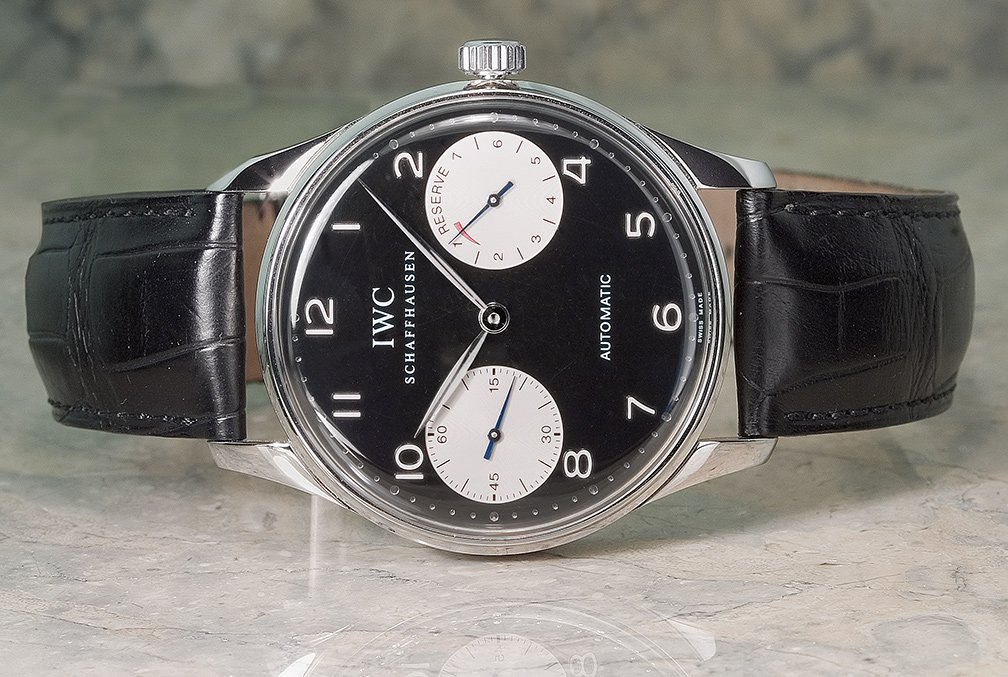
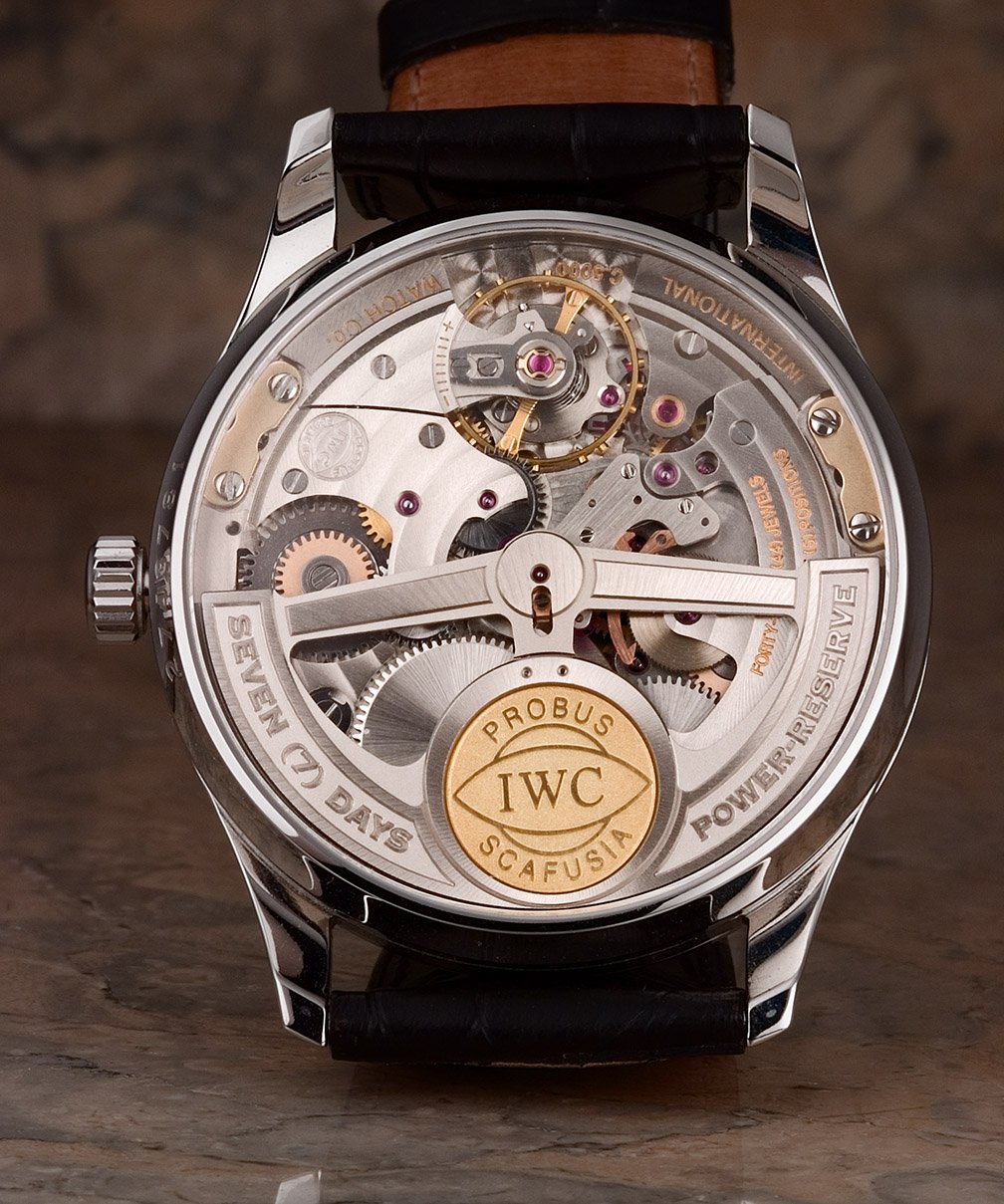
Steve! The difference can be seen in the 2 IWCs..yours is incredible.Here's why..
Dear Steve, it is great to read from you. First...I have always admired your absolutely clean multilayered photography of your watches.
In fact, I have looked at your caliber 5000 and so has Denis and Opald at IWC in 2006. We noticed that you have a model that is the earliest released production species !!!! It is a grand daddy of the cal 5000!!! Look at the plate that is next to your crown..then look at the rg version that I wear...and then at the prototype next to mine...you have a early plate.
I don't know how many were released with this plate.
Many owners of the cal 5000 in the limited early release can go home now and examine them.
I guess, that the US had about 100 or so and the european market another 100 more...I am an early asian owner, probably among the firat 100 as well..but I recieved a second generation plate.
WOW.
I wanted to tell you this 2 years ago...hmmmm...apologies. I really totally forgot.
We may spot more differences.
Thanks so much for the primer on these
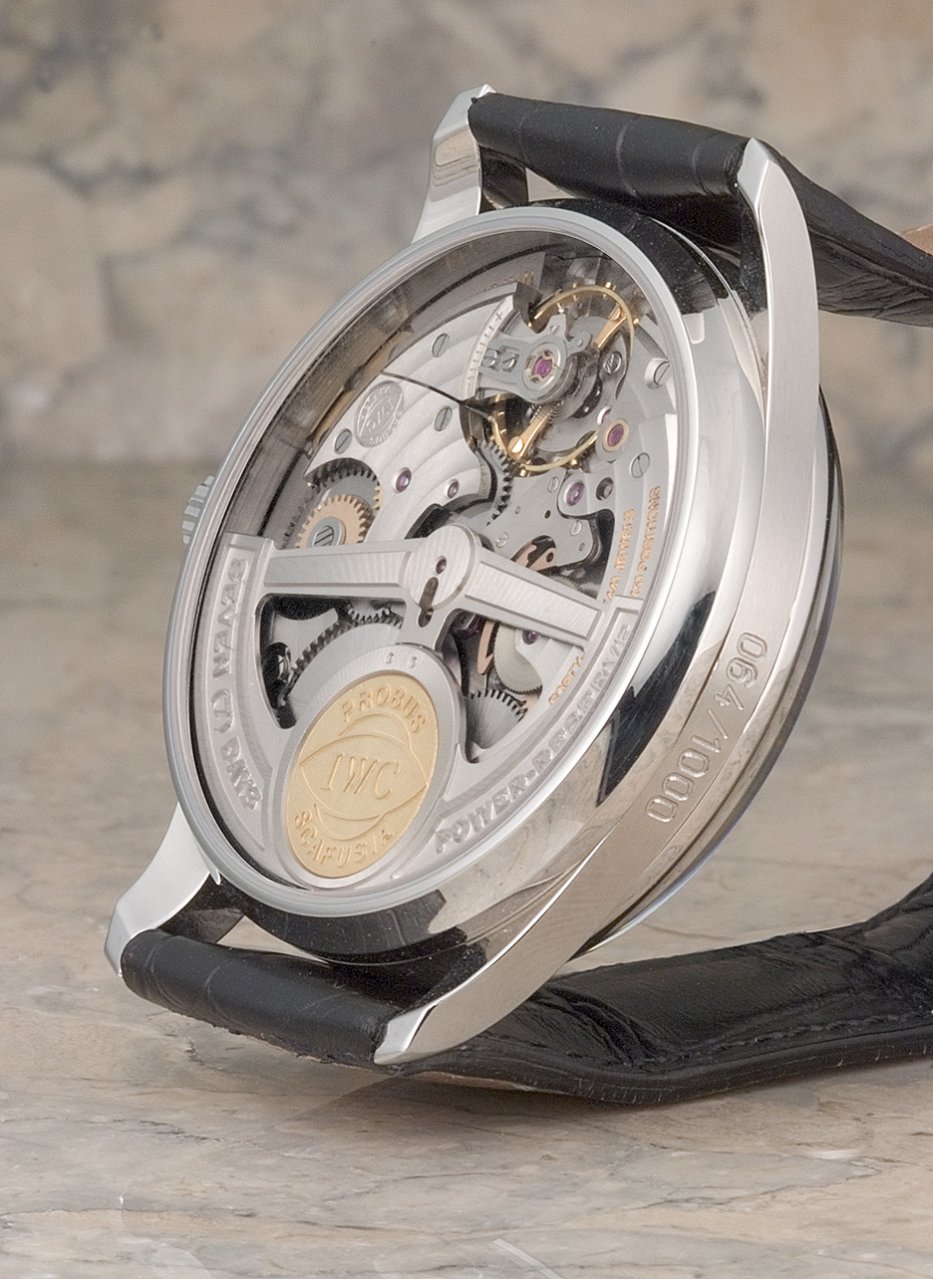
What you say makes good sense because my watch was originally part of a 3-watch set, so it has this
very low issue number:

I am dusting off my camera this year, and will be posting more.

Thanks Bernard for the insight! Any reason why the rotor ...
Is it too heavy due to the the rotor size or the additional 'gold-coin' added?
Kong
This message has been edited by Kong on 2008-01-05 21:22:24
The arm design
Normal rotors are about 12x to 5x lighter, multiply that by the radius of the swing, and you get the torsional forces at the pivot.
So, a flexible arm was thought of by Denis Zimmerman.
The flex allows the rotor to touch the plate..very rarely..but it happens if you flick your wrist very hard.
Clever, and an example of how IWC used to do things then.
Great post Bernard...
The caliber 5000 is one of my all time favorite automatic movements. Your post made me take a second look at my caliber 50010. I’m very interested to read more. Please post more photos and details, thanks!
Cheers,
Vernon
The Cal 5 is one of the "real" ground up inovations
Brillant Post!

Thanks, Bernard and Steve, for this thread . . .

You can watermark
Bernard,
Thanks for the history and evolution of this movement...still the only BIG automatic out there.
I don't know if it helps to watermark the photos using the photouploader utility......
Regards,
MTF
Very interesting to see the development
thanks, Bernard - and you have more? Don't hesitate!
Dirk
Resizing the 15megapixel photos now.
I've seen watches being tested like this...
Thank You Bernard
