
A Review of the Tudor Monte Carlo ref. 7159
The Tudor brand has been underestimated by watch collectors for years. Nevertheless, the interest in some of their vintage models has been growing recently. In particular, people realize now how interesting the Monte Carlo chronographs are.
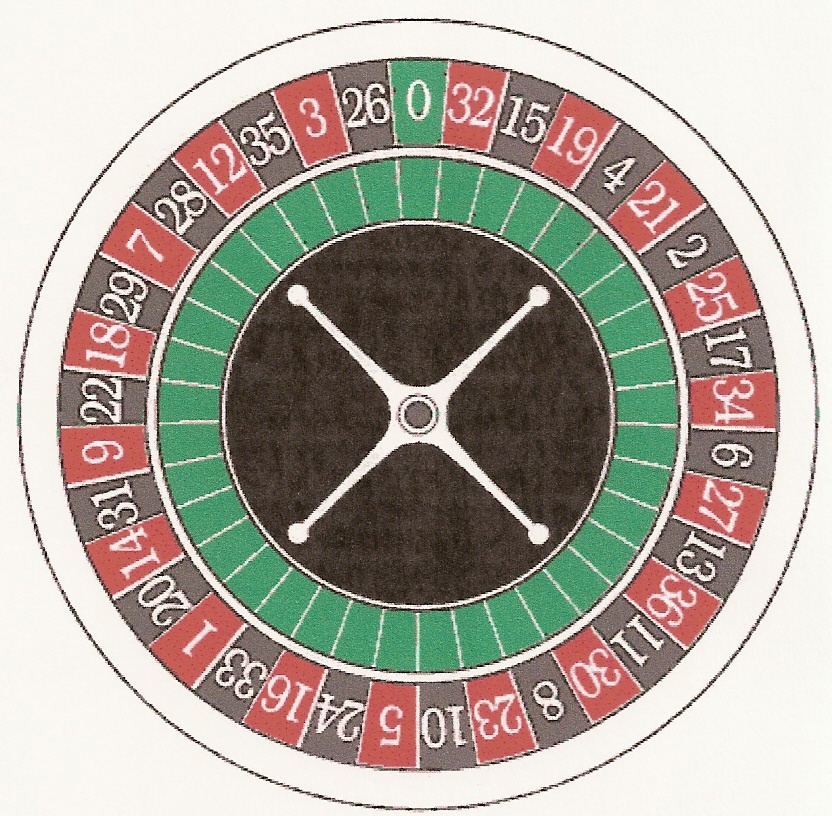
The definition of a Monte Carlo dial is simply a two-tone dial used on early plexi Tudor Chronographs. The Tudor Monte Carlo received this nick name because of the resemblance of the dial to a roulette wheel in the gambling halls in the famous casino:
History
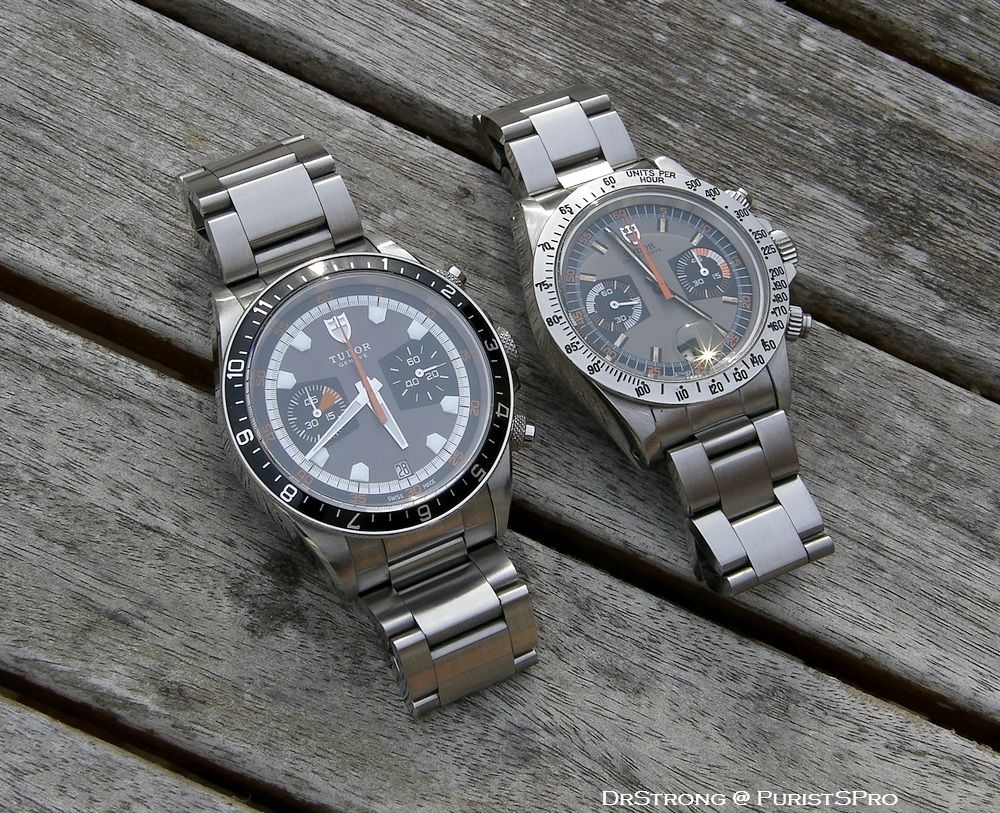
The first Monte Carlo was lauched in 1970 under references 7031 and 7032 depending on the type of bezel: bakelite or a fixed metal. 7033 covers the prototype turnable bezel design seen in the new Monte Carlo re-edition. The dial has the “homeplate shaped” 5 sided lume dots and exists in a black or grey color.
The vintage Tudor 7033 and the 2010 Heritage re-edition
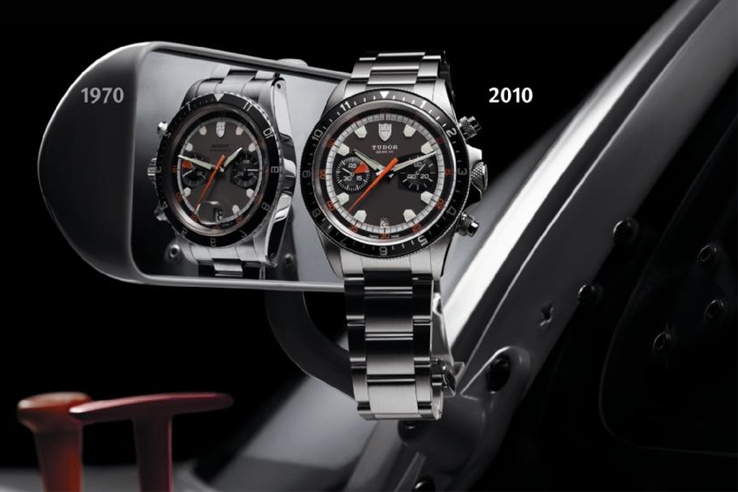
The 2010 Heritage re-edition and the vintage 7159
The watch is powered by a hand wound Valjoux 234 movement which is the Valjoux 23 with the date feature:
Valjoux 234 movement used in the Tudor Monte Carlo
The production of this references was stopped in 1972, so we can guess that the homeplate is a very rare watch.
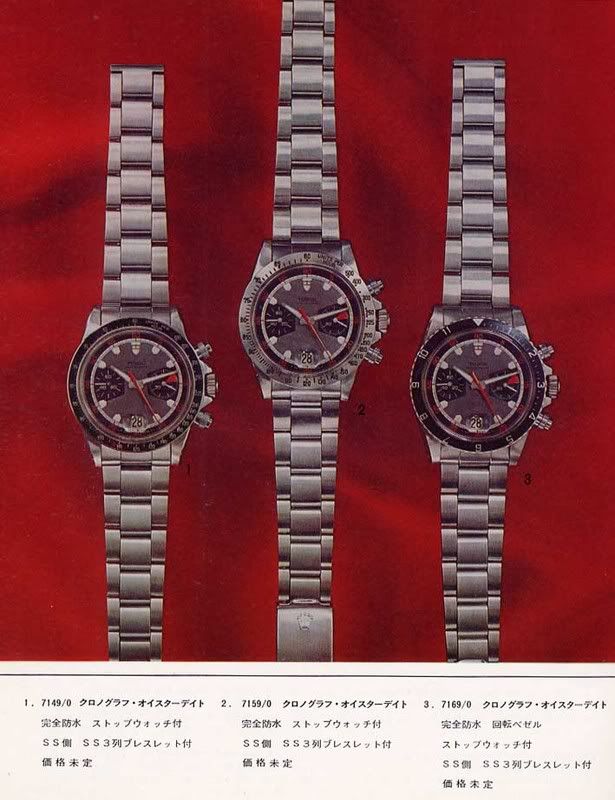
From approx 1973, the next generation of the two registers arrived in 3 flavours:
- 7149/0 Bakelite bezel. Blue or Black dial
- 7159/0 Fixed bezel. Usually black/grey dial.
- 7169/0 Turnable bezel design. Black or Blue dial
Again, these watches were only produces over a very short time period and we can guess that the production numbers are much lower than the Rolex Cosmograph for example.
The Watch in Detail
My watch is a 7159/0. It is characterized by a massive 39mm case with a brushed finish metal bezel.

The winding crown and pushers are identical to the Rolex Cosmograph of the same era, but the watch is larger:
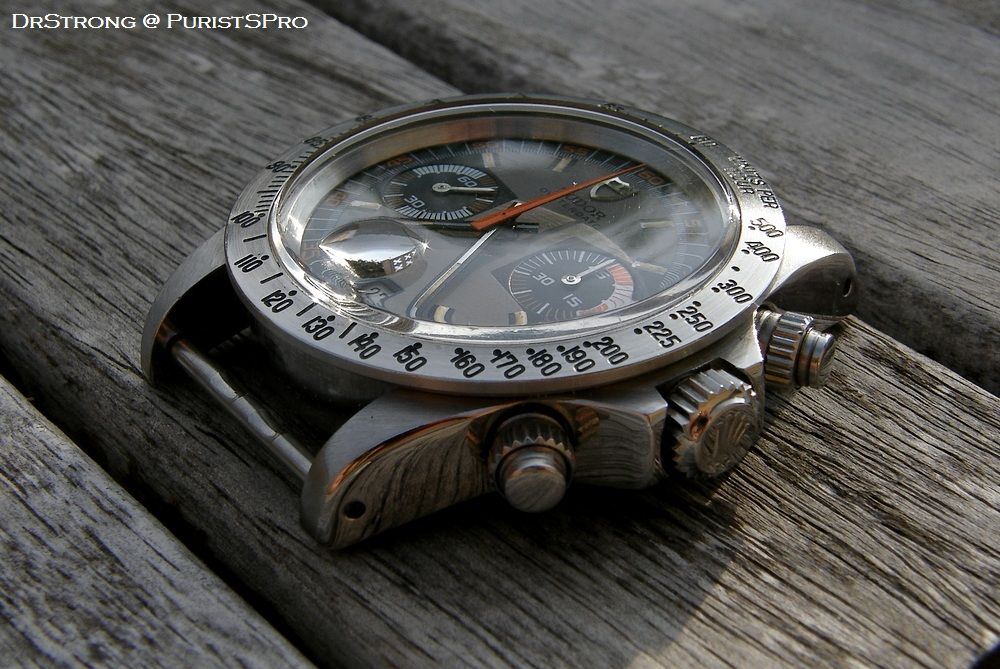
The thick crown guards surrounding the winding crown add to the character and bulkiness of the case:


The cyclop on the plexi is usually seen at three o clock on the Submariner to magnify the date. It is located at six o clock on this watch and to my eyes it gives a lot of vintage charm to the piece. It also sort of balances the dial, which has the metal shield on top and the two subdials on each side.
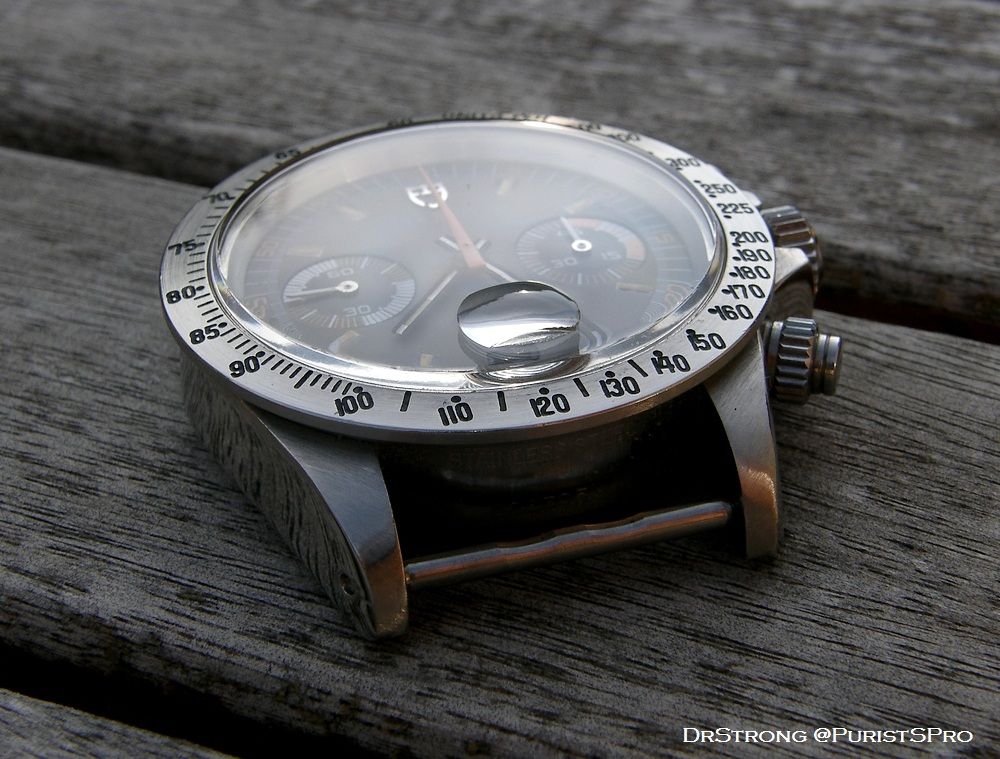
The flat caseback has the specific “Tudor by Rolex” engraving:

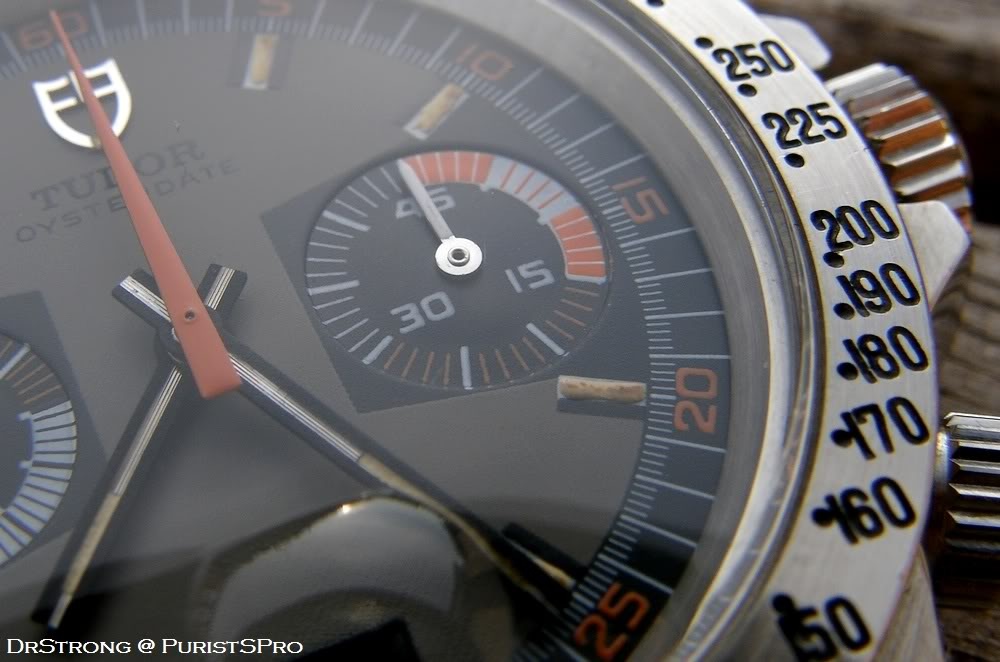
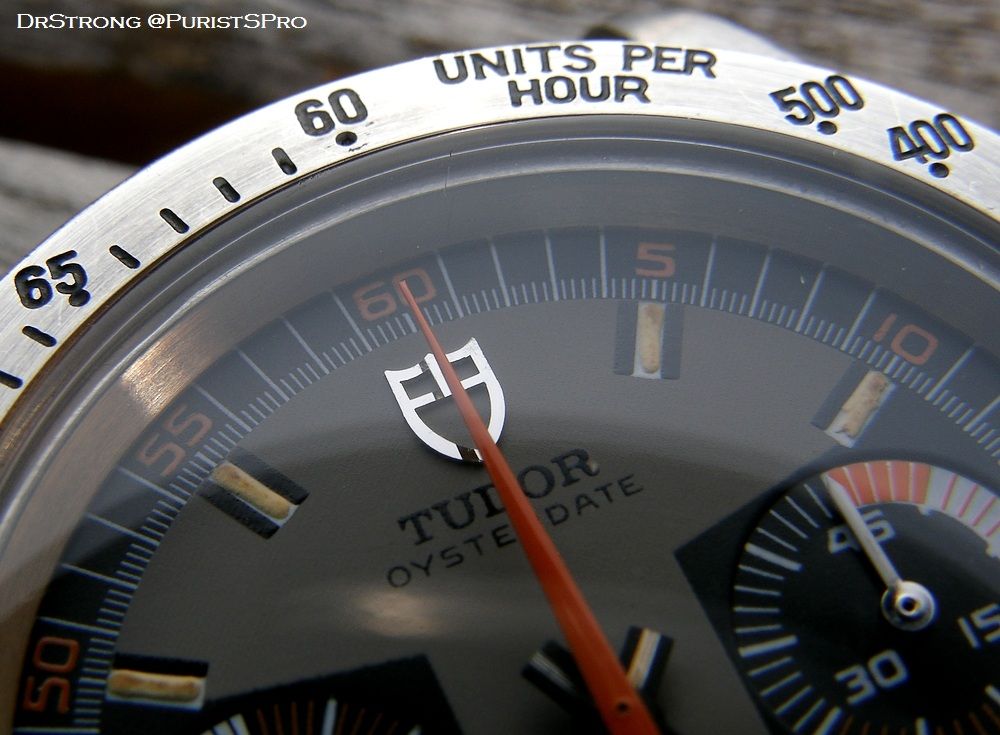
The dial is very colourful and has a lot of nice 1970’s details to look at. This is the main difference between the Tudor Monte Carlo and the Rolex Cosmograph, which had a much more classical and conventional design.

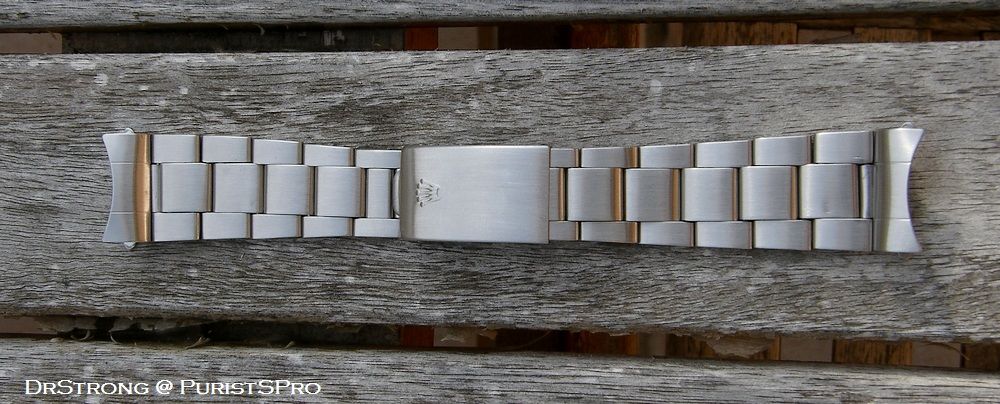
The bracelet is a folded Rolex Oyster ref. 7836, that is also used on the Rolex GMT master.
Documents
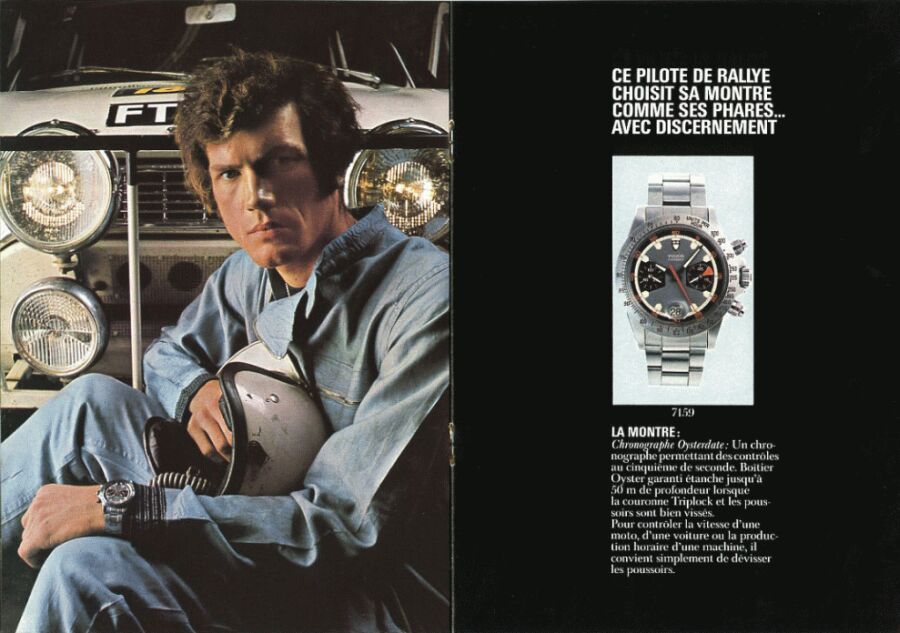
Here are some original brochures showing some Monte Carlo models. Their design prove that these watches were aimed at a younger clientele than the Rolex models.
I can feel a real sense of humor here….do you feel it too ?
Acknowledgements: Morgan King, Aakviper

Clealry an underestimated watch.
Thanks for the great post, I feel I learned a lot about this watch that I did not know and now have a better comprehension of the brand.
Best regards,
George

A great seventies watch!

Thanks for the review!
F


Jeff...something special about the MC

I would say that the MC has a racing look, Baron. More than the Dayto, I think; [nt]

Tudor Question
Long before I became a watch fanatic, I worked in NYC and would, on occasion, visit Tourneau to get some jewelry, change a watch battery (quartz...eeek!!) or get my wife a birthday or anniversary present (my wife bought me my first decent watch -- a steel-gold Ebel chronograph -- in 1993). Whenever I would have time to stare at watches, I would inevitably (as an uninitiated non-WIS) stare at the Rolex watches (since any non-WIS knows that Rolex is the creme-de-la-creme in watches and that singularly unattainable holy grail...LOL!).
Now back then, I was often told or led to believe by their sales people that if I couldn't afford a Rolex I could always get their "cheaper, lower cost" alternative, which was held out to be Tudor. Ever since then, I never really took Tudor seriously.
So my questions: Is Tudor just a bargain-priced low-cost alternative to Rolex or does it have its own horological merit? Who owns Tudor?
Tudor was owned by Rolex...
I'm not sure about their current situation.
It was kind of a "low cost" Rolex, with the same cases but less sophisticated movements.
They have experimented very cool and creative designs over the years.
Some have a very interesting military history.

According to Ebay, Tudor is Owned by Rolex...
"In 1905 Wilsdorf set up his own company in England and began producing high quality watches. It was in 1908 that he began the Rolex brand. He ran the business in England for about fifteen years and then moved to Geneva in 1920.
"Hans Wilsdorf first opened Tudor watches in 1946. The brand name Tudor was chosen because Wilsdorf wanted to pay tribute to the Tudor period of England.
"The most important difference between Rolex and Tudor was already inherent in the 1940's when the first Tudor Oyster reached the market: Inside the screwed-in Oyster case, there was not a Rolex manufactured movement, but a movement supplied by Ebauches SA, ETA. The Rolex company still places value today on the fact that the modified automatic calibers by ETA are "especially made for Tudor."
"The best sales argument for Tudor was always their direct connection to Rolex. Conceived right from the beginning as the "second" brand, Tudor is more moderately priced than its bigger, more famous brother. Genuine Tudor watches are sold through official Rolex retailers but are currently not available in the United States. It continues to be sold in Europe, Asia and Canada."

Thanks Jeff
Thanks for this splendid post. I still wonder why people think that having Tudor in a collection is not a good thing. Fortunately, you're here to prove otherwise. So informative.
Guillaume
Interesting review, Jeff.
I must confess that I'm more and more interested by this Chrono.
Which one? One like yours seems to be a good compromise, while the Ref 7032 is my first choice.
SS bezel, in all cases, please, for me.
Mechanically speaking, it is not inferior o the Rolex from the same era, and it has a more " racing " look.
More " Seventies ", too, compared to the more timeless look of the Daytona.
The only thing I prefer on the Dayto is the lack of the date, but, on the MC, it is cleverly located at 6.
Yes, a very nice and interesting watch, to collect and enjoy!
Best,
Nicolas.
Nice review
I must say, this watch opened my eyes even more so to the tudor.
I liked it so much i tried it on my wrist during my last purchase but decided to go with another watch instead.
It is a very sporty without being so loud IMO.
cheers


Fantastic review Thanks
Thanks for a great review Jeff.
Bill

I always come back to this review of the Rolex Tudor 7159
Bill
This is a very interesting watch, and not only for aesthetical reasons.
Time for me to prepare something, on this one...

Best,
Nicolas
