
Tick Talk
[Moderator Emeritus]
2359

Best of The Hour Lounge: Skeletonizing

Skeletonizing at its most basic is, according to The Illustrated Professional Dictionary of Horology, taking a watch and rendering the case and various parts of the movement transparent, enabling the underlying parts to be seen. Frankly, this seems a woeful description for the astonishing levels to which haute horlogerie has taken the art of skeletonizing.
The Foundation de la Haute Horlogerie informs us the concept sprang from the mind of André Charles Caron sometime between 1720 and 1760 when this Parisian horologist, also renowned as clockmaker to Louis XV and master of Jean-Antoine Lépine, first pierced the bridges and plates of his watches to allow a view of the mechanical motion occurring beneath.

In one of the earliest articles found at The Hour Lounge, Alex Ghobti narrated the story of skeletonizing, or "openwork" as they've dubbed it, at Vacheron Constantin circa 2007:
"Skeletonizing a watch movement into a piece of scintillating metal tracery demands exceptional deftness and precision, generating considerable added value in the process. Scrupulous observation of a series of mandatory steps is vital to the successful production of that delicate combination of airy transparency and delicate lacework that mark Vacheron Constantin's skeleton pieces.
The process begins with the drilling of holes in the bridges, bars and mainplate on a jig boring machine, preluding more elaborate machining sequences. Following a precise cutting plan, the various workpieces are subject to a slow electro-discharge process according to a predefined pattern in order to remove part of the metal. In fact, these components lose up to half of their initial volume in the course of the skeletonizing process.

Now machines yield to craftsmen. First they need to check that the components have not been deformed in the cutting process, then their job is to embellish everything the eye can see. The surface of every previously pierced and machined part is methodically touched up, circular grained then painstakingly bevelled by hand.


These components are then sent for engraving. Vacheron Constantin is one of the very few manufacturers with an inhouse engraver; 25 year old Jeanne Ulrich who joined the brand two and a half years ago after completing a 4 year course in engraving. "Sensitivity, rigor and exactitude in striving to attain perfection are the qualities which make a good engraver" says Jeanne Ulrich.

The engraving process begins with the "cementing" of the component to be engraved; this consists of firmly fixing it on a previously heated wax type material which solidifies once cooled. The piece is then placed on a rotating bowl shaped tool enabling the engraver to hold the component in the desired position.

"It is as difficult to work on a time only movement as it is on a tourbillon or minute repeater because of the small surfaces and thin components" says Ulrich. The main difficulty resides in the type of metal worked on, gold is a regular metal and easier to work with than maillchort (German silver) which has an irregular surface and hardness.
Once the components engraved (a single rotor can take up to half a day!), it is uncemented and bathed in different solutions to clean them of particles.


The watchmaker in charge of the watch now takes over, further refining the work and adding various finishing touches: the sink, or concave chamfer around each hole (in which the jewels are fitted) receive their final polishing with a diamond-tipped tool. The mainplate, bridges and bars, mainspring barrel and hour wheel are then plated (either rhodium or red gold as for the new Patrimony Traditionnelle Perpetual Calendar)."
1924
Vacheron & Constantin's first skeleton watch. Calibre RA 17''', rock crystal case circled in platinum with sapphires. Photo reference 2479-81.

1925
Skeleton movement produced for American market under Merimont brand, Calibre 16''' 14/12.


1920s through 1930s


1929, Verger Frères
Twelve skeleton clock movements produced with double going-barrel and constant force remontoire d'égalité with spiral spring, straight-line lever escapement. Only five clocks are known to be completed; three between 1932 and 33, and two cased in 1990s.


1953

Merimont skeletonized calibre in pink gold from 1925
1960

1978

Calibre 1003 SQ in 14K yellow gold
1964
Vacheron & Constantin's first skeleton wrist watch. 9''' Calibre based on 1003.

1977
Calibre 1003 SQ (Squelette) used from early 1970s in serial production of skeleton watches.

1982
Vacheron Constantin's skeleton version of 1120 automatic calibre. Reference 13012.

Christies image
1984
Reference 33058.

1984
Reference 43032 Perpetual Calendar.

1990s
Reference 47102 Chronograph.

1991
Reference 30051 double-barrel tourbillon.


Paul Boutros images
1994
Reference 30030 minute repeater.


Deniz images
1990s
Saltarello with jump hour complication and Audubon LE with cloisonné enamel dials.

Saltarello

Audubon
Audubon
Examples from current collection of 2007. Malte Openwork with Calibre 1120.
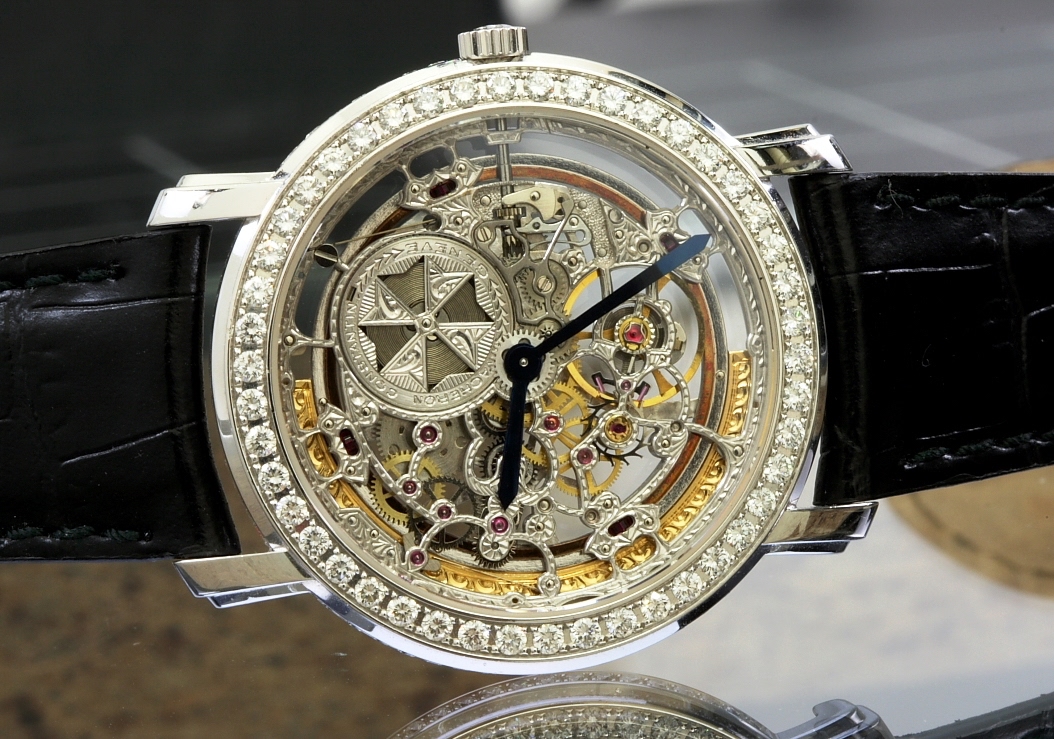

Malte Openwork Small Model with Calibre 1003.


Malte Openwork Tourbillon with Calibre 1790.


LE in twenty pieces for Turkish market, engraved with arabesques inspired by Saint Sophia Cathedral, Istanbul.

Métiers d'Art $20 Openwork with Calibre 1003.


Cabinotiers Openwork Minute Repeater Calibre 1755. Introduced in 2006.


Patrimony Traditionnelle Openwork Perpetual Calendar with Calibre 1120 QPSQ and Geneva Hallmark. Decoration by Jeanne Ulrich, inspired by the Eiffel Tower.


References
- The Delicate Art of Skeletonizing by Alex Gohtbi, Vacheron Constantin Community and Social Media Manager, as published on The Hour Lounge internet forum 10 Dec 2007
- The World of Vacheron Constantin Genève by Carole Lambelet and Lorette Coen, Editions Scriptar SA/Vacheron Constantin 1992
- Treasures of Vacheron Constantin, Éditions Hazan 2011
All photos credit Vacheron Constantin unless otherwise noted.
💰210 Marketplace Listings for Vacheron Constantin›Vacheron Constantin Patrimony · 1 for sale · 1219 discussions›

New Release
WHL surveys Vacheron Constantin's SIHH 2010 novelties. Discover new Patrimony models, platinum cases, slate grey dials, and high complications.
6 replies5473 views

New Release
Explore Vacheron Constantin's SIHH 2012 novelties: Malte collection updates, Patrimony Tourbillon, and Métiers d'Art Les Univers Infinis. Geneva Hallmark details.
19 replies7543 views

Vintage
Explore Vacheron Constantin's historic repeater watches, including rare references like the 4261, in this curated article from 'The Hour Lounge' archives.
21 replies5990 views

New Release
Discover the Vacheron Constantin Malte Tourbillon Collection Excellence Platine, a limited 50-piece edition in 950 platinum with Calibre 2795 and Hallmark of Geneva.
3 replies954 views

Review
Review Vacheron Constantin's 2012 novelties: Malte Tourbillon, Patrimony Traditionnelle 14-day Tourbillon, and Overseas Chronograph blue dial.
6 replies2355 views

Manufacture
Blomman Mr Blue reviews Vacheron Constantin's Caliber 2755, Overseas Chronograph, and Patrimony Perpetual Calendar from a Stockholm event.
27 replies6589 views

Manufacture
Vacheron Constantin hosted events at Madison Avenue Watch Week, showcasing 2012 collections and discussing vintage timepiece value with experts.
1 replies1191 views
Best of The Hour Lounge: Skeletonizing
Skeletonizing at its most basic is, according to The Illustrated Professional Dictionary of Horology, taking a watch and rendering the case and various parts of the movement transparent, enabling the underlying parts to be seen. Frankly, this seems a woef...

Wow! Awesome well researched article!
One of the definitive guides about skeletonization! Amazing. I need to read it again! Great job!

Thanks as usual for a superb, scholarly-level article Dean! I recently acquired a hand-engraved watch from another “historic” manufacture….and I can truly attest to the absolute beauty of this art, to an extent I wasn’t even expecting to discover!
The most surprising piece of information you shared is the remarkably young age of the artist working for Vacheron — it would be lovely to see some of her production in person👍Cheers.

great post Dean
I didn't know all these models. I like this vacheron ref 33058 de 1984 Do you have more info on this one, i.e. size. Variations in different metals? Best, Patrick ...
Alas, I only have the one image
and nothing further on this reference :-( Its size can be appreciated by knowing the movement is 9 lignes or just over 20mm.


Thank you for this amazing tour.
In the present world of horology, many are still drawn by hype, the craftsmanship has been ignored.

Once again, thanks for adding context to the history of VC, in this case, the skeletons.
I thought I had seen most of the variations of VC skeletons over the years, but today I learned of a new one. However, is it a reference 30051, instead of 30021? That's what came up on Google when looking at more pics of this! What a beautiful watch. VC i...
Well spotted :-)
You are absolutely right! 30021 was a monumental piece of itself but not a double-barrel tourbillon. I will correct the original THL article and this one accordingly.

Wow... truly amazing post,.....
Beautiful watches, thanks for the in depth history lesson!

1994 Pièce Unique
This pocket watch is coming up at auction early in the New Year and, while certainly OTT, deserves to be included here. Tourbillon Squelette in platinum with diamonds and rubies, made in 1994. Photos courtesy Arcturial ...