Dje
7532

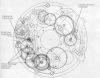
Duometre a Chronographe movement pic and full press release.
Here is coming what many of you are waiting,
a full size picture of the new Duometre a Chronographe calibre 380.
This is what I may call a nice point of
view. Don't hesitate to click on the pic to get a full screen pic.

Here is also
the full length press release issued by Jaeger-LeCoultre:
Duometre
a Chronographe
The chronograph
reinvented by Jaeger-LeCoultre.
Acclaimed recent
accomplishments such as the Gyrotourbillon I, the Master Minute Repeater and
the Reverso Grande Complication a triptyque – the world's most
complicated wristwatch – have borne eloquent testimony to the technical
inventiveness of Jaeger-LeCoultre, setting the seal on its extraordinary renown
within the highly selective field of Haute Horlogerie complications.
This year, the
Manufacture maintains this intensive pace of innovations with the unveiling of
a new collection, the Duometre, and the presentation of
the first model in the line, the Duometre a Chronographe. The latter's distinctive styling and unprecedented technical features clearly place it in the most exclusive echelons of watchmaking fine art. This genuine micromechanical revolution houses a new-generation Calibre 380, nicknamed "Dual-Wing". Two independent mechanisms respectively serve to drive the time display and an additional function, while a single shared regulating organ ensures chronometer-worthy operating precision without having to renounce the use of a complication. As the first representative of the new lineage, Calibre 380 is the first chronograph mechanism with no coupling-clutch, offering peerless time-measurement precision and read-off to the nearest one-sixth of a second. Housing this movement and endowed with a new case featuring welded lugs and a finely grained dial, the Duometre offers a superlative reinterpretation of a great watchmaking classic.
The
Dual-Wing concept
The new Duometre
line immediately commands attention with its brilliant new movement construction
concept. Two separate watch mechanisms – one for the time display and
another
for an additional complication – are synchronised by a single regulating organ. Each of these mechanisms has its own source of energy and there is no interaction between the two. The
only element they share is the regulating organ that supplies them with the time basis. The first movement to embody this new construction concept is Jaeger-LeCoultre Calibre 380.
It drives time displays with chronometer-like accuracy, as well as a chronograph that is unprecedented in terms of its indications and its precision. One going train is entirely dedicated to the conventional time-display function (hours, minutes, seconds), and the other to the chronograph function, including a one-sixth of a second jumping seconds hand. Each mechanism is powered by its own barrel, ensuring a 50-hour power reserve (50 hours for the time and 50 hours for the chronograph). There is no transfer of energy in either direction. A single crown serves to wind the two barrels: when rotated clockwise, it winds the time; and when turned counter-clockwise, it winds the chronograph. This calibre is housed within the very first chronograph wristwatch to operate without any need for a coupling-clutch to handle the start/stop functions of timing operations. A single push-piece ensures perfect coordination of the five chronograph counters.
The
chronograph reinvented by Jaeger-LeCoultre
The art of measuring and counting off periods of time has always been a source of fascination to humankind. Theoretically speaking, a chronograph mechanism and the layout of a chronograph dial must be extremely accurate and suited to repetitive and continuous use without ever jeopardizing the exactness and precision of the measurement. Nonetheless, by its very nature, a classic chronograph mechanism is directly activated by the seconds wheel and draws the energy required to drive it from the same mainspring as that of the time-display mechanism.
As its name
implies, a coupling-clutch mechanism couples the chronograph mechanism to the
time-display mechanism when starting an operation, and then uncouples it when
the timing operation is stopped. The disc-based vertical coupling-clutch is the
most effective type used today, and it minimises the losses in energy linked to
this mechanism. Nonetheless, it cannot avoid significant variations in the
precision of the watch when running with or without the chronograph in
operation. Differences that may be negligible for measuring short times become
far less so over longer periods of time. Applying the original Dual-Wing
movement concept to the chronograph does away with the need for a
coupling-clutch. The precision of the watch is not influenced by the
chronograph.
The Duometre a
Chronographe may therefore be considered as the first authentic chronometer-precision
complication watch.
The construction principle of the Calibre 380 uses a fascinating horological device to replace the coupling-clutch: the jumping-seconds mechanism. Mounted on the arbor of the escape-wheel, an additional 30-toothed wheel transmits the cadence of the balance to a six-toothed wheel. The latter performs a complete rotation every second, and shows one-sixths of a second via a hand at 6 o'clock. By a reduction process, a kinematic chain enables it to display the chronograph seconds, minutes and hours. A finger-piece activated by the column wheel serves
to stop the jumping-second star in an intermediate position that thus enables the jumpingsecond escape-wheel teeth to move past without touching it. When the chronograph is restarted, the finger-piece is withdrawn, the torque supplied by the chronograph barrel sets the star rotating again, and the latter once again engages with the 30-toothed wheel.
Creating such a simple and yet subtle mechanism within such a diminutive space calls for exceptionally precise components as well as the kind of watchmaking talents that only a Manufacture mastering the full range of watchmaking professions is able to provide. The jumping-seconds mechanism was used for the first time in 19th century pocket-watches. At the time, the jumping-seconds hand was directly activated by the fourth wheel of the watch in order to indicate fractions of a second. For this reason, the jumping-seconds hand kept on running continuously and could not be stopped or reset. Jaeger-LeCoultre watchmakers would not have dreamt of presenting a chronograph worthy of its name without a resettable jumping seconds hand. For the Calibre 380, they therefore developed a system making it possible to reset the jumping-seconds hand at the same time as all the other chronograph counters.
Peerless
readability
Remarkably
beautiful and superbly finished, Jaeger-LeCoultre Calibre 380 features a large balance
wheel (11.5 mg.cm2) beating at a frequency of 21,600 vibrations per hour,
meaning six
vibrations per second. Jaeger-LeCoultre has chosen the appropriate one-sixth of a second fraction not only for the jumping-seconds counter, but also by precisely dividing any seconds
indication into six parts so as to ensure that the central time and chronograph hands can move exactly over a scale with one-sixth of a second markings.
Both
aesthetically and functionally, the Duometre a Chronographe is an exceptionally
designed watch distinguished by absolute clarity and readability – a real
challenge in light of the
complexity of the functions. Two large subdials are arranged symmetrically, one at 10 o'clock with the watch hour and minute hands, and another at 2 o'clock with the chronograph hour
and minute hands. An aperture in the chronograph subdial reveals a disc indicating the minute units from 0 to 9 and thereby facilitating accurate reading of the times being measured. This
new display, for which a patent has been filed, enables one to visualise at a glance the time elapsed in hours and minutes, for example 2 hours and 6 minutes, without needing to carefully
study the position of the minute hand. The dial also carries two power-reserve indicators, one at 7 o'clock for the conventional watch hands and the other at 5 o'clock for the chronograph.
The
jumping-seconds hand which jumps in one-sixth of a second increments is
cleverly positioned at 6 o'clock, below and between the watch and
chronograph subdials. In order to handle this vast array of indications, the
team of designers headed by Janek Deleskiewicz have allocated a colour code to
the various functions. The hands linked to the standard time function and
indicating the minutes, seconds and power-reserve are gold-plated or
rhodium-plated, depending on the version; whereas those for the chronograph
hours and minutes, the numerals on the minute-disc, the chronograph seconds and
the jumping-seconds hands are in blued steel. This distinctive colour coding
ensures instant reading of the time and of chronograph measurements at any
given moment, even when the indications are in operation. The complex nature of
the watch is easily mastered when starting, stopping or resetting the chronograph
mechanism. Each time the single pushpiece located at 2 o'clock is
activated, it operates in the exact same start-stop-reset, start-stop-reset
sequence. Each press in fact starts, stops and resets all five key functions:
chronograph hour and minute hands, the minute-unit disc, as well as the central
chronograph seconds hand and the jumping-seconds hand. Admiring the intricate
resetting ballet performed by the four chronograph hands and the disc is a
truly fascinating experience.
Exceptional
aesthetics and decoration
Such a
prestigious watch naturally features a superb exterior as well as movement
finishing worthy of the most exceptional Haute Horlogerie creations. The new
case of the Duometre is
distinguished by polished welded lugs and an elegantly satin-brushed caseband. The dials are finely grained and carry the movement or watch number on a dedicated plaque at 6 o'clock. All the slender hands and pointers are exquisitely elegant. Embodying an entirely innovative concept, the Jaeger-LeCoultre 380 'Dual-Wing' movement powering the limited edition of the Duometre a Chronographe may be admired through the sapphire watch crystal. The independent barrels are snailed and bevelled by hand, while the ratchet-wheels are sunray-brushed with engraved and gilded "chronograph" and "hour/minute" indications. The bridges, hand-bevelled with polished sinks, reflect the Dual-Wing concept through taut, straight shapes for the standard watch mechanism, contrasting with arabesque motifs for the chronograph revealing the hearts, hammers, jumper-springs, column wheel and all the intricate workings of this mechanism. This decoration is inspired by the brand's traditional pocket-watches. The going trains are circular satin-brushed with hand-polished sinks. The wheels and pinions, also hand-bevelled or embellished with polished sinks, feature snailed or smoothedoff surfaces. And finally, the flame-blued steel screws underscore the complex nature of this exceptional calibre.
As the first
model in this prestigious lineage, the Duometre a Chronographe watch will be issued
in pink gold and platinum, while an 18-carat yellow gold edition will be
presented in a limited series of 300. The Duometre vividly illustrates
Jaeger-LeCoultre's unassailable position in the highest spheres of
technical watchmaking. Although the watch might look deceptively simple to the
uninitiated, the first Duometre a Chronographe may well prove to embody the
ultimate in chronographs – at least until the appearance of a new
creation destined to take its place in this exceptional lineage.
Duometre a Chronographe: technical specifications
Movement:
• Mechanical manually-wound, Jaeger-LeCoultre Calibre 380, crafted and decorated by hand
• 21,600 vibrations per hour
• Two independent barrels, each with a 50-hour power reserve
• Approximately 390 parts
• 48 jewels
• 6.85 mm thick
• ø 33.70 mm (15 lines)
Functions:
• central hours, minutes and seconds, power reserve
• power reserve
• chronograph: concentric hours and minutes, minute-unit indicator, seconds, jumping seconds
Dial:
• platinum 950: platinum with grained-finish
• yellow gold: eggshell
• pink gold: hand-grained, silver-coloured
Hands:
• hour and minute: leaf-type, brass, gold-plated or rhodium-plated
• chronograph hour and minute: leaf-type, blued steel
• seconds: baton with pear-shaped counterweight, gold-plated, rhodium-plated or blued
• power reserve: baton type, gold-plated, rhodium-plated or blued
Crown:
• 1 crown to start the watch, to wind the watch power-reserve clockwise, to wind the chronograph power reserve counter-clockwise, and to adjust the hours and minutes
• 1 single pushpiece to control the chronograph and jumping seconds; start/stop/reset
Case:
• ø 42 mm in 950 platinum, 18-carat pink gold, 18-carat yellow gold
• welded lugs
• polished and satin-brushed finishing
• cambered sapphire crystals, hardness N°9, glare proofed on front and back
• water-resistant to 50 metres
Straps and
buckle :
• matt grey or matt black or matt chocolate-brown alligator 21/18
• 18 mm double folding clasp in 18-carat gold
References:
• 950 platinum: Q6016490
• 18-carat pink gold: Q6012420
• 18-carat yellow gold, limited series of 300: Q6011420


Duometre a Chronographe movement pic and full press release.

I just do not get it! How can a company that produces something as sublime