
patrick_y
[PuristSPro Moderator]
33533

Hublot Big Bang Ferrari

We have many PuristSPro members with a passion for automobiles, and Ferrari seems to be one of the favorites among all automobile lovers throughout the world. Many members already know that Hublot has recently become the horology partner with Ferrari.
Most PuristSPro members are heavily discerning individuals when it comes to watches and we are usually wary about watch brand and car brand marriages. Some of us have seen uninteresting partnerships in the past and many of us think such partnerships are normally a marketing ploy to add value to one brand or the other. Normally we are right.
However, every now and then, we are approached by something interesting, something that makes car and watch brand partnerships worthwhile. Upon closer examination of the partnership between Ferrari and Hublot I see substance, style, and synergies that really comes out in a unique homogenous product. The watch's design was truly inspired by many parts of the car that the driver interacts with.
The first action one does when wearing a watch is putting it on. Strapping on the watch is a breeze, the watch features the typical Hublot folding/deployant clasp. There are two straps included; an alcantara/rubber strap and a stitched leather strap. The deployant buckle itself features a carbon fiber insert.
As I’m attaching the strap to the watch and closing the clasp, I feel like I’m
buckling in my seat belt. The
little button on the top reminds me of the seat belt release.

The crown sets the date and time and has a Hublot logo and
red rubber dot surrounded by 11 black dots. The red rubber dot points in a specific direction when the
crown is locked and the Hublot logo is perfectly upright when the crown is in
its locked position. This is
another fine detail that Hublot did not overlook, and it helps complement the
perfect aesthetics of the watch.

After setting the watch and twisting the crown into its locked position, it’s kind of like twisting a key. Coincidentally, as I am turning the crown, I do hear an engine turn over close by.

The watch is a chronograph, but here we really see some ingenuity
from Hublot – paddle shifter chronograph buttons! The buttons have firm but fairly smooth actuation and are
actually hinged near the 3 o’clock position next to the crown to simulate
paddle shifting in a Ferrari. I
find this to be a very clever and unique feature! The start/stop “paddle” has a decorative rubber treatment,
where the reset paddle has a Ferrari logo.

With the brake pedal depressed, if you hold the up-shift paddle, the car will
shift from neutral or reverse to 1st gear or start the chronograph.

In addition to a fairly discreet prancing horse at 9 o’clock
the dial features a red 60-minute chronograph counter and a yellow date window,
both at 3 o’clock. The yellow date
window with laser-cut numbers was inspired by the yellow tachometers in Ferrari
automobiles. The dial is
transparent and you can see parts of the engine room inside,
including the chronograph column wheel. The dial has applied even arabic numbers and applied indices for the odd numbers along with
white second markers and red quarter second markers. The numerals, indices, and hands feature an attractive satin finish and the hands are imbued with luminous material. Overall, it’s a complex but good-looking dial. It appears to me that Hublot even used
a similar font used on Ferrari instrument clusters for the numbers to give the
watch a true homogenous extension for the Ferrari car driver.
From the dial, one also gets the first glimpse of the engine room. Hublot employed its in-house manufacture "UNICO" movement under the hood of this watch. This movement features a 60 minute flyback chronograph with column wheel control, date, automatic bi-directional winding, and an impressive 70-hour power reserve.

Looking down at the instrument cluster, one sees the time on the wrist. Looking between the wrists, one sees
the engine revolutions.

The case features a double layered bezel, carbon fiber
accents, screwed construction, and is either primarily executed in titanium or
executed in “Magic Gold.” The
latter is 18K gold that is comprised with a significant percentage of ceramic. This is to give the gold a more subtle
appearance and more importantly improves scratch resistance. Hublot is especially proud of their in-house
material science research in this field and promises to pioneer and create more
exquisite timepieces in specialty materials. The Ferrari watch is the first watch to be offered to the
public by Hublot in Magic Gold.

Limitation for this watch is unfortunately severe. Hublot told me that the production of this watch is very small; only 1000 in titanium and another 500 in the special “Magic Gold” gold material. The watches are definitely garnering a large amount of attention from Ferrari owners, but are also attracting non-owners, aspiring owners, watch lovers, and Ferrari fans due to its clever and unique features. We all know that Ferrari automobiles are difficult to obtain with long waiting lists, perhaps an unofficial saying will soon be “if you thought the car was hard to get, wait until you try to get the watch.”
At the end of the day, Hublot has created a product that doesn’t fall under the same classifications as other Ferrari labeled products. This is not just another re-labeled product, with a Ferrari shield logo to give it a new lease on product-shelf life. It’s a good watch, with a great looking new design, that’s a lot of fun and really pertinent in many ways to the cars made by Ferrari. It was obvious that both parties invested significant time to collaborate on the design of the piece, and when one looks at the watch it really appears as if the watch shares tremendous identity with the Ferrari product. At the end of the day, it is a great fun watch, and isn’t that what both brands, Ferrari and Hublot, are about?

Many thanks to Hublot and Ferrari for taking the time to show me and point out the interesting synergies shared between the two brands.
This message has been edited by patrick_y on 2012-08-26 13:39:01
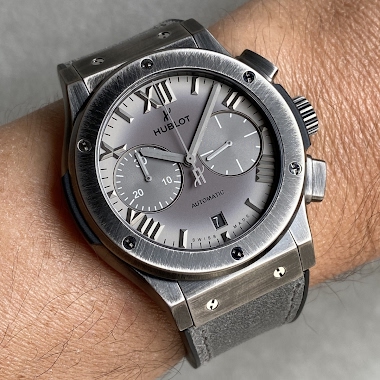


Hublot Big Bang Ferrari

Thanks for the report Patrick. Love the design of the Hublot Ferrari Big Bang!
It's truly a great watch that goes exceptionally well with the car...

Thanks Patrick!
Now I want the car, just so I can have an excuse to wear the watch!

Thanks for the report..
It is a cool design feature...

Thanks a lot for the comprehensive review Patrick!
It was a seductive piece for sure...

I love this report.
Both of us are hoping for the same...
Wow.
Indeed, the skeleton extra thin is a piece of value...
Thanks for the write-up, Patrick!