Kong
[Moderator]
7855

MONACO Twenty Four Concept Chronograph
MONACO Twenty Four Concept Chronograph
The Monaco's iconic image was popolarized by the actor Steven Mcqueen in a racing film with the Porsche 917 driving
scenes. At that time, the official Heuer ambassador was Jo Siffert, a Swiss Le Mans and Formula 1 driver. Mcqueen
wanted to replicate himself as real as possible, right down to the Heuer Chronograph worn by Siffert. Accordingly, it was
the Heuer Chronograph's radicle look which broke the tradition making it standout from the pack.
The name was specially picked too. During 60's, Heuer had a Monte Carlo watch and a new name for the new
avant-garde Chronograph should appeal to a chic, high-end target public who frequent places like Monte Carlo.
Thus the name - 'Monaco', was later chosen.
The revival of the Monaco started in 2003 with the Monaco 69, 2004 with the Monaco V4 the belt-driven concept watch
(which should be released in November to commemorate the Monaco's 40th Anniversary). In 2007, the Monaco 360LS
Concept Chronograph and this year, 2009, the Monaco 24.
The Monaco 24 was covered by Timm Delfs at Basel 2009.
To read his writeup, please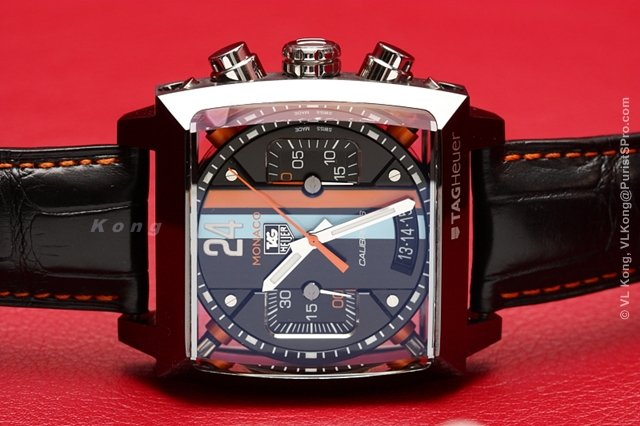
The unique tubular design Monaco 24 concept watch is inspired by the GT racecar technology.
The two-part see-through PVD coated case of 40.5mm consists of a Calibre 36 Movement
(beating at 36,000 beats/hour), a Zenith El Primero, suspended by four “energy manifold”
steel-tube-housing similar to a race-car’s driver’s protective cockpit cage.
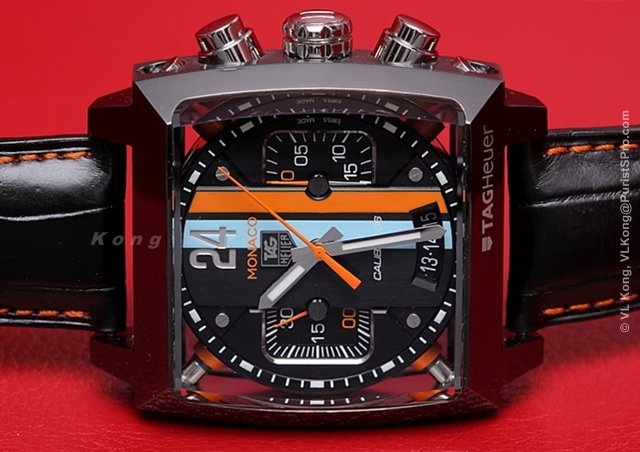
Polished black PVD-coated case with a huge sapphire crystal is to better address the scratching issue.
It seems water-resistant to 100m.
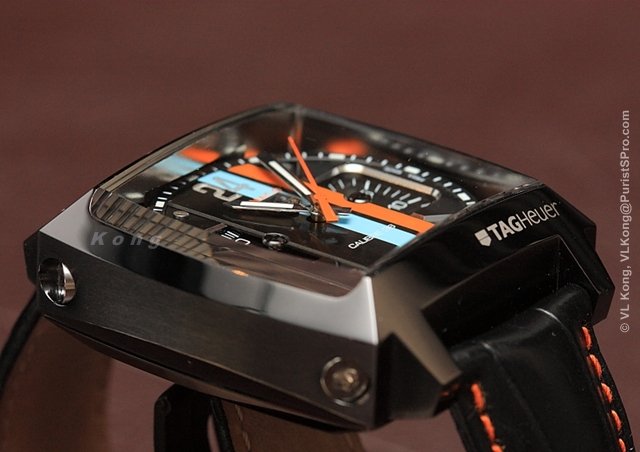
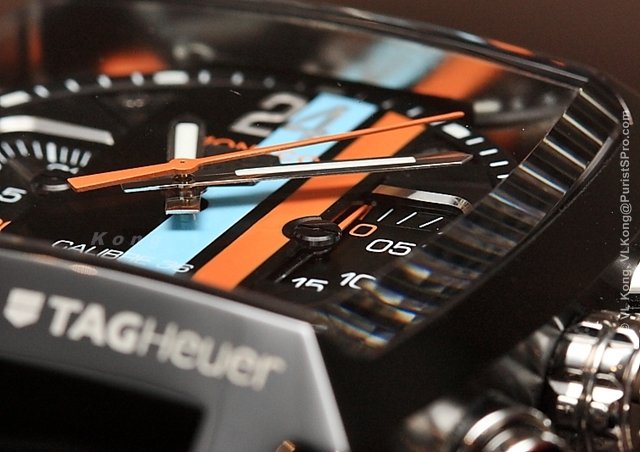
The thick and convex double anti-reflective sapphire crystal for better readability.
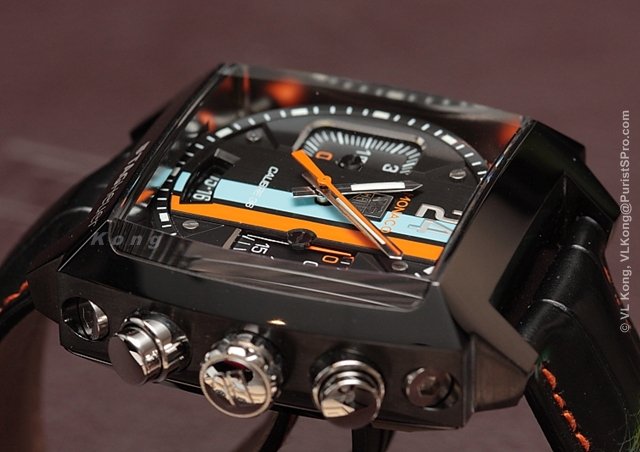
Clear view even from the side or at an angle.
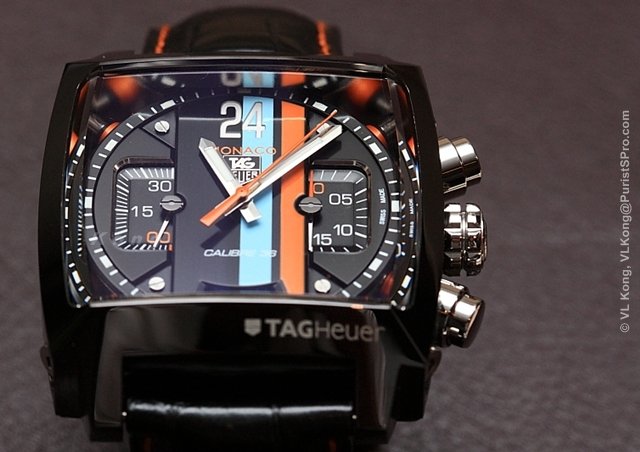
The subdials- at 3'o clock, indicating the chronograph minute while the at 9 o'clock indicating the small second.
The two-part dial’s semi sub-counters at 9 and 3 o’clock have “doubled” hands (coloured orange and white),
the readout will need to do some arithmetic.
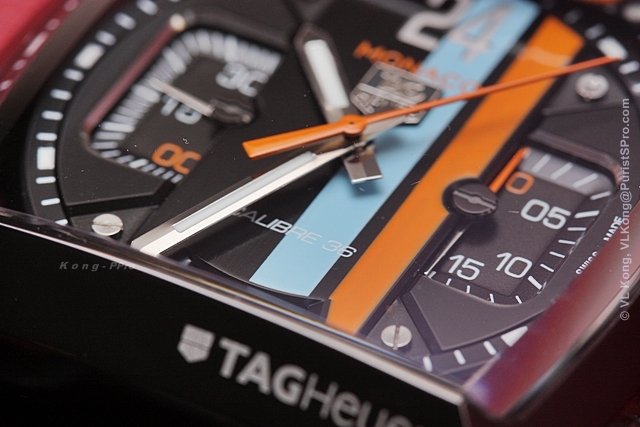
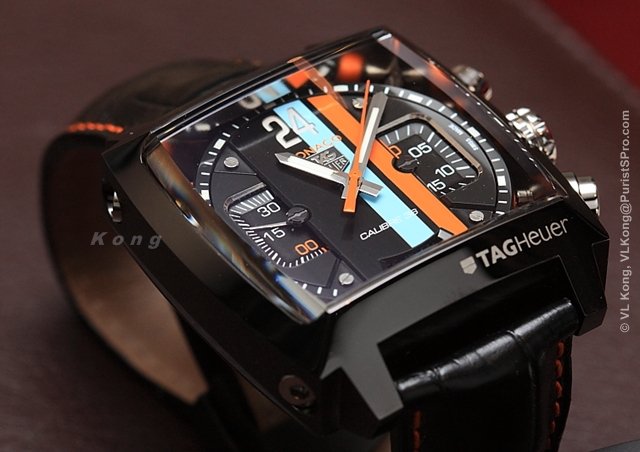
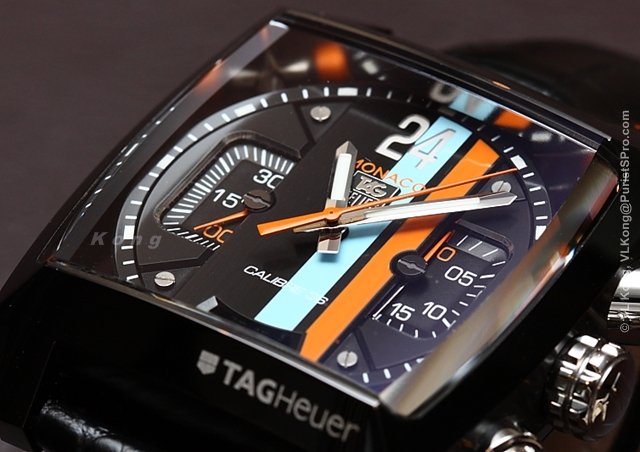
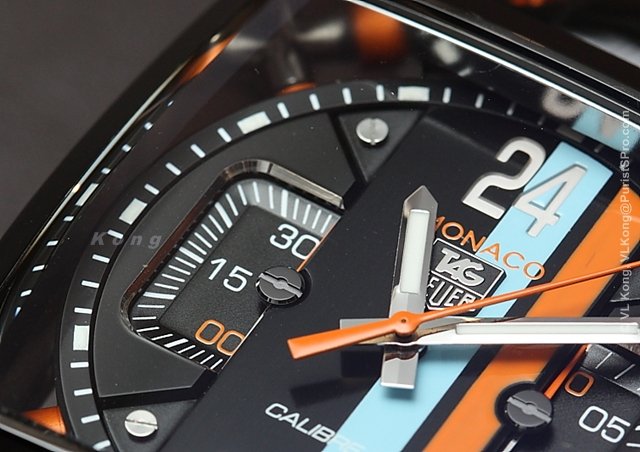
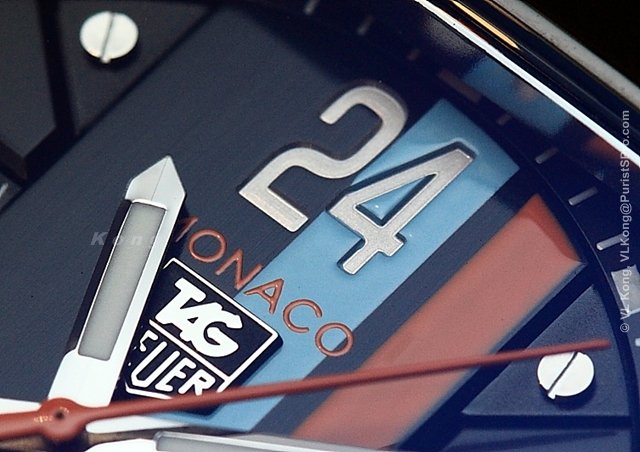
An oversize “24” at 12 o’clock and the emblematic blue and orange of Gulf Oil (the same colours
TAG Heuer Ambassador Steve McQueen wore in his 1970 film classic, Le Mans) , in honour of the 24 of Le Mans.
Note a layer of transparent ink was printed to create a glossy contrast.
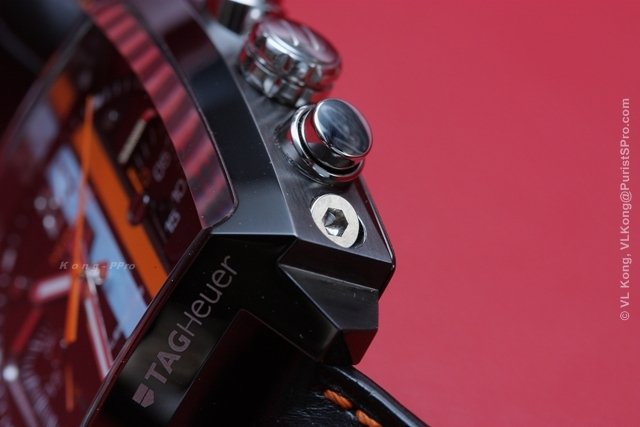
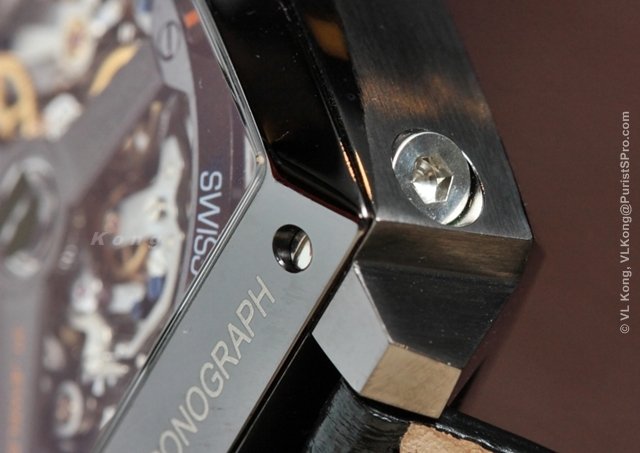
The Allen screw secured the steel-tubing which you later see.
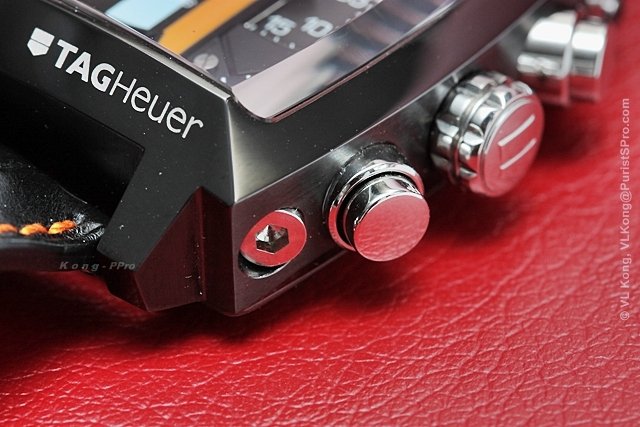
The Lug-design is shorter than the current Monaco casing which is good for smaller wrist.
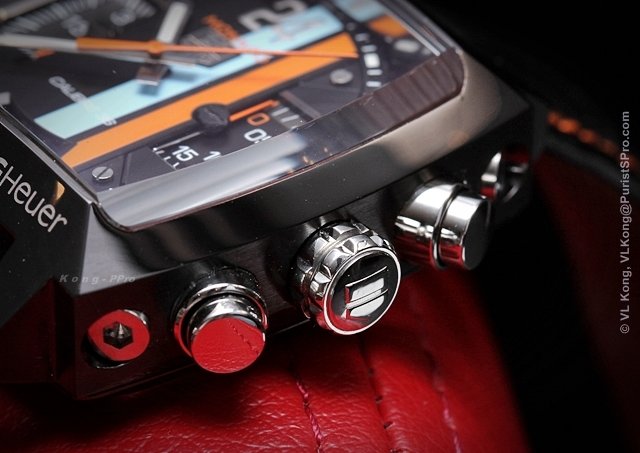
The signed crown and the chronograph pushers.
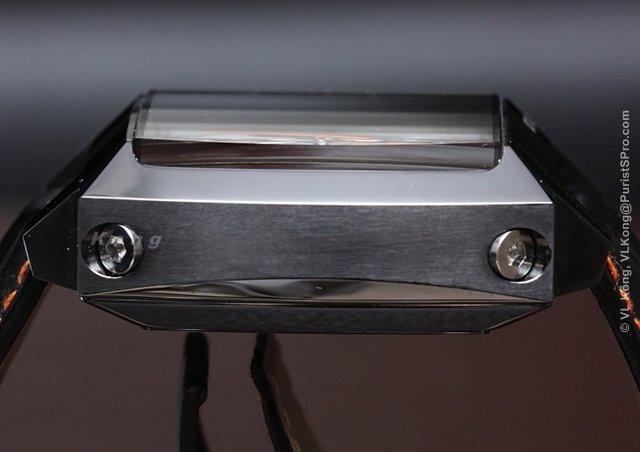
A side view of the case, if you could note the extreme curved and thick sapphire.
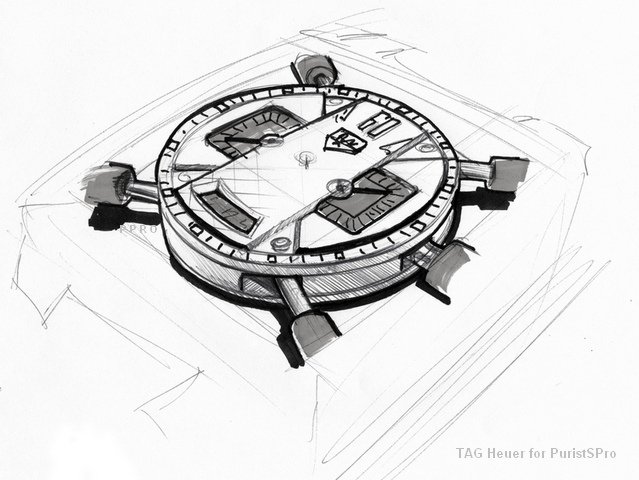
A sketch of the suspended movement.
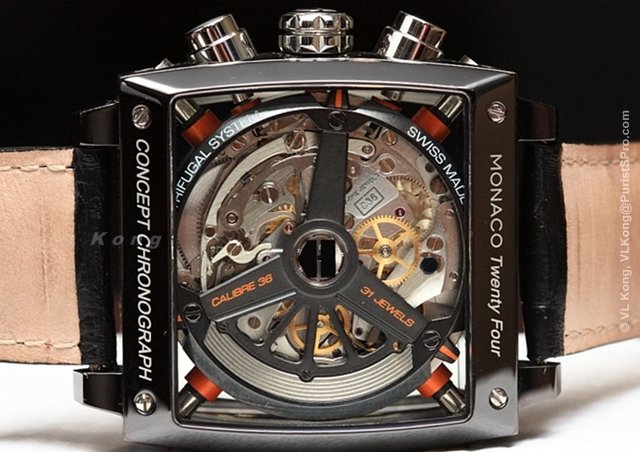
The rotor material is made of high density tungsten, and shaped like a GT car's chrome mag wheel.
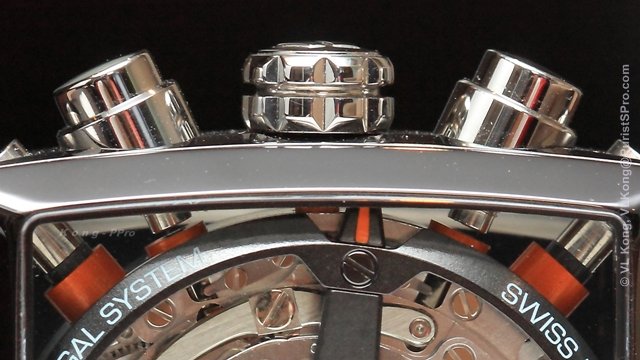
Note the movement is suspended with the help of four steel-tubular arms (which are secured to case with the allen screws).
More importantly, note the black band between the orange and steel tubing. The black band is a
“composite filler” shock-absorbing insulating material used in aerospace and auto racing.
Understand this Advanced Dynamic Absorption System (ADAS), could absorb up to 24,000G,
which is the same as a 20-metre fall.
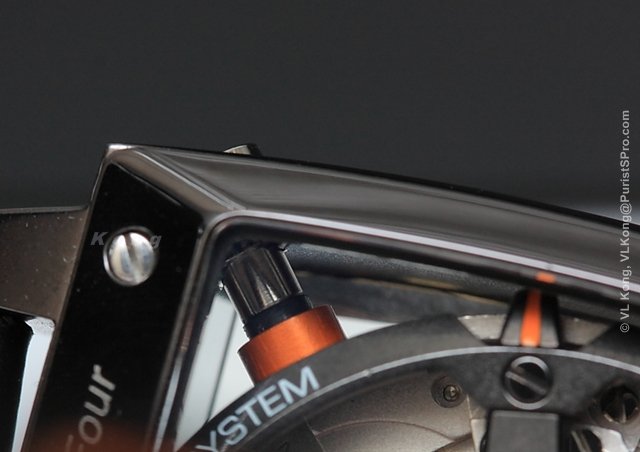
Observe the gaps between the chrono-pushers, while the winding stem is attached to the crown.
A special joint is used attaching the stem to the crown, which allows the crown
to move and isolate it from any vibration from the case.
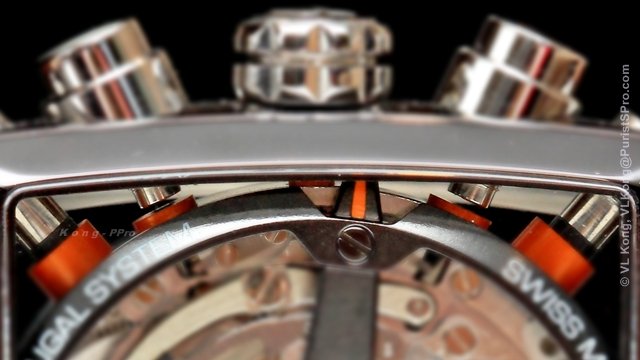
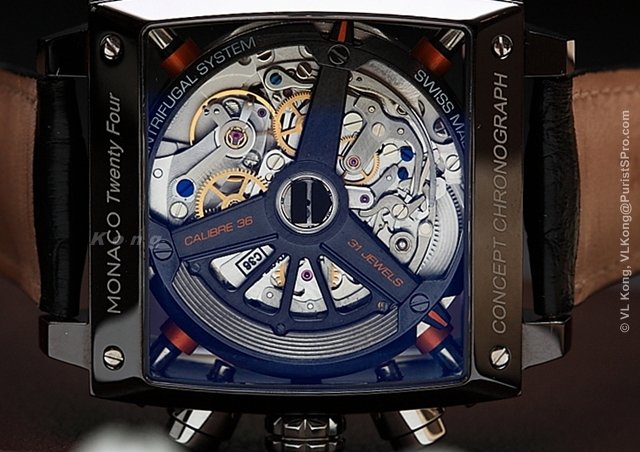
Another view ...
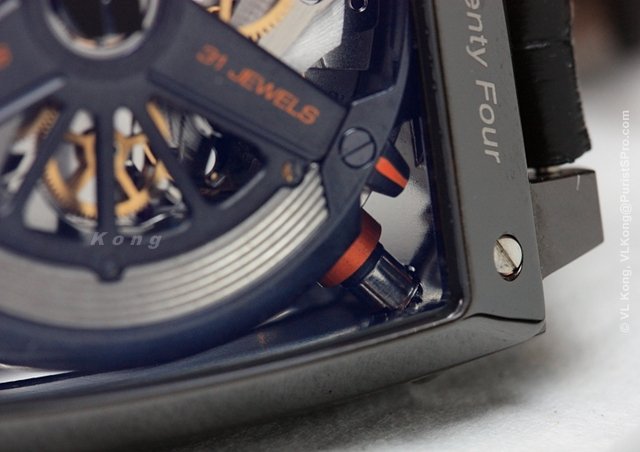
The joining of the tubular arm to the casing after secured by the allen screw.
The Monaco's iconic image was popolarized by the actor Steven Mcqueen in a racing film with the Porsche 917 driving
scenes. At that time, the official Heuer ambassador was Jo Siffert, a Swiss Le Mans and Formula 1 driver. Mcqueen
wanted to replicate himself as real as possible, right down to the Heuer Chronograph worn by Siffert. Accordingly, it was
the Heuer Chronograph's radicle look which broke the tradition making it standout from the pack.
The name was specially picked too. During 60's, Heuer had a Monte Carlo watch and a new name for the new
avant-garde Chronograph should appeal to a chic, high-end target public who frequent places like Monte Carlo.
Thus the name - 'Monaco', was later chosen.
The revival of the Monaco started in 2003 with the Monaco 69, 2004 with the Monaco V4 the belt-driven concept watch
(which should be released in November to commemorate the Monaco's 40th Anniversary). In 2007, the Monaco 360LS
Concept Chronograph and this year, 2009, the Monaco 24.
The Monaco 24 was covered by Timm Delfs at Basel 2009.
To read his writeup, please
The unique tubular design Monaco 24 concept watch is inspired by the GT racecar technology.
The two-part see-through PVD coated case of 40.5mm consists of a Calibre 36 Movement
(beating at 36,000 beats/hour), a Zenith El Primero, suspended by four “energy manifold”
steel-tube-housing similar to a race-car’s driver’s protective cockpit cage.
Polished black PVD-coated case with a huge sapphire crystal is to better address the scratching issue.
It seems water-resistant to 100m.
The thick and convex double anti-reflective sapphire crystal for better readability.
Clear view even from the side or at an angle.
The subdials- at 3'o clock, indicating the chronograph minute while the at 9 o'clock indicating the small second.
The two-part dial’s semi sub-counters at 9 and 3 o’clock have “doubled” hands (coloured orange and white),
the readout will need to do some arithmetic.
An oversize “24” at 12 o’clock and the emblematic blue and orange of Gulf Oil (the same colours
TAG Heuer Ambassador Steve McQueen wore in his 1970 film classic, Le Mans) , in honour of the 24 of Le Mans.
Note a layer of transparent ink was printed to create a glossy contrast.
The Allen screw secured the steel-tubing which you later see.
The Lug-design is shorter than the current Monaco casing which is good for smaller wrist.

The signed crown and the chronograph pushers.
A side view of the case, if you could note the extreme curved and thick sapphire.
A sketch of the suspended movement.
The rotor material is made of high density tungsten, and shaped like a GT car's chrome mag wheel.
Note the movement is suspended with the help of four steel-tubular arms (which are secured to case with the allen screws).
More importantly, note the black band between the orange and steel tubing. The black band is a
“composite filler” shock-absorbing insulating material used in aerospace and auto racing.
Understand this Advanced Dynamic Absorption System (ADAS), could absorb up to 24,000G,
which is the same as a 20-metre fall.
Observe the gaps between the chrono-pushers, while the winding stem is attached to the crown.
A special joint is used attaching the stem to the crown, which allows the crown
to move and isolate it from any vibration from the case.
Another view ...

The joining of the tubular arm to the casing after secured by the allen screw.
-----------------------
This message has been edited by Kong on 2009-07-05 11:41:13

Innovation
Amanico reviews the TAG Heuer Monaco V4, detailing its revolutionary belt-driven movement, design, and the extensive R&D behind this concept watch.
78 replies42095 views

Market
Explore Phillips' inaugural watch auction curated by Aurel Bacs and Livia Russo. Discover rare Patek Philippe and Vacheron Constantin vintage watches.
19 replies7959 views

Automotive
Explore the Omega Speedmaster Grey Side of the Moon PCA Edition, a limited release for Porsche Club of America members. See its unique design and collector reactions.
23 replies5214 views

Vintage
Discover the Bologna vintage watch fair with Dimardi, featuring iconic Rolex Explorer 6350, Daytona 6263, and Vacheron Constantin timepieces.
24 replies4787 views

New Release
Discover the Tag Heuer Monaco Twenty Four Concept Chronograph from Basel 2009. This article explores its innovative design, visible shock absorbers, and homage to Le Mans racing.
6 replies2342 views

Reference Guide
Explore the Patek Philippe 5070 chronograph: an in-depth review, historical context, and collector insights on its movement, design, and place in haute horlogerie.
247 replies226974 views
MONACO Twenty Four Concept Chronograph
MONACO Twenty Four Concept Chronograph The Monaco's iconic image was popolarized by the actor Steven Mcqueen in a racing film with the Porsche 917 driving scenes. At that time, the official Heuer ambassador was Jo Siffert, a Swiss Le Mans and Formula 1 dr...
Pics of MONACO 40th anniversary Re-edition Automatic Chronograph Calibre 11 & Calibre 12
MONACO 40th anniversary Re-edition Automatic Chronograph Calibre 11 Limited to 1000 pieces At this front view, observe the pushers.... they look like the gas pedals! This 'Reissue' is close to the original. One of the key attributes remains - the 'HEUER' ...

Great comprehensive report Kong, thanks very much! These are
some cool and thought provoking watches, need to really study to get the full gravity of what is going on here. Best to all, Tim

I like.....
the Gulf version..... However I am a bit hesitant as to the size, it could have been a bit bigger I would like to see it in metal........ Cheers
Something beautiful for the Ladies : MONACO Watch Lady Grande Date
MONACO Watch Lady Grande Date Black or Brown Python QUARTZ Brown dial with beautiful Brown Python straps Black dial with Black Python straps This is a decent and versatile piece of lady's watch, pretty good mileage (my opinion). It carries well for day of...

Tag Heuer encroaching on Jaeger-LeCoultre territory!
I first saw the advertisement for the Gulf Tag Heuer watch about a month ago and it struck me as odd. Why has Tag Heuer partnered with Gulf Oil, I thought that Jaeger LeCoultre had partnered with Aston Martin who had partnered with Gulf Oil. I think becau...

Superb report, Kong!
I think the Monaco has come a long way and proven that it has a loyal following, too. No doubt I like the the remakes and so on. On the female version, I think I can imagine myself wearing the Lady Grande Date in brown dial and brown python strap. The wat...
Chrono with the current combination would likely to be a winner!
This configuration is quite a looker. Kong

Beautiful....
..but overkill to some extent. McQueen would've wanted it that way, car-wise, suspension and all. The 'petite secondes' and chrono-minutes are not easy to figure out for us engineers who have no idea what math is (except when getting paid and doing our ta...
Funny!
Engineer who does not know how to count Not surprise it may change, as this is a proto. The El Primero is chosen because of its higher frequency, which supposedly to be less susceptible to shock. Kong

Interesting Reading, Kong
Will have to try this one in the flesh, because each time I see one, I'm tempted, and once on the wrist, the temptaton has gone... Curious, but if the 1mmm difference with the re edition is important, it may be a watch to consider. The shock absorber syst...


Very Interesting. great movement, great design, great history
i sort of agree with patrick about the Gulf Oil connection, but they've done a gulf oil tag for a couple of years already havent they? love the 24. i've always loved the original Monaco. thanks Kong Graham
interesting....
the shock impact reminds me of the one utilized by GO on the Sport Evo Impact I would like to see this watch in metal Thanks for posting Cheers
