
Ornatus-Mundi
[Zenith]
7136

Some of my (older) pictures to water your mouth...
are here. Let me start with the large seconds version:
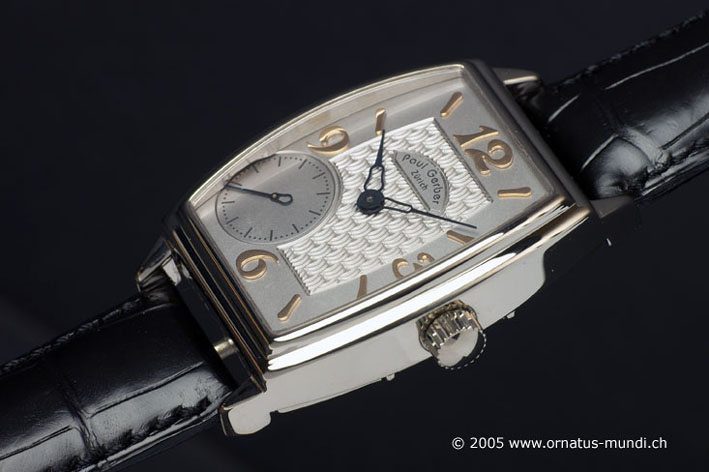


Then, there is the spherical moon-phase watch, here still with the small seconds:
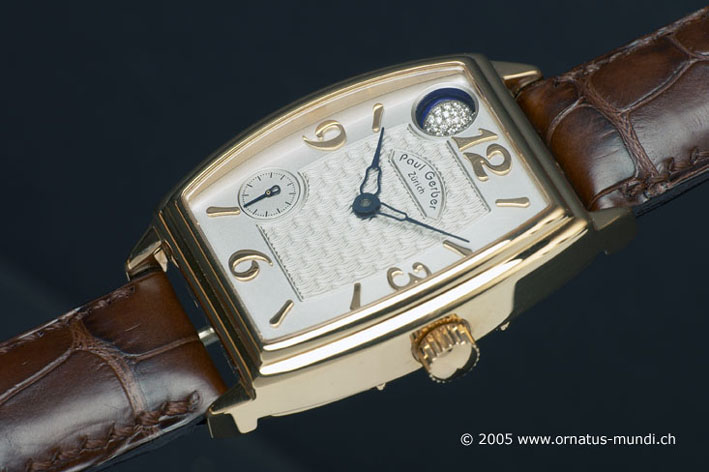


The movement is his very own cal. 33 movement. Note that the wheels are 18kt red gold (a special alloy!):
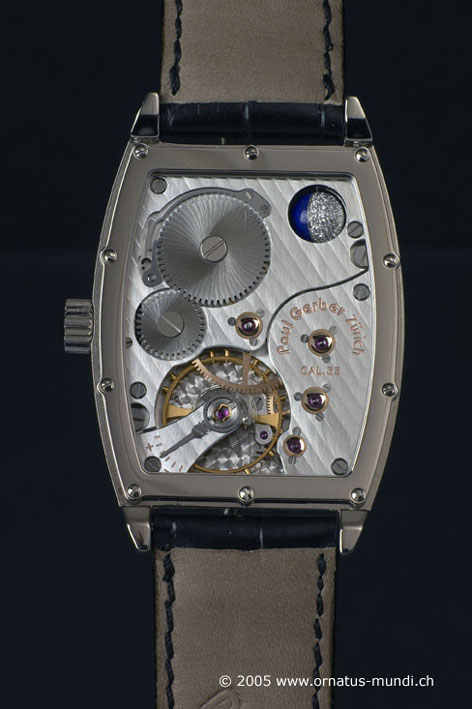
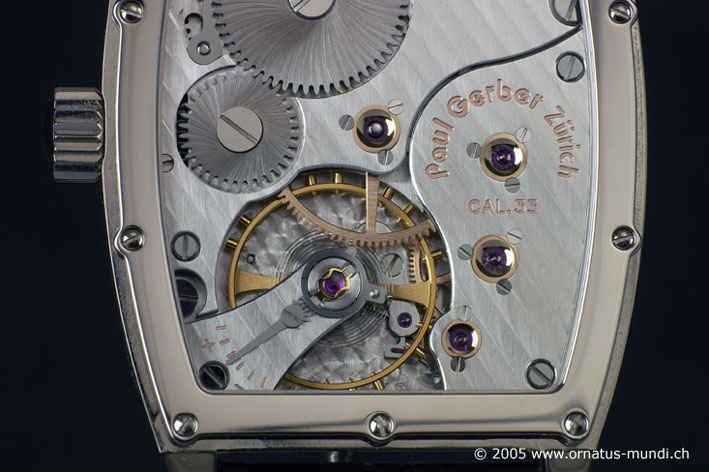


It contains his very own proprietary escapement. Its fundamental concept is the lack of compressing forces in action. So why is it so important to avoid these troublesome forces? Just make an experiment: Imagine you are working in your garden, just finished with harvesting a huge bunch of spring potatoes. All your potatoes are now collected in a huge wooden box. Now, how to get the box into your house? Try to push it - almost impossible! But, how about pulling the box? Yes, this might work. Now you already got the difference between compressing forces (push) and diverging forces (pull).
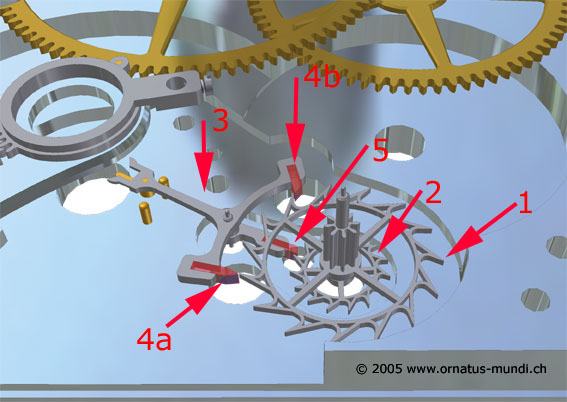
The latter ones are the forces Paul Gerber employed in his new Cal. 33 to drive the escapement. To enable the exclusive use of diverging forces, Paul Gerber had to separate the labour between impulse and stop. Consequently, the pallet wheel is separated into two coaxially located specialized wheels (resting wheel (1) and impulse wheel (2)). Three ruby stones, placed on the one pallet (3), act on the pallet wheels: the pallet’s two resting-rubies (4a, 4b) act on the large resting wheel (1), whereas the impulse-ruby (5) drives the balance (not shown) via the impulse wheel (2). This layout eliminates compressing forces and operates only with diverging impulses.
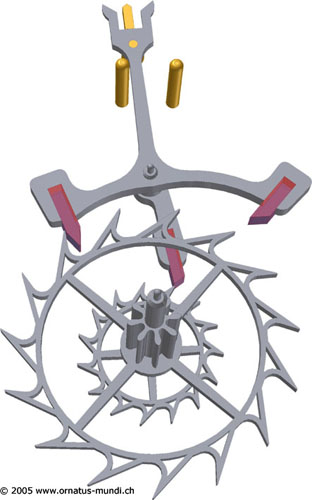
The complete sequence can be divided into entrance and exit positions. In the entrance position (left image), the pallet wheel rests because the entrance resting-ruby stops the resting wheel. The hairspring is tensed and drives the balance to swing back. This causes the entrance resting-ruby to release from the resting wheel. The pallet wheel springs forward with a small jump, driven by the power of the mainspring, until the resting wheel is stopped by the exit resting-stone.
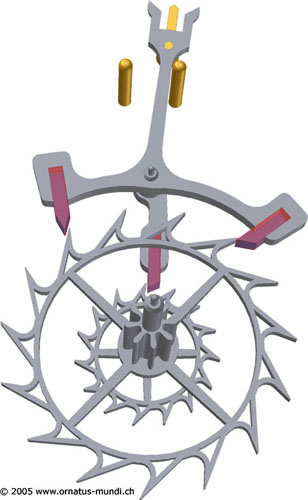
Now, the exit position follows (right image) and the balance swings back again, and the exit resting-stone releases the resting wheel. Then the impulse wheel drives the impulse-stone, which in turn drives the pallet and the balance. This movement is manifest with a great jump of the second’s hand. The pallet turns until the entrance resting-stone blocks the pallet wheel again. From here, the whole sequence starts again – 10.800 times/hour, because the movement carries out 21.600 beats/hour.
There is much more to write about this.... Cheers, Magnus
Grail - Paul Gerber
I've visited and met many members of the AHCI over the years. But there was one I've always wanted to meet - but never had. Paul Gerber is a watchmaker's watchmaker - his work on the 'Worlds most complicated watch" which was commissioned by Lord Arran - a...
Paul's workshop
I took the tram to the last stop - and then walked for several minutes up a suburban street. Here was the address - was this really where my extra-ordinary watches had come from? But perhaps - is that a workshop where the garage would be? Yes - this is th...

Greg, thanks for ...
sharing one more part of your gorgeous trip, which I appreciated a lot. Oliver
thanks for the pics
Your pics of his workshop is a wonderful window to Gerber's world. Jason

Thank you Greg.
Paul Gerber is one of my heroes as well, I hope one day to own the MIH. I am even more attracted to his work learning that it is made in such modest circumstances.

intersting Reoprt Greg
though im greedy and looking forward for more pics . the small size of pauls watches is a bit of an issue to me. yet i admire his work still . Faisal

Thanks for the workshop pictures Greg...
I too just don't seem to make it to Zürich much. But Paul is on the list. Don

Thanks very much for your report!
Paul Gerber is not only a great Constructeur of watchmaking, but he has made one of the most beautiful watches that I have ever seen - and have the immense privalege to own and wear - the Caliber 33 - with or without the spherical moon; mine is with but n...
Cal 33
This was my first chance to see the cal 33. And as you describe, it is wonderful. Very few watchmakers have attempted their own escapement! As you say it's an amazing watch, you must be proud to own one. Can you post some pictures?
Hi Greg, pictures hope to - but unfortunately not now
My version retains the large seconds hand going under the case, while introducing the moon. Rejected, by me, was a proposal of counter-balancing a large seconds hand sub-dial with a circular month on the other side. The movement of the seconds I found nec...
Some of my (older) pictures to water your mouth...
are here. Let me start with the large seconds version: Then, there is the spherical moon-phase watch, here still with the small seconds: The movement is his very own cal. 33 movement. Note that the wheels are 18kt red gold (a special alloy!): It contains ...
Interesting tick...
Magnus, Great stuff - thanks. Do I remember correctly that the escapement has an 'asymmetric' tick? I think Paul showed me this - and in fact it was one of the things that led him to the large second display - so that this could be seen clearly? Of course...
Absolutely...
the two movements are clearly visible, even with the small seconds model: the small move of the seconds hand results from the release of the entrance resting-ruby to release from the resting wheel. The mainspring drives the pallet wheel springs forward by...
Thanks magnus, another question...
Is the escapement reserved for the cal 33 - or does he use it in the Anno 50 too?
Its quite costly to produce and thus...
is exclusive to Cal. 33 at this point. Cheers, Magnus P.S.: I'd love to see it in other watches as well. Paul told me it can be interchanged with existing escapements if basic dimensions allow!
Interesting...
I guess it would be possible to have it fitted in something like the Anno 50 - would be a nice touch given Paul makes the movement anyway, Might even be possible to fit Paul's triple rotor if there is enough depth in the case. - Greg
Is this...
similar to a co-axial technology escapement or different? Just wondering. Low to no lube I imagine? Very interesting! Thanks! =:^{D>
Thanks for the lesson Magnus...
So this is similar to a Daniels co-axial but with impulse only on every other half swing of the balance. Do I see that right? Don
that seems right to me - but ask Marcus, as you already did
Also it may not be "self-starting", riquirinng a tap or two in the palm of the hand after having run down and being wound up again. By the way, for many weeks it has been keeping excellent time, in all positions. Sorry to butt in again, Amery
really sorry - Magnus!
I was a little unhinged last evening ... In fact his earlier report inspired me to order the Cal. 33! amerix