
Moonshine Runner
14

The real ocean – Porsche Design by IWC Ocean 2000, Reference 3504
The real ocean – Porsche Design by IWC Ocean 2000, Reference 3504
Ferdinand Alexander Porsche:
Ferdinand Alexander Porsche (* December 11th, 1935, † April 5th, 2012), grandson of Ferdinand Porsche, the man trusted by Adolf H¡tler and supposedly the "sole developer" of the KdF car, and son of Ferdinand Anton Ernst "Ferry" Porsche, the designer of the Porsche 356, left primary school in Stuttgart in 1942 after only one year and moved with the family to Zell am See, where he finished primary school in the following years. In 1949 the family moved back to Stuttgart, and Porsche attended the Waldorf School there. He began his studies at the Hochschule für Gestaltung in Ulm, which he left after only two semesters. In 1957, he began working in the body styling studio at Porsche under the direction of Erwin Komenda, and in 1962 became Design Director at Porsche AG. His best-known work is the Porsche 911, the sports car icon presented at the 1963 IAA.
Ferdinand Alexander Porsche died on April 5th, 2012 at the age of 76 in the presence of his family. His grave is in Zell am See, where his urn is buried in the house chapel of the "Schüttgut" estate in the Schüttdorf district. He left behind his wife and three sons.

Porsche Design Studio (today: Studio F. A. Porsche):
When Porsche KG was converted into a public limited company in 1972 and all family members retired from all important positions, F.A. Porsche founded Porsche Design Studio in Stuttgart, whose headquarters he moved to Zell am See in Austria in 1974. There he created the design for a wide variety of products in all kinds of areas, so it is not at all easy not to come into contact with products designed by Porsche.
Glasses, kitchen utensils and entire kitchens, telephones, writing utensils, vacuum cleaners, clothing, shoes, sports equipment and clothing, cameras, suitcases, briefcases and travelling bags, jewellery, lighters, tobacco pipes, lamps and lights, knives, yachts and sports boats, aeroplanes, trains and cable car gondolas, televisions and monitors, Car radios, motorcycle helmets, hard disks and optical drives, computers, power tools, bicycles, seating furniture, dental units and drill heads were all created by the Porsche Design Studio - even the design of the beer crate of the Veltins Brewery in Meschede, Sauerland, was created by Porsche.

Porsche Design by IWC:
The fact that the Porsche Design Studio also designed watches was nothing new. Porsche built its first chronograph with the Swiss manufacturer Orfina in the early 1970s, in 1978 the connection between Orfina and Porsche Design ended and the cooperation with IWC began.
The first watch to emerge from this joint venture was the "Compass Watch", reference 3510, which was initially - and this was also a novelty - only available with a black titanium case and black titanium bracelet. With the compass watch, the watch case could be swivelled upwards after pressing the two release buttons on the 6 o'clock side, thus allowing a view of the oil-damped compass below.
This expedition watch thus united several premieres in the art of watchmaking: the combination of a mechanical watch with a compass in one case, the first-time use of titanium, a case and strap material that was still very difficult to work with at the time, the design completely in black and the strap geometry "Geo 1", which was used for the first time and patented by IWC. The Porsche Design by IWC compass watch was a complete success and was retained in the portfolio throughout the entire cooperation period.
In total, nine further model series were created under the Porsche Design by IWC label in addition to the classic IWC range with Portofino, Da Vinci, Portugieser, Ingenieur and the pilot's watches.
The 20-year relationship between the Porsche Design Studio and International Watch Co. saved the survival of the Swiss, who had been severely affected by the quartz crisis of the 1970s.
The Porsche Design by IWC Ocean series:
The diving watches from IWC with either 50 or 200 bar pressure-resistant, elegant and futuristic titanium cases were established in 1982 and no longer bore the name "Aquatimer" but "Ocean 500" or "Ocean 2000".
The Ocean models were the first IWC diving watches with an external rotating bezel and they also ensured that the material titanium became much more popular in watch making.
The development of the Ocean series was commissioned by the [I]Bundesamtes für Wehrtechnik und Beschaffung[/I], the watches were to be used as service watches for the combat swimmers and weapon and mine divers of the [I]Bundesmarine[/I] and for this the [I]Beschaffungsamt der Bundeswehr[/I] set a whole bar of requirements.
There were three different models for the [I]Bundeswehr[/I], which took into account the different requirements of the combat groups:
- the combat swimmer watch with quartz movement, reference 3314 and 3315, supply numbers 6645-12-199-5070 and 6645-12-344-0903
- the diving watch with automatic movement, reference 3509 and 3529, supply number 6645-12-197-9681, 6645-12-197-8096 and 6645-12-339-1536
- and the amagnetic mine-diver watch, also with automatic movement. This watch, reference 3519, supply number 6645-12-199-3503, was the first and for a long time the only watch to comply with the NATO Standardisation Agreement (STANAG) 2897 for magnetic behaviour
It is perhaps interesting to note that the watches supplied to the German Navy were only certified with a pressure resistance of 30 bar, although they were given technically identical cases and sealing systems, albeit a flat glass, to the civilian versions, which were pressure-resistant up to 200 bar.
The revolutionary Porsche Design by IWC strap geometry:
With the introduction of the Compass Watch, the first watch to emerge from the joint venture between IWC and the Porsche Design Studio, a revolutionary bracelet system was also developed, which allowed the owner to adjust the bracelet of his watch to his needs or even remove the bracelet from his watch in just a few seconds.
In total there were three band geometries, I will limit myself to adding only the patent specification for the band geometry "Geo 2" as a supplement, because my watch still has this bracelet system.


If you take a closer look at the patent specification, you will see that Lothar Schmidt is listed as the inventor. Some watch fans may know that Lothar Schmidt bought Sinn Spezialuhren GmbH from Helmut Sinn in 1994 and has been CEO there ever since.
Prologue (can be skipped):
Actually I wanted to treat myself to an Omega Seamaster 2254.50.00 for my birthday some years ago, but more or less at short notice it became an IWC GST Aquatimer 2000, with which I am more than satisfied.
"Postponed is not lifted" I thought, and with that it was once again incontrovertibly certain that the "Peter Blake" would definitely be the next watch to move in with me (finally again) - I thought...
While studying the history of the International Watch Co. for the Aquatimer presentation, I came across the most fascinating model of the "Ingenieur" series, namely the 500 000 A/m. The watch captivated me and since the "Peter Blake" could certainly wait a little longer, it was clear that the reference 3208 would be the ideal complement to the Aquatimer - I thought...
...and then came the Porsche.
The watch:
I don't like titanium.
Not that I have anything against this material in general. Titanium spectacle frames are something wonderful, for corrosion-resistant ship propellers and as a hypoallergenic material in medicine it is excellent, if not irreplaceable, but as a material for making watch cases and straps? No. Too light, too warm, too...
... hard, cold and heavy steel is something completely different, better! After all, you want to feel the couple thousand euros or dollars you spent on your watch on your wrist. Don't you?
But since you have to die some kind of death and the Porsche Design by IWC Ocean 2000 radiated an incredible fascination on me and still does, it was quite easy for me to jump over my shadow and buy the second titanium watch in my life.
While researching for the Aquatimer presentation, I not only came across the fascinating world record Ingenieur 500.000 A/m, but of course inevitably also the direct predecessor of the GST Aquatimer, the Ocean 2000, an equally, if on another level, interesting watch.
I myself had imposed a significant reduction of the existing stock and so, before the final decision between Ocean and Ingenieur, the three Longines and the Oris had to go in addition to the Seiko New Turtle, which had been on the shooting list for a long time. After this project was completed, the final decision was made in favour of Ocean 2000. The choice of another diver's watch was based solely on the small case diameter of only 34 millimetres of the Ingenieur, which made me doubt it, considering the wrist circumference of about 19.5 cm. However, the watch is still very high on my wish list and I very much hope that I can try on a corresponding watch someday.
I found my Ocean 2000 at a private seller in the Lower Bavarian district of Passau. Like I bought the GST Aquatimer, I wanted to have a full set with box, box, the tools and all papers available at delivery. This wish made the search difficult and the purchase relatively expensive - but in the end I was lucky and could buy the watch for a price that I think is fair for both sides.
My Ocean 2000 has apparently seen a lot of the world in her life so far. It was sold to the first owner by Poncini Export Trading Services Ltd. in Port Louis, Mauritius on June 1st 1997. Here the trace gets lost at first, but it is sure that it came to Germany sometime and was last revised in October 2017 by the IWC certified watchmaker Boxberg in Overath.
Concerning the rate values, the Weishi shows good things: the beat error is 0.0 milliseconds in all positions, the amplitude varies between 242° and 251° depending on the position and the daily deviation between -2 and +4 seconds. On the arm, the watch proceeds according to "Watchtracker" in 24 hours 0.3 seconds.
However, the good piece does have one annoying flaw: during the last maintenance of the watch at an independent watchmaker, the reworking of the dial was also commissioned and this work was thoroughly messed up by the German master craftsman. What made this sloppiness a particular annoyance is that the dial is no longer available from IWC. Fortunately, however, I was able to get hold of a matching NOS dial from a Swiss dealer a few weeks ago.
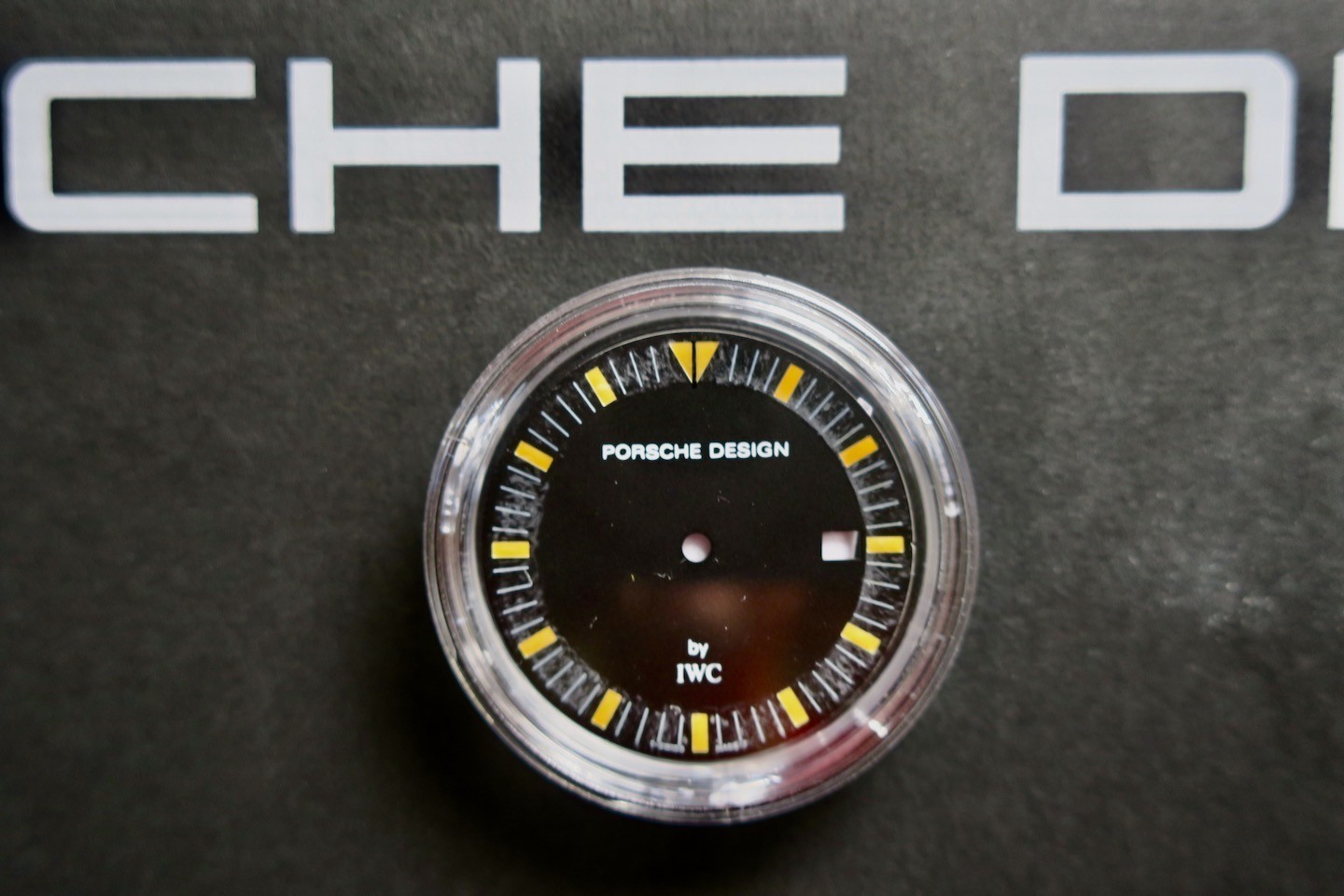
By the way, the photo is deceiving: the dial is absolutely flawless, the smudges and scratches are reflections on the protective case.
Specifications:
Case:
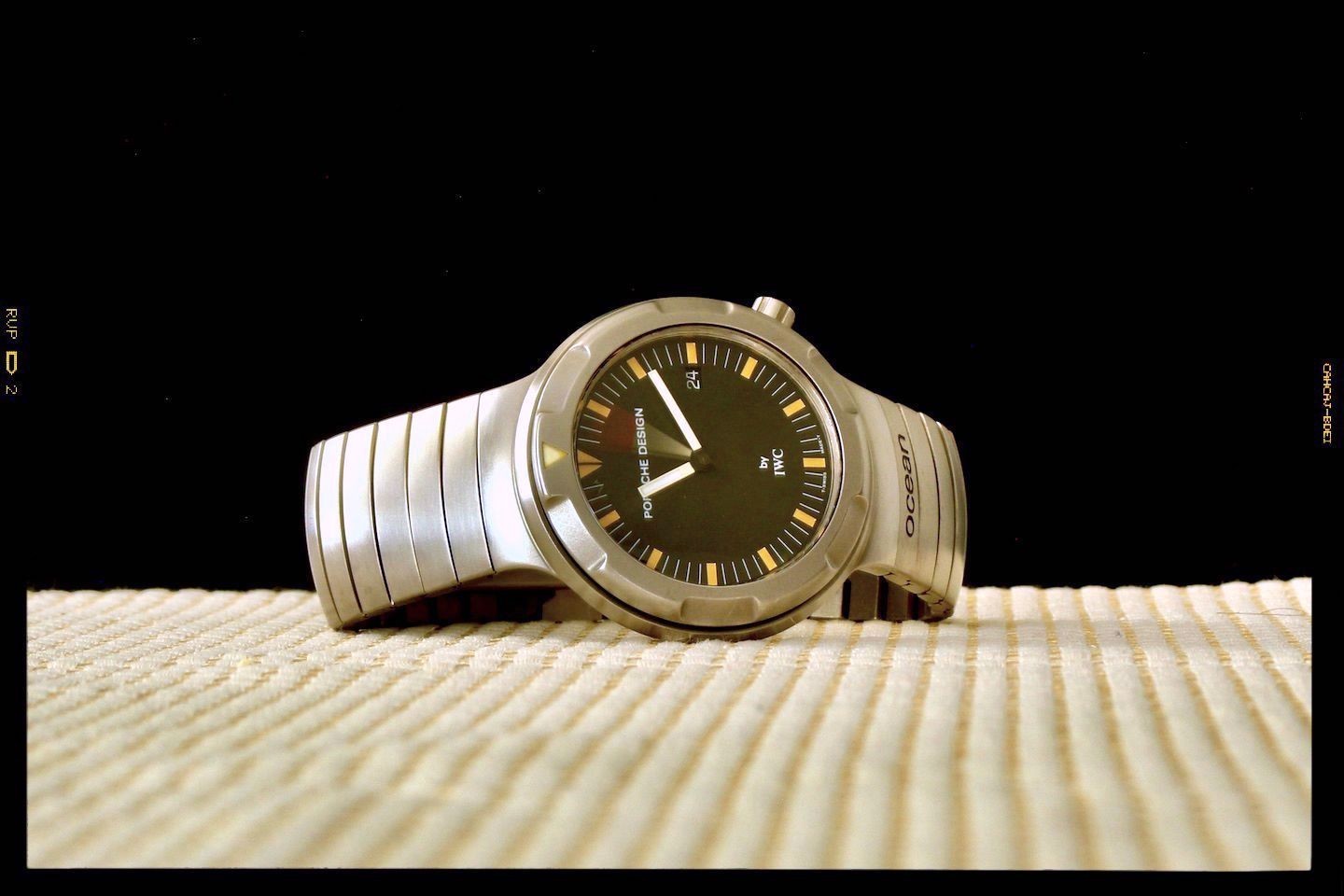
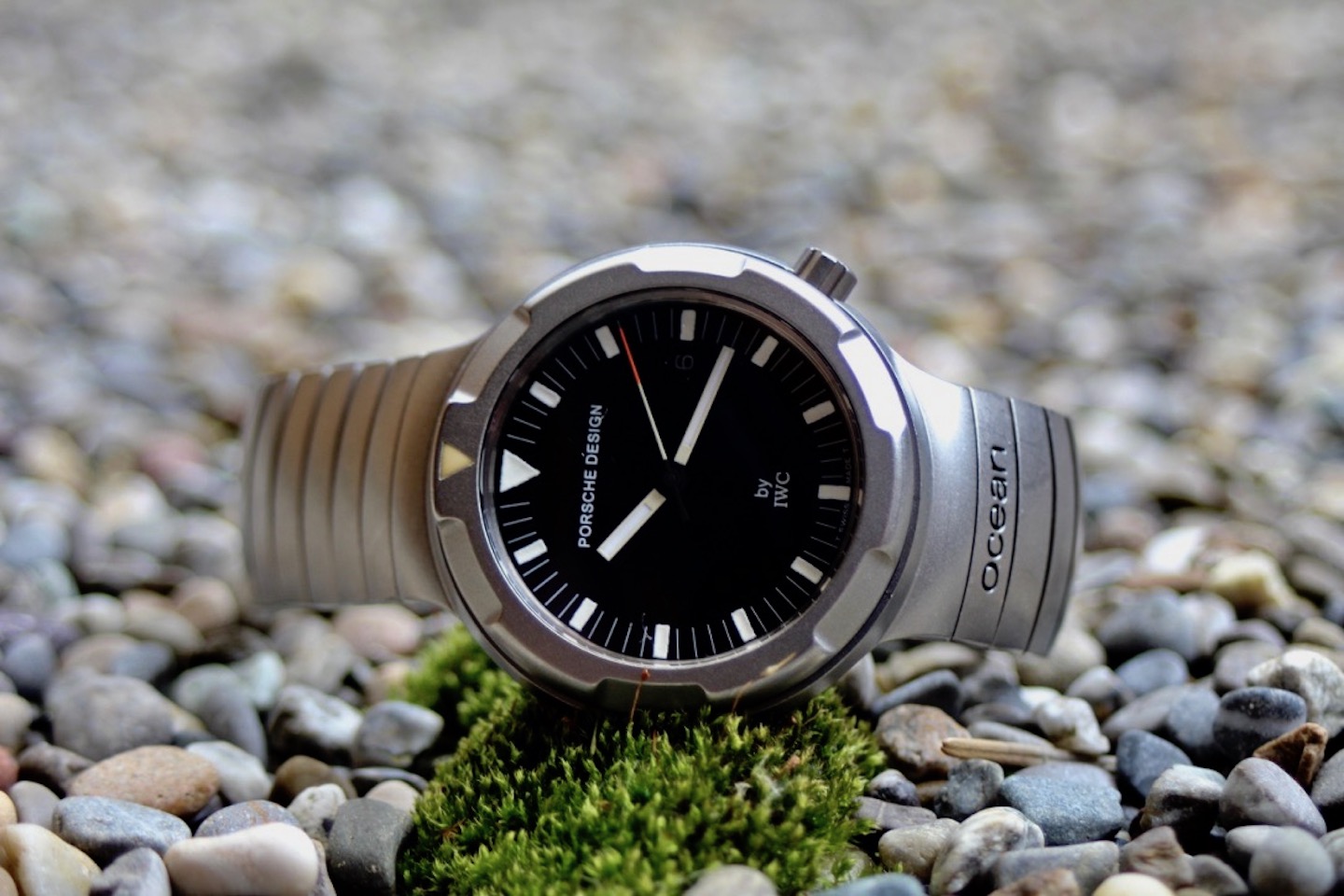
Material: satinized titanium
Crystal: slightly cambered sapphire crystal, non-reflective
Case back: screwed case back
Dimensions: Ø 42.50 mm, ↕︎ 10.50 mm, ↔︎ 52.00 mm
Weight: approx. 125 g
Watertightness: waterproof up to a pressure of 200 bar (2000 m)
Features: unsigned crown at 4 o'clock, screwed-in, 5.5 mm diameter, 3 gaskets, separate steel crown tube
Dial and hands:
Colour: matte black dial, white lacquered hands, covered with tritium
Hour scale: printed white indices, covered with tritium, printed white minute scale
Date display at 3 o'clock
Hands: white lacquered hands, coated with tritium, second hand with red tip
Movement and functions:
Calibre: gold-plated automatic calibre 37524 (based on ETA 2892-A2), 28,800 A/h, central second, black date disc with white lettering, 21 jewels, Glucydur balance, Nivarox hairspring, shock-protected and anti-magnetic, pearled and decorated with Côtes de Genève stripes, rotor in 21kt. solid gold, stop-seconds, manual winding possibility, date quickset
Power reserve: approx. 42 hours
Function: hours, minutes, seconds and date
Bracelet:
Material: satin titanium
Colour: titanium grey
Buckle: signed titanium safety folding clasp, key closure, no diver extension
Special feature: proprietary IWC metal strip system "Geo 2"
Optional available Bracelet:
Material: Nylon
Color: Grey
Clasp: Velcro (hook and loop) closure
List price (1997):
5,750.00 DM (2,939.93 Euro | 3329,49 Dollar)


Epilogue:
The Porsche Design by IWC Ocean series was launched on the market in 1982. The design does not look at all like its nearly 40 years in the meantime, on the contrary, the watch still looks fresh and up-to-date today. The credo of the father of the Porsche 911 "A formally coherent product does not need any embellishment, it should be enhanced by the pure form". hits the mark with the Ocean 2000 and makes this watch also appear timeless.
The fact that new ways were taken in the production and that in the mid-1980s titanium as a case material was hardly used at all due to the difficult processing, makes the watch appear even more modern.
After the GST Aquatimer and a Sportivo 02, the Ocean 2000 is now the third watch from IWC and also this time the materials used, the quality of workmanship and the precision of the movements convince me.

Conclusion:
With the purchase of the GST Aquatimer, I had already fulfilled a dream from the early days of the beginning of my watch life and with the Ocean 2000, another dream watch from that time found its way to me. The Blancpain Fifty Fathoms Concept 2000 presented [URL='https://www.watchuseek.com/threads/le-monde-du-silence-the-silent-world-die-schweigende-welt.5343529/#post-54057061']here[/URL] was also an unrealizable dream at the time, which I was recently able to fulfill. Let's see if I manage to get the other then unaffordable watches sometime.
The Ocean 2000 wears differently than all of my other watches, not more uncomfortable or more comfortable, but "lighter" - no wonder, the watch weighs only 118 grams with only two links removed from the bracelet - you can hardly feel it on your arm. The titanium makes the watch a pleasant "wrist flatterer", it actually feels warmer than the steel of the Aquatimer and the organic case design also contributes to the excellent wearing comfort.
The quality of the material and workmanship are, as usual with IWC watches, beyond any doubt.
Post scriptum:
Of course, the history of the connection between IWC and the Porsche Design Studio is once again only roughly outlined and incomplete. It is simply not possible to present the complete history of both companies in such a small outline, nor can all the highlights and developments be discussed in detail, because that would fill books (and it does!) and go beyond the scope here. I hope once again that I was able to convey a little bit of the history of the Porsche Design Studio and the connection to the watch manufacturer International Watch Co. with my amateurish description and that I did not bore you too much.
Source references:
International Watch Co. "Porsche Design by IWC 1993/94" and "Historical Selection - Engineering Time Since 1868" | Collection Rolf Heyne GmbH & Co KG "PORSCHE DESIGN" | Konrad Knirim "Military watches. 150 Years of Timekeeping in the German Military." | Konrad Knirim "Military Watches. | IWC.com | Chronos "Milestones: IWC" | Wikipedia
Image sources: Figure 1: Dr. Ing. h.c. F. Porsche AG | Image 2: C. & A. VELTINS GmbH & Co. KG | Images 3 to 10: German Patent and Trade Mark Office | Images 11 to 31: own work
The real ocean – Porsche Design by IWC Ocean 2000, Reference 3504
That seems like an excellent weekend read, about a reference that I love

On the contrary …this was a fascinating piece and well researched.
Dive standards & Sinn watches


Hello Moonshine Runner! Welcome to our Community and thank you so much for these two great posts, so well researched and interesting reading for this weekend.


What a post!

Herzlich willkommen. Great reportage with beautiful pictures. This IWC Porsche Ocean diver was way ahead of its time at launch. Lothar Schmidt developed interesting case and material techniques
