
Ornatus-Mundi
[Zenith]
7136

In case I am right your picture shows it well...
I am talking about the shape and the geometry of the chronograph teeth.
Minerva sought to improve the measurement of
time by optimising the interaction of the transfer wheel (which
is mounted in the axis of the seconds wheel and engages, once the Chronograph
is switched on, with the intermediate wheel to transfer the energy to
the Chronograph seconds counter) with the intermediate wheel.
This is
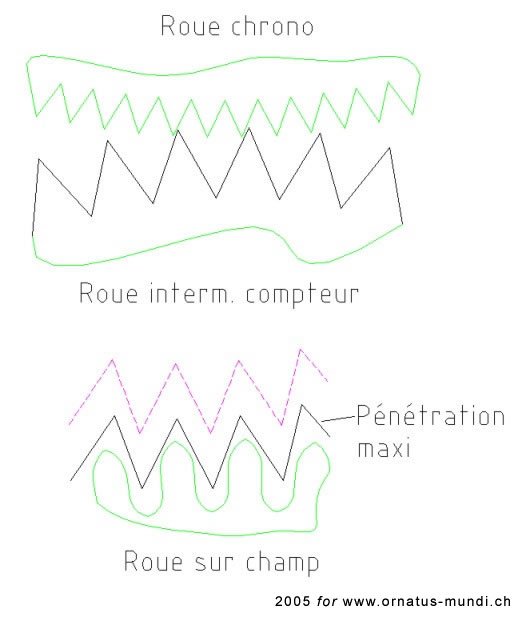
achieved by altering the shape of the teeth on the transfer wheel to a
more rounded, nearly epicycloidal shape of the teeth (lower part of the image below). This allows for
a maximun of depth of engagement between the two wheels while minimising
friction, resulting in an increased regularity and consistency of interaction. Your picture is shows how deep the wheels interact. Imagine the friction that could occur if wheel engage that deep!
It seems to bring real benefits: According to Demetrio Cabiddu, the amplitude
of the balance stays constant at nearly the same rate with or without
the Chronograph being engaged, a testimony to a Chronograph mechanism which requires
less energy. To cite him: "This new shape may be less traditional
or optically not completely in the spirit that we are striving for, but
it is technically more advanced and more functional". 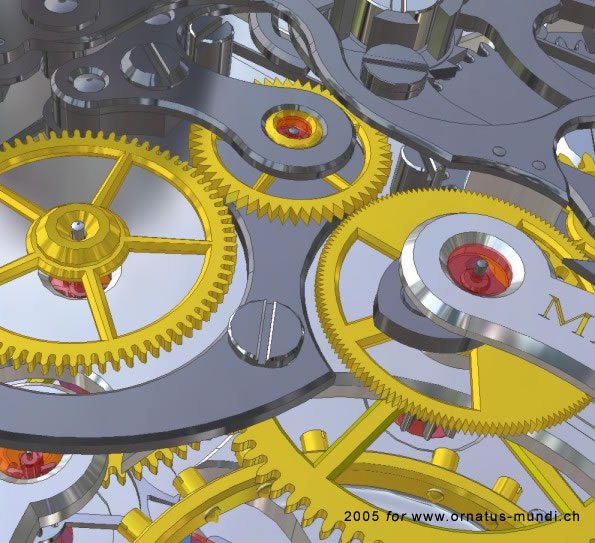
This type of
teeth are found on the transfer-wheel of the Cal. 13-21 and Cal. 16-29.
Best,
Magnus
This message has been edited by Magnus Bosse on 2009-04-28 08:05:46

Tradition and innovation. Let's have a discussion over esoteric watch engineering theory
Are you talking about the blocking lever...
So close but no :-)
In case I am right your picture shows it well...
Spot on! But is it really that simple? Why hasn't it been done before?

Funny thing is.....
Hi Suitbert! It is good to hear from you. Yes the underlying principles have been
Hello, Mike,....
No worries Suitbert, I'm glad you expressed your opinion
You are right Suitbert...
Magnus, you touched on the two points

Even if it does cause less of an amplitude drop
I don't think it can....
I need one as well...

Should I be getting one too then...