
jporos
2327

Leica D-LUX 6: An neophyte’s review
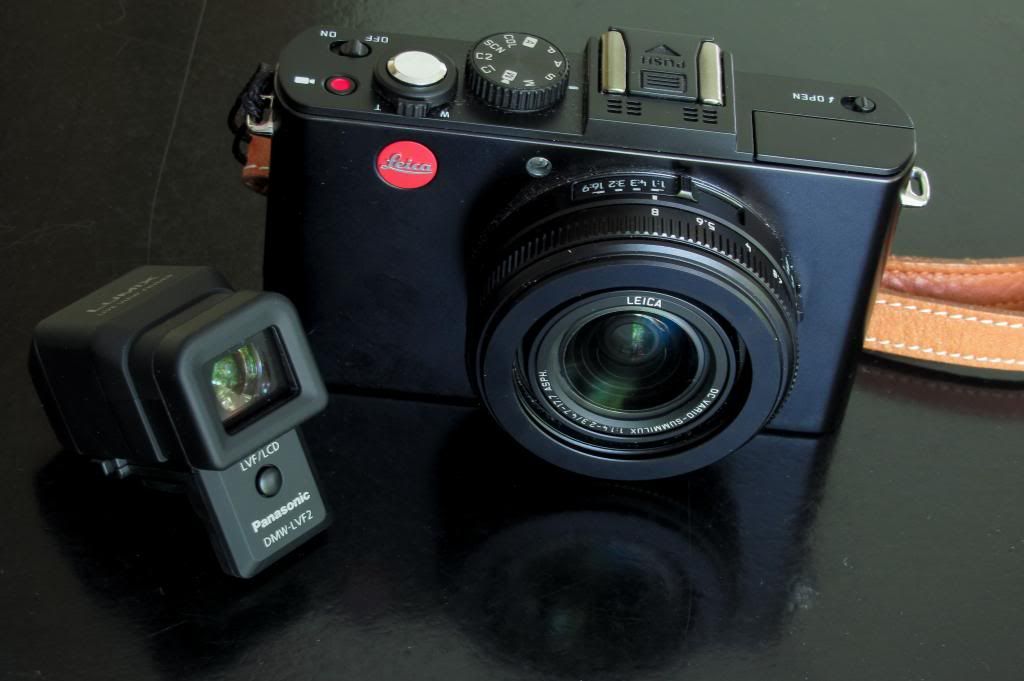
Having taken more than 1,500 shots with the Leica D-LUX 6, I thought that I would hazard a review. How I came to acquire the D-LUX 6 came by the suggestive power of the French vampire. Innocently thinking about watches, I came upon the following post: Here Now I had been using an old 2 megapixel Kodak camera or borrowing an Olympus DSLR to take mostly watch shots to this point. Leica? What a beautiful thing! And it takes pictures too? I began to haunt the web, photography forums, blogs and other dark corners of the Internet to find out more. I realized that the D-LUX 6 was the one for me. Even my old Kodak had been a real pain to take on trips and a DSLR was like carrying a small child around. The D-LUX 6 was what I was after, small enough to fit into a pocket or regular bag but with the ability to take decent photographs. The vampire’s grip came again (I do not know how it works transatlantically, but it does) and the Leica was in my possession.
The kit
As I mentioned before, the first thing that struck me was the look of the camera. Spare, clean, no-nonsense, exactly what I like. No pesky texturing, or grip, or unnecessary writing, the form is that of an Ur-Camera, something a child would draw. The controls are straightforward for the most part as well. On the top, a mode dial, shutter button with zoom lever, on-off switch and video recording button. In back, the view screen, ubiquitous five button circular controller with four buttons around it, a manual focus lever and a dial to be able to scroll through various functions. Most importantly, around the lens is an aperture ring and aspect ratio switch.
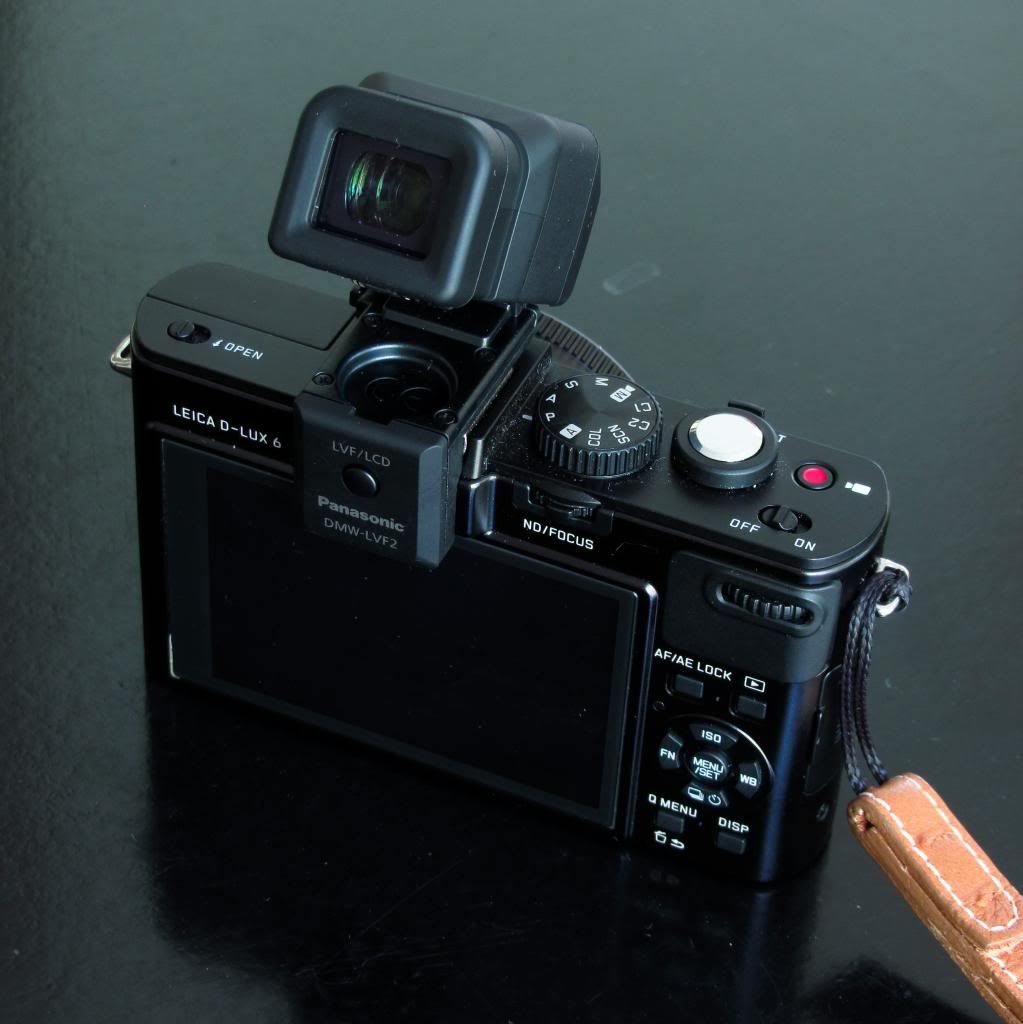
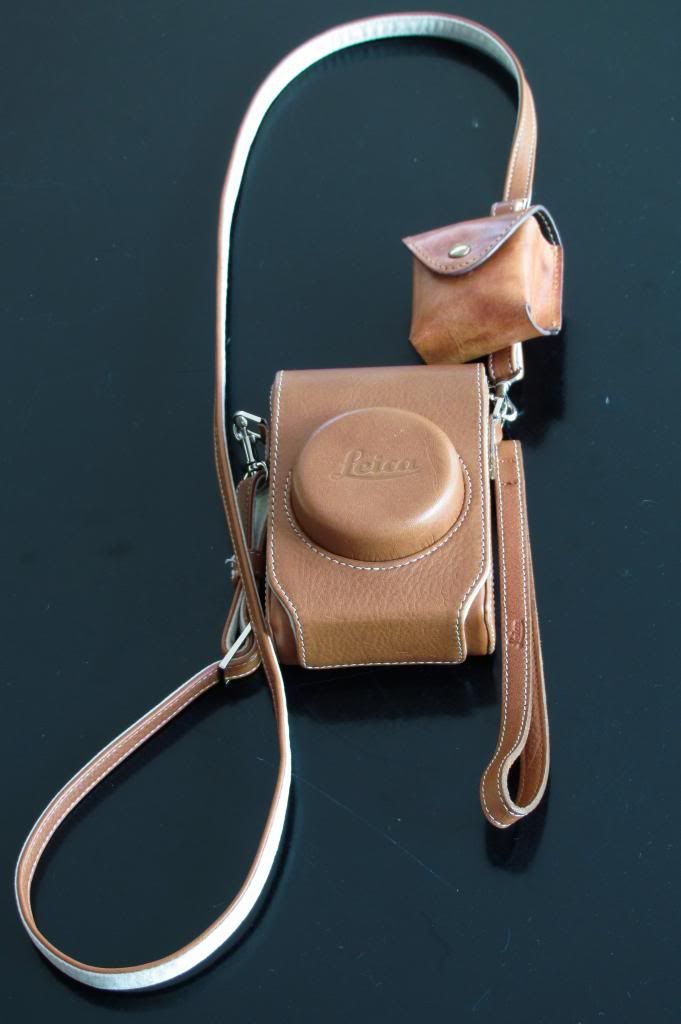
I bought two accessories for the D-LUX 6. The first was the leather case from Leica. The camera fits like a glove in this very well made case. The second accessory is the external viewfinder. I bought the Panasonic DMW-LVF2 and not the Leica branded EVF-2, which is the same viewfinder with the Leica name on it. The viewfinder works well and I will discuss it later in the review. I had to buy a third party leather case for the LVF2.
What I like about the D-LUX6
If this were a proper review, I should probably start in with all sorts of technical specifications, complaints about sensor size, feature bashing and the like. However, I just moved up from a 2 megapixel Kodak that I thought was O.K. (Even won a couple of Wristscans with shots from the Kodak) What I would like to do is tell you what the camera has allowed me to do based on the pictures I take and let you find and read all the really excellent technical reviews from the pro and semi-pro photographers on the Web.
Size
The D-LUX6 fits easily into a jacket pocket or a bag. This has translated into the opportunity to take the camera with me at all times and capture photographs I never would have before. Shots at restaurants, covert wrist shots, or just being able to carry the camera around daily and catch that amazing tree or light on a wall, this camera has made photography part of my every day routine.


Low Light
Low light photographs are something that I never had the chance to do before. With my previous cameras, I felt that I had to get out from behind the viewfinder and push the light through the lens myself in order to get a shot. With the f1.4 lens on the D-LUX6, I really don’t worry about available light that much anymore. You can see the kinds of shots that I can take now that I would never think I could do before.



Aperture & Aspect Ratio
While many cameras allow one to adjust aperture and aspect ratios, this is usually done through a series of menus. With the D-LUX 6, both of these adjustments are made through manual rings on the lens barrel. The ease of making these adjustments with the D-LUX6 lets me consider aperture and aspect for every shot I take. 16:9 aspect ratio is my new friend.


Zoom Lens
I’m an architect so if I cannot take good pictures of buildings, a camera is fairly useless to me. Key to this is a decent wide angle lens. The 24mm focal length does a nice job of this.


On the other hand, there are plenty of other cameras with better ability to capture shots at a distance. You will not be able to zoom in that closely with the D-LUX 6. Nevertheless, here are some shots I took at a baseball game where I zoomed to the limits of the lens. Not too terrible.


Macros
Will this camera take the quality macros that a big camera with a lens the size of your forearm can take? No. Is the macro good? Judge for yourself.


These macros were taken handheld in natural light.
Menus
I am terrible with menu systems: phones, appliances, cars whatever, mostly because those menu systems are so poorly and illogically designed. The Leica’s menu system is straightforward, easy to navigate, consistent and graphically elegant. My one criticism is that the aperture/shutter speed scale does not automatically show up on the display when manipulated unless the correct display mode is on, a minor problem given the usual difficulty I have with menus.
External Viewfinder
While the viewing screen on the camera is quite good, it is still tough to accurately compose a shot in glaring sunlight. I bought the Panasonic version of the EVF because Leica wanted way too much money to print their name on the same viewfinder. The clarity of the viewfinder is excellent and I really appreciate the diopter adjustment so I can use it without my glasses on. A button on the viewfinder allows switching between the camera back screen and the viewfinder. The viewfinder also tilts, but I find that I do not use this option that often. A major mistake for Leica is that there is not a leather case for the viewfinder that matches the case for the camera; I had to buy a third party alternative.
Lightroom
What has turned out to be the best accessory to the D-LUX6 is Adobe Lightroom 4. I usually view most Adobe software as bloatware. Not so with Lightroom. Lightroom has not only been powerful in editing my images, but organizing them as well. Worth the price of entry and a license is included with the purchase of the D-LUX6

Why not a Panasonic LX-7?
Absolutely. It’s exactly the same camera as the D-LUX 6. EXCEPT for that built-in handgrip. The need for the handgrip was something I struggled with. I hate the look of it, maybe despise is a better word. But then I worried, did Panasonic know better about the ergonomics of this small camera? When I finally got the D-LUX 6 in my hands the answer was clear to me; the handgrip is unnecessary. In fact, I am sure that it would ruin the feel of the camera for me. The smooth, flat area in the front of the camera lets me with even my fairly large hands grip the camera well and use my thumb to manipulate the buttons on the back. Nevertheless, I would suggest the use of the wriststrap in all conditions because this is a small camera.
The D-LUX 6 is significantly more expensive than the LX-7. Other reviewers have suggested that with Lightroom and the extended warranty that one receives with the D-LUX 6, the cost is similar to the LX-7. However, the numbers do not add up. The key reason to choose the D-LUX 6 over the LX-7 is that it looks so much better. No handgrip, or extraneous writing, or contrasting finish buttons. Simple and refined always costs more.
Are you paying more for the red dot? Of course, but in my mind I wish that they had actually branded this camera ‘Panaleica’. Two great companies worked together to release this camera and the expertise of each enhances the product. As you can tell, I greatly enjoy this camera and think it will meet my needs for a long time. Thanks for reading…
This message has been edited by jporos on 2013-06-18 17:53:10
Leica D-LUX 6: An neophyte’s review

Good Review John....
Thanks Dreamer!

Very interesting review, jporos.
Thanks Nicolas, you were the one...

re: review
Truthfully, I have not used the video even once.
re: truthfully
Maybe an M2...
The M2 is a superb film Leica...

Thanks for the review!

Nice Read !
I could not figure out all of those charts and graphs...

Tanks for the interesting review, marvelously illustrated! ...
Marcus, I use RAW mode 90% of the time...

Great review of the DLux6
Thanks Ed!

Thx for this comprehensive review ! .. Very helpful..