
amanico
[JLC Moderator]
401405

Another expression of UN's Genius: The Perpetual Calendar
In 1996, for the 150th Anniversary of the brand, U.N, under the imagination and the genius of a man, Mr Oeschlin, introduced the Perpetual Calendar. ( Don't know who to credit for this picture )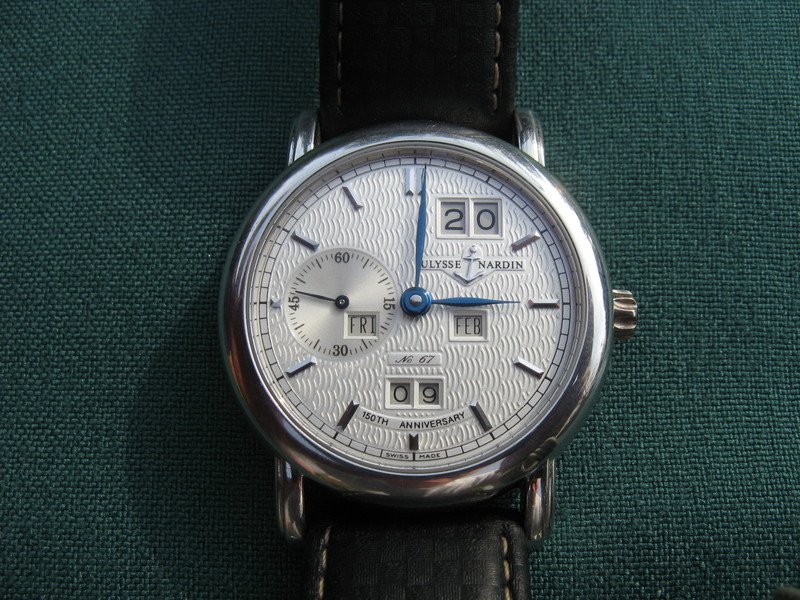
You will tell me that we didn't have to wait till 1996 to see a perpetual calendar in a watch, even in a wristwatch, and you're true.
BUT, the revolution was that with this perpetual calendar, you had some big and really interesting improvements, as it allows the owner to set the date backward and forward by only using the crown.
No more pushers here and there, no more " danger zone " to avoid when setting the date.
The Perpetual Calendar becomes a friendly, and almost intuitive complication, not a too complicated one, as you don't have to read the huge booklet anymore before manipulating the watch.
In 1999 ( 10 years, already! ), U.N made another step in the friendly use of the Perpetual Calendar, by adding another complication to the Perpetual Calendar: The GMT, which is paired to the Date, so if you have to change the local time, it well automatically change the date.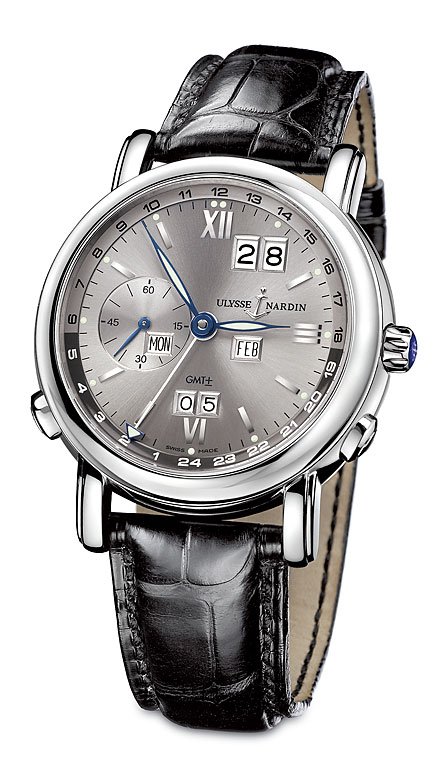
For example, and to make it clear, if the home time is 2 AM on the 1st of May, and that the local time is 11 PM ( -2 ), you will set the hour backward, and the date will automatically change with the hour to the 30th of April.
Ideal for those who travel with their perpetual calendar, without having to be worried by the change of the hour!
Firstly housed in a " wise " conventional but elegant round 38, 5 mm case, this Perpetual GMT was offered a more audacious, young and bigger ( 42 mm ) case, inspired from another great U.N Watch, the Sonata.
The Sonata: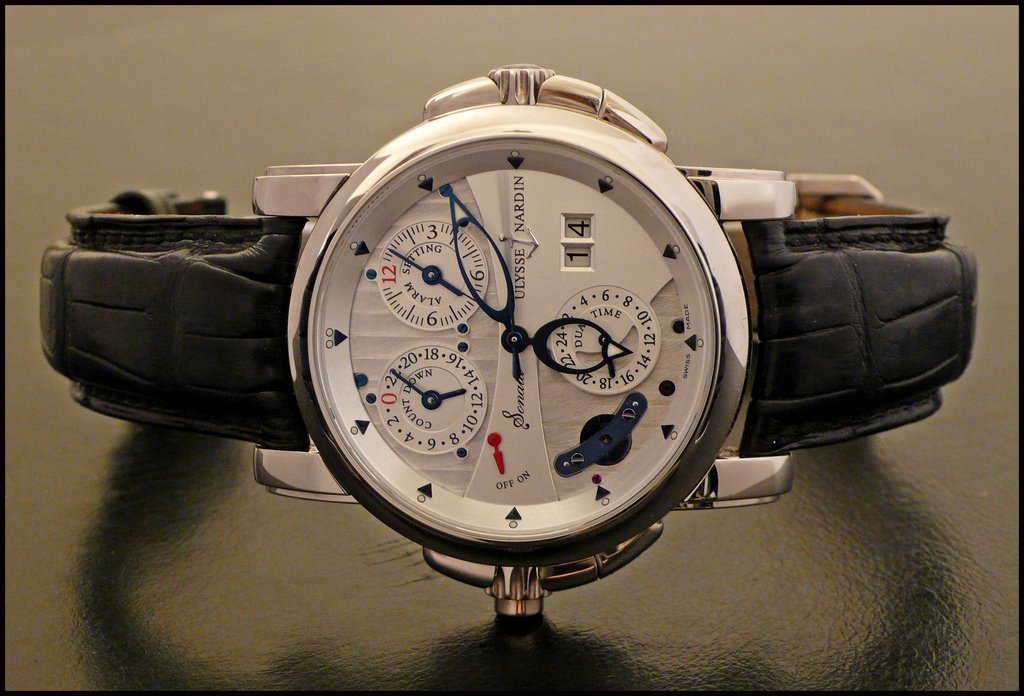
The Perpetual GMT Limited Edition: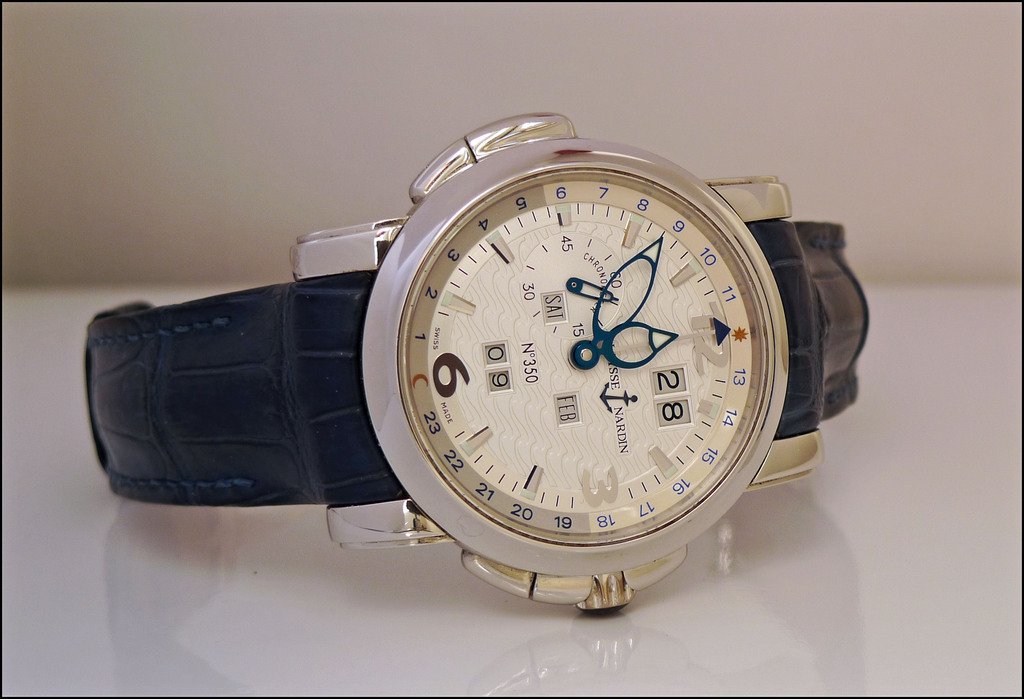
As you can see, the GMT Perpetual and the Sonata share the same case, the same special bezel ,the same dimensions, the same leaf blue hands, and even the same spirit, as the Sonata is another great traveller watch, with the Alarm, the GMT, the Big Date, and the Alarm countdown.
So, let's see this GMT Perpetual in detail...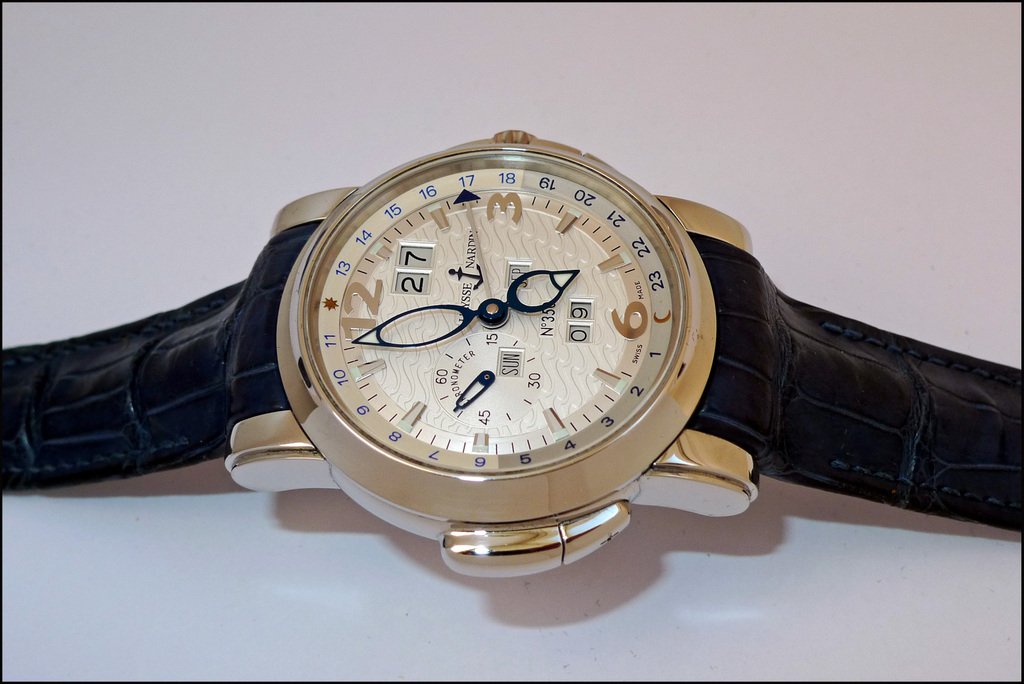
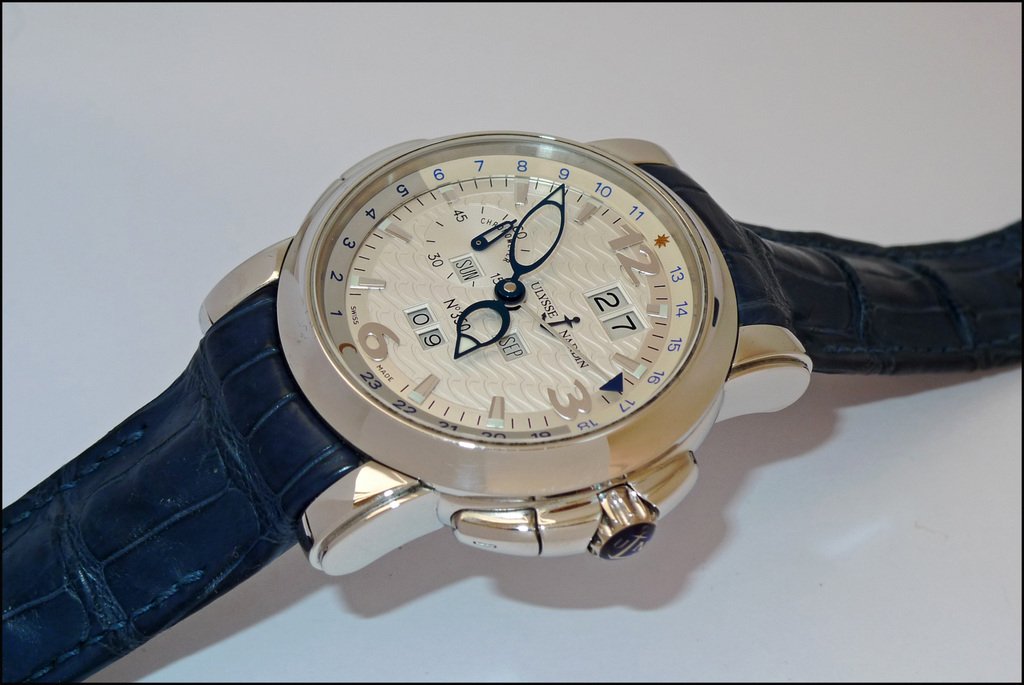
1/ The form and the function:
What is eye catching on this watch is first of all its legibility, and the choices made for it.
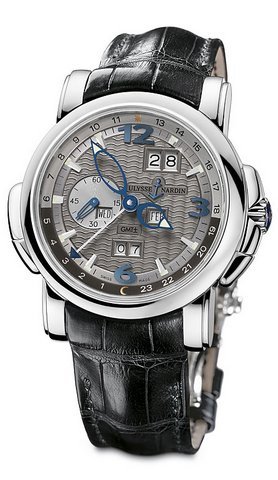
The special empty ( local time ) hands don't disturb the legibility, even when they are located on the Date Windows.
The Date Windows are obviously more legible than a lot of date sub dials, too.
The Big Date, which is the most important information on a Perpetual Calendar has a bigger size than the day or the month, which is quite smart and clever.
At the beginning of the metal indexes, you have a small Luminova dot, making echo to the hands, permitting a reading of the hour in the night.
The inner 24hours bezel dedicated for the home time hand is also easy to check.
2/ The Aesthetics:
This perpetual calendar has a sporty, dynamic look, obviously.
U.N didn't go as far as they go with the Acqua Perpetual, which was a Diving Perpetual Calendar ( water resistant to ... 300 meters! ), of course, but the look, the design is much more audacious than the previous Perpetual GMT.
The Acqua Perpetual: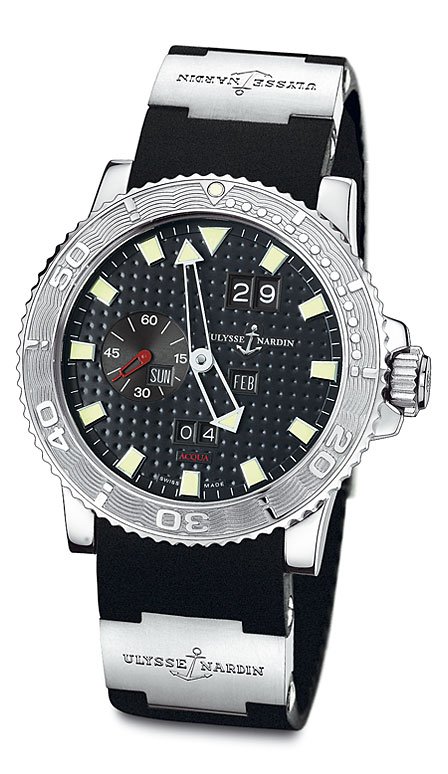
The GMT Perpetual is a big and thick watch ( 42 mm big, and I'd say a between 14 and 15 mm thick ), and, in platinum, a heavy watch.
The dial is white, finished with small waves, ( copper dial for the RG version ), and blue heated hands, to give to the dial a nice contrast.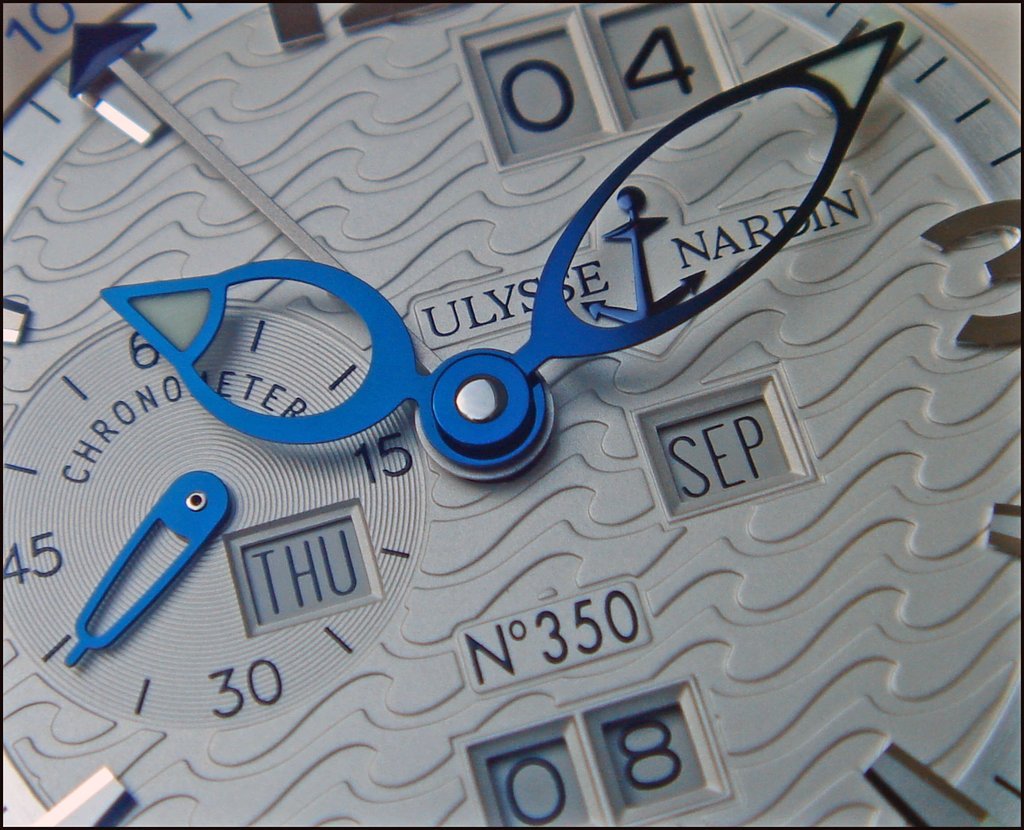
The cherry on the cake is these lovely and large applied numbers 3 / 6 / 12.
All is clear, neat, quite sober, with a small and elegant touch of dynamism, at the service of the Legibility.
Some will say that the lack of moonphase is sad, but if we refer to the philosophy and the spirit of the watch, a moonphase indicator would have caused a loss of homogeneity to to this dial.
The crown is conventionally located at 3 while the 2 GMT pushers are at 4 and 8.
They all are surrounded by a guard.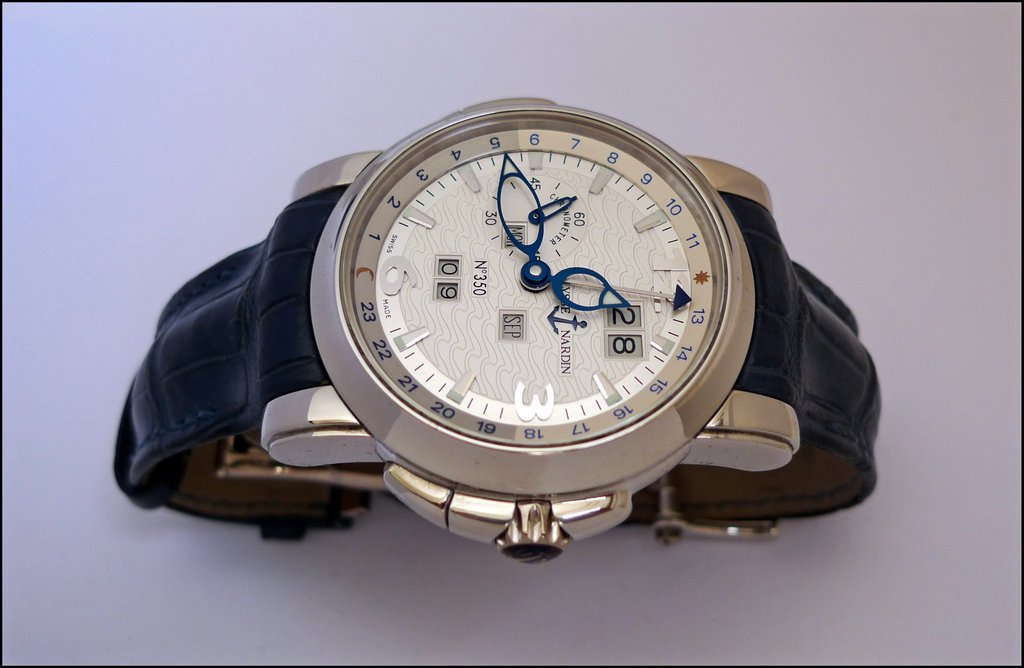
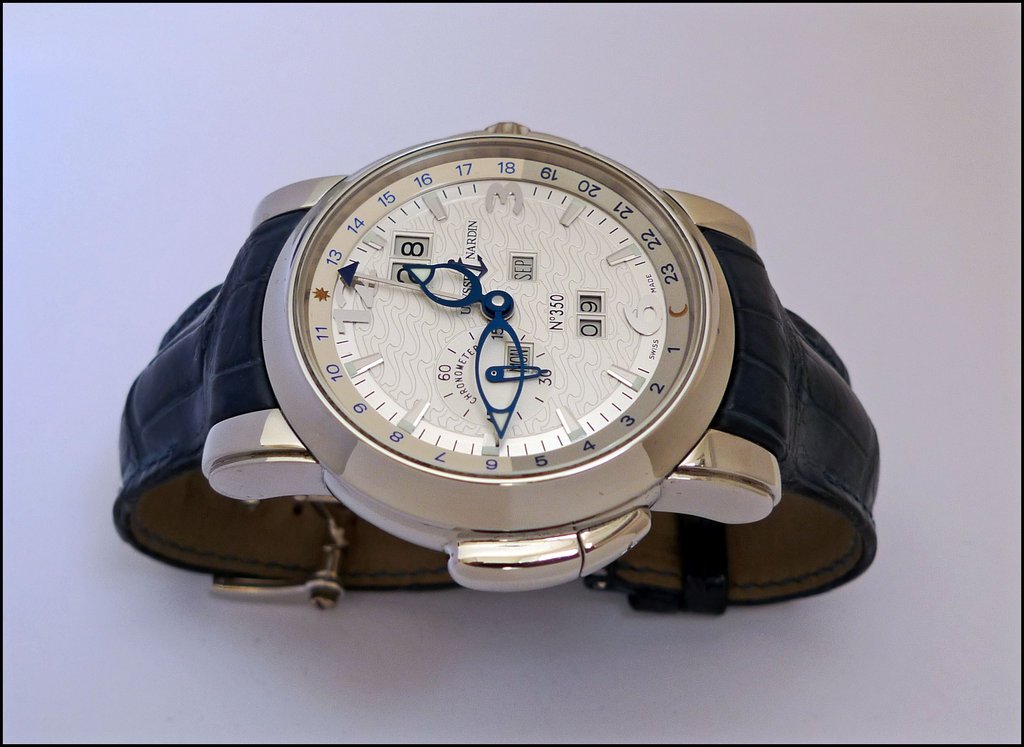
The pusher at 4 is to set the local time Backward, while the one located at 8 is to set the time forward.
To be complete, this model was developed under different presentations, in White Gold, too:
The Piccione Limited Edition ( 60 pieces, if my memory is good ) :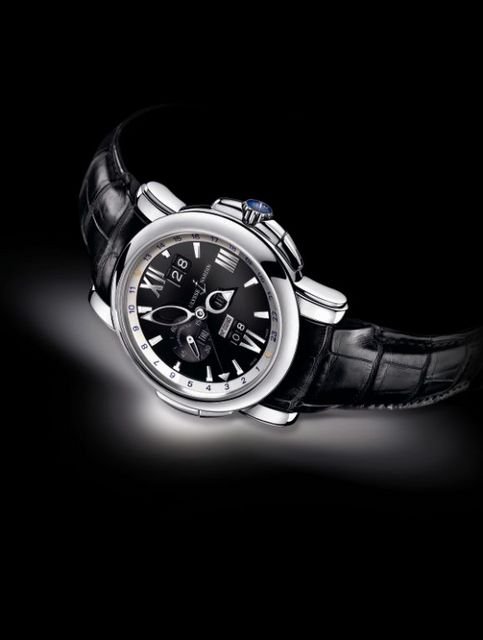
And 2 Non Limited Editions: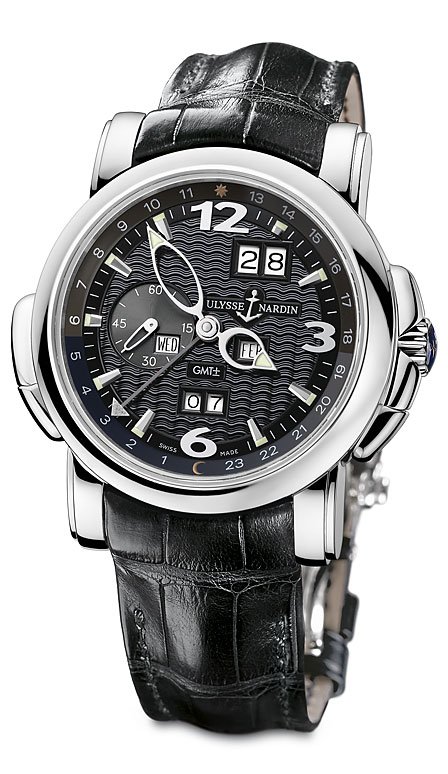
3/ The Movement:
The Beauty is also in the movement.
The Calibre UN-32 is well finished, indeed: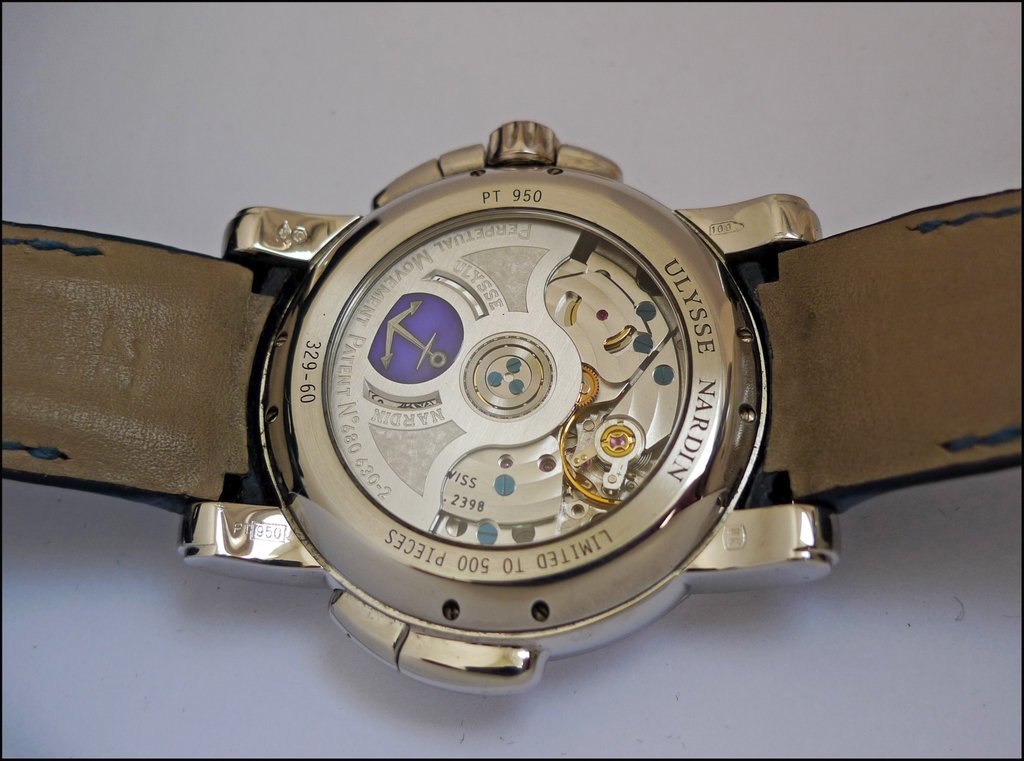
A nicely decorated rotor, Cotes de Geneve on the mainplate, blued screws, perlages, all is here.
The ebauche is a Lemania, and, as it is said in the " Making of a Masterpiece " Book, " All other parts as well as the movement assembly are produced in - house".
So, the secret is here, and the solution found for this very special perpetual calendar strictly belongs to Ulysse Nardin.
You will also notice that this movement is a certified chronometer, which is pretty accurate ( on mine, it gains only 2 seconds per day ).
Conclusion:
Once again, the Freak alone cannot sum the interest, the Genius of U.N Watches.
The Freak is certainly the most spectacular U.N Watch, the most known, but there are other marvels, like the Sonata, the Astronomical watches, and the Perpetual Calendars which deserve more than only a " succès d'estime ".
I hope that this post will contribute to give them the place and the consideration they deserve.
Best,
Nicolas This message has been edited by amanico on 2009-09-29 14:15:41 This message has been edited by amanico on 2009-10-07 03:15:16
Another expression of UN's Genius: The Perpetual Calendar

fabulous post Nico and one that is close to my heart as i have a ludwig perpetual
While preparing this post, Graham
you've spurred me on Nico....

Nico, for clarity...
Arthur
Thanks Nico
Totally agree, once again

And also the first coupled with a big date, and ....
Right, Marcus!
The first wristwatch perpetual was made - of course - by Patek ...
Great Watch
Hi, John

More beloved ovoid leaf hands!
Aaah, Daos, yes, the Sonata is my favorite, too

Aha ...
I always have something under my sleeve, Filip.
A very good case, Mr. Lawyer
In this case, things are easy, Respo

Indeed.
The Sonata and the Perpetual are priced the same, Michael


Love the perpetual movement
Damn, SJX

Well, wonderful, I don't know, but passionate ...Certainly.

More classic and conventional, indeed, Ronald.
What a wonderful post, dedicated to my topmost favourite UN! ....