Comments:

Note: all images from the internet
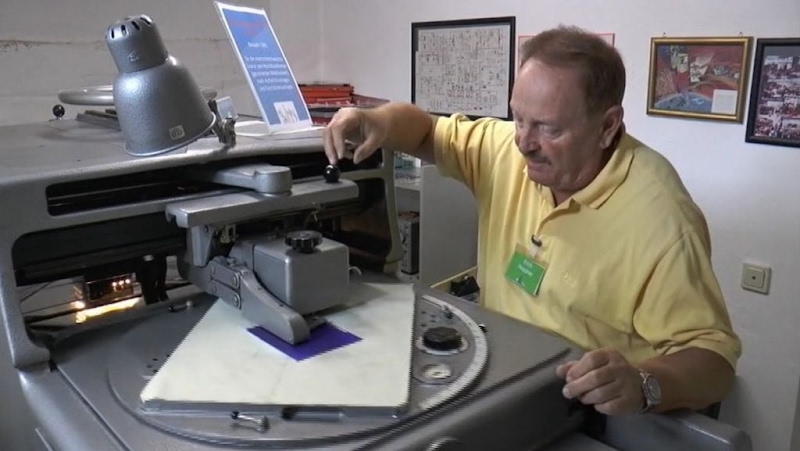
My introduction to scanning...
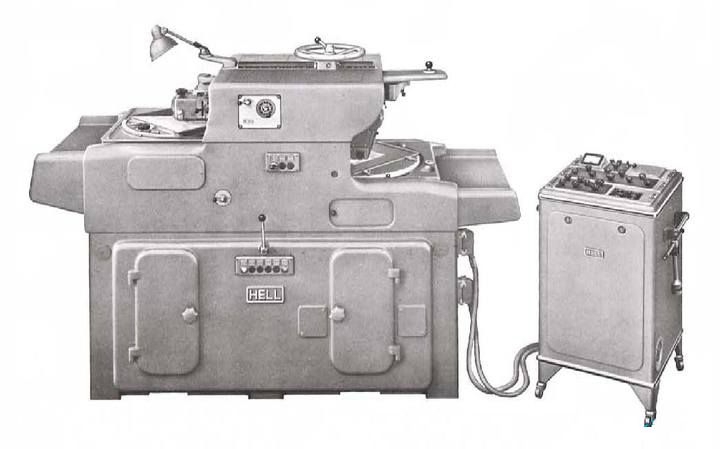
I did my first scanned halftone colour separations on a Hell Vario-Klischograph K 181 in 1966 or 67. Before that our shop produced their offset colour separations via a film/filter methodology. Our first venture into mechanical scanning was supported by a contract with the local newspaper for a fixed number of colour separations for their newly purchased four colour press... Using newsprint, we ran our separations at ~64 dpi.
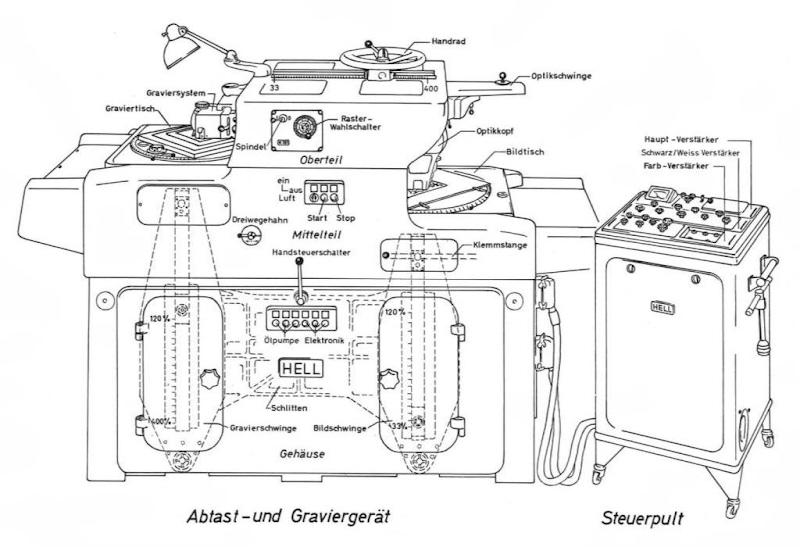
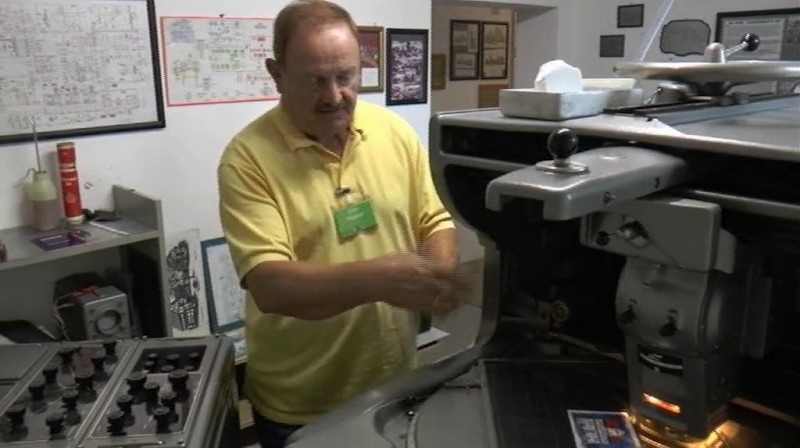
The Klischograph scans a picture line by line, and the resulting scan signal is used to control a steel stylus, which engraves shallow or deep cuts into the surface of a printing plate, depending on the grey tone value of the pixel being scanned. Colour-compatible thanks to the scanning head with colour filters.
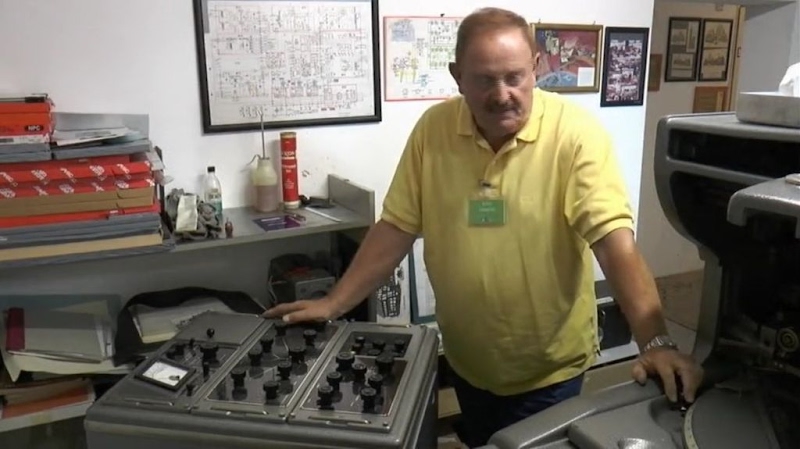
Rather than metal we used orange coated plastic for the engraving and contact printed the results to film. One scan for each of the colours plus black for offset printing... the CMYK colour model - Cyan, Magenta, Yellow, and blacK. The "controls" as I remember them were fairly basic. There were multiple dials and an analog meter that we used to set the white and black points... The control pannel was chuck full of vacuum tubes.
Note: all images from the internet
Vario-Klischograph was first presented at the 1957 Lausanne trade fair. Understatement: it was a fairly large machine at 2,320mm long x 800mm wide x ~1,600mm tall and weighed in at a hefty 1,100 kg. The results were remarkable considering the times ;-)
Casey
Note: some material / images from "hell-kiel de"
.
Don't even get me started on old print tech...
...I was speccing type and using wax and Xacto knives : ) ...even when Macs were available they weren't camera-ready yet : ) To this day I really miss the sound and smell of ink at a print shop during a press check...
Once you have worked in a print shop, ink is in the blood ;-)
thanks for the comment... Casey
I was an office slave doing the design...
...but I always looked forward to press checks and photo shoots...
For me it was a small offset shop so I did a little of everything...
Photography, type-set, layout, copy camera, colour separations, film development, plate making, press operator (17x22 Consolidated Pearl), folding, binding, cutting, drilling, delivery... most of the time I was in the darkroom... it was a great learning experience. Casey
Thanks for the behind the scene look .......
That's amazing. I got into offsett printing in 1972, but only did black and white. We had a monster camera with the copy and camera outide and the film part in the darkroom. Now it's a whole new world.
Bob
Oh Yes... the monster copy camera...
I wish I had a photograph. Like yours, the camera back was in the darkroom and the copy frame was in the next room. We could process 17x22 inch film on the camera back and had development / rinse / hypo trays to match. All chemicals were hand mixed - most likely not acceptable today... Lighting was provided by four arc lights (an arc lamp produces light by the sparking -an electrical arc- of a high current between two conducting electrodes, usually carbon rods). We normally shot max 8½ x 11 inch film (held in place on the camera back via vacuum) and did the film layout on a large light table before contact burning the offset plate.
After darkroom work, I spend a huge amount of time at the light table... with colour film we worked in complete darkness but with b&w we could use a red safety lamp... with an auditable second tick for timing...
Brings back memories... it was all a manual process ;-)
Brings back memories... it was all a manual process ;-)
Casey
.

Yes doctor, that is INK in my veins
This is motivated by Casey's scanning tale. Forgive me for being so verbose.
My first job was at a newspaper, on a machine collating the sections before dumping them in a cart for delivery to the paperboys. It was there I was told "You can't trust the sales dept; they'll say anything to sell an ad" and "Don't trust editorial; they'll write any old thing just to fill the white space between ads". So "just concentrate on production and keep your head down" and I might say, your hands and arms black with ink and bulging like Popeye after a can of spinach.


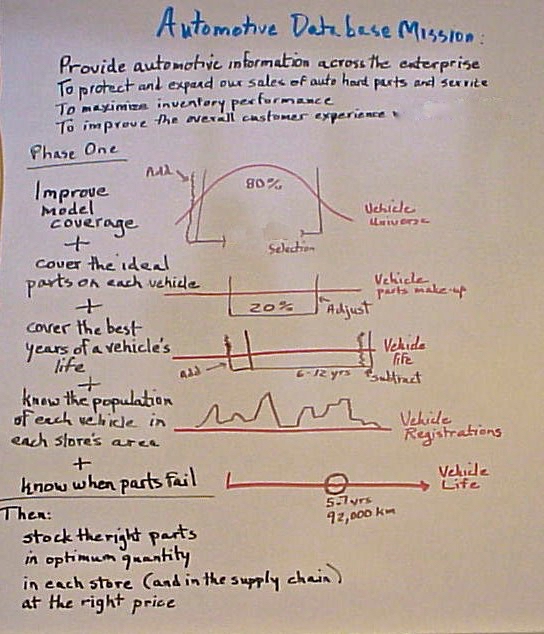
Then I got diverted into developing systems that would serve the whole "enterprise" in automotive service and repair. The white board was our strategic development tool. I did the thinking and other guys did all the hard work of coding and so forth. But I had to talk the bosses into funding the whole thing - sometimes they did and sometimes they didn't.


Actually here I was not packing books, but sending a $15,000 AP perpetual loaner watch back to its rightful owner, SteveH. I'm wearing the Rolex I still own.

I retired about 10 years ago but continue doing 1-2 books a year for myself or friends and relatives.

This chronicles our discovery of 1000 whales in one year

And that led me to developing iBooks.


Then I went to a publisher who was still setting type by hand and eventually progressed to Linotype machines. I was in editorial by then. Finally I moved to a company that did hard bound books; here's the plate for embossing a cover.
A few years later I was manager of all the editorial systems, as we transitioned from OCR readers scanning type done on IBM Selectrics and converted to paper punched tapes for output on typesetters. A massive leap forward came in 1983-4 when 16 of us got our own b/w terminals on a DEC computer. I was sent off to school to learn typesetting / programming. Eventually that progressed to developing the first electronic auto repair manual library in the late 1980's but still before Windows came out. That's my hand and ring (no watch shown) using a light pen which I decided was the best pointer device for greasy-handed mechanics.
Then I got diverted into developing systems that would serve the whole "enterprise" in automotive service and repair. The white board was our strategic development tool. I did the thinking and other guys did all the hard work of coding and so forth. But I had to talk the bosses into funding the whole thing - sometimes they did and sometimes they didn't.
This job drew information from a variety of providers and sources so required a lot of travel and fast talking. Concept to reality is much harder than people think.
After that project ended I moved into publishing math textbooks. This got me back to my roots (from a production point of view)

Notice there is no math on my computer screens! And I am wearing my new MIH hot off the presses from Switzerland.
Actually here I was not packing books, but sending a $15,000 AP perpetual loaner watch back to its rightful owner, SteveH. I'm wearing the Rolex I still own.
I retired about 10 years ago but continue doing 1-2 books a year for myself or friends and relatives.
This chronicles our discovery of 1000 whales in one year
And that led me to developing iBooks.
Writing about watches on the web is right up my alley.
Cazalea
Great story and photos Mike...
I wish I had taken some photos in the shop, it was a life changing experience. Casey
I remember another thing about film developing
You reminded me …
We ran galleys a few feet long on our typesetters. Then we ran them through a waxer, cut the film into pieces and stuck it onto the page masters. Illustrations were spliced in where they were needed. Razor blades assisted in the fine spacing of headers and footers. Plus corrections, of course.
If you are interested, there’s a quick illustrated summary here, showing 1970’s technology (and dress).
overbeck.com

We ran galleys a few feet long on our typesetters. Then we ran them through a waxer, cut the film into pieces and stuck it onto the page masters. Illustrations were spliced in where they were needed. Razor blades assisted in the fine spacing of headers and footers. Plus corrections, of course.
If you are interested, there’s a quick illustrated summary here, showing 1970’s technology (and dress).
overbeck.com
But the fun bit for me was the silver recovery machine which extracted the silver from the developing solution.
We made hundreds to thousands of dollars each year (depending price/oz) when we took the dregs down to a precious metal guy. Of course the boss kept the cash and used it to cover budget shortages or previous overspending.
Mike
We used rubber cement for the paper paste-ups...
black paper was glued in place where the photos would be located and the half-tones were taped in once the pages (negatives) were shot.
The 70s fashion photos are hilarious...
Casey
.
I found a photo that I couldn't locate last week
Here I am in the data center for the Oklahoma City newspaper, the Daily Oklahoman. They were the first paper that I knew of who went to full digital page makeup, and I was there to learn how they did it.
One thing I was told was they only rotated images during lunchtime, because it took all their processing power 30 minutes to rotate a 5x7" color image 90 degrees.
Those drives in the foreground are 300 mbytes, EACH. Only half of a CD-ROM and I think they cost about $15,000 each.

This was the editorial group at my company, which published auto repair manuals and parts catalogs. It's a manly group, isn't it? I was sort of the clean-cut kid relative to the rest of the gang.
This was the editorial group at my company, which published auto repair manuals and parts catalogs. It's a manly group, isn't it? I was sort of the clean-cut kid relative to the rest of the gang.
The fashions are re 1978

My first computer related job...
was a medical billing package running on Apple II with duel 5¼ floppy disk drives, b&w monitor of course... it was a really big story when we introduced a hard drive ;-)
Love the photos... it was the fashion of the times that I remember well...
Casey
.