Comments:


Do You Buy Quality Or Do You Buy A Brand Name?
Let's face it. Some of us get excited simply because there's a Patek Philippe logo on a wallet. Not realizing those wallets are made by an external corporate gifts supplier who hired a contract manufacturer in Florence, Italy to make the wallets.

The area where the hardware attaches to the leather strap is an area which can wear out if the strap is used for years. Thus, it should be made with a second flap as shown in the crocodile example in the photo above. This second flap can be unstitched from the rest of the strap, when it is worn out. The flap can then be replaced. And the strap would have a second life. But the lower calfskin strap would have to be cut and re-stitched. Which would effectively shorten the strap.

The calfskin example stitching looks to be machine stitched, whereas the crocodile strap is ”cous main" or stitched by hand. Again, notice the edge paint is not even on the calfskin example.

Notice the edge paint is uneven on the calfskin example. The edge paint layer is also thin, flat, and clearly shows the demarcation line. On the crocodile example; the edge paint is domed, more even, and is of a thicker layer. The artisan strap has four layers of edge paint and the leather substrate is sanded with sandpaper to create a perfect smooth dome. Four layers of slow-drying edge paint is used. This allows the edge paint to stay flexible and not crack.

The calfskin example is really ordinary quality in my eyes, as you can see more uneven edge paint in this example. Yet, millions of women chase the Hermes Kelly bag because it’s what the celebrities wear; presuming that it's of the highest quality because the brand is one of the most expensive on the market. The crocodile strap, which is obviously of higher quality, is made by an artisan in Europe; where I will write an article about in the coming weeks!
An emperor blindly trusts two conmen tailors to make his clothes. The tailors charge an exorbitant amount but really dress the emperor in no clothes at all. Claiming that only the "truly worthy" can see the magnificent clothes. Eventually, an innocent child blurts out the Emperor is naked. This is the story by Hans Christian Anderson that we all heard as a child - yet - many of us seem to make that mistake in adult-hood. We buy brands because we implicitly trust them, they're well marketed and reputable brands, and because others have endorsed the product (all while claiming we are immune to typical marketing). But we don't really understand quality ourselves - we place a blind trust into the system.
Over the past ten years, I have been interviewing leatherwood's craftsmen. Not entirely content with the products from the big Maisons (a la Hermes, Vuitton, etc.), which had mediocre corners, fraying edge paint, and other small imperfections. I wanted to see an artisan product. What is the Philippe Dufour equivalent in the handbag world? I believe I've found that equivalent and will be writing an article about him soon.
I searched in Europe, USA, Japan, Taiwan, Vietnam, and more. And I interviewed almost ten leathergoods craftsmen and ordered dozens of products. I also learned that many of the products sold by Montblanc, Dunhill, Vuitton, etc. are made by contract manufacturers in Spain and Italy, much like how Apple contracts Foxconn to make their iPhones.
Here's a strap comparison. One strap is from an artisan-level producer. The other is from a huge brand that actually makes this strap in-house (not contracted out). Which one is of ordinary quality? And which one is of exceptional quality?
The area where the hardware attaches to the leather strap is an area which can wear out if the strap is used for years. Thus, it should be made with a second flap as shown in the crocodile example in the photo above. This second flap can be unstitched from the rest of the strap, when it is worn out. The flap can then be replaced. And the strap would have a second life. But the lower calfskin strap would have to be cut and re-stitched. Which would effectively shorten the strap.
The calfskin example stitching looks to be machine stitched, whereas the crocodile strap is ”cous main" or stitched by hand. Again, notice the edge paint is not even on the calfskin example.
Notice the edge paint is uneven on the calfskin example. The edge paint layer is also thin, flat, and clearly shows the demarcation line. On the crocodile example; the edge paint is domed, more even, and is of a thicker layer. The artisan strap has four layers of edge paint and the leather substrate is sanded with sandpaper to create a perfect smooth dome. Four layers of slow-drying edge paint is used. This allows the edge paint to stay flexible and not crack.
The calfskin example is really ordinary quality in my eyes, as you can see more uneven edge paint in this example. Yet, millions of women chase the Hermes Kelly bag because it’s what the celebrities wear; presuming that it's of the highest quality because the brand is one of the most expensive on the market. The crocodile strap, which is obviously of higher quality, is made by an artisan in Europe; where I will write an article about in the coming weeks!
Thank you for reading!
Excellent. Can't wait to read the full article on this truly world-class leather goods producer =)
I almost bought a niche high end handbag co in 2024…
I think there’s a lot of money to be made in lunching downstream brands with lower quality. Still good, just more value focused.
Absolutely, lots of opportunities.
You only have to be slightly better than Hermes, and you would be able to sell in high volumes. Also, look at M.A.D. watches, the revenue from that is substantial!
Yeah the one concern I had though
Is that many people don’t really care about quality. It’s surprising to me and I don’t get it fully
People buy an image.
Driving this brand of car, wearing this brand of clothes, wearing this style of watch; all have these connotations and stereotypes. I want to be associated with those stereotypes, or I think I fit those stereotypes, thus I buy that brand of car/clothes/watch.
I don't let an "influencer" or a paid celebrity
endorser try to tell me what to buy. Personally I look for quality, in any product
over the brand name attached to it. I have said it before on the forum,
name brands and high prices do not always indicate high quality.
Look closely at what you are purchasing and choose carefully.
Gotta look closely at the Montblanc products...
The pens are made in-house and are of a very high quality (but at an even higher price tag). But the leather goods are dear in price and not usually dear in quality.
I saw an "undercover" video of
Montblanc bags being made by workers less than qualified to do so, and it was not flattering
to Montblanc. I have confidence in their writing instruments and have several, I do find them
to be high quality albiet expensive, As much as Iike their leather goods the price to quality ratio definitly keeps me
from getting anything. Looking forward to your article.
to Montblanc. I have confidence in their writing instruments and have several, I do find them
to be high quality albiet expensive, As much as Iike their leather goods the price to quality ratio definitly keeps me
from getting anything. Looking forward to your article.
That is what keeps me form buying a Montblanc
bag, fear of spending big $$$$ and getting
an inferior product. But that is the risk with
any purchase anymore. Buyer Beware!!
an inferior product. But that is the risk with
any purchase anymore. Buyer Beware!!
Montblanc has most of the pens made in-house in Hamburg.
Even the gold nibs are made in house and not contracted out anymore (they were using an external supplier at one point).
Exactly.
Montblanc pens are decent. But, if you look at other brands of pens, Montblanc can be seen as a poor value. Thus, I would say, the best pieces from Montblanc are standard 146 and 149 pens. The value in the pen is in the size of the feed and the size of the nib. Larger nibs are generally "bouncier" or more flexible and have better writing characteristics.
For instance, the Guggenheim model we both like, that has the same size nib as the 146, which has a 6mm feed. The 149 pen has an 8-9mm feed and thus an even larger gold nib.
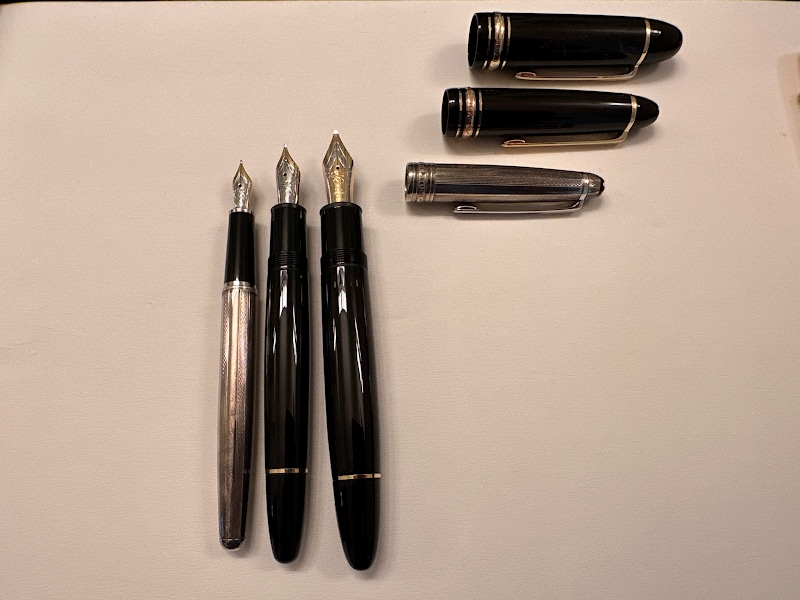
4mm feed with the standard Montblanc nib; 146 model with a 6mm feed with a large nib; and a 149 model with a 9mm feed with an extra large nib! When I say size of the nib, I'm not referring to Fine, Medium Broad; I'm referring to the actual size of the gold material.
4mm feed with the standard Montblanc nib; 146 model with a 6mm feed with a large nib; and a 149 model with a 9mm feed with an extra large nib! When I say size of the nib, I'm not referring to Fine, Medium Broad; I'm referring to the actual size of the gold material.
Other German pens that are less expensive than Montblanc and yet have a wonderful writing experience include the Pelikan brand which is very similar to Montblanc and is very wet and smooth. A Pelikan is about 20-30% less than a Montblanc and is really a great pen. I recommend the Pelikan M800 and M1000 models; which are equivalent to the Montblanc 146 and 149 models.
I also highly recommend the Pilot model of pens; they're incredibly smooth. Not quite as wet as the European brands. But absolutely delightful pens to write with.
Thank you so much for these valuable informations, mon ami. And oh, yes, we both like the Guggenheim!
I got the Borghese one.
But I didn't get the Guggenheim. The Borghese is fairly modern looking. I do like the Guggenheim, but alas, I can't use them all!

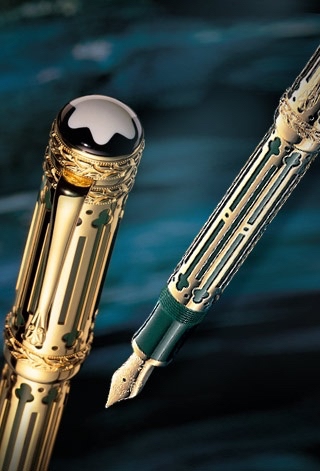
I still really like Peter the Great. What a stately pen! Totally uncomfortable to write with though! I've never written with mine, but just holding the pen, the skeletonization of the barrel can be felt by the hand.
Some years ago I was crossing the Atlantic sitting by an elegant looking older gentleman. I think our destination was Amsterdam or Paris. In any case, his final destination was China.
Eventually we started a friendly conversation and I learned he owned some duty-free stores worldwide and was traveling to China to meet with the head of a large manufacturer of clothing. To cut it short, he explained how these people would make shirts for a significant number of brands. He recited at least fifteen very well known upscale brands sold in the US and other parts of the world. They would manufacture brand’s X shirts as well as brand’s Y, K, etc. Or if you had a brand of your own they would make them too depending upon volume.
However, the manufacturer offered different types and “qualities” of material (higher or lower thread count per inch, for instance, or different materials: silk, cotton, etc). Then the buttons. The stitching and so on. So there could be a significant difference in price.. and quality. That said, then there is the “goodwill” (in accounting) or brand (in marketing). Is a Nautilus “worth” $120,000 better quality than a Datejust that sells for $12,000? Hell, no!!! On the contrary. But then, I think this conversation is as useless as it is self-evident.
Lots of those in Hong Kong.
Li and Fung is a business that does that - I don't know if they own retail stores in airports. But they do make garments for many well known brands.
Quality over a name, yes.
But, certain names do associate with a history and assurance of quality.
In Italy there are so many independent leather establishments with no particular name and which I would always choose over many standard high street luxury brands.
Really hard to find a big name that really is about quality - it's more about the history of the brand these days.
Almost hard to think of a big name that is still super-focused on quality. At least in the leathergoods industry.
Yes, it seems that big names are more focused on mass production and getting
the product on store shelves quickly that they have let quality become a thing of the past.
There are plenty of times where these brand names offer an appealing aesthetic. I've seen bags/briefcases that are are artisanally well made but look clunky. Can apply this to the shoe market too
I think about it as a journey
In my experience very few people are interested in substance and understanding the product that they buy. For example I'm always surprised at the amount of people who have no clue what kind of engine is in their cars, the same can be said about watches or leather products. I definitely don't look down on people regardless of how they approach a purchase and over the years I have learned to limit sharing my journey with only close friends and even within my family not all members could relate. What I have learned is that there are amazing people all over the world with outstanding craft. Besides quality I am particularly fond of the journey as a customer: getting to know the people, discussing options, refining your concept, making a product your own. Unfortunately very few tier one brands offer such sophistication and when they do it is definitely way beyond my means, as such I'm always looking out for options away from mainstream. I am looking forward to your next update!
I take it you're not a "Porsche person."
No offense to Porsche fanatics - I used to be one. But the 911 and the Boxster/Cayman are the only very-expensive cars that still use a MacPherson strut suspension (aka single wishbone suspension). Rolls Royce, Bentley, Aston Martin, McLaren, Lamborghini, Ferrari, Maserati, are all double-wishbone. Porsche is the only expensive car brand that has single-wishbone cars. Single wishbone cars have reduced tire contact patches in off-camber corners, whereas double-wishbone have a second pivot point to maximize tire contact patch in both on-camber and off-camber corners. The vast majority of Porsche 911 owners don't know this detail - I didn't - until one day my alignment technician explained to me why I was losing time on turns 9 and 10 at a racetrack which happened to be off-camber corners.
Imagine a very expensive chronograph without a column wheel. Or a tremendously expensive watch made in 14K or lower gold.
Cars and handbags (and even watches to an extent) are all about buying an image. "I want to convey that I'm a sporty well-to-do individual, so I sport on my wrist a Richard Mille." "I consider myself a modern James Dean, hence why I drive a Porsche." This brand is the image. Hermes represents a different image than Vuitton. And some consumers want one image over the other.
Imagine a very expensive chronograph without a column wheel. Or a tremendously expensive watch made in 14K or lower gold.
Cars and handbags (and even watches to an extent) are all about buying an image. "I want to convey that I'm a sporty well-to-do individual, so I sport on my wrist a Richard Mille." "I consider myself a modern James Dean, hence why I drive a Porsche." This brand is the image. Hermes represents a different image than Vuitton. And some consumers want one image over the other.
I guess for the layman
a brand name gives the confidence that the product would be at a certain level of quality. Whether the premium you pay for the brand over the no name product is worth the extra confidence (or quality) is another matter.
I for one have to rely on the brand name for products that I have little knowledge, yet would choose quality over brand for products of which I have more knowledge.