
A look at De Bethune - the De Bethune superthread
In early December, David Zanetta and Denis Flageollet were in Singapore to present the latest creations from De Bethune. I first profiled De Bethune in 2007 when I was deeply impressed after visiting them at Basel (click here for my Basel report of that year). Two years later I am even more amazed by the brilliant creations from the company.
De Bethune watches are of a sheer, high quality that is difficult to find elsewhere, coupled with a remarkable penchant for innovation. That is thanks to Denis Flageollet, who together with Vianney Halter and Francois-Paul Journe founded Techniques Horlogères Appliquées (THA) in Saint Croix before going their separate ways. Denis is the resident genius at De Bethune; from what I understand every single De Bethune innovation is his work, even when David conceives of an idea, like the triple pare-chute for instance, Denis is the one who executes it.
Denis’ genius extends to production and manufacturing as well. He developed the techniques for polishing titanium to a high sheen, as seen on the Dream Watch One and the titanium cases of some of the sports models like the DB24. And when I visited De Bethune at Basel in 2006, I was given to understand the waterproof, carbon fibre texture watch straps used by De Bethune were invented by Denis; even though they are water resistant they are still porous for comfort (Denis speaks almost no English so understanding technical descriptions is a challenge).
Radical as they look, De Bethune watches are utterly conventional in how they tell the time, save for the Digitale, all De Bethune watches use a pair of hands. There are no orbital, spherical or trapezoidal gadgets that float, sweep, jump or jiggle. Instead De Bethune concentrates on technical innovations in the movement and a remarkable standard of finishing on every part.
The attention to detail in terms of construction and finishing is outstanding. Take for example the hand-made blued steel plate for the moon phase which is fabricated by pressing bits of solid gold into the star-shaped cut-outs on the plate. Or the mirror finished titanium dial of the Dream Watch 1. These are admirably challenging and complex to execute. That is not to say that the level of finish is perfect. With a macro lens imperfections on certain parts of the movement are visible; you can see some in my photos. I will not point them out, I like admire the brand’s work too much to do that, but they are there.
I do not know if some of the movement innovations, like the exotic balance wheels or bevelled escape wheel, truly offer any tangible benefit to timekeeping. But whatever may be the case, the level of thought and ingenuity that goes into the movements is incredible.
One downside of this perpetual quest for the next invention is that some models never seem to be delivered. For example, the Maxichrono, a brilliant chronograph that combines all the hands into a single axis, was first shown a few years ago but has yet to be delivered. However, in the mean time the spring loaded titanium lugs of the Maxichrono have been used in the Dream Watch 2.
That being said De Bethune has a terrific record of delivering on its promises. With a production of less than 300 watches a year it is especially amazing. David is particularly proud of the fact that De Bethune manages to deliver a dozen or so in-house (they really are) movements that work perfectly (anecdotal evidence from owners bears this out).
Some may remember the first De Bethune watches, which were relatively traditional in style, save for the bizarre bullet-shaped lugs, and contained mostly reworked vintage movements from Venus, Enicar and others. The evolution to today’s collection is astonishing.
When I first encountered De Bethune I was sceptical – what achievement is there in reworking an Enicar (of all brands) automatic movement? But as the brand has developed and I learn more about the company and its people I am won over, totally. Very often in modern watchmaking the product does not equal the promise, De Bethune avoids this let down and the product is actually magnificent. David himself is conscious of what is product is and he brutally rubbishes the products of others. He hilariously describes “fusion of rubber and metal with a 20 franc ETA bullshit movement” as a lousy product.
The biggest shortcoming of De Bethune is that it starts at a very, very, very high price. The entry level DB25 automatic, the cheapest watch in its collection, retails for about US$50,000 (yes, fifty thousand). On the face of it, that is abnormally steep for an automatic wristwatch with no complications, even one with a 10 day power reserve. But there is nothing comparable with the same level of inventiveness and the quality of finish and materials. David Zanetta says, with undisguised assurance, if you create something so well made that nothing else compares, you can charge a thumping price. And that is true.
- SJX
This message has been edited by SJX on 2009-12-05 09:07:28 This message has been edited by SJX on 2009-12-05 09:07:57Part I: De Bethune dinner
Held at the Four Seasons hotel and hosted by retailer The Hour Glass, it was a wonderful chance to listen to David Zanetta explain the technical innovations of De Bethune who presented the 19 “innovations, inventions and patents” of De Bethune. The presentation is reproduced in the next post.
Food was from the excellent Cantonese restaurant of the Four Seasons, Jiang Nan Chun. I found the fried rice (pictured below) and chicken soup (I forgot) notably good.


This message has been edited by SJX on 2009-12-05 08:37:31

Part II: Presentation of De Bethune technical innovations
This is a copy of the presentation given by David Zanetta, detailing the various innovations created by De Bethune, most of which is the result of Denis Flageollet's genius.
Some of the notable slides include the one detailing the evolution of the De Bethune balance wheel. Most of them have been used in one production model or another, De Bethune constantly upgrades existing models with the latest innovations. For instance, the DB15 Perpetual Calendar, which has been in production since 2003, has seen its balance wheel evolve from something fairly conventional to the spider-like balance wheel shown in the presentation.


This message has been edited by SJX on 2009-12-05 08:37:48

Part III: De Bethune DB25 Moon Phase in rose gold
The original DB25 automatic, which I like tremendously, could be accused of being plain. This version features the trademark spherical moon phase of De Bethune.
The DB25 Moon Phase is available in rose or white gold, and two movement finishes: a conventional Swiss Cotes de Geneve decoration or a smooth, black polished finish. The Geneva striped finish is shown here while the photos of the white gold show the black polished bridges.
At 44 mm in diameter the DB25 is not a small watch, but the movement is appropriately sized with no movement ring used. The calibre inside is a double barrel manually wound movement with a six day power reserve (the automatic DB25 has a 10 day power reserve).
Like the Dream Watch 1 this uses De Bethune’s silicon balance wheel – the wheel, not the hairspring or escape wheel. The balance wheel pictured is not the silicon balance wheel, that one can be seen in the photos of the white gold DB25. This movement also features the triple pare-chute shock absorber, a titanium bridge held by two columns on each end.
Shown here is a variant with a guilloche dial; the dial is silver-plated solid gold and comprised of four pieces, the outer ring with the hour indices, the ring surrounding the moon phase, the moon phase indicator and the guilloche central portion. Made from blued steel, the leaf hands possess an arch to allow them to clear the height of the moon phase sphere. The moon sphere is two halves of steel and platinum, treated over a flame that blues the steel but leaves the platinum unchanged.


This message has been edited by SJX on 2009-12-05 08:38:06

Part IV: De Bethune DB25 Moon Phase in white gold
The stunning blue dial is heat treated titanium with solid white gold studs pressed into the dial for the stars. Close examination of the dial reveals it is not a consistent blue colour throughout, instead it contains varies shades of blue and even bronze as a result of the heat treatment, just like the actual night sky. And right under 12 o’clock sits the blued steel and platinum moon sphere, giving the whole dial a sense of purpose.
Denis Flageollet says the movement bridges are black polished which I would assume take an inordinate amount of work. This finish is inspired by identical decoration found on bridges of vintage pocket watches, particularly those made for the Chinese market, according to David Zanetta. I have never seen such a finish on a wristwatch before, though I have seen pocket watches like David Zanetta describes at auctions.
Even though this DB25 is actually conventional in design, the execution and materials used are extraordinary. This watch is absolutely stunning but the dial is so eerily blue that it somehow feels disturbing on the wrist; I am not sure if I would like to see it on my wrist. But it is a wonder to behold.


This message has been edited by SJX on 2009-12-05 08:47:11

his one..I have to get. it is priced too reasonably! a perfect pair with a certain Patek.
The Emperor finish, a traditional polish, can be so damned impressive that one will not look again at "another" traditional big brand. Ever.
After this, it will be simply emotional responses to mechanical sculptures like MB&F and more DB classic works..such as the DB Dream 1.
You killing me with this
the finishing just on par with the top 2 big brand
Thanks JX
Part V: De Bethune Dream Watch 1 with matte dial
The Dream Watch 1 is offered in several dial variations, including this sandblasted titanium finish. The fine and even finish of the dial is amazing. This version is actually fairly subtle, the other version pictured here with the polished dial is a riot of shiny surfaces.
The Dream Watch 1 is a time-only watch with a spherical moon phase. It contains De Bethune’s latest escapement in which the balance wheel is a silicon disc, so when it oscillates the motion is almost imperceptible, except for slight movements in the reflections in the silicon disc (which means it isn’t perfectly flat). I am not sure if the balance wheel is identical to the one in the DB25, De Bethune has so many different balance wheels I am confused.
Even more intriguing are the pair of pushers in the case back which allow the wearer to regulate the watch. This is likely the only (I can’t think of any other) watch in the world that allows the user to tweak the rate of the watch.
Uniquely, the massive and detailed crown is platinum, machined by a three-axis CNC machine. This is unusual, most platinum watches have white gold crown and pushers, even Lange’s piece de resistance Datograph. When I asked David Zanetta if the crown was white gold, he look almost offended, “Of course it is – everything [we use] is the best.


regulation..
SJX, thanks for the AMAZING pictures. I did not even notice the difference between the matte/polished titanium versions until I saw your fascinating macro shots.
With regards to self-regulation, I believe URWERK started offering it before De Bethune, starting with 103, and available on the (now discontinued) 201 as well.
Part VI: De Bethune Dream Watch 1 with polished dial
Polishing titanium to a glossy sheen akin to that of white gold is difficult; that is why polished titanium cases are so rare. But because it is so difficult, De Bethune decided to make an entire dial – composed of multiple pieces – out of mirror-finished titanium. The result is an extraordinarily shiny watch. It is so incredibly polished it’s impossible to photograph properly.
The downside of such a finish is that even the minutest imperfection will stand out like a pink elephant wearing a toupee, but even though the watch pictured is a prototype I could not see anything flaws with my naked eye; I didn’t use a loupe to examine it lest my eyes catch fire.


My choice for a pairing with either a Dufour or an Opus 5
So I bought one.
The amazing thing is...I didn't notice this watch before. This is one disadvanatge of having TOO many watches coming at me all at one time. However, the DBD broke thru this night, with out any problem, and I did not need any persuation.
I am so in awe of the work...that it may eclipse my anticipation of Opus 3 completely.

My Absolute favorite DeBethune now!

Part VII: De Bethune Dream Watch 3 tourbillon
And finally my absolutely favourite-st watch, the Dream Watch 3. This watch contains the world’s lightest tourbillon. The escape wheel, hairspring and cage of the tourbillon are silicon, giving the whole tourbillon a weight of only 0.18 g. It is also the highest beat tourbillon and runs at 36,000 bph. Does that give it better timekeeping? Well David Zanetta says the Dream Watch 3 shows a deviation of only about 4 seconds after 5 days wear. I’d certainly relish the chance to prove him right or wrong.
The dial is made of heat blued titanium engraved with extremely fine concentric rings while the backdrop of the tourbillon is mirror-finished titanium. Despite its wholly conventional two-handed display, this watch is one of the most avant-garde I have come across. This is what cutting edge watchmaking is supposed to be.


I LOVE DB!!!!

I am in awe!!!!
Amazing...
Look forward to seeing these in the metal hopefully someday soon. I imagine that distribution of these watches given their low annual production must be limited to a few select retailers. Kudos must be given as well to said retailers who dare stock such unconventionally finished, technically packed albeit normal looking timepieces with these astronomical list prices. It certainly takes more than just putting said watches in shop showcases but demands an open mindset and kind patience as well to enlighten all interested parties of DB's technical prowess that is beautifully manifested in its watches. Thanks for sharing JX!
Very good quality and fine pieces.
In fact, they are much better than a lot of other high end brands and the independents.
Regards
Ling
Electrical storm.
Stunning timepiece and pictures, thanks for sharing.
Vte


Great thread, SJX!
Thanks for all the work you put into this thread. It was a great read! I have tons of respect for De Bethune, and the DB26 is a true dream watch for me. I love the way De Bethune marries incredible technical innovation and a forward-thinking viewpoint with various nods to traditionalism in its finishing techniques and certain design choices.
Thanks again for the fantastic post!
Cheers,
Daos

I dont see too many tourbillons without an exhibition back..

Outstanding write up . . .
When I speak with industry insiders about which independants they most respect, De Bethune is among the two or three most often mentioned. Their watches are innovative and advanced in both technology and design, yet also incorporate traditional elements to bridge the gap between the past and the furture like few other manufacturers.
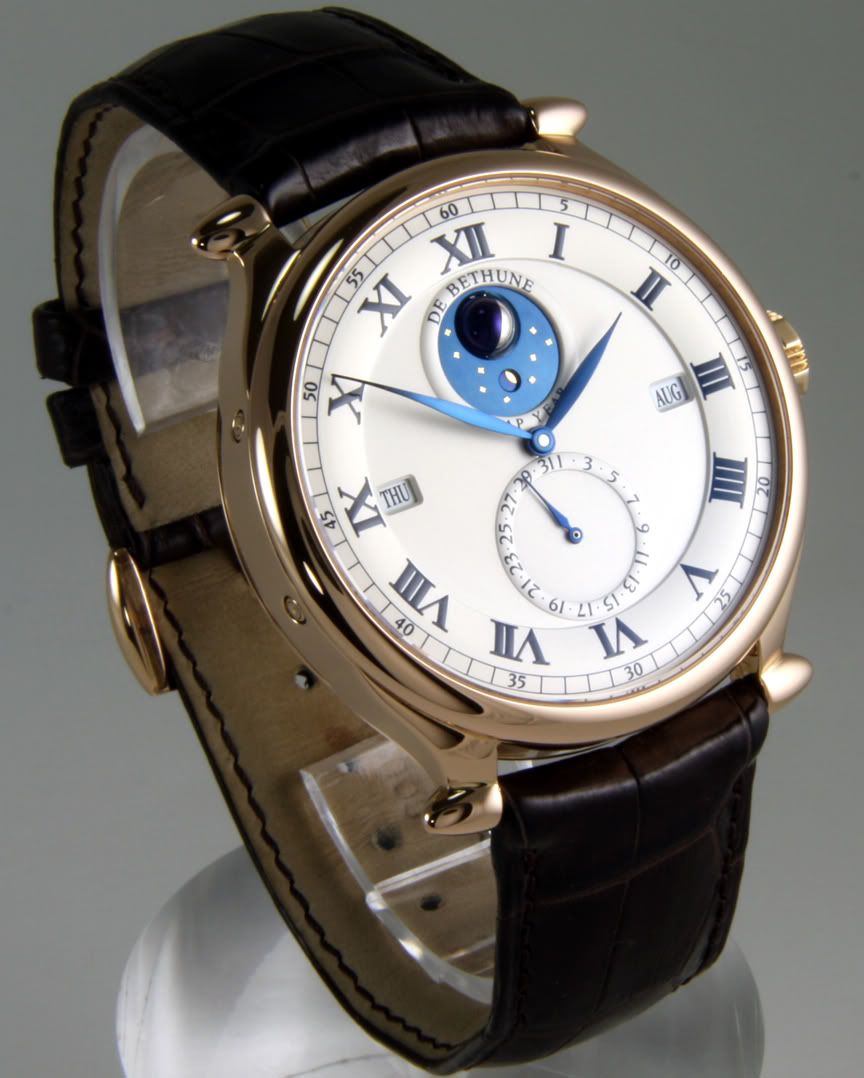
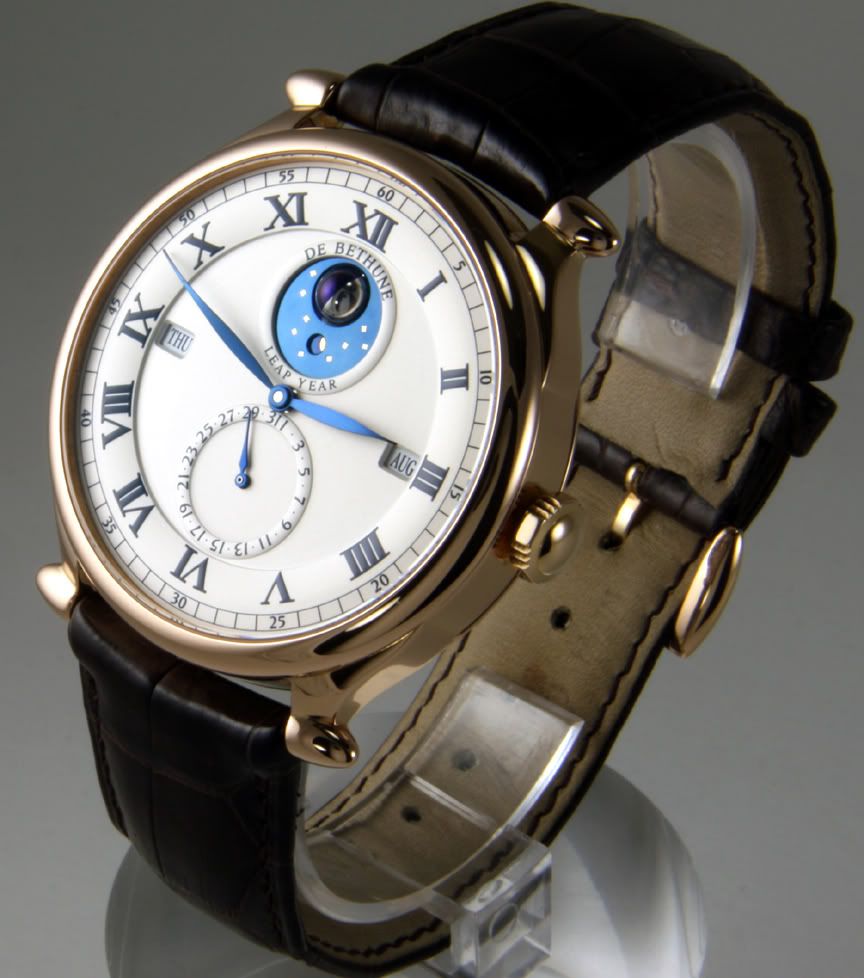
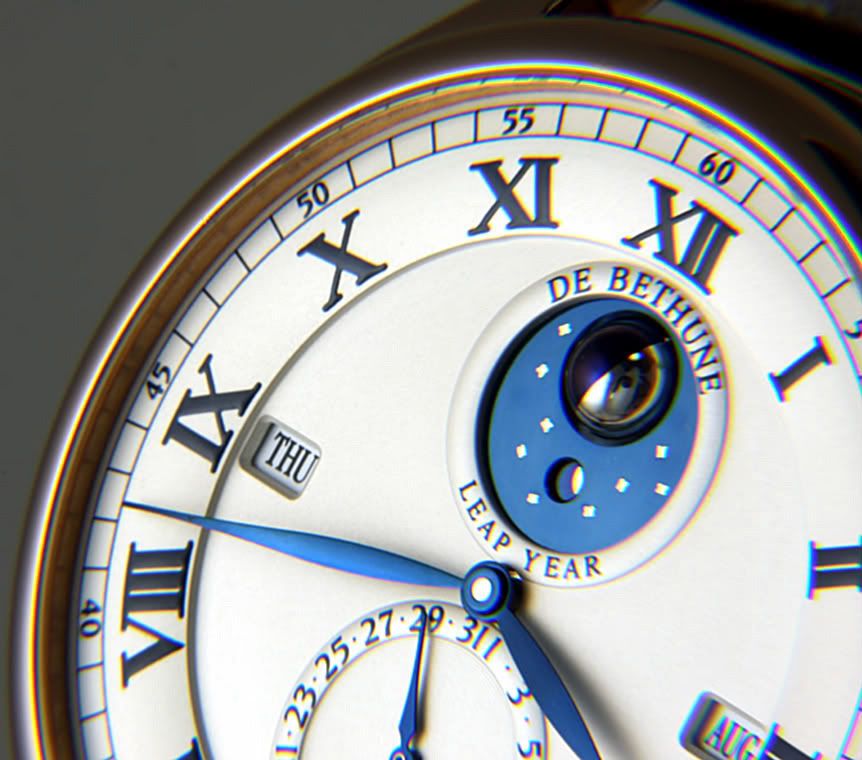
The DB15 remains my favorite:


Craig
Craig! The DB15 was what caught my eye from DB but...
... having seen, held and felt the DW1 on my wrist.... this is clearly my favorite DB now. It is very different in look, feel and function to the DB15 no doubt but given my extremely scarce resources, I think I can only settle for 1 DB at some point in time and the DW1 PT is the one I will be striving for.
I have it as my wall paper on all my computers now and will see if the look and initial wow fades.... I think it will not..
