Comments:


Twenty Years of MB&F Max Busser and Friends
It's been an amazing ride. And doesn't the time just fly away in a blink?

MB&F's Motto: The creative adult is the child who survived.
It was definitely not easy. The brand was founded in 2005 in the summer. There was no product for two years. Almost everything was running off of Busser's savings. The first product came out in 2007. Fortunately, the retailers had given Busser some deposits, funds he was able to use for company operations. Then disaster struck, one of the suppliers was no longer able to work with him. Busser, whom was low on money and on time, had to call a few friends, including his friend/competitors at Urwerk, to get extra help. In the end, Peter Speake-Marin, Felix Baumgartner, and a few other people helped MB&F get the first batch of watches made. The watch deliveries were late, but fortunately the retailers and consumers didn't complain too much.
Busser is forever thankful to the watchmakers and friends who came to his rescue. And Busser is forever thankful to the retailers who didn't cancel their orders and retract their deposits and who put their money on the line at great risk. Retailers knew it was a possibility that Busser's company may go belly up, and take their deposits with him, but they trusted him.
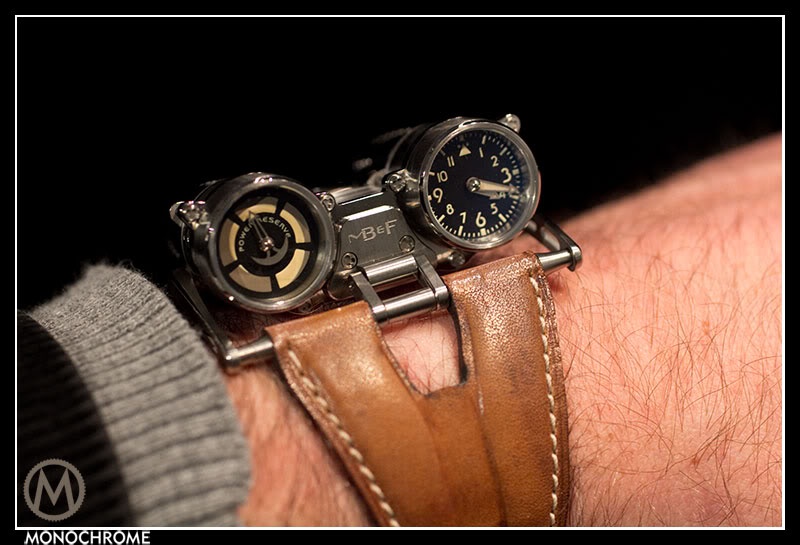
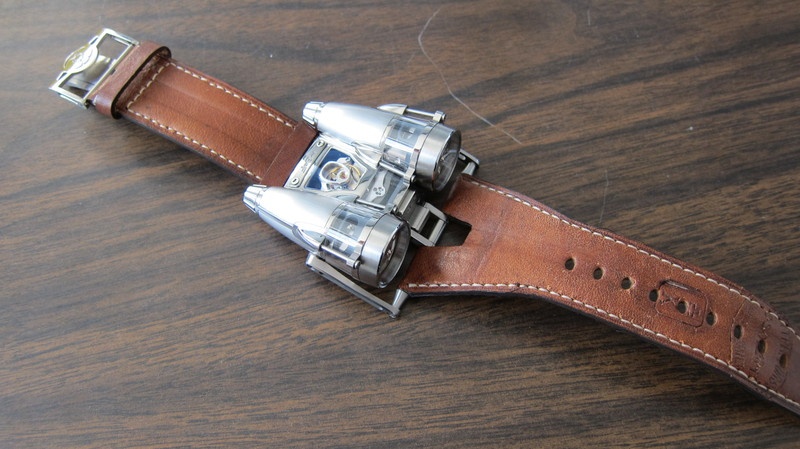
Busser is also a true artist, one who has fiercely stuck to his own style, even at the risk of commercial failure. Many of his creations are also extremely unusual and they are all very expensive. HM1, 2, and 3 are all very strange watches that appeal to super-niche audiences. They're even more niche to wear than a Panerai. And they were fabulously expensive, so they could only appeal to a tiny eccentric niche. I really liked HM4, but it's not easy to wear on the wrist. Thus, business was difficult. The debut of Legacy Machines did turn things around, this was a great modernization of Breguet's La Tradition, and was easier to sell and still very true to Busser's own artistic identity.
The business was difficult and tough for the first 10+ years or so as it was a constant juggle to keep costs under control. Without consistent profit and growth, no investors are interested - and the ones who are interested want terms favorable terms as they're taking on big risk - they also want to see product lines that are more "conventional" and this doesn't agree with Busser's artist-first philosophy. Notice, Busser's title is not President, it's "Creative Director." The Creative Director also had his own extremely aggressive milestones and his consistent expansion and growth like opening the M.A.D. Gallery, an unproven concept, was an incredibly risky move at the time. Retail is incredibly expensive and an entirely different set of expertise. In the first ten years, Busser came out with several different calibers, a new retail concept, non-watch consumer products such as music boxes and clocks, and a new line of Legacy Machine watches.
And has only gotten easier for him probably just before the pandemic, the pandemic made things super stressful, and around 2021 more production challenges and high demand challenges came.
Today, MB&F is one of the most desirable watch brands in the world. It rests on the shoulders of one of the kindest and fairest individuals, and an individual who has great empathy for others. Founded in 2005 by Max Busser, it's a perfect business test case of a successful small independent watch brand that has been created in the past 20 years. The pioneering success of MB&F (established 2005), Urwerk (established 1997), and F.P. Journe (established 1999) has also encouraged other watchmakers to build their own brands which have created a renaissance in this centuries old art form.
I raise a flute to toast Max Busser and the team at MB&F. Happy 20th Anniversary MB&F!
MB&F's Motto: The creative adult is the child who survived.
Max and his friends all are amazing! ASK yourself.... How many new MB&F movements in how many years? Not just subtle variations...
...we're talking truly unique movements each. Yes, let's us raise a glass to 20 incredible years!

Sherman, get the drinks......
You are very kind my friend. Let's also thank L'Epee 1839 for being Friends with Max. 😎😍🍺
Well, you know what enjoythemusic sings....
and a 4...3...2...
i like BIG clocks and i can not lie
You other Brothers can't deny.....
i like BIG clocks and i can not lie
You other Brothers can't deny.....
Agreed! Among the best mottos out there!
Patek Philippe's motto is good. MB&F's is another great one. Vacheron Constantin's current advertising campaign with the words "One of not many" at the bottom of most recent advertisements isn't great.
That's not really their motto....
It's 'do better if possible, and that is always possible'. Their current advertising efforts, despite not being astoundingly good, are still remarkably well done in my opinion, especially compared to what most other manufacturers have been putting forward.... Also, the latest collaboration with The Louvre is truly spectacularly good 😚🤌🎩....
Yes. I'm aware of that old VC motto.
And I would say it's not well publicized. And it's also shared by another. It closely replicates the Rolls Royce motto: "strive for perfection in everything you do" and "Take the best that exists and make it better, if it does not exist, invent it." The two brands had an informal partnership for 2012, where they co-hosted an impressive event together with consumers from both brands, and discussed the similarity of their mottos.
I wasn't aware of the Rolls-Royce motto....
But, given that the company was founded in 1906, it is certainly far 'younger' than the VC counterpart 🙂. Oddly enough, or not, I see Patek as more conducive to draw parallels with RR than VC........ Cheers, Filip
Indeed a great achievement and some truly incredible watches plus possibly the best Motto ever.
Whilst some of the watches may not have been to my taste a lot of them are and all of them carry a level of design and finish to inspire awe. I can't wait to see what comes next.
Marc
Agreed!
Some of the watches are huge and I can't quite wear them well. But they are still great works of art!!!
Max Busser and friends are remarkable but I also have to say that Max is a first class Monsieur. I always liked his " children " but the only I could wear are the LMs.
One which I really loved, the Frog, I was lucky to see in Vegas, during our IGOT II, in 2011:

Best,
Nicolas
A amazing and inspiring brand for many.
I always been in love with their watches. Pure art on the wrist imho . Congrats to max and his amazing team 🥂
MB&F was the first brand that opened my eyes to the independent, original and out-of-this-world horology. Such excellent work and outstanding creations, with lasting respect for their MAD customers.
A dream forever for me but they will always have my admiration.
Dreams do come true!
Do you like the M.A.D. watches? Those dreams are attainable. But yes, the Horological Machines and Legacy Machines are VERY PRICY!
The M.A.D. design is very inspiring, but alas not for my taste. The HM 4 and LM 1 are my Poster Watches. Look at those eyes...!!