
An “On-the-wrist” Review of the St. Gallen PVD Disinfectable “Rescue” Watch
An “On-the-wrist” Review of the St. Gallen PVD Disinfectable “Rescue” Watch
By Anthony Tsai & Dr. Mitch Katz
© March 2008
In today’s world of watches, black watches seem to be the latest “hot” trend - Audemars Piguet recently released its all forged carbon Team Alinghi, IWC debuted its ceramic cased Pilot’s double chronograph last year, and the square Bell & Ross PVD BR01 is becoming a common watch to see at watch enthusiast events. If you are hunting for a black watch and don’t have $5k, $15k, or $40k to spend, then you might want to take a look at the St. Gallen PVD Disinfectable “Rescue” watch. Not only is it affordable and easy on the wallet, the “Rescue” is a rugged, entertaining, and functional timepiece.

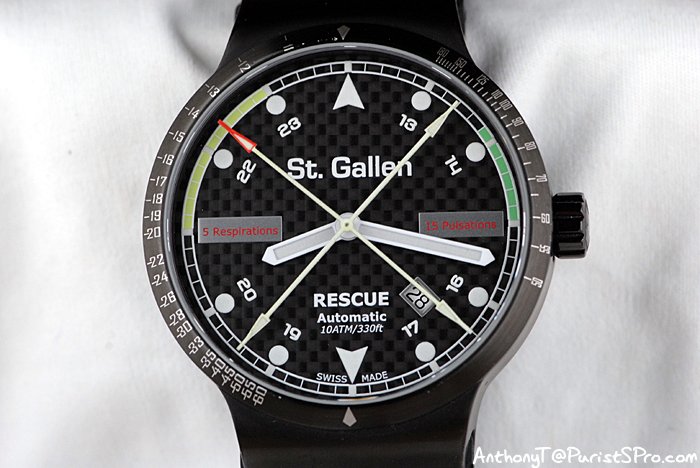
St. Gallen PVD Disinfectable “Rescue” watch
BACKGROUND
Ever since the first outbreak of SARS (severe acute respiratory syndrome) in 2002, the world that we all live in has become more vigilant and ‘on guard’ against infectious diseases, germs, and bacteria. St. Gallen is a Swiss company with international investors that produces Swiss Made watches. It is known for a line of of “disinfectable” watches, referred to as “The World’s First Hygienic Watch” that can be immersed into the harsh cleansers used at hospitals for disinfecting and killing bacteria and germs.
Many of today’s household products target sterilization and hygiene, and pretty much every home has antibacterial soap, Lysol spray, and even disinfectant wipes. Furthermore, many of us even take multi-vitamins daily to give our bodies the essentials they need to ward off infection and keep our immune systems in tiptop shape.
The battle against germs, disease, and infection is a never-ending constant battle, whether or not we realize it.
DISSECTION OF WATCH
Enough talk about disease and sterilization (I think I feel I have to go wash my hands now with antibacterial soap  ), let's take a look at St. Gallen's Disinfectable "Rescue" watch. I will dissect the watch first, and then later on Dr. Mitch Katz will explain how one can measure your pulse and respiratory rates with this watch.
Please take note that the “Rescue” watch we are dissecting today has been well worn for over a year so you may see signs of normal wear and tear.
The “Rescue” consists of 4 parts – the watchcase, 2 rubber straps, and buckle – as shown in the picture below.

4-piece construction
Case
The “Rescue” 42mm PVD coated steel case houses an ETA 2824-2 automatic movement that has a power reserve of 38 hours. The case is a seamless single block of 316L stainless steel, which has strong oxidation tolerance and is perfect to use as a daily beater watch even in medical sites. The bezel is part of the watchcase, so there are no crevices or uneven surfaces that can hide germs. The case is totally submersible and has the feel of, and is, a solidly constructed watch.

Single block case construction including bezel & “Disinfectable” etched into left side of the case
The PVD coating of the case seems “abuse proof” and less likely to suffer the small dings that daily wear and tear seems to attract. I’ve even advertently banged the bezel against my wood table several times with substantial force, and I can’t see any dings or scratches with my naked eye. My wood table has some battle scars now, and I’m fairly positive that my stainless steel Panerai’s would share the same fate as well!
Dial
The dial is very attractive with a Carbon Fiber Weave Pattern, highly legible and easy to read. The date window is between 4 and 5 o’clock; and if you look at the dial at an angle, you will notice that there is depth to the dial. The Carbon Fiber Weave Pattern layer is beneath the printing on the dial creating an interesting 3-D / floating type of effect.

Carbon Fiber Weave Pattern of the “Rescue”
The second hand is quite clever with four hands at 90-degree angles with the main second hand accented in red. Besides the functionality of the 4-second hands, there is a definite eye catching “cool/fun” factor.
Hands, dial, and hour markers are coated with superluminova giving the watch excellent luminescence in low light situations, and below is a video of the rotating seconds hand in pitch black conditions so you can see how unusual and captivating this watch is in the dark and unlike no other you’ve ever seen.

Caseback
The screw-in caseback is PVD’ed as well like the case, and the circle surrounding “St. Gallen Horology” is engraved rather than in relief.

Screw-in caseback of “Rescue”
Crown
The screw-down crown, nicely sized for easy handling, protects the inner movement from any fluid including the disinfectant solution that might be used. The crown is also PVD’ed and accented with the St. Gallen cross.

PVD crown accented w/ St. Gallen cross
Lugs and Strap
The watch lies comfortably on the wrist, even on Mitch’s small 6.25” wrist, thanks to the lugs that slope at an angle that sends the strap downwards, not outwards.

Downward sloping angle of lug for a better fit on the wrist
The medical grade silicon rubber strap is 22mm and non-tapering in width, but it does taper in thickness from 5mm at the lugs down to 2mm (strap at 6 o’clock) and 5mm to 3mm (strap at 12 o’clock). I presume the strap at 12 o’clock is thicker due to the buckle. And for comparison’s sake, the rubber strap on the “Rescue” is more pliable and soft when compared to the standard Audemars Piguet Royal Oak Offshore rubber strap.
The rubber strap slips on and off by way of the grooves in the lugs and can be easily removed for the, as advertised, disinfectability of the watch.

Grooves in the lugs of the “Rescue”
The strap is certainly supple enough to wrap around Mitch’s small wrist but it did not have enough holes in it and so it sat somewhat loosely on his wrist. My wrist at 6.75” is slightly larger than Mitch’s, and therefore I use the first hole. If you’re interested in purchasing this watch and have a smaller wrist than mine, you might want to consider ordering a short strap (I presume they make a short strap).
At the end of the rubber strap at 6 o’clock, there is an oversized hole to be used for suspending the watch with a hook-like device for dipping into disinfectant.

Picture of hole and fixed keeper
The keeper on the strap is fixed which is very unusual. All the rubber straps I’ve seen and used have mobile keepers. Mitch notes that the end of the strap at 6 o’clock, also known as the “strap tail,” annoyingly sticks out and sometimes catches his sleeve cuff, which bothers his obsessive/compulsive side. I don’t have the same problem as my wrist is larger, hence my sleeve cuffs are wider, and so the strap tail doesn’t catch on my sleeve cuff.
Buckle
The buckle also slides out from the strap for easy maintenance and cleaning just like the straps; however, both Mitch and I found that securing the buckle tooth into the strap hole can sometimes be very frustrating.

Removable buckle of the “Rescue”
You cannot just pull on the strap tail to get the buckle tooth to slide closer to the strap hole due to the friction of the rubber straps. Mitch says he frequently has to lean his wrist and watch against something to steady it in order to get the tooth into and through the appropriate hole. I found the best method is to slide the top of the buckle with your thumb towards the direction of the lugs while simultaneously sliding your index finger on the top of the rubber strap near the lugs toward your buckle. It’s very difficult to explain but you’ll understand once you see this watch in person.
Either way, strapping on the watch can be an annoyance and may take a couple more seconds longer than when you strap on a watch w/ a normal tang buckle.
THE WATCH FROM DR. KATZ'S POINT-OF-VIEW, AS IN INSTRUMENT FOR THE MEDICAL PROFESSION
I work in the medical profession where there is a constant battle against “germs,” bacteria, viruses and fungi. It is a constant struggle to prevent the spread of these agents from one patient to another. Personal accessories, such as jewelry and watches, can serve as the means of transmission by virtue of their ability to harbor these germs in crevices. Not only is the St. Gallen’s Disinfectable “Rescue” watch well designed to address these concerns, the watch is also constructed to allow the wearer to take both a pulse and respiratory rate.
How to measure pulse and respiratory rate with the "Rescue"
Rather than having to wait until the second hand reaches the 12 o’clock position or any other easily rememberable mark, the wearer only has to wait, at most, fourteen seconds for one of the four hands to the reach the 12 o’clock in order to make the desired measurements. Usually, when someone wants to take the pulse, or respirations, the requirement is to count the number of heartbeats or respirations that occur in a 15 or 30 second time frame and then multiply by 4 or 2 respectively to get the pulse or respiratory rate. St. Gallen has cleverly placed a scale on the bezel along the right side of the watch so that when a second hand reaches the twelve, the wearer then counts 15 pulsations and then reads on the scale the converted heart rate.

15 pulsations scale
Similarly, to count the respiratory rate, when one of the four seconds hand reaches 6 o’clock, the wearer counts 5 respirations then reads off the scale on the bezel along the left side of the watch the converted minute respiratory rate. This is a very clever feature and works well for those of us in need of such information; however, the numbers for the pulse were small and my old eyes had trouble reading them even with relatively new prescription lenses in my glasses. Also, the 11 on the respiratory rate scale is misaligned to the inner side of the bezel.

5 respirations scale
Lastly, as we often have to take vital signs in low light situations, it would be helpful if the two scales were luminescent.
ANTHONY TSAI’S FINAL WORDS
From a non-medical, watch enthusiast’s point-of-view, the Disinfectable “Rescue” watch is a fun watch. It’s different, refreshing, and has this 4-handed seconds hand which is simply mesmerizing to watch. Scroll up this report and take another look at the animated gif of the luminescent rotating 4-handed seconds hand in the dark. Doesn’t the watch look like it’s “alive” and “beating” like a heart? How cool is that!
I used to own a FP Journe Tourbillon and would always stare at the rotating tourbillon for a few seconds every time my eyes glanced at the dial. I find myself doing the same thing with this 4-handed seconds watch!
The PVD coating is super tough and can easily withstand everyday wear and tear. Obviously if you bang the watch against a metal railing or door, you’ll get a scrape and ding as shown in several of the above pictures of this well worn “Rescue” watch.
There are different colored rubber straps you can purchase so you can match your clothes or doctor scrubs if desired and perform strap changes on the instant in record time of a couple seconds.
The only times I would use this watch to calculate my pulse rate is after going out for a run (my Nike sneakers seems to be collecting cob webs though) so I can chuckle at how badly in shape I am nowadays. I do need to exercise and run more, but until my wife says I’m starting to get love handles, I don’t think I’d be fully utilizing all the capabilities of this watch . The 1/8 seconds counter in my Panerai PAM246 foudroyante is useless for me in real-life but who really cares? Owning a watch that lets me calculate my pulse rate on the instant is just too damn cool to have, and any watch costing over $200 is a luxury item in my opinion. I buy luxury goods to pamper myself and reward myself for my hard work, and the Disinfectable “Rescue” is a perfect watch to reward myself, buy for a fellow colleague in the medical field, or for any WIS (watch idiot savant) to own.
DR. MITCH KATZ’S FINAL WORDS
The St. Gallen Rescue is an interesting watch that did catch a number of eyes and comments from a number of my colleagues. In truth, in this digital age, sophisticated electronic devices register pulses and respirations along with various other vital signs, but this watch provides a truly eye catching, fun alternative. Besides, the reason we collect mechanical watches is not to combat the advancing surge of technology. Rather, we appreciate the workmanship that lies behind the watch and the ability watchmakers have to make a mechanical watch provide useful functionality.
Tech specs
Movement: automatic mechanical ETA 2824-2; Incabloc anti-shock device; power reserve 38 hours
Functions: date; hours; minutes; seconds (cross shape); pulsations & respirations scale
Case: diameter 42mm; seamless single block 316L stainless steel; screw-down crown
Bezel: built into case
Back: screw-in case back
Dial: carbon fiber; super luminova display; date window between 4 & 5 o’clock
Crystal : anti-reflective sapphire crystal
Water resistance: 10 ATM / 330 ft.
Strap: medical grade silicon rubber
Anthony Tsai & Dr. Mitch Katz have asserted their rights to be identified as the author of this article that has been accepted for print publication.
This article appears here by courtesy of ThePuristS.com and is published in print by iW Magazine, a FineLife Media publication. All rights reserved; March 2008
--------------------------------------------------------------------------------
PuristSPro Homepage | ThePuristS Homepage
Comments, suggestions, and corrections to this article are welcome.
© March 2008 – Anthony Tsai, Dr. Mitch Katz, and ThePuristS.com – all rights reserved

Interested in this watch? You can now purchase a PuristSPro version of the St Gallen PVD Disinfectable! For details, please CLICK HERE This message has been edited by AnthonyTsai on 2008-03-29 14:25:19

PuristS and NOT elitists.....
Thanks Anthony and Mitch for the "dissection" and medical review.
Why isn't the Journal of the American Medical Association (JAMA) as much fun?....er actually the first week of April issues are a hoot!
But seriously, as a doctor who used to be in critical care and scooping half-dead bodies off motorways, I like this watch. It's a solid Swiss watch (St Gallen is one of the highest Swiss cities) and does it's job as a disinfectable medical watch.
The current Mrs MTF likes the funky seconds hand(s?) - it's like an affordable "tourbillon" for the PuristS who are not elitist nor want to use a $50,000 watch in a cold, wet, frankly dodgy place ! Hope we don't develop epilepsy from just staring at the hands LOL.
Your review also shows that PuristS are interested in ALL watches at ALL price points as long as the raison d'être for the watch is pure.
Regards,
MTF

The benefit of the community is that we each bring different types of expertise
MTF you are absolutely correct that in general medical literature is devoid of a certain flare or sense of flare or humor.
It was a pleasure reviewing this watch and doing more than rationalizing why I should buy the next watch. There is truly a function that is utilitarian for this watch.
Enjoy
Mitch

Thanks, Mitch and Anthony, for a look at an unusual watch concept...
I have also heard this watch has been accepted for exhibition by the British Horological Museum for its innovativeness and application specific appropriateness.
Bravo, St. Gallen and PuristSPro for out of the box thinking!
TM
Even though I am not a doctor, I would like to get one.
Thanks Anthony and Dr. Mitch.
Regards
Ling


Well Done guys. Thanks for such a detailed review.

Love its originality
Oops sorry guys
Yes it is a boo boo on my side confused by the name and facts. Sorry Anthony and Dr Mitch, all the credits go to you both on his article write up and apology on my confusion and mistake. But I really like that watch. Where to get it ?
Thanks and cheers,Linda


excellent post guys. a watch like this should be on the wrist of anyone
in the emergency services and military. it should be standard issue in Hospitals to nurses, doctors, paramedics, cleaners, in the Military to everyone, the fire service and even the police. in fact anyone who deals in gunge and living bodies should have one.
on top of its excellent functional qualities IT LOOKS GREAT Form and Function in perfect harmony which is a rare thing to see.
i dont do any of the above anymore, but i'd consider buying one just for the funky windmill second hand.
the wishlist just gets bigger and bigger.
Anthony, Mitch, thanks again.
Graham
Thanks for reviewing this fascinating watch! I like it a lot!...nt


How is the crystal attached?
a

Solid job on the report
Good job Anthony and Mitch and thanks for bring this to our attention..
Thanks
Bill

Thanks, Dr. Katz and Anthony.
Thanks,
Bob
Washing and Sterilization Protocol
Excerpt from St Gallen Information Pack
A.To Clean the Watch by WASHING only:
1. Fill a suitable receptacle with tap water and household detergent solution.
2. Wash the watch in the water and detergent solution. (Only detach the watch parts for washing if it is soiled or contaminated.)
3. Rinse the watch under running water.
4. Dry the watch in a paper towel.
5. Ready to wear.
B.To DISINFFECT the Watch:
1. Follow A steps 1 to 4.
2. Fill a suitable receptacle with non-chlorine based disinfectant of recommended concentration.
3. Using the ‘T’ hook provided, suspend the watch by hooking the larger hole at the end of the long strap.
4. Place the watch in the disinfectant solution and leave for ten to 15 minutes.
5. Repeat A steps 3 & 4.
6. Ready to wear.
Remarks :
The small brush provided
with the packaging is used to scour the linear cavities of the case and buckle and to remove any stubborn dirt adhered to the watch in a very adverse
scenario.
List of disinfectants (non-chlorine based) recommended for use:
- 70% ethyl / methyl alcohol
- Chlorhexidine group (e.g. Hibitane)
- Glutaraldehyde group (e.g. OPA Cidex)
Please follow dilution method as per recommended by the disinfectant manufacturers.
Regards,
MTF
Thanks AT and Mitch for the comprehensive report. 3 questions...
2) It was mentioned on the St. Gallen website, the silicon for the straps are different from other silicon straps used in the market....
"....Its anti-shear power (to 250 ppi) exceeds any other silicon-based watch strap in the market."
What is anti-shear and how it applies to straps?
3) This watch is designed for easy disinfection with disinfectant solution or detergent.
Any tests done to verify the life of the gasket (sealing the crystal) to withstand daily disinfecting?
Kong
Microbial and Durability Testing Results
Excerpt from St Gallen Information Pack
Laboratory testing
The whole construction was subjected to protracted laboratory testing, experimenting with persistent and virulent CFUs (colony-forming units) of micro-organisms after using every known domestic and medical-strength cleaning agent and disinfectant. The net result was 100% success in maintaining the physical perfection of the watch and in cleansing it of all contaminants.
Wear-ability trials
Wear-ability trials have been conducted, particularly in relation to the operation of the strap and buckle, both under and over clothing and in adverse conditions, indoors and outdoors. Whilst this revolutionary design takes a bit of getting used to, such minor inconvenience is amply compensated for by the technically simple, robust and secure strap-fastening mechanism.
Regards,
MTF
Medical grade steel
Kong,
I don't know the real reason "functionally" for using normal stainless steel 316L compared with 904.
Maybe they don't see added advantage of sea-water resistance despite it's 100m water resistance rating?
My suspicion is that they kept to the "medical grade 316L steel" because that is in keeping with medical functions.
Regards, MTF
This message has been edited by MTF on 2008-03-05 09:18:02Sea water resistance
Although the Rescue can be used by anyone...including sea rescue, I can't see that much call for salt-water resistance of 904 steel.
Not too many clinical staff immersed in sea water for too long
Regards, MTF

The myth of 904L
904L has very high corrosion resistance, higher than 316L steel. But such high corrosive environments are rarely encountered and 904L steel is significantly more costly than 316L, so it is mostly used for marine and petroleum applications; I doubt such corrosive environments are encountered in medical situations either.
Rolex is one of the few companies that use 904L steel, but it's more marketing than any real tangible benefit.
- SJX
May a materials engineer be permitted to comment?
Type 316 stainless steel is often the default choice for corrosion resistance in seawater. However, in hot seawater (e.g. desalination plants) or under high structural loads, it does not perform as well as 904L, being more prone to pitting and cracking. Type 316 is also commonly used in chlorinated water and in swimming pool hardware, where it has better corrosion resistance than 904L. Type 316 is prone to cracking if in a corrosive environment under under heavy loads, such as architectural structures.
Note that the above mention of "high loads" indicates stresses that would immediately destroy a human arm: for use in watch cases, the difference in performance will be apparent only in circumstances that kill the wearer. If you expect to come out alive, do not concern yourself with the strength and corrosion resistance of the grade of stainless steel.
You could look up performance data on stress corrosion cracking and PREN for austenitic and superaustenitic stainless steels in engineering handbooks or American Society for Metals data sheets, but you won't find anything more authoritative than Rolex advertisements.
er....so in layman's terms
Common-or-garden medical grade stainless steel 316L as found in my medical kit, is good enough for normal chlorinated water at human loads and survivable temperatures.
I'll take that!
MTF