1000 Gauss watches: what can they stand?
we all know some watches have the movement surrounded by a ring of soft iron to protect it from the influence of magnetic fields, up to usually 1000 Gauss or 80.000 Ampere/metre. Unluckily I was no good at physics, so I wonder what can generate such a strong magnetic field or even stronger and influence the accuracy of an antimagnetic watch. Are they electric machines we use in our everyday life or not? What about that?
Thank you

Gauss strength...
Well, the difficult thing here is that Gauss and Ampere/metre aren't measuring exactly the same thing.
Ampere/metre is a measure of the strength of a magnetic field (the B field), while Gauss (or Tesla) measures the flux density (the H field)
In any case, taking Teslas/Gauss (same thing, different scale). Tesla is the SI unit and is "bigger" than Gauss.
A 1000 Gauss field is equivalent to 0.1T
An MRI machine runs at around 2.5T. 25 times the rating of a 1000Gauss watch.
There's heaps of different magnets, but the ones in a good Subwoofer are going to be in the order of 2T. 20 times the rating of a 1000Gauss watch. The strongest ever used was about 14 Tesla....say goodbye to your Milguass.
The Earth's magnetic field maxes out about halfway between the equator and the pole at 60 micro teslas. No problem for any watch.
The thing is though is that the field strength drops rapidly so just don't wave your watch in front of a loudspeaker...
Then, how useful is the 1000 Gauss protection?
You raise an interesting counter question...
I do think they're useful.
Imagine a watch with an old-syle blued hairspring. You'd have to be careful around fridge magnets! So the greatly increased non-magnetic qualities are definitely an advantage.
But there are limits. In all these specifications or claims (1000 Gauss), there are limits that are beyond the capabilities of the materials and the design. I am sure you could make a extremely non-magnetic watch, but would you wear a half-kilogram chunk of soft iron on your wrist (Panerai fans excepted  ).
).
So the question is - I can't answer this without detailed research and comparison - are watches that proclaim high levels of anti-magnetism really at the optimal level given then constraints of size, weight and acceptance?
The real question is: could they do better? I am inclined to think that in the case of the original Milgauss, which was created for this purpose, probably not.
In the case of modern watches, also probably not, but advances in materials should make this a possibility. Subject again, to the limitations above.
All of course, my opinion only, would love to hear others,,,,
This message has been edited by BDLJ on 2009-10-13 03:43:14
Good to know

Of course, I'm not telling that we should wear a frying pan made of soft iron, nor that the protection is completely useless, I just though it was more "powerful" (?)
Is there a concrete difference between an antimagnetic watch up to 1000 Gauss or, like IWC declares, up to 80.000 Ampere/metre or not?
And just to add another question, I would like to have more example of machines or appliances that generate magnetic fields stronger than 1000 Gauss and the distance where this magnetic field is so strong. Thank you and sorry for the "technical" questions.
Current IWCs..
There was a time, however, when IWC took magnetic resistance seriously: the 500,000 A/m Ingenieur of the early 1990s. All accomplished using an ETA-based movement in a 34 mm diameter watch without soft-iron shielding!
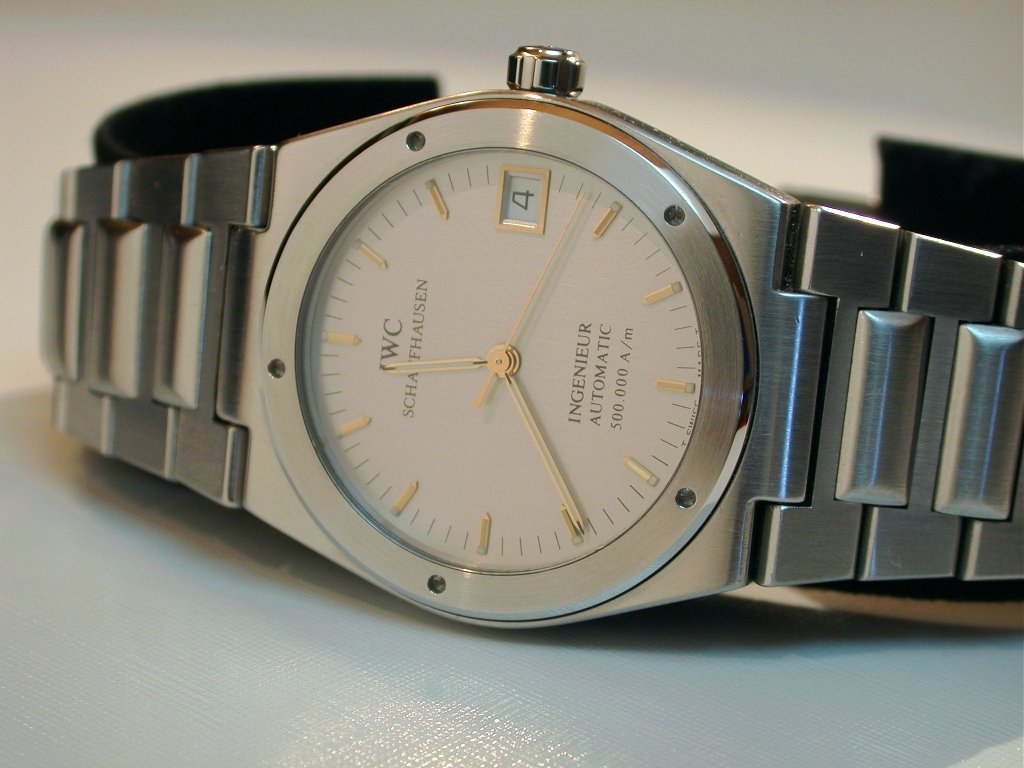
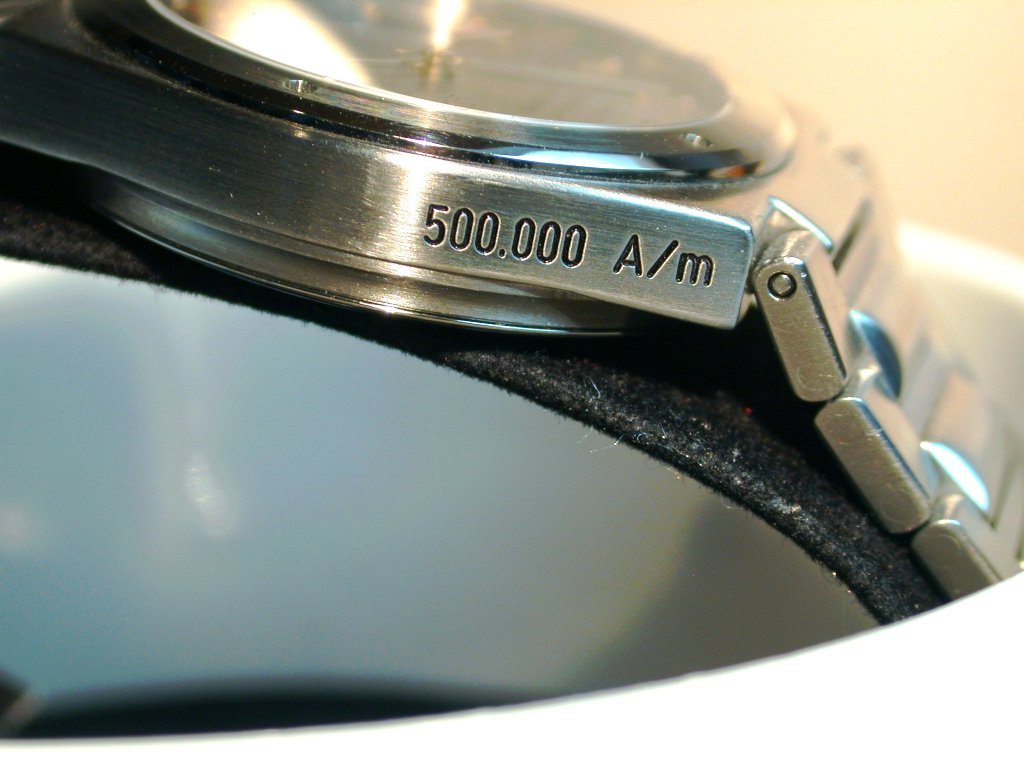
Extremely difficult to tell...
...and the maths doesn't really help in real world circumstances due to all the variables affecting both the watch and the surroundings - their resistivity, the temperature, etc.
The other thing to consider is that I don't have access to the actual test procedure used to determine the anti-magnetic number. Without this, it is difficult to determine how it might relate to real world use. (Not dissimilar to 'dive' watches that do not meet the ISO spec, yet proclaim huge depth numbers....without knowing the test procedure, who knows how long (and how) they resisted that pressure, how many were tested, etc)
So best bet is to find yourself a magnetometer and wander around near speakers, computers etc. That'll give you the best indication of what's out there.
This message has been edited by BDLJ on 2009-10-14 16:03:20

An MRI is a mean machine ....
The strength of these machines is illustrated well by the fact that non-amagnetic parts in the human body, such as older hip prothesis, can be virtually ripped out from the body, once the MRI is activated.
I had played with the idea to place the UN Sonata Silicium into it, but then I was advised that besides silicium, gold and brass, there are still many parts in the watch that are affected by magnetic fields; the watch would have probably be en severely damaged.
Regards,
Marcus
Wow...
At the end, the only thing I can say is that the only anti-magnetic watch possibile is the one whose parts are not influenced by magnetic fields, which is maybe not completely possibile in the modern watchmaking world.
I still remain with mt doubt, it is difficult to say wether an "anti magnetic" watch works in most "extreme" condition in the real life
Hi Vic,
Hi Vic,
Just to confuse you further... or add to the discussion, Wikipedia have a pretty extensive say on magnetic watch resistance.... copy below.
I have also had an interest in this subject, although my interest has been trying to decipher if the "soft inner Iron case" was necessary or helpful to assist in magnetic deflection.... .....or to add weight to supplement the lack of Gold content in the case. (considering the fact that todays alloy metals and materials if used, could virtually ignore magnetic fields)
OK I am a sceptic.... but it is very easy for a maker to skim on gold and add soft iron to give a feeling of a substantial gold watch..... while stating that this was all in the name of accuracy..... and while it might be credible in watches designed for engineers.... I find one watch company who markets to a close association of aircraft .... producing Pilots watches... uses this soft inner iron core.
Remarkably ... aircraft Cockpits are almost devoid of any material which emits magnetic fields or attractions. Radios are shielded etc.
Anyway, from my experience, I have never had a magnetic problem.... and as a game boat owner skipper/ aircraft pilot, I have always been aware of magnetic influence in relation to navigation and compass interference.
I would think it goes.... that if you have a sufficient amount of steel on your wrist to shield magnetic radiation.... then the same amount of steel could well affect your compass reading during navigation.... especially in the close confines of an aircraft cockpit.
In the old days before aluminum beer cans.... we never put our steel beer can too close to the ships compass when navigating at night.
OK so all the do-gooders ask ... why are you drinking while driving a boat... well in the real world this was the way life was many years ago before there was a law for everything... (responsibility with managed enjoyment)
Anyway... here is what Wikipedia have to say...
kindest regards,
Jack
ISO 764 magnetic resistant watches standard
The international standard ISO 764 Horology—Magnetic resistant watches defines the resistance of watches to magnetic fields. According to ISO 764 or its equivalent DIN 8309 (Deutsche Industrie Norm - German Industry Norm) a watch must resist exposition to a direct current magnetic field of 4,800 A/m (Ampere per meter). The watch must keep its accuracy to +/- 30 seconds/day as measured before the test in order to be acknowledged as a magnetic resistant watch. Annex A of ISO 764 deals with watches designated as magnetic resistant with an additional indication of intensity of a magnetic field exceeding 4,800 A/m.
There are two ways of building an anti-magnetic watch:
The first way consists in using different alloys, capable of withstanding magnetic fields. These alloys include Invar (iron - nickel - carbon - chromium alloy), Glucydur (beryllium - bronze alloy), Nivarox (iron - nickel - chromium - titanium - beryllium alloy) and Elinvar - an alloy similar to Invar, though less resistant to magnetism and more resistant to thermal influence. These alloys are preferred by different watchmakers due to their differing properties. Since the 1950s, Nivarox and Glucydur were extensively used by watchmakers[who?]. In the 1960s, almost all Swiss watches had Glucydur balance and Nivarox hairsprings. The anchors, escape wheels and other watch mechanisms were also made of non-magnetic metals or alloys.
Another way of making a watch non-magnetic is to house the entire movement into a case made of a highly conductive (permeable) material. The movement is covered by an additional soft-iron clasp to prevent the forming of magnetic fields inside the watch itself. (See Faraday Cage.)
[edit]History
The first recorded experiments in anti-magnetic watch-making are in 1846. Watchmakers from Vacheron Constantin were among the first to experiment with anti-magnetic features of a watch. However, they succeeded in assembling the first antimagnetic watch only several decades later. That watch was able to withstand magnetic fields because some of its parts were made of non-magnetic metals: the palladium-made balance wheel, balance spring and the lever shaft.
In 1896 Charles Edouard Guillaume discovered the nickel based alloy Invar. Afterwards, in 1920, when he received the Nobel Prize in Physics, he developed another alloy - Elinvar. These alloys assisted in the assembly of anti-magnetic watches. Invar and Elinvar are able to resist magnetic fields, allowing the watch to continue to keep accurate time.
The first anti-magnetic pocket watch was assembled by Vacheron Constantin in 1915. Later, in 1929, Tissot assembled the first ever non-magnetic wristwatch. In 1954 Vacheron Constantin continued to innovate by producing the first anti-magnetic chronograph. In 1958 Jaeger-LeCoultre improved the chronograph's resistance to magnetic fields by doubling its anti-magnetic case.
[edit]Usage
Since their appearance, anti-magnetic watches have been favoured by people who deal with high magnetic fields. They are widespread among electronic engineers, and in other professions where magnetic fields are present.
Today, even divers' watches (according to ISO 6425) must be anti-magnetic as well as being water resistant, sufficiently luminous, shock resistant and have solid straps.
[edit]Contributions
After discovering the alloys for assembling anti-magnetic watches many watch-making brands use the materials in production and try to improve the performance of such timepieces. The most outstanding watches of this class were made by IWC: in 1989 IWC assembled the Ingenieur. It was able to withstand a huge magnetic field of 500,000 A/m. In 1993, when IWC celebrated its 125th birthday, the company substituted this model with a more conventional Ingeneur, resisting a magnetic field of 80,000 A/m. IWC Pilots' watches have the feature of showing accurate time under a moderate magnetic pressure too.
Almost all timepieces from Vacheron Constantin have this feature, especially those from the Overseas collection. These watches had an anti-magnetic screen in soft-iron for the protection of the movement.
The Olympic Games' timekeeper Omega also manufactures watches corresponding to ISO 764, which is based on the accidental exposure of the watch to a magnetic field of 4,800 A/m. Patek Philippe has also introduced a few innovations into this field: the engineers developed a non-metallic, silicon-based material for building parts of a watch's mechanism, thus making them fully non-magnetic.