
The JLC Duometre Unique Travel Time with its competitors A comparative review
My first idea was to compare the latest Duometre UTT with a travel watch I own in my collection, and which I love a lot, the Patek World Time, reference 5110P.
Launched in year 2000, the Patek World Time ref 5110 has been a reference in this complication, replaced in 2006 by the Ref 5130.
The Patek Philippe 5110:
The Patek Philippe 5130: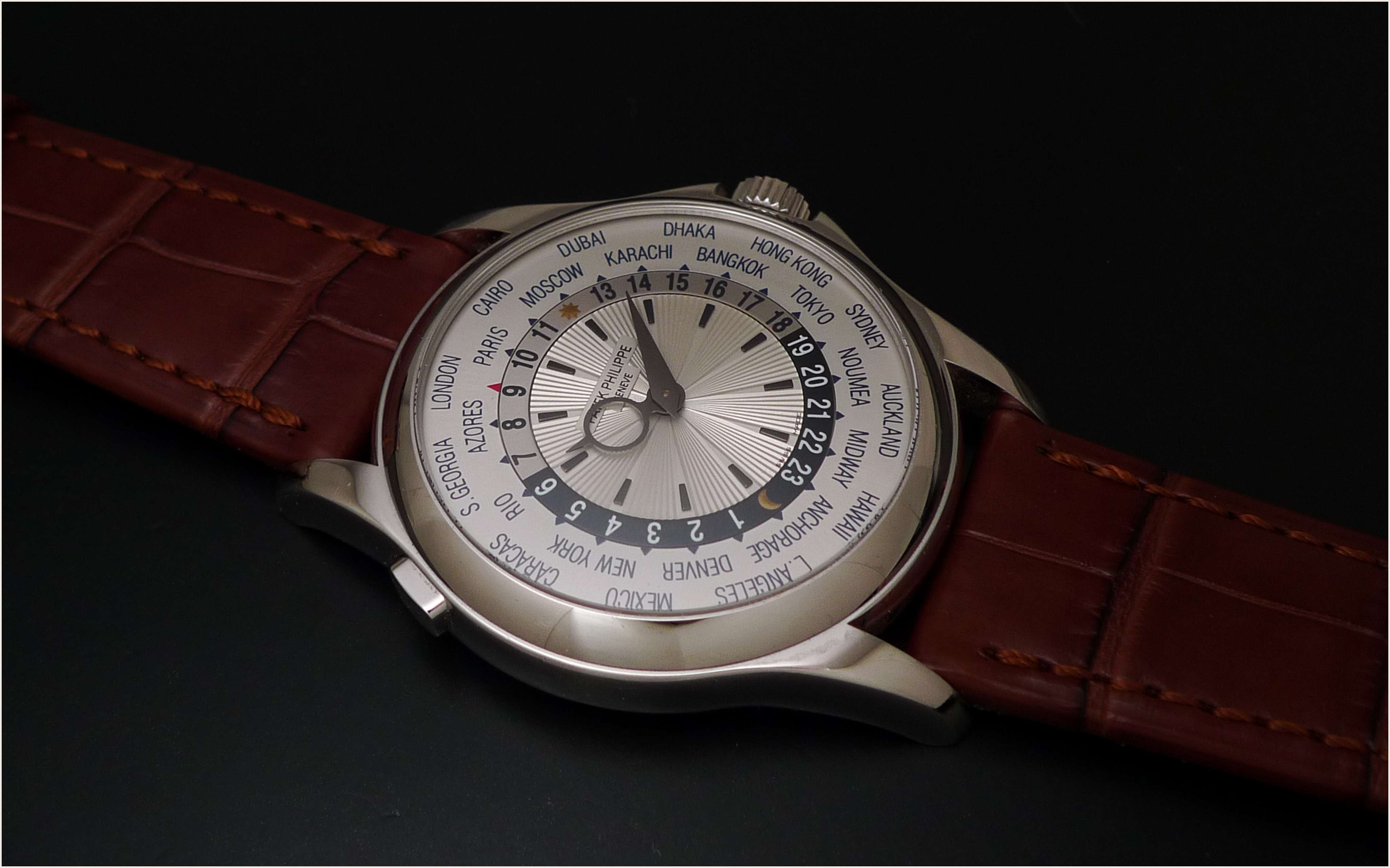
Jaeger-Lecoultre unveiled the Duometre Unique Travel time in November 2012, but it belongs to the 2013 collection.
The Duometre Unique Travel Time:
The question I aksed to myself was to know if it was worth to add this Duometre, when you already have and enjoy the Patek.
Then, I started to wonder how I could rank the Duometre in the family of travel watches, which widens the examination to other watches than the Patek World Time.
In this comparative article, we'll focus on three questions:
1/ Is the Duometre UTT a World Time?
2/ How can we appreciate the Duometre UTT, compared to the Patek World Time?
3/ How can we rate it, compared to other Travel Time watches?
1/ Is the Duometre UTT a World Time?
Let's go straight, here: The Duometre is NOT a World Time.
A World Time is a watch which allows you to have, at first glance, immediately, the time of the 24 cities of the world.
The Patek Philippe 5110 is a true World Time.
Its 24 Hours ring turns, WITHOUT intervention of the pusher, once you select the time zone you live in or you will go to, with the pusher.
On the Duometre UTT, you don't have this immediate legibility, as you have to do something to know which time it is in a part of the world.
Indeed, there are two ways to read the time everywhere in the world, with the JLC:
- You read the time it is in your place, you have a look at the case back, and then, you calculate.
In the example shown below, the UTT is set in my time zone ( Paris ) which is GMT +1.
It is 1 PM.
How do I know that?
Simple: The inner ring shows " 1 ", and the hemispherical zone is clear, not dark. It would be dark, it would mean that it is 1 AM.
The repere is the triangle at 6 o 'clock.
As I don't travel right now, I've also set the 2d time zone at the same time than my home time.
Then, if I want to know what time it is in any other part of the world, I must have a look at the case back, read the cities, and calculate.
For example, New York is GMT - 5, so, as I live in Paris, GMT +1, the difference is - 6 hours.
1 PM - 6=7 AM.
- You don't want to calculate:
You report to your case back, you read what is the time zone of the city you want to know, then you use the use the pusher at 10 if the time zone in question is + or at 8 if the time zone is -.
Then you willl read the second time zone on the subdial which is located at 10 o' clock, the window showing the digital jumping hour.
If we take the example of New York, and that you live in Paris, you will have to use 6 times the pusher at 8 o' clock, to read the time it is, there.
If we take the example of Moscow ( GMT + 4 ) and that you live in Paris, you have to use the pusher at 10 o' clock three times to know what time it is, there, on the subdial at 10 o' clock.
On the Patek, you don't have to do so, all the 24 time zones can be immediately read.
For example, on the picture above, you immediately know that it is 10. 15 PM in Paris, 4. 15 AM in Bankok, and 1. 15 PM in Los Angeles.
No need to calculate nor to use the pusher to know that.
The main advantage of the Duometre UTT is that your second time zone is clearly indicated, in a legible way.
2/ The interest of the Unique Travel Time, compared to the Patek Philippe World Time.
There are two ways to answer to this question, on an aesthetical point of view, and in terms of complications.
- The Aesthetics:
You have two very different watches, obviously: The case diameter, the dials, the hands, the case profile and finishings are way too specific to each of these 2 models to be compared.
The Patek is 37 mm big, its case is all polished, there are crown guards, the lugs are not welded and have a superb shape.
The dial is guilloché, the hands have an original shape, and most interesting, you have this inner 24 hours ring and another ring bearing the name of the 24 cities of the world which is so particular to a World Time watch.
The Jaeger-Lecoultre plays another partition: The case is much bigger ( 42, 5 mm versus 37 mm for the Patek, 13, 65 mm thick for the JLC versus 10 mm for the Patek ), with the top which is polished while the sides are brushed, no crownguards, a bigger crown, and welded lugs.
The dial is grained, with these two characteristic subdials, showing different times, and a third dial showing the Earth, which moves with the pushers, and surrounded by an inner ring which shows the 12 Hours in the GMT + Zone, and the 12 Hours in the GMT - Zone, covered by a plastic insert which indicates the day and the night time.
The two competitors, showing their profile:
Which one to prefer?
With such different watches, it is hard to give an objective answer.
I would say that I slightly prefer the volumes of the Patek, due to the fact that it is much thinner ( 3, 65 mm less thick, exactly ). 1- 0 for Patek.
I am crazy about the silver grained dial of the Duometre, and I am deeply in love with the guilloché of the Patek, without saying that the blue grey color is to die for. 1-1, here. While it would be 2-1 for the JLC if we consider the dial of the 5130.
The crown of the Patek is a jewel, but much less comfortable to wind than the JLC. And I much prefer the absence of crownguards, while I love the Calatrava Cross Signature on the Patek.
1-1, then.
Aesthically speaking, Patek wins 3-2.
- The horological point of view:
Let's see this aspect under two angles, the concept ( complications ) and the movements.
The complications, as explained above, are not the same at all.
Let's say that the World Time is a dream rather than a tool ( even if it can be useful ) while the Travel Time is more a tool than a dream.
Indeed, in my opinion, at least, the World Time is more charismatic, and the Travel Time is more useful.
I would also say that the JLC Travel Time is more sophisticated, too, as you can go backward and forward in the time zones, which you can't do with the Patek World Time, which can only go forward, a problem when you travel to the western countries.
Therefore, you have a jumping and digital indication of the hours on the JLC, and the minutes can be set at the exact time you want, with increments of one minute, which is not possible with another Travel Time, the Patek 5134, because you only have one minute hand for the local time and the travel time.
The Patek 5134, in the four metals ( Yellow Gold, Rose Gold, White Gold and Platinum )

Is that important to set the minute hand at a different time?
Yes, for two reasons:
First because you may travel in countries which have a difference of half an hour in India and Birmania, while there is a difference of 3 quarters of hour in Nepal.
How can you do with a World Time or with a classic Travel Time like the 5134? It is just impossible.
Then because you may just want to have another hour than the civil time:
Let' s imagine that you are the kind of person to always be late. You would prefer to set your minute hand 10 or 15 minutes after the cilvil time, just to avoid to be late.
That is JLC conception of " UNIQUE " Travel Time " which stands for YOUR " own time.
The planet Earth is a nice decorum, which turns with the pushers, as well as the day night indicator and the GMT + / - hours.
A very complete Travel Time, here.
So the score should be: 1 Patek ( for the Dream ) - 2 Jaeger-Lecoultre, for the sophistication and the utility of the concept.
The movements:
The Patek movement Cal 240 HU is very nice:
Correctly finished, it is very pleasant to see, and its micro rotor is a big part of the pleasure, for sure.
It is quite small, but still coherent with the size of the case and it doesn't seem lost or sunk, here.
The dimensions are 27, 5 mm ( diameter ) with a remarkable thinness ( 3, 88 mm ).
Beating at the pace of 21600 alternances, and offering a power reserve of 48 hours, it is made of 239 parts and 33 jewels.
I will shortly mention the Cal 215 PS FUS 24H of the Patek 5134 Travel Time, which is less interesting, in my opinion.
Much smaller, it is lost in the case: 21, 9 mm for the movement / 36 mm for the case.
Beating at 28800 vibrations per hour, and offering a power reseeve of 44 hours, this manual movement is made of 178 parts and 18 jewels.
The Duometre UTT movement, Cal 383, is playing in another league.
The first feeling you have when you look at the Duometre movement is admiration.
Admiration for its concept ( Dual Wind, one barrel and its dedicated gear trains for the Time, the second one for the complication, the Travel Time, in this case ), admiration also for its decoration, even if, as a very picky person I am, I would have loved to see a slightly higher level of finish, on this movement.
But the Patek Cal 240 HU is not better in terms of finishing, in my opinion.
The Cal 383 beats at the same pace than the Patek Cal 240, 21 600 alternances per hour, and offers a power reserve which is very close, although a bit superior ( 50 hours ).
It is made of 498 ( Yes, you read it correctly, 498 ) parts, which is almost one hundred more than for the movement of the Duometre à Chronographe ( ! ) and 54 jewels, which hilights its level of sophisitication, compared to the PP Cal 240, and I don't even mention the Cal 215 PS FUS 24H!
A side by side picture speaks better than figures and words:
Of course the Cal 240 is an old movement, produced for the first time in... 1977, and we have to remind this, when comparing it with the much younger and modern Cal 38x from the Duometre Family.
But I have to say that when you compare both of these movements, with a side by side picture, well, the Duometre movement is hard to beat, and this will certainly not be the Cal 240 which will beat it!
So, the score is 1- 0 for JLC, and even 2-0 if we compare the UTT with the 5134 Travel Time from Patek.
Some other criterias I would explore:
- The use of the pushers:
For all those well know the modern Patek World Times- 5110 or 5130- we can all agree that the pusher is not the bigger virtue of this watch, as it doesn't have a very pleasant feeling, and it seems that the ring of the cities will jump out of the dial, when you use it.
The JLC Duometre UTT is another story, in terms of comfort and pleasure.
1-0 for JLC.
- The Iconic side of these watches.
The Patek 5110 or 5130 is an icon, undisputably. While the Duometre still has its " lettres de noblesse " to write and gain.
But one watch ( The Patek ) is 13 years old, and much more if you consider the first ones which are reaching the sky at watch auctions, while the UTT just saw the light, and is not already delivered to the Paris Boutique.
1-0 for Patek.
So the total score and the winner is... 6- 5 for Jaeger-Lecoultre, and the score is even larger when you compare the UTT to the Patek Travel Time.
3/ Is the Duometre UTT THE new milestone, in terms of travel watches
Was it pertinent to compare the Duometre UTT and the Patek World Time?
We saw that they were playing two different partitions, in terms of complications.
But the UTT and the World Time both share the spirit of Travels, and both are the flagships of their respective brands when it comes to travel watches.
So, yes for this sole reason, we can compare them. Also because they are two very nice and attractive watches, while the UTT clearly beats the Patek 5134, which is closer to the JLC than the 5110, from a pure horological point of view.
The true competitor of the UTT is the Parmiginani Kalpa Hemispheres by the way, but I much prefer the JLC for its movement and its design.
The Parmigiani Kalpa Hemispheres:

The other competitor is the FP Journe Octa UTT.
A seducing dial, a case with some nice volumes, the Octa UTT is an interesting Travel Time, but not as sophisticated as the UTT.
Indeed, you don't have a specific minute hand, for the second time zone, and if the integrated pusher is a good aesthetical solution, it is not as friendly as a classic pusher.
Therefore, the map of the world is hard to read.
And the movement cannot compete with a Duometre, in my opinion:
The last competitor is maybe the closer to the Duometre UTT, the Lange One Time Zone:
A beauitiful manual movement, with a bigger power reserve ( 72 hours ), but more conventional in its architecture:
And a very complete travel time, with two dials ( the main subdial is for the home time, the smaller for the dual time ), two day night indicators ( ! ) and a ring bearing the name of the 24 cities of the world which you can select to set the time of the place you are.
Aesthetically, it is a matter of choice. Some will prefer the busy dial of the Lange, others will be happy with the cleaner dial of the JLC.
Same for the cases, which are very close in shape and diameter ( 41, 9 mm for the Lange ), the Lange having the advantage of a thinner volume.
BUT the JLC is a tad more sophisiticated, as you can set the minute hand of the time zone independantly, which is not possible on the Lange.
Back to my original comparison, and to end with this review, while I was writing this article, I asked to myself: " Would you trade your Patek 5110P for a JLC UTT "?
I think my answer means a lot to sum my feelings, here: I won't trade my Patek for this UTT, BUT I would gladly add this UTT to my Patek.
Why? Simply because they are so different in their common expression of Travel that they are complementary.
Therefore, through this long examination of the Duometre UTT, I now got the convinction that it is, without any doubt, a new milestone in the category of travel time watches.
Looking forward to reading your thoughts and comments,
Nicolas

That reads like an epic battle between major forces.
You asked for thoughts and here are mine. I have no personal or professional use for worldtime watches as I need to know time in a maximum of two timezones at each instant. Therefore, it is easy for me to incline towards the Duometre with its cleaner dial. I would have preferred though that the left side dial be fashioned in regular hands format like on the right side dial, like a mirror image (think MB&F Legacy Machine No. 1).
Honestly, I am not sure of the advantage of the digital hour window. Does that hour ring contain only one set of numbers from 1-12? Or are there two sets with differing colors for AM and PM? If the latter is the case, then I can appreciate instantly the advantage of the digital hour window. I remember seeing some promotional pics where the digital hour appears in red. But given disc size, font size and spacing, I cannot see how two sets of 1-12 in two colors can fit in. Maybe my memory is playing a trick with me!
Anyway, thank you for the insightful review. It is indeed necessary to revisit these topics every once in a while to feed the mind.
Ruckdee
We all have our favourite complications, Ruckdee.
I can understand that a Travel Watch is not a priroirty for those among us who are not frequent travelers.
On another side, are we fascinated by complications we only use? For example, how many of the Chronograph fans use this complication?
As for your question, no, there is no 24 hours scale on the jumping second time zone digital hour. But the inner ring helps you to know if you are in the AM or PM area.
Best, my friend.
Nicolas
You made a good point. Yes, I am fascinated. That's why I read...

Will show this thread to a friend who is considering both the Patek Worldtime and the Duometre with moonphase. He is a frequent traveler and may be interested to look at the Duometre Travel Time as a good option between the two. Thank you.
Ruckdee
;) Thank you, Ruckdee. Your friend should see it in the real life....
It is much better.
Best,
Nicolas
Thank you for this great review...
It is a pleasure, Social. If I could contribute to make you love them, that would be the
Nicest compliment!
Best,
Nicolas This message has been edited by amanico on 2013-12-31 03:45:13

This is a review to top all reviews!

A brilliant review , thoroughly enjoyed it

And my two time zone

I'm happy with these
These are two icons, in the travel watch world...
But the Duometre UTT has to write its own history, to become an icon. No doubt it has some strong assets, for that purpose.
All the best, my dear friend.
Nicolas

I knew that emotionally you wanted the JLC

As for the deposit, well, I hope to be able to do it.
The problem is that I realized that I " needed " both Duometre, the Black Chrono, and the UTT. Funnily, because I have the Patek Competitors ( the 5070 and the 5110P )
Thanks for reading, Joe.
It is up to me now, to ask you the same question: Are you in?

Best,
Nicolas

A stellar review.. Of marvels, similar at first sight but quite different in reality ! ..
your hypothetical examples, which was great, to follow the thoughts, your thoughts..
Also - for completeness sake and helpful as well, you balanced beauty vs function,
and concept vs appeal..
To summarize, for me that is another very systematic review, but with enough emotion
( you said it, you need both - guess you might have anticipated this a priori
Also thanks a lot, as this is a somewhat complex theme, where psychology
and way of rationalizing and reasoning play a role..
For my humble part, I just need two time- zones, so my good and trustworthy
Reverso Gd GMT is way enough, ( I usevit a real lot !) and
- for a bit more on the indication, and decoration - side ( no complication in reality) I enjoy looking
on my Memovox International, again knowing these limitations,
- and finally I do still use my Geographic, on the classical side, which takes a while though if you have to look
for a given timezone.
If a profane question is allowed : are UTT and the Patek(s) in a similiar prize range ?
( if against the rules, please ignore/ delete the Q..)
Thank you so much for this work and what again is a very enjoyable and informative read ;
Exactly the right stuff to dive into during the holidays..
My best, for the evening and the rest of the Festive days !
hs
Your bases are pretty well covered with such watches, hs.
You have to be mad about this complication to go deeper in the theme...
As for your question, yes, both the 5130 and the Duometre UTT, in the same version, in white gold, are approximatively in the same price range, the Patek being 4 K Euros less expensive, but less sophisticated, horologically speaking...
Best, my friend, and thanks for your input!
Nicolas This message has been edited by amanico on 2013-12-25 08:40:29

Another great review Nico!
Another superb review of yours that I read with great interest, many thanx Nico!
And as Ruckdee very well put it "an epic battle between 2 major forces".
But even if the score is very tight (I accept the verdict of your fierce battle) I must say that, to me, one key factor is missing, and even probably THE key factor that counts more that any other one: love! I know there isn't any other factor more subjective than this one: probably many PuristS friends will push me through the window (joke) but please forgive me if I put the score 5-1 for Patek on this one (the 1 that I give to the UTT on this one is more for the very high respect due to JLC than for the UTT itself). Indeed, the UTT lets me cold while the 5110P makes me excited like on the first day! There is something special that I can't explain with the 5110 (specifically the Pt version) that would not make me hesitate if I would have to vote.
But love is obviously very personal and thank God is not necessarily shared by all for a specific watch; so surely many others will vote for the UTT and they will be equally right. ;-)
Best,
Mike
There are several things I must precise....
If we are talking about Charm, the 5110P is a clear winner. Not that the UUT lacks charm; but the 5110P is playing on another league.
I will repeat it once again, but when I saw the first official press release, the UTT let me totally cold. I can also confess a certain negative à priori... Till I saw it in the flesh.
And even... Love became stronger and stronger for this Watch. It took me some time to warm on it...
Thanks for your input, Mike. Much appreciated ,as always!
Best,
Nicolas

What a review
This must have taken you quite a bit of time for this review. Much appreciated and great pics. Perfect for the holidays when some of us have the luxury of time to read. Many thanks
The duometre movement has a warm mesmeric charm

You already have a Duometre, Seeks? So, what are your thoughts on this one? [nt]
Yeah, this old one
It follows me to quite a few events too

UTT - I must admit I didn't warm up to it at the beginning, partly as I do not travel as much now. BUT I realised it doesnt have to me MY own unique time, it could be anyone else's timezone if one needs it. Or any important event for the week that is away from the home time. The globe is stunning and I do not find it imposing.
Still, the duometre with the highest ranking on my list is the WG chrono! Been thinking about it for awhile and your many posts about it drive it higher
The two WG pair would make an interesting photo composition, no?
Cheers
-- Seeks
The " own time " concept is great.
Therefore, the Travel Time is important if you have friends, clients or partners all over the world, and that you want to contact at some time.
I often use my travel watches for that purpose, by the way.
And to tell you all, a Travel Time, Wrold Time or GMT makes me travel in my mad head.
Oooh yes, a white gold pair would be stunning. A Trio even better!
Best,
Nicolas
Heh. Those would be a great trio to own - agreed :)
Kind regards.
Happy, very happy to see that you are a Duometre Fan, my friend.
This is the most interesting family of products, at JLC, in my opinion.
Best,
Nicolas

