
Royal Oak Jumbo
Can't resist to the pleasure to post here some quick pics of the Original Royal Oak, the one, the only one, which started the R.O Saga.
A small package, with a box which you will easily store:
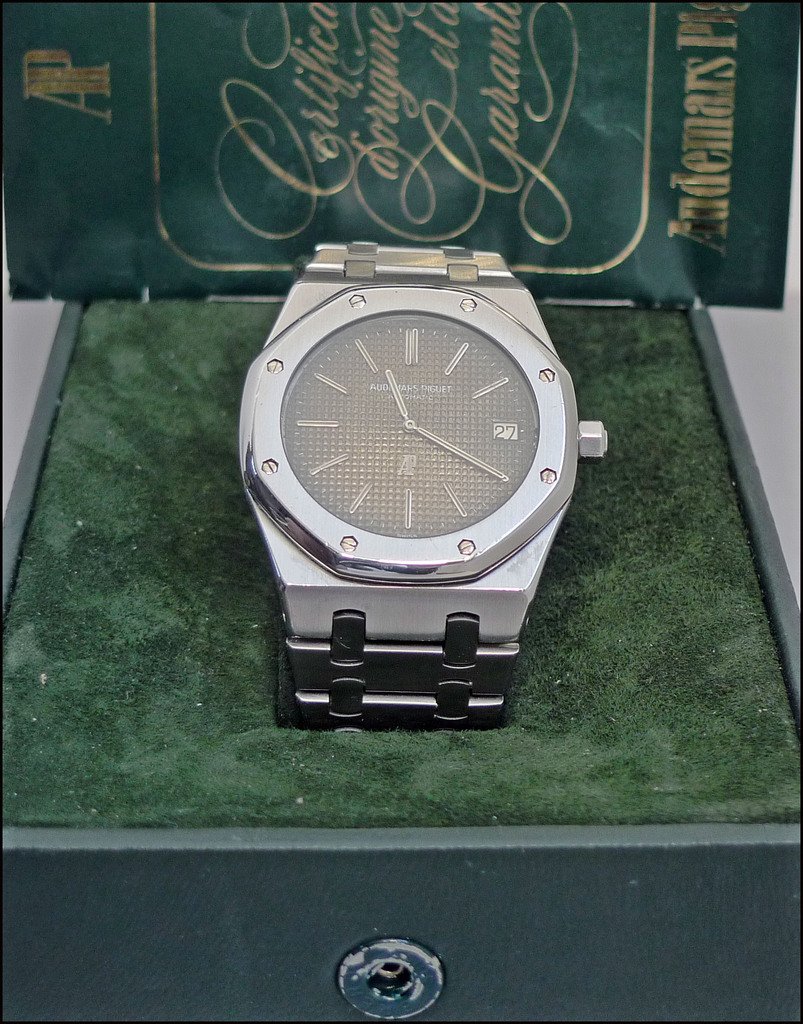
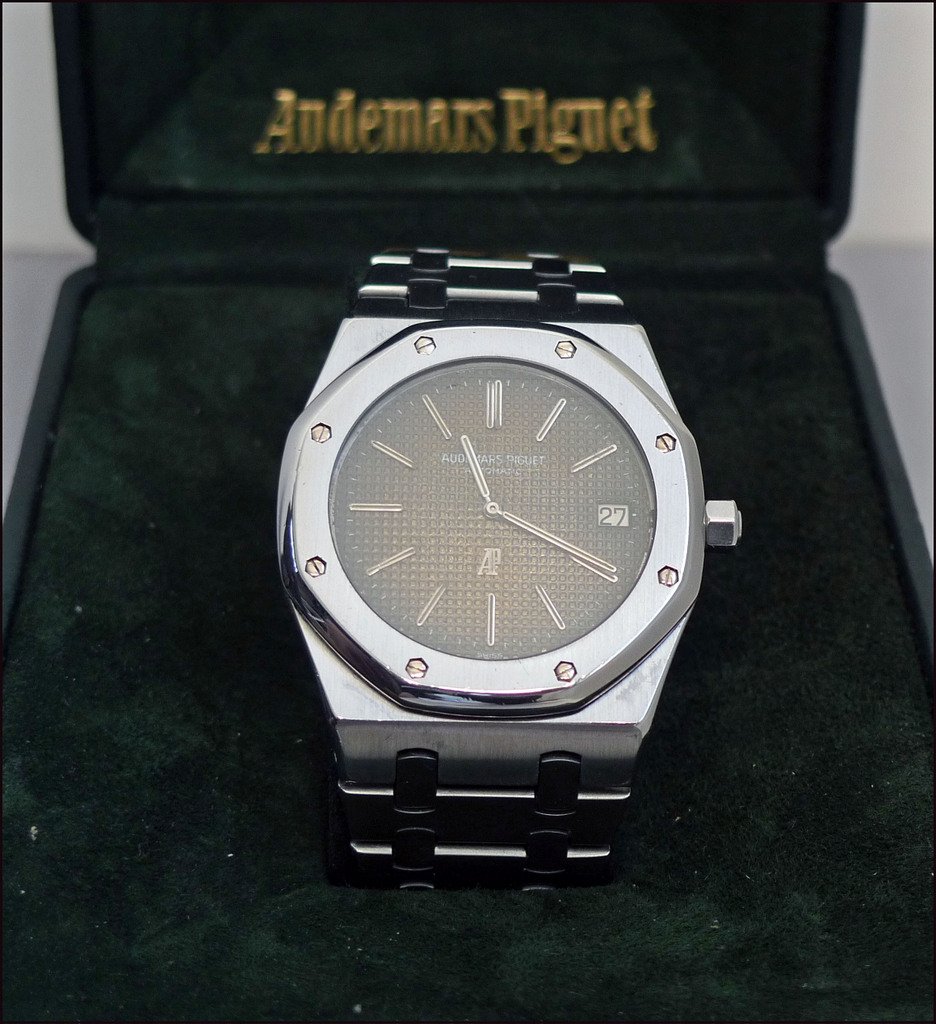
If I was attracted by this Original Royal Oak, it is not only because it was the first, but because of the great purity, strenght, beauty of its design.
Here a pic with the original blue dial in the background ( before it gets this stunning brownish patina )
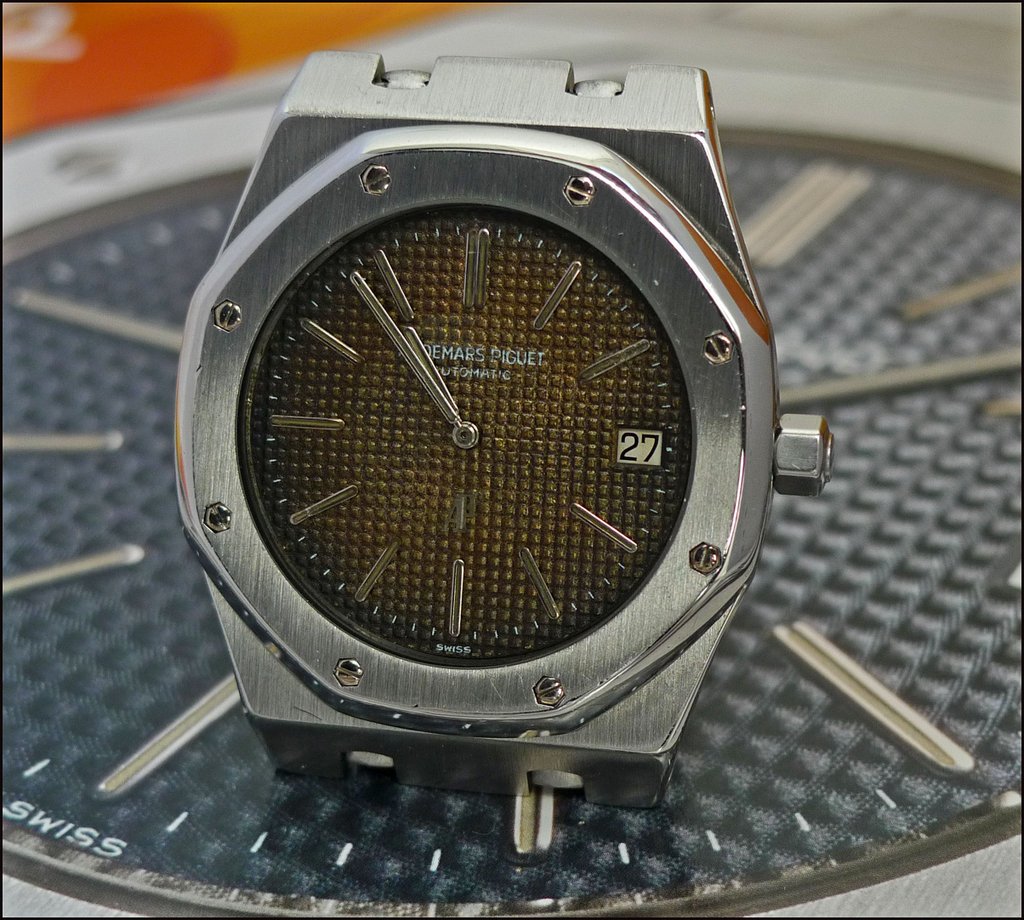
A bit like a " before / After " trip!
The superb and uniform patina extraordinarly enhances the Beauty and the strenght of this watch, don't you think so?
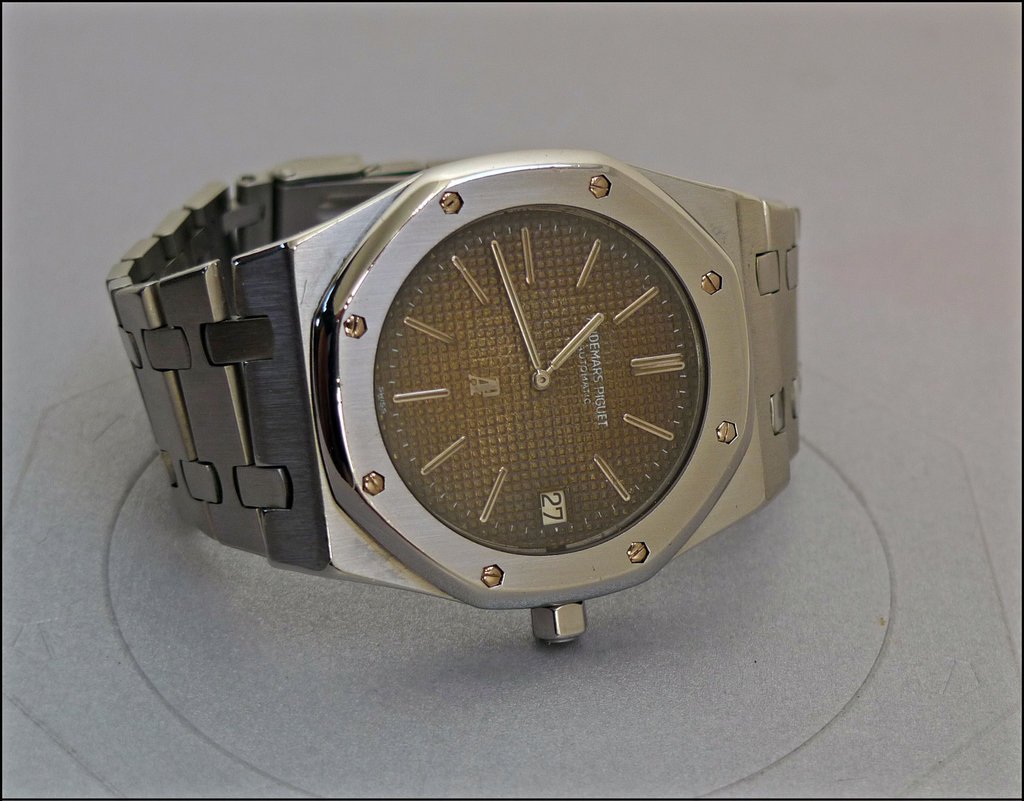
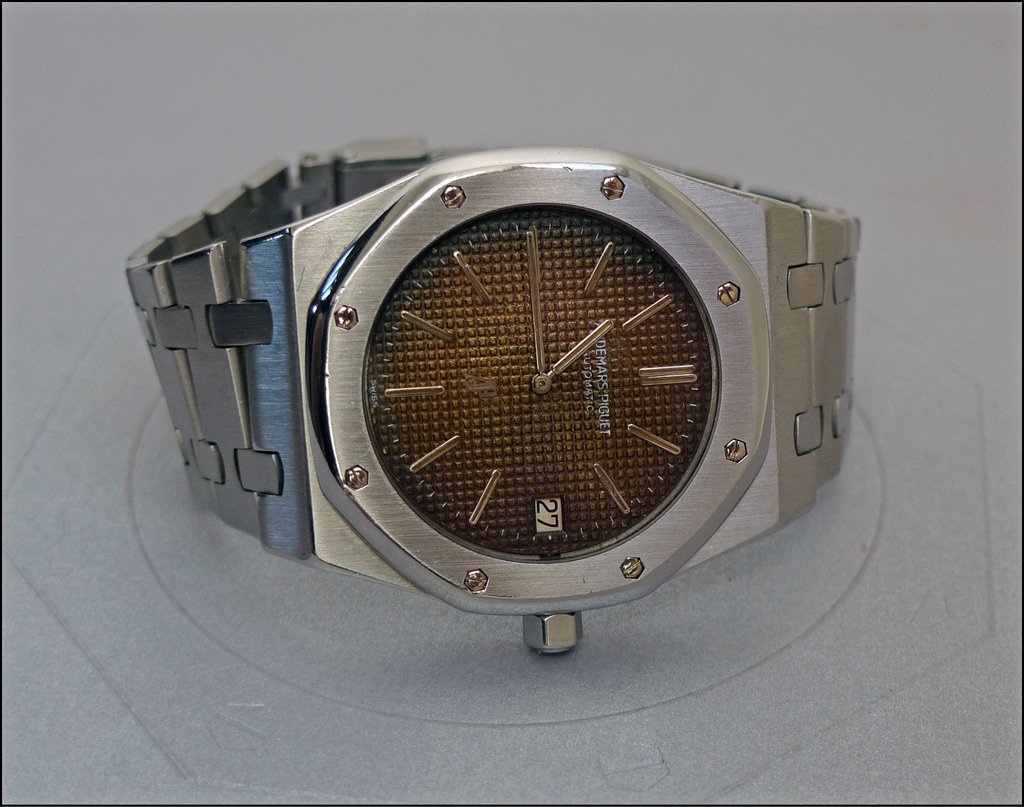
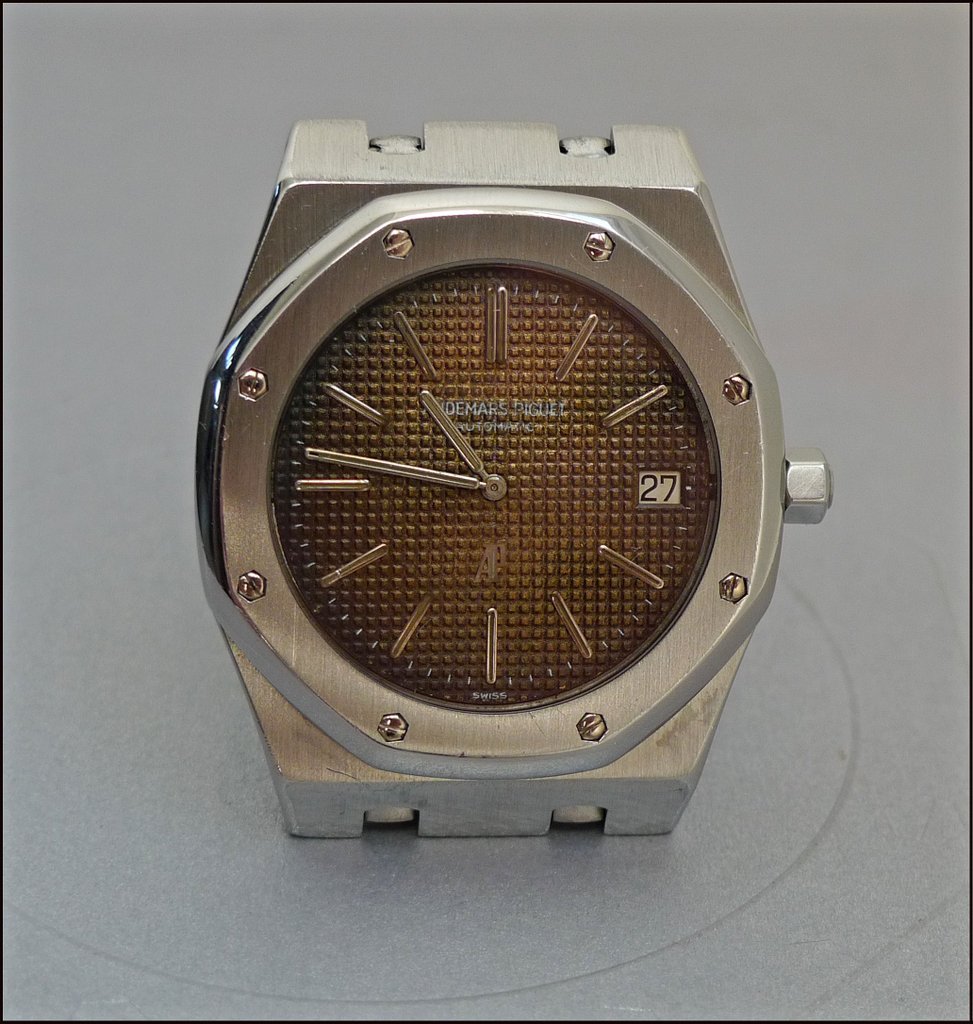
Another superb thing is the Octogonal brushed / polished bezel, as shown on the pics above.
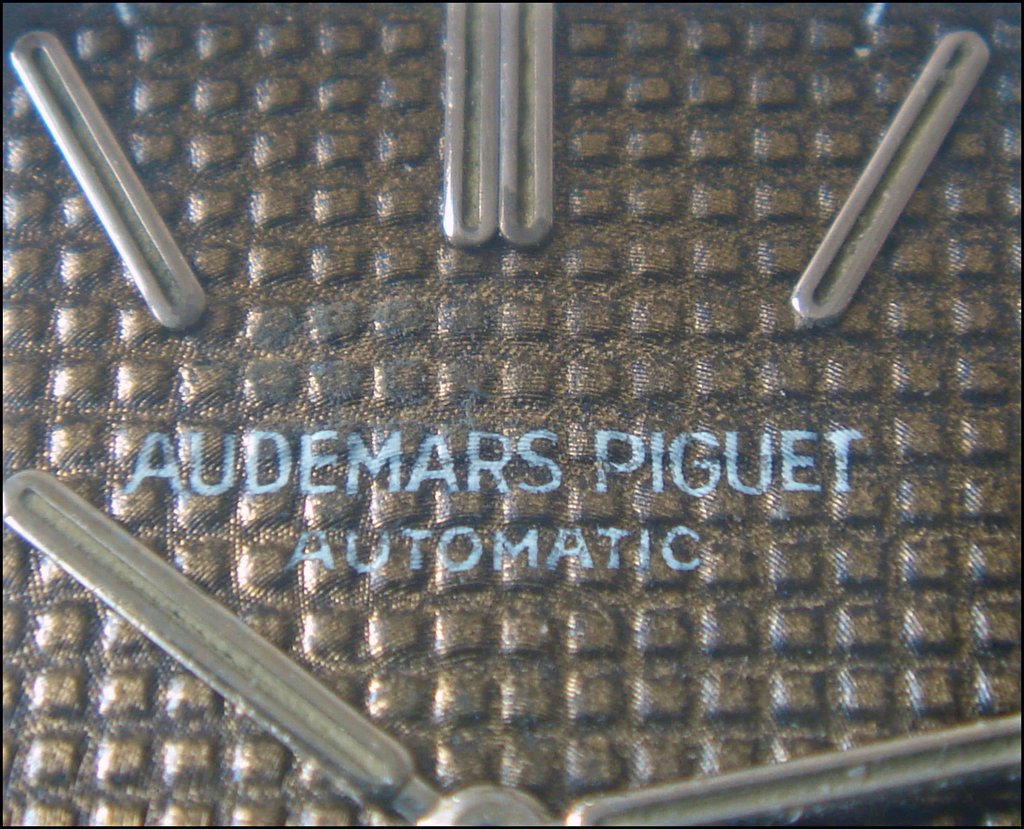
The Hobnail dial is another sublime detail, and nothing can beat some macros to have a more precise idea of the outcome:
" Audemars Piguet Automatic " just below " 12 " Index.
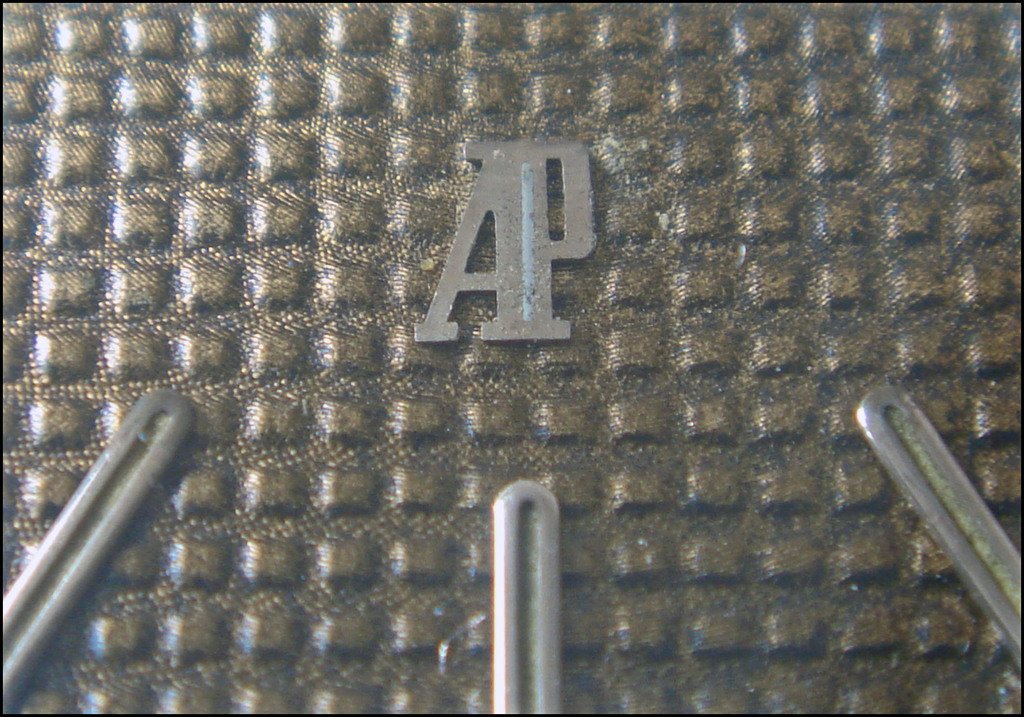
" AP " Logo just under " 6 " Index:
12 Nice and thin Rectangular indexes, a superb " Tapisserie " finish, and thin baton hands:
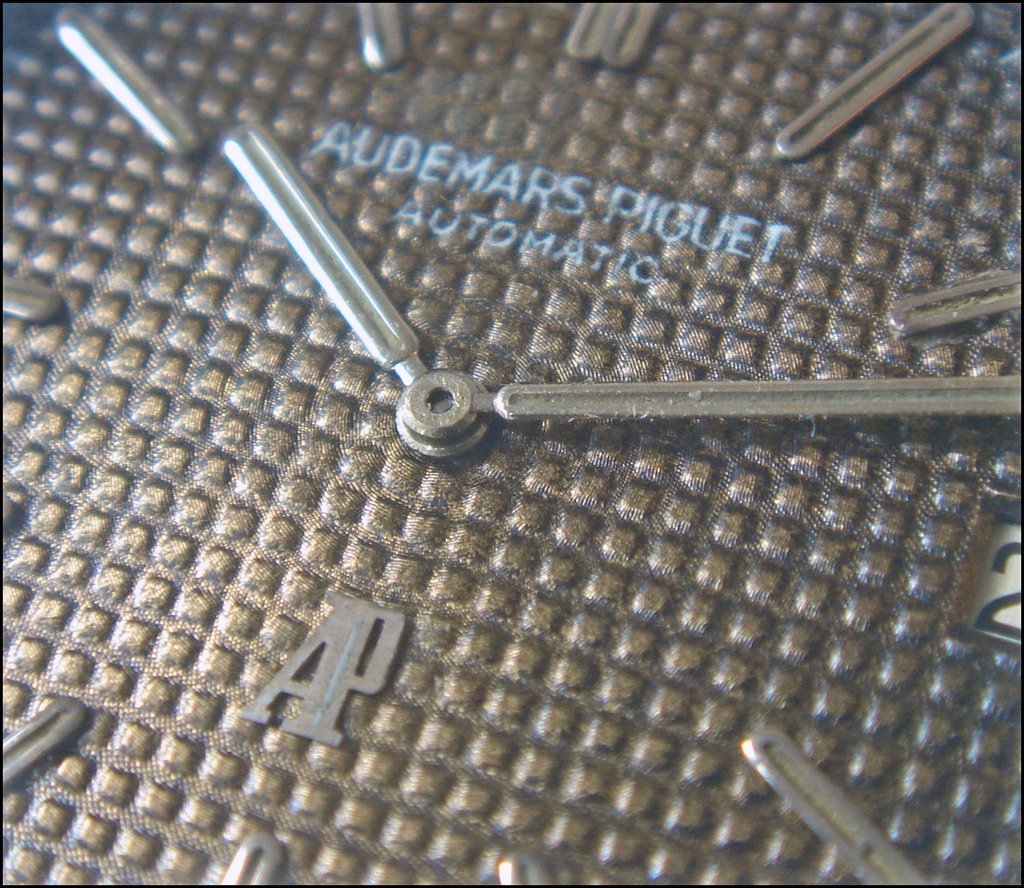
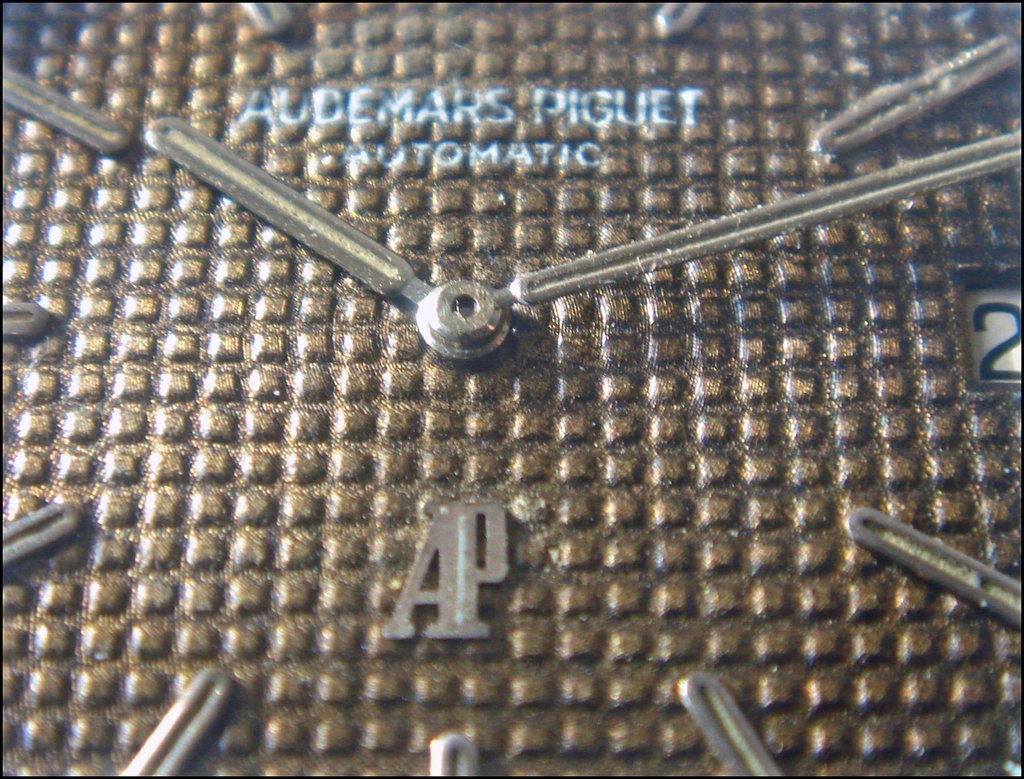
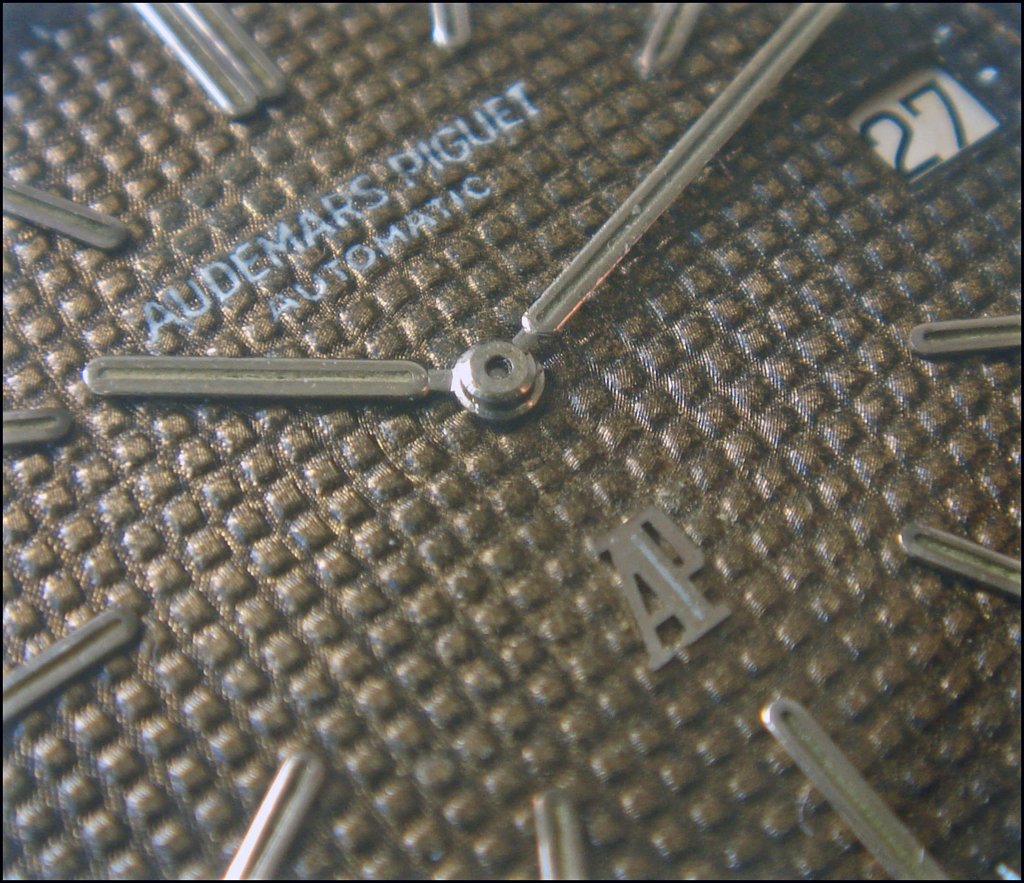
Its volume, thinness, are awesome, too.
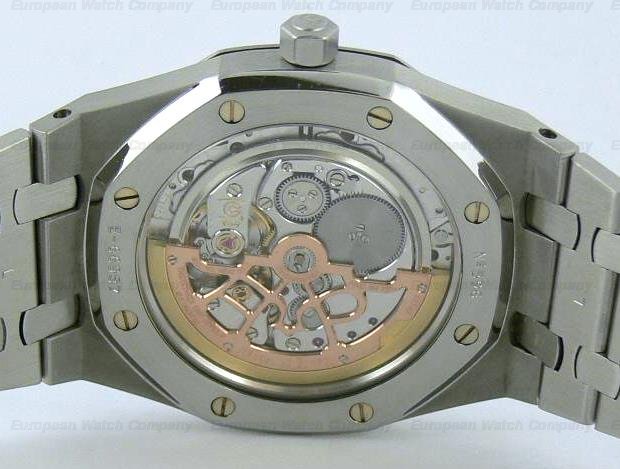
The case back is solid, and if you add a reliable JLC movement, you have a dressy and very pleasant soprt watch, with the soul of its unbelievable patina.
What else?
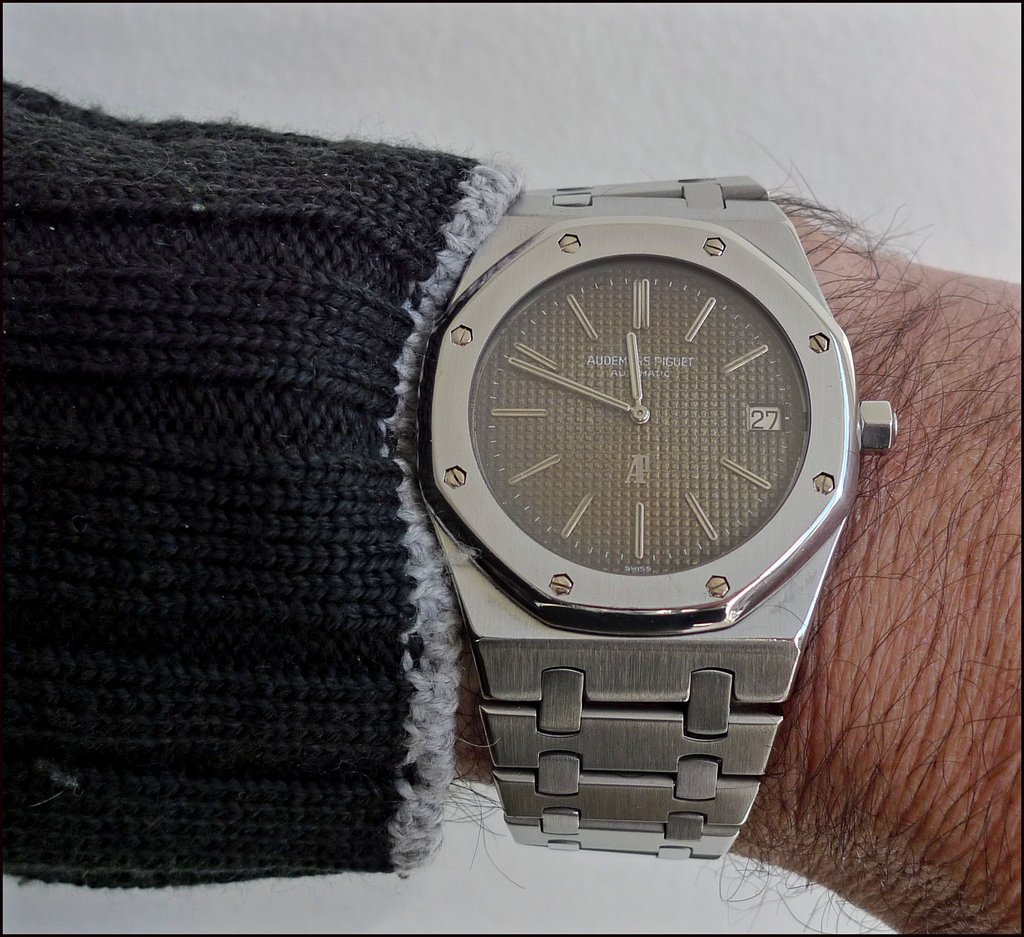
Bye Bye the City of Sails, welcome to the RO Jumbo!
Best.
Nicolas
Thank you...
Is it an A, B or no series at all?
A C Series, Steve
I agree with you...
To me too, this is the Best RO.
And when I compare it to the ROO, I prefer it even more!
Best.
Nicolas
So basically, nice watch...
 ... lol.... Btw, didn't JLC sell movements to AP in the early century? I think that the 1st models had a genta movement... not sure though.
I often dream of tailor made watch to my desires... Like a 44mm daytona or a 44mm Lange datograph,etc.... Maybe in Bale2009, we might get close to something.
Nice post, reminds me of my 1st love, that i wore for 10 years... royal oak chrono steel. Thanks for the post buddy, u've jst brought back sweet memories

Karim
Of course, some here will be more qualified than me to answer
But I understand that JLC sold movements to AP, not GG, for this watch...
Therefore, GG designed the RO, and didn't make the movement, nor ...any movements, AFAIK.
Sweete memories?
Certainly, my friend...
That's another reason why I jumped on it.
Best, and thanks for your nice words, Karim!
Nicolas
As far as I remember...
It included some special features which made it one of the most slim automatic movements of the time. For example, the rotor runs on jewelled rollers around the periphery of the movement. That way they could allow reduced clearance between the rotor and the movement but avoid the damage which would occur when the rotor would run against the movement. The operational part of the movement is rather small to fit inside the circumference of the rotor weight and it uses a small balance wheel using the PP adjustable mass system.
All three of the "Big Three" manufactures used the movement, but by the late 1990s AP was the only remaining one. Some time ago AP took exclusive control of the movement and now make a very limited number in-house each year.

The AP cal 2121/2120 (VC 1120) nee JLC 920 is widely considered
Flat reliable torque, ultra thin, advanced engineering that actually worked in its rotor winding system, exotic design features like hanging mainspring barrel...
The 920 movement was indeed funded by AP and VC; PP's version was later and slightly "inferior" (thicker) as they were a minority partner in the trio of development sponsors (PP used their version of this movement in the original Nautilus.)
The Original RO launched in 1972, shipped in 1973, through A, B, and C series used this caliber - AP 2121 (2120 with date; there never was, and cannot be, a version with seconds hand, contrary to an internet myth started a decade ago based on an erroneous extrapolated "conclusion")
Later called the Jumbo in subsequent series.
GG did have a glorious movement development and production house, making some of the most complicated movements in the world, but they didn't supply to AP.
The original jumbo (no capital J) came with the AP above the 6 rather than under the 12 only for the first 1000 pieces (no letter) and A and B series, officially. Some early C series also have this dial but ...and of course, the redialed pieces, by AP and outside, are extant as well.
AP has exclusive rights (read: own the rights) and the equipment to this movement today, part of the JLC sale to Richemont and AP selling their significant share holding of JLC to Richemont.
Cheers,
TM

waow... ur an history or do u work for AP :) ??
... lol... then again, he's my father, so he'll always think that he knows better K.
P.s: I refused to take care of the transformation
collecting AP specifically for...
over 30 years eventually forces a little bit of knowledge on the collector.
"Father is always right" - even when he's not.
Cheers, K
TM
It would better, be, Father. :)))
I can't forget my meeting with the " Uncle" Martin, a few months ago, Thomas...
Best,
Nicolas
Thanks a lot, Thomas, for these precious informations.
And for the corrections too, about GG movement, and the j instead of the J.
Best, my friend.
Nicolas
How much of the provenance do you have on the piece, Nicolas?
I'd be curious to know how much of the history was "travelling" with the watch.
The heavy handed case polishing (shoulders of the case, edges, transitions at the octagonal points, as Alec points out) would make me worry about the service history of the movement. The fairly heavy corrosion / deterioration of the hands and markers (some corrosion is common among early RO's) would also concern me, vis a vis the movement - did moisture get into the movement area? If you haven't already, I strongly suggest you have the movement checked out. Hopefully the movement is in very good shape.
A great catch nonetheless, any early jumbo that is still running reliably is always a special find. Congrats!
TM
Well, the movement is runnig with great accuracy, Thomas
I will enjoy it a bit, and then , I will give it to AP to restore it...
Maybe a new bezel, a nice polish, and a Movement Service with a new Bracelet.
I will think about what I'll do on it.
But, for the vmoment, I enjoy it.
Best, and thanks for your input, Thomas.
Nicolas
That's great news.
Hi, Nicolas,
Just be aware that the bracelet on early RO jumbos are NOT inter-changeable with later Jumbo's; nor are the links so do NOT lose any links you might have taken out!
Enjoy it!
Cheers,
TM
I asked Yesterday to the AP Boutique, in Paris, Thomas
And yes, once again, you're right, Father...
I will need to get a special one for this special piece...
I'm waiting for the AP tel Call today, they will tell me all.
Best,
Nicolas
wow, if you can get a full bracelet for an original jumbo...
even from Le Brassus that would be a minor miracle. Even links are well nigh impossible ... believe me, I speak from experience...
I'm looking forward to seeing the piece in person, be sure to hold on to it until at least we next meet.
We might even be able to have a family reunion of sorts...
;-)
TM
Will be fantastic, Thomas!
Let me know when you can come, Thomas...
Or maybe I'll ba able to do the Trip til you HQ.
Of course, I will keep it till we meet...
I have no hurry to let go this piece.
Best.
Nicolas

Thanks TM for very helpful info...
What is a "hanging mainspring barrel"?
Other than the finshes and skeleton rotor, are there any variations/differences between the 2121 used in the original 1972/73 Royal Oaks and the ones used today in the 15202?
Pat

Hanging barrel
Is a barrel that is not supported on both ends, so only supported by the barrel bridge and not by the main plate (so it is cantilevered from one end).
Cheers, Al
What is the advantage...
Thanks a lot Al for the reply.
What is the advantage of such arrangement? More compact (need less space) or easier removal of the mainspring barrel?
Pat
More compact is a primary reason...
Hi, Pat,
Been limited to PDA access, thanks to Al for giving a very good answer.
The downside is that it is more difficult to service, requiring a special spacing tool to service properly. It is possible to service without the tool, but to do it right, the watchmaker would need very special skills or really, really know what he / she is doing.
I personally would never let someone who is not experienced with this specific caliber work on this movement, in whatever case.
Cheers,
TM
Thanks TM for the tip..
Looks like the two-hand-date-watch-movement is not as simple as it looks.
There have been variants - 2120; 2121 (without date; with date) and
variants with variable inertia balances and traditional screwed balances.
Cheers,
TM
Noted with thanks.
Seems that the variants on 2121 are not much significant over the last 30 years. Pretty much a 1973 movement for the current in production 15202..
Probably AP should improvise/update the already legendary (best automatic) movement with silicon escapement, ceramic ball bearings, etc. What do you think?
Pat
no, no, no, no!
Those, to me, are not improvements!
Sacrilege! Put that crap on new, unproven movements that haven't withstood the test of time; or to make right what wasn't right to begin with...
I would not put fuel injection in a vintage Bugatti, or even a 1960's/1970's Lamborghini; I would have no interest in seeing ceramic ball bearings or silicon anything in a cal. 2121...
imho, of course...
TM
ha, ha, ha, ha!
Guess I have pressed the wrong buttons.
I agree with you vintage legendary historical pieces should not be meddled at all. I am not suggesting that we take a 1973 Royal Oak 2121 and replace the parts (if that could be done). To do that would kill the history of the significant watch.
Ya, it was a great technological achivement in 1973 to produce a 3.05mm auto movement, thus all the cal.2121 in the 70s are historically significant as Vintage pieces. But that history was made 30 years ago.
What I am referring to is the 2121 produced say in 2008. It is a NEW watch. Made in the 21st century. If there are alternative better materials to improvise the watch (maybe ceramic and silicon are not qualified-not tested like you said), why not? So that the 2121 can continue to create NEW history. Something like what Patek is doing for the 315?
It all boils down to whether a new movement manufactured today based on a 1973 specs would make this particularly piece in question instantly historical?
Really appreciate your patience on ignorant me.
Pat
LOL! I understood your original idea, Patrick. I still feel the same way.
Hi, Patrick,
My original point was that silicium, silicon, ceramic bearings, etc - if the original classically designed movement was well designed, well produced, the benefits of the high tech components are minimal, at best, and loses much of the "old school touch" of using naturally occuring materials, produceable with "hand tools"
But certainly ceramic bearings and silicium wheels can "cover up" lots of sloppy design or sloppy production.
I'm sure there are lots of "gear heads" (used with utmost respect and affection) who will argue with me to death about these points, but for me, I feel the same as I feel about machine finished finishing on movements vs hand finishing a la Dufour and Voutilainen, even if there are no functional improvements with the hand finishing.
So to be clear, no, I would have no interest in a modern day 2120/2121 with ceramic bearings or silicium wheels.
Of course, Mr. Karl Friederich Scheufele had a very witty reply to my point when I brought it up to him in a recent conversation...
Cheers,
TM