Is Yellow Gold Still OK?
I sure hope the answer is yes. In truth I guess I am not given to a single color--rose, white. Yes to both. Even though you have to search these days to find yellow, it looks just as good to me now as it used to. And so does this one, my first tourbillon, which, funnily enough, is in yellow gold. 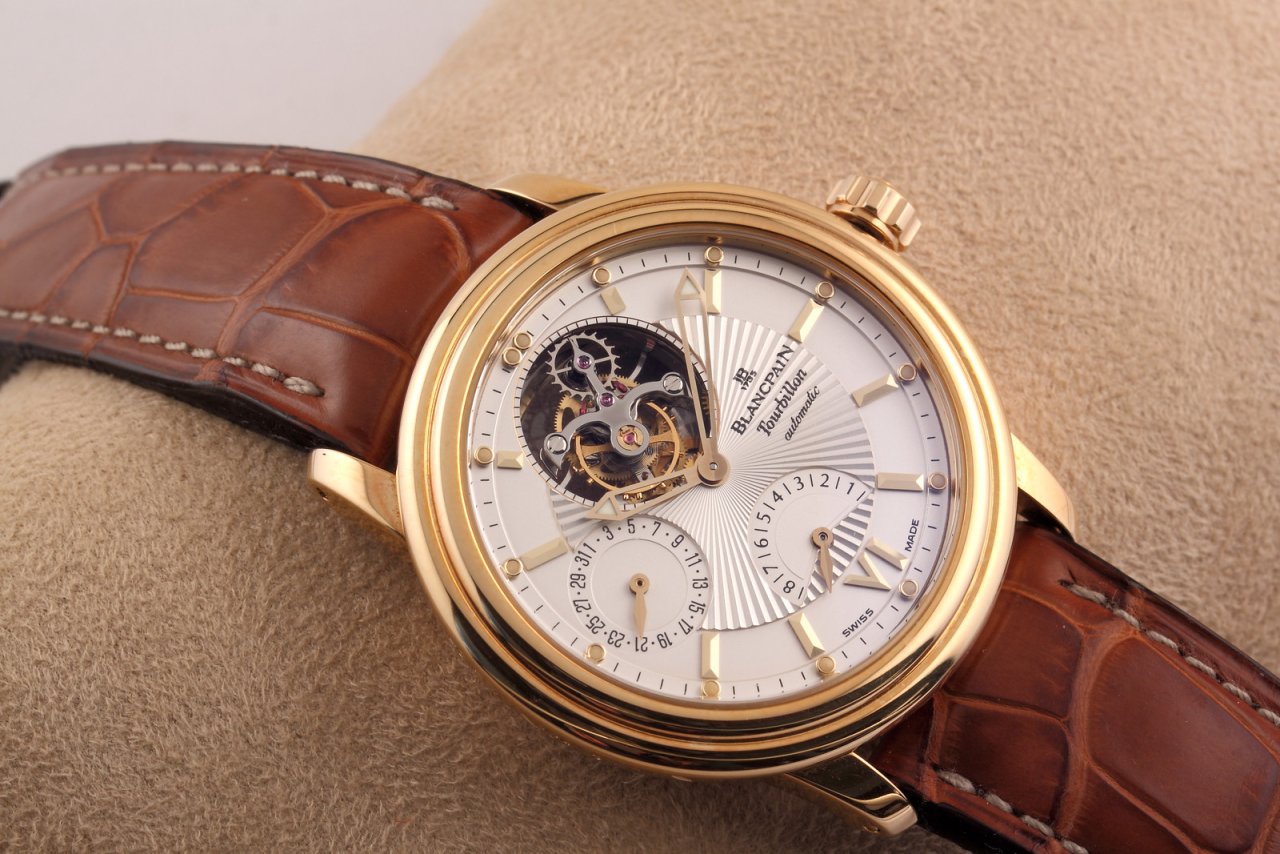
This is really a unique watch. As far as I can find out, only two of these were made. One resides in Blancpain's safe. The other is mine. This watch came from the first group of automatic winding tourbillons ever produced by Blancpain. Actually it can be said a bit stronger. Blancpain was the first brand to offer an automatic tourbillon.
Blancpain's tourbillon was designed in large part by Vincent Calabrese, who now works full time for Blancpain in the movement design department. From day one, he envisioned automatic winding being added to the movement and designed the watch with that in mind.
And what gives away this design criteria?????
I'll leave that open for a few guesses on the forum before spilling out the answer.
Jeff

Excellent pic, Jeff, very lustrous! But...
As for your question, I can only guess. Sure, its not the 8 day power reserve. Sure also, its not the flying construction. But could it be the fact that the tourbillon cage is located at the dial side? That way, the rotor would never obstruct the view on the cage.
Best,
Magnus
P.S.: I still remember when we met in Paudex years ago and you were handed over this very watch from service!

I believe they placed the tourbillon at 12 rather than 6
as Magnus said, the first automatic tourbillon wristwatch was AP.
... and thus...
Best,
Magnus
Exactly Right
Steve, you nailed it on the position of the tourbillon. I spent a day with Vincent Calabrese talking about his creation of the Blancpain tourbillon (and for that matter his work on the Blancpain Carrousel). The convention had been to place tourbillons at 6 o'clock. He did not want to do that because, as you rightly pointed out, when a winding rotor was added, it would naturally come to rest at 6 as well, cluttering the view in the dial port hole. So he put the tourbillon at 12, as he was already planning an automatic version.
Speaking of the winding rotor, I would guess by now you noticed Blancpain's little finishing detail on the rotor. of course it is hand carved on the side you see when looking through the case back. I would guess all winding rotors are finished on that always visible side. But Blancpain finishes the OTHER side of the rotor--since that side becomes visible from the dial port hole every time the rotor passes behind the tourbillon. I did not notice that when I firset got my tourbillon, then one say as the rotor wizzed by i saw the carving and could not believe it was there. Neat touch.
As for who was first to have an automatic tourbillon, Blancpain vs. AP I will research that. I know of the first AP torubillon, it was that strange looking TV screen on edge piece. What most people don't know was that it was ETA that did the watch for AP. Anyway i will check the facts on that.
Jeff

I believe......
I believe there's no question AP's autmatic tourbillon presented in 1986 was the first automatic wrist watch tourbillon.
And, all matters of tastes aside, I'd say is a remarkable example as well - titanium tourbillon cage (this tourbilllon even has it's balance wheel in center
 ) and impressively thin (IIRC the entire watch is 4.8mm only!) . Achieved by using the case back as movement mainplate and I believe it's also the reason fo rusing a pendulum weight for automatic winding. It's an incredibly slim watch (and IMHO calling this "..., it was that strange looking TV screen on edge piece." doesn't really do it justice).
 As for "What most people don't know was that it was ETA that did the watch for AP. " ....thhat's really interesting and you've made me really curious.
"Eta did the watch for AP" surely sounds like "this watch is physically made by ETA" and just labeled AP??
I wouldn't be surprised to learn that a specialised part of the ETA group played a role in design, construction or delivering specialized parts - as they
do for many, many others....
But as said - "ETA did that watch for AP" sounds like much. much more.
As I know you're a real industry insider and you'd not use this sort of explicit phrase thoughtlessly - I'm really keen on learning more about the background on this!!!
As for the reason designing the cage/porthole at this position - of course I believe this to be the reason if Mr. Calabrese told so, but....
first, I've to admit that I personally would very much prefer the (decorated or not) rotor as background for thetourbillon any time - to me almost anything looks
more attractive as a hairy skin pressed against glass
Of ourse that purely personal and to me that's also the reason I can admire skeleton movements only if not on the wrist.....
Best regards and keen tol earn more!
Suitbert

I'm curious, too, Jeff . . .
. . . as the movement in the AP automatic tourbillon introduced in '86 doesn't seem like the sort of project ETA would normally get involved with. A movement with an 18 kt plate that doubles as the bottom of the case, no shock absorption, a pendulum rather than a rotor, and an absence of manual winding facility strikes me as more of a project intended for very limited production . . . cordially, Art
Art, ETA indeed has a Haute Horlogerie atelier...
The concept of using the case back as movement platine was something special and here indeed ETA had the unique savoir faire to develop such watches. In the early 1980, the ETA team around Elmar Mock and Jacques Müller was entrusted to create a cheap but reliable, stylish plastic watch - a project that debuted in 1983 and gained fame as the Swatch. Such a watch would require less parts, is easier to assemble and less prone to failures (due to lesser part number). Remember, more parts might easily be sold as more complicated, but is this also more intelligent?
Clearly, this expertise was useful for the AP Tourbillon. It is a landmark piece in many aspects. Walt Odets once wrote a en-depth report on this. He states:
- first production tourbillon with automatic winding
- smallest tourbillon ever produced (at that time): a diameter of 7.2 millimeters and height of 2.5
- first tourbillon cage made of titanium (by means of computer-controlled electroerosion)
- the movement is comprised of approximately 120 parts, including screws (the automatic Blancpain Calibre 953, the small 40h PR movement used now in women's watches, has 175 parts)
BTW, the watch was developed under the leadership of Maurice Grimm and André Beyner, who later created the first wristwatch with central tourbillon for Omega! Beyner prix later received the prestigious Prix Gaïa, the 'Nobel Prize of Watchmaking'.
ETA indeed is a very surprising company!
Best,
Magnus
Here are a few pic taken by Foversta, you clearly see the rubies in the backplate:


Thanks, Magnus .....
I know only little about those specialized parts of the ETA group - just gathered a bit here and there....
I'm a little bit familiar with the Omega central Tourbillon and the developement thoug - and also the part ETA played there.
There's no doubt that the Omega tourbillon and the AP automatic tourbillon share some design specialities.
I always thought this is based on the fact they share their roots - Maurice Grimm. And wasn't Mr. Grimm working for Omega??
And later on brought life to "his brain child" (the later AP automatic tourbillon) for AP (as sort of free lance work or part time worker for AP?).
Also the historical bit about the swatch developement - I always thought it to be the other way around - the basic concept was partially borrowed
from (again Maurice Grimm's ) the concept for the Omega Dinosaur.....so in my book more Omega's (i.e. Maurice Grimm's) expertise??
You're totally correct, IMO that most people most likely underestimate ETA though - both for design/construction, etc. and specialized micro engineering/ manufacturing.
But I also believe this is more or less an industry wide role of ETA.....
I'm still struggling with "....ETA did that watch for AP..." though
Best regards and of course any correction more than welcomed!
Suitbert
Jeff, you're mistaken if you think ETA made the watch for AP...
I've never seen anything as proposterous as this! No way that ETA made the watch for Audemars. You are 100 % wrong and really should stop spreading this misinformation. Its obvious that you're confused about the idea that yes, ETA did come out with the idea to use the caseback as part of the movement to achieve the thinness but in no way did they have any involvement with AP's tourby itself. Go back and recheck your 'facts' and you'll see that this is total nonsense.
Mods, can this thread be deleted as we should not allow Jefferey's misinformation be spread out as he has nothing to backup his satement? It's obvious Kingston doesn't know much about anything and is very confused! This message has been edited by Dr No on 2009-08-16 13:19:50
I found the statement Jeff made to be troubling as well, but . . .

Nothing wrong with yellow gold for me...
Hi there,
A fantastic watch you have and to me it look best in yellow. I do believe some watches looks best in yellow, esp alot of Breguets and Blancpains, the classic ones of course. Then again, its very personal I do not have preference over which gold but to design though. Thanks for sharing the pict. Cheers.
Regards

What a piece and picture!
That’s an absolute beauty!!! Congratulations!!!
And it has a power reserve of 8 Days?!?! I thought the IWC Portuguese 7 Day was the automatic with the longest power reserve.
Just amazing!!!
Marcelo
Long Power Reserves
That’s simply outstanding, Jeff!
Thank you for the detailed info on this impressive horological novelty!
I took the opportunity of visiting Blancpain’s website, following your reply, to ask for the most recent Blancpain catalogue.
Best regards!
Marcelo

A wild guess...
First of all, beautiful watch.
My guess is that Vincent Calabrese designed the automatic rotor to be skeletonized so the rotor wouldn't cover up the flying tourbillon portion of the watch? Wild guess, don't hold it against me.
Enjoy this beautiful rare watch.
Doing more research on the dates
Well this discussion has really gotten interesting. The current debate is over which was the first automatic winding tourbillon. In fact there was quite a delay between the time when Blancpain finished the development of its automatic winding tourbillon (the caliber 25) and when it introduced in on the market. The construction was done in the 80s even though the watch was not sold on the market until around 96. Why the dealy? Why did they sit on it? At the moment I have no answer.
Jeff
According to Blancpain's website...
Best,
Magnus
This message has been edited by Magnus Bosse on 2009-08-13 01:45:35