
Baselworld 2016: CHOPARD celebrates 20 years of L.U.C Collection with L.U.C XPS 1860
Yet do much less, so much less, Someone says,
(I know his name, no matter)—so much less!
Well, less is more, Lucrezia: I am judged.
-- Robert Browning; “The Faultless Painter” (1855)
Less is More
Friends, PuristS, Horophiles: lend me your ears!
For soon it will come to pass that an elegant and distinctive timepiece by Chopard will pay homage to the first watch in the L.U.C collection: the original L.U.C 1860 launched in 1996 at the creation of Chopard Manufacture, and whose 20th anniversary is drawing nigh.
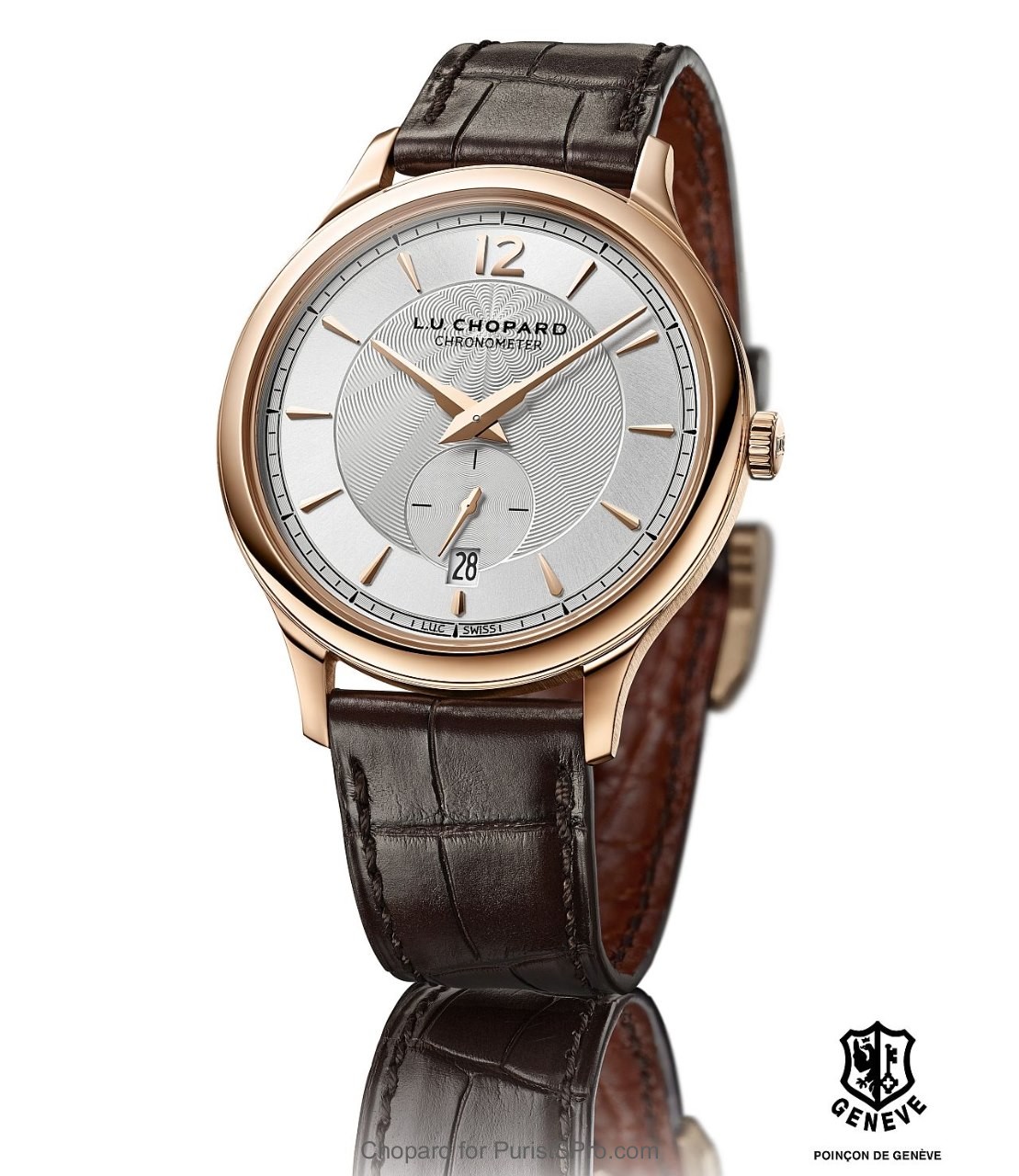
The new L.U.C XPS 1860 watch with its hand-guilloché dial and ultra-thin case is a contemporary interpretation of a great classic, combining discreet elegance and sobriety with the first Chopard Manufacture movement: the L.U.C Calibre 96.01-L.

The L.U.C XPS 1860 is a classic. It belongs to the line of ultra-thin Chopard watches and features a small seconds sub-dial at 6 o’clock. The year 1860 refers to the date when Louis-Ulysse Chopard founded his watch manufactory. In 1996, following the creation of Chopard Manufacture, Chopard presented its first contemporary L.U.C watch, the L.U.C 1860. Like its forebear, the L.U.C XPS 1860 is distinguished by its respect for grand watchmaking traditions and for chronometry or timekeeping precision – two key elements that Chopard Co-President Karl-Friedrich Scheufele was determined to incorporate within the L.U.C collection.

A distinctively elegant watch
The supremely elegant original L.U.C 1860 foreshadowed the ultra-slim trend. With its case featuring refined finishing, its contemporary Dauphine-type hands, its elegant applied hour-markers, the L.U.C. XPS 1860 offers a new take on this historical watch. Like all L.U.C watches, it is entirely dedicated to its owner’s service. Hedonists will thus find in the L.U.C XPS 1860 an essential wardrobe item, a watch that becomes indispensable through its technical qualities, its inner beauty and its outward style. Its strength stems from the breadth of its possibilities. Just as a double-breasted grey flannel jacket can be worn with a matching or deliberately mismatched pair of trousers, so too, the L.U.C XPS 1860 plays several roles with equal panache.
An object endowed with exceptional finishing
The L.U.C XPS 1860 is a decidedly contemporary timepiece. It has a 40 mm diameter that makes it truly universal. Its short, ergonomic lugs ensure a perfect fit on even the smallest wrists. With a total thickness of just 7.2 mm, it is very much part of the ultra-thin category. Its elegance is enhanced by its distinctive dial, on which, the central part bears a sophisticated hand-guilloché motif radiating out from the logo at 12 o’clock. The L.U.C XPS 1860 is offered with an 18-carat rose gold case, produced in a 250-piece limited series featuring a gold dial.

Precision and fine craftsmanship dedicated to gentlemen
The L.U.C watchmaking approach goes far beyond a mere interpretation of a fine classic. Not only is the L.U.C XPS 1860 an ultra-slim and elegant watch, but it is also one made for today’s men. Its Calibre 96.01-L, the first movement created by Chopard Manufacture, is automatically wound by a 22-carat gold micro-rotor, a rare horological speciality that is practical as well as ensuring slimness. It is endowed with Twin® technology, ensuring a 65-hour power reserve, well beyond the usual standards for ultra-thin watches. Moreover, the L.U.C XPS 1860s is one of the very rare ultra-thin watches to display the date. Like all L.U.C watches with a seconds indication, it is chronometer-certified by the COSC. It bears the prestigious Poinçon de Genève quality hallmark that distinguishes the quality of its construction and finishing, as well as its resilience to the trials of daily life.
Technical details
Case:
• 18ct rose gold
• Total diameter 40.00 mm
• Thickness 7.20 mm
• Water resistance 30 metres
• 18ct rose gold crown with L.U.C logo 5.00 mm
• Vertical satin-brushed sides and inter-horn space, polished bezel and case-back
• Glareproofed sapphire crystal
• Transparent exhibition caseback

Movement:
• Mechanical self-winding L.U.C 96.01-L
• Total diameter: 27.4 mm
• Thickness: 3.30 mm
• Number of jewels: 29
• Frequency: 28,800 vph (4 Hz)
• Power reserve: 65 hours
• Micro-rotor in 22ct gold
• Two barrels - Twin® technology
• Bridges adorned with Côtes de Genève motif
• Chronometer-certified (COSC)
• Poinçon de Genève quality hallmark
Dial and hands:
• Silver-toned gold dial, hand-guilloché centre with sunburst satin-finished surround
• Gilt Dauphine-type hours, minutes and small seconds hands
Functions and displays:
• Central display of the hours and minutes
• Small seconds display at 6 o’clock
Strap and buckle:
• Matt brown hand-sewn alligator leather strap
• 18ct rose gold pin buckle

Ref. 161946-5001 – In 18 ct rose gold 250-piece limited edition
MTF: As an owner of one of the 100 pieces of the original L.U.C 1860/1, I can testify about its timeless elegance and respect for grand watchmaking traditions. Surely, one of the iconic timepieces of the 20th century.
Now that we are into the 21st century, it is fitting that an even thinner watch from the XPS line takes its place amongst the pantheon of the greats.
There will be nay-sayers who gripe about the presence of a date display or even a seconds hand in an extra flat watch. However, those were crucial elements of the original L.U.C 1860. Furthermore, only watches with seconds hands can be certified as chronometers by COSC.
L.U.C is about respect for grand watchmaking traditions and for chronometry.
All Hail the L.U.C 20th Anniversary!
Regards,
MTF

Everything looks very nice on this watch. The dimension of the case, the dial,

Chopard always issues the launch model in rose gold
Keeping to tradition, Chopard always issues the first regular model of a new L.U.C movement in rose gold. (Special Editions are a different matter)
Usually, platinum is next and followed by white gold. There are not enough L.U.C movements to encase in steel nowadays.
Thus, it was unusual and we were highly honoured that the L.U.C 1963 Chrono PuristS Edition was in steel case, albeit issued one SECOND after the rose gold version!
The date display was mandatory for two traditions: the original L.U.C 1860 had a seconds display at 6 o'clock and it is uncommon to have an extra flat watch WITH a date display.
Regards,
MTF

Very informative.
Thanks for sharing - How very interesting. Great a WG version may be possible.
As a homage but not a caricature, maybe?


Try it!
Like Patek Philippe, this Chopard L.U.C XPS 1860 is only 40 mm diameter; that is the current norm
Studies of wrist girth are few but we can extrapolate height and girth changes over the last 40 years.
The best records are kept by military entrance examinations but difficult to acquire. So we rely on general census data.
Using the USA as an example because data is more available, we detect an increase an human size over 40 years REQUIRING a change in watch size.
However, we do NOT need to increase watch sizes further because the human race (in general), assuming optimal nutrition and terrestrial location, has reached its maximal size.
[As a side note: the Dutch are the tallest (as a nation) due to optimal nutrition and health care but lets use the easily available USA data to extrapolate]
Mean Body Weight,Height,and Body Mass Index, United States 1960–2002
Authors: Cynthia L. Ogden, Ph.D.;Cheryl D. Fryar, M.S.P.H.; Margaret D.Carroll, M.S.P.H.; and Katherine M. Flegal, Ph.D., Division of Health and Nutrition Examination Surveys
The study was conducted by the National Center for Health Statistics at the Centers for Disease Control and Prevention (CDC).
This report presents trends in national estimates of mean weight, height, and body mass index (BMI) from the National Health Examination and the National Health and Nutrition Examination Surveys between 1960 and 2002. The tables included in this report present data for adults by sex, race/ethnicity, and age group and for children by sex and year of age. Mean weight and BMI have increased for both sexes, all race/ethnic groups, and all ages. Among adults, mean weight increased more than 24 pounds. Although not as dramatically, mean height has also increased for most ages and for both males and females.
The following figures are for Americans age 20-74 years:
The average height for men increased from just over 5-foot-8 inch (172.7 cm) in 1960 to 5-9 inch (175.3 cm) in 2002.
The average height for women increased from slightly over 5-foot-3 inch (160 cm) in 1960 to 5-foot-4 inch (162.6 cm)in 2002.
Added girth:
The average weight for men rose "dramatically", in the CDC's words, from 166.3 pounds (75.4 kg) in 1960 to 191 pounds (86.6 kg) in 2002.
Women went from 140.2 pounds (63.6 kg) in 1960 to 164.3 pounds (74.5 kg) in 2002.
Regards,
MTF
Thanks for the write up!

Just out of curiosity - a seconds hand on the case back side, i.e. not visible would still suffice for COSC, right?
As for the watch - very nicely done! While the standard XPS is still prettier in my eyes, this watch has a different role and is an excellent 'tribute piece'.
+1
Agree with you that the standard XPS sans date is more appealing, at least to me
Backside seconds hand probably not acceptable to COSC because..
Assuming that COSC has to test nearly 800,000 watches per annum (in a good year), you can work out how many machines they need to run for the duration of the tests.
Thus, they are set up with image analysers to compare the sequential position of seconds hands every 24 hours and in different "wrist" positions or temperatures.
In theory, a backside seconds hands could trigger the image analysers but then they would have to "recalculate" the positions as mirror images of a watch that has hands on the dial side.
For a run of 250 pieces compared to nearly a million tested, I don't see COSC accommodating the request.
Actually, if you do the arithmetic, it is hard to believe that COSC actually could test a million watches a year!
Don't go there...I don't want to start anything........
Regards,
MTF

How many movements do you count being tested here?

Photo credit: Google
I understand this as a company own testing facility on top of COSC.
Best regards, Kolosstt

OMG stunning: I love it , imagine if this was in white metal,steel? [nt]
See latest update of a steel version (LINK inside)
CLICK following URL link to read: