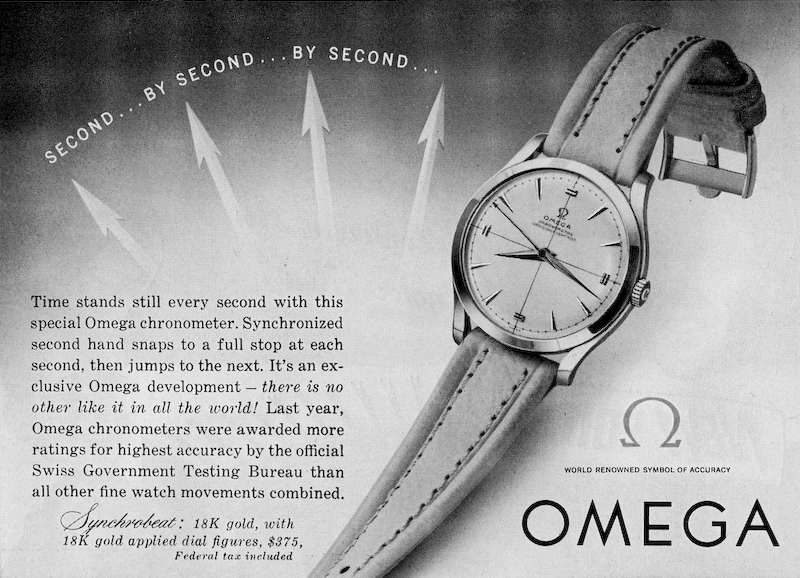
i've just seen a cal 372 synchro beat dead second chronometer. does anyone own one?
i have just seen this amazingly rare watch in my usual hunting ground and just wondered if anyone on the forum actually owned one.
according to details given 1000 movements were made between 1951 and 1954, but only 17 were ever cased in 18kt gold for commercial sale in the North American market. this particular one dates from 1953 and looks to be in perfect condition. this possibly is the holy grail of Omega watches.
as it costs 1/2 my gross annual pension i wont be buying it, but its a very interesting watch and i would if i could.
so if you are very very lucky and own one or know more about them please come forward.
best
Graham
They had major technical issues...
Mr X has one for sale currently . He also has the Doxa "Dead beat" model .
POST EDITED TO REMOVE AUCTION NUMBERS AND SELLER NAMES, BS.
This message has been edited by Bill Sohne on 2009-03-24 17:07:20
would you believe i've just come across a Doxa dead second as well!!
i dont believe whats happening tonight, but 10 minutes after the Omega i've come across a Doxa dead second with 21 jewel Chezard 116 calibre movement. 1/10th of the price, but still a lot of money.
i'm quite taken by the dead second movements. i dont know why except they are different and few and far between.
Francois i've just read your post, but i'll post this anyway. i was being subtle and didnt mention ebay. the sellers a good guy.
Rolex did one i believe as well.
if they had tech problems how rare are they now?
graham
Francois, your post crossed mine. we hunt the same ground it seems :) [nt]

The Omega dead beat is the Omegamania watch
Which sold for about $46,000 including buyers premium if I recall correctly. The current asking price represents a sizeable loss if Watchpop was the Omegamania purchaser.
Dead beat movements are not particularly rare, but not common either.
>> Omega pulled the watches because of service issues and supposedly destroyed them. Only 17 were officially sold, but clearly more than that number exist in the wild.
>> Rolex had the "Trubeat" and they trade for 5 digits and well up. They had a relatively short product life, I understand.
>> Doxa was one of several manufacturers which used movements produced by Chezard in several variations. Whenever I look for one, I always find two or three for sale, and always at prices just beyond what I think they are worth.
After all, it is manually wound mechnical watch which will behave exactly like a quartz, but be far less accurate.
My price/value point on these watches equates to a curiosity item --- buying a ladies watch with an interesting movement that my wife won't wear just to have and play with. They have typically been priced close to what an Omega 30mm chronometer brings, which doesn't work for me.
Still, one of these days I may buy one.
Sam, i cant believe that...
Antiquorum as he is a dealer first and foremost so perhaps someone is hit by the
credit crunch.
sense of being different to the norm. i know its a fairly simple mechanism and
are prone to faults, but as you say they are not common. the prices put me off
at the moment though.
I think Watchpop...
Videos!
I always like to trot out this video when the talk turns to Tru-Beats:
http://www.youtube.com/watch?v=hv5HN9tM6TA
Here's a video of the movement in action:
http://www.youtube.com/watch?v=aBLvmo_9ofY
Here's one of the Chezard movement:
http://www.youtube.com/watch?v=shf5PErxJfk
Can't find a video of one of the 17 Syncho Beats, so this is the next best thing I suppose.
Enjoy,
gatorcpa
thanks for those Vids, very...
the rolex and chezard have the same reliability problems as the
omega?
The Rolex was so unreliable...
... watches that were sent in for factory service had their "Tru-beat" pieces pulled by Rolex without appeal, even if working perfectly. Most of the cal. 1040 movements out there have been neutered by Rolex over the years.
Don't know much about the Chezard/Doxa movements other than what Francois noticed in the video.
Take care,
gatorcpa
Francois, i 'thought' i noticed...
thought it was my imagination and as i didnt want to sound stupid i didnt say
anything :(
alone and let them pass into the annuls of history as 'something we
tried'.
could ever afford it.
i'm glad i asked.
Ah!
Well, I'm never afraid of sounding stupid! ;-D
...I probably don't realize it!

Francois, i've had some personal...
mind over the last couple of days and when thats the case i'm liable to either
sound stupid or be too blunt for my own good so best not to say anything
:)
quite right, the function is totally useless so why did they go too all that
effort and buying one now would be buying into trouble it seems.
afford a Journe.
learnt a lot so thankyou.

I understand ...
Hi Graham,
I understand your thoughts that you think it is useless to buy a watch with a useless complication.
Just see it this way: There was a (maybe stupid) competition between several brands to create a dead second movement.
If Omega had one in their catalog Rolex also wanted to be able to show/sell one and vice versa...
Concerning the decision to buy one or not - I can only talk for my decision, and maybe other collectors think a similar way - is the rarity of the watch for a thematic collection.
I collect mainly Omegas and as a special subject chronometers, so the decision was clear for me...
Have you had a look on the desk clocks with the 8 days movement - also dead second chronometer grade movement which I included in my post?
They are very reliable and accurat, no issues at all - similar dead second construction... but as the movement is about 59mm in diameter it was much easier to build a reliable movement. And they look marvellous on the desk 
regards
Erich
Erich, please forgive me,...
who chooses to own such a watch. at one time i used to collect only Omegas and i
would certainly have wanted one in my collection at the time so i can fully
understand you having one in your collection.
what i have from this post i would have bought one in a flash if the money had
become available.
use. it seems that they joined in a race with others for a complication not
really essential or beneficial. its rareity is a very good reason to own one as
long as it can be worn regularly without fault.
my wife would kill me if i bought another clock.
was never my intention. it is a watch to be proud of with only 17 in
circulation.
Hi Graham
please do not worry! I did not take you wrong. I have not been offended at all as I did not take it personally.
My response was just a try to explain why those attempts of various brands have been started...
And why I decided to go for one (not for the price of Omegamania though!!!).
Take care
Erich
Irregular beat?
Am I alone in finding that the Chezard seconds hand is moving somewhat irregularly? It seems there are short, and longer seconds...
The "whip" mechanism is inherently irregular.
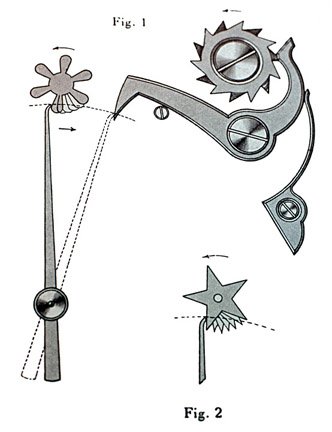
Drawing from Les Montres Compliquées, by François LeCoultre, Third Ed., Neuchâtel, Suisse, 1985
Invented by a 23 year-old watchmaker in 1776 or 1777, Mr Jean-Moïse Pouzait, in Genève. Breguet used the expression "seconde d’un coup" or "sudden second".
In 1955 the Chézard manufactory created a movement with jumping seconds whose seconds hand could be stopped by applying pressure on the crown. This movement was used in particular by Doxa.
Here is what LeCoultre writes about this:
"There is a double seconds-driving mechanism, that includes a whip (made of a variety of bronze called "dardaine", or gold), called a flirt, whose end meshes with the escape-pinion's leaves. The flirt is released every second and makes one complete revolution. This movement is transferred to the seconds hand which advances by one increment per second. The ratio between the seconds wheel and the flirt-bearing pinion has to be 1:60.
In a watch whose balance beats at 18,000 v/h, the ratio between the seconds wheel and the escape-wheel pinion is 1:10 (the escape pinion has 6 leaves and the seconds wheel 60 teeth). Thus the whip will complete a full rotation every 5 vibrations (Fig. 1).
In a 21,600 v/h caliber, the seconds wheel has 72 teeth, and the escape pinion 6 wings. Thus the ratio is 1:12. In that case, the whip is not engaged directly by the wings of the escape pinion, but by a 5-toothed star wheel (Fig. 2)."
By the very nature of the "secondes mortes indépendantes" mechanism, the beat is irregular. This is explained in the Journal suisse d'horlogerie et de bijouterie By Fédération des sociétes des anciens élèves des écoles techniques de la Suisse, available here, on Google Books (!!!).
"Si l'on se sert du poussoir à la boîte pour mettre en mouvement l'aiguille des secondes au commencement et pour l'arrêter à la fin de l'observation, ces deux époques sont exposées à des irrégularités considérables, qui sont tellement liées à la construction qu'on ne peut pas les éviter. Le saut de l'aiguille des secondes à secondes entières est en effet dû à ce qu'un petit levier léger, appelé fouet, fixé au dernier pignon du rouage dus secondes, tombe clans les dents d'une étoile fixée sur la tige du pignon d'échappement. Ce pignon fait un tour en six secondes et l'étoile a six dents, en sorte que, à chaque seconde, le bout du fouet quitte la dent correspondante de l'étoile; après qu'il a fait un tour entier, le fouet tombe dans la dent suivante de l'étoile, et ainsi de suite. Le jeu se fait très régulièrement aussi longtemps que la seconde continue sans dérangement. Mais quand elle s'arrête, ou quand on la fait marcher après l'avoir arrêtée, les irrégularités signalées se produisent. Imaginons que la montre est arrêtée: dès qu'il est libre, le fouet tombe dans l'étoile; mais la vitesse angulaire de chaque dent d'étoile est d'environ 50 degrés; si donc le bout du fouet tombe quand cet angle est presque entièrement parcouru, le départ se fait de suite, et l'aiguille des secondes saute d'une seconde entière, tandis que peut-être un intervalle d'un dixième de seconde seulement a été franchi. Ce n'est que quand le fouet tombe au commencement de l'angle décrit, que la première seconde est à peu près juste. A la fin de l'observation, on pousse un levier qui empêche tout mouvement ultérieur du fouet. Si alors le fouet vient seulement de tomber dans l'étoile à ce moment, dans le cas le plus défavorable, il pourra se passer encore un dixième de seconde avant que l'effet se produise. Si une observation est faite au moyen d'une montre ainsi disposée, elle pourra paraître avoir duré près de deux secondes de plus que sa durée réelle.
Ce qui précède suffit pour prouver qu'avec ces montres, il est impossible de faire une observation à peu près exacte."
Because the whip is released every 5 or 6 turns of the escape pinion, if the whip is stopped for some reason, when it is freed again, it will be blocked by one of the wings of the pinion (that has been turning all the while) in one of 5 or 6 possible positions, and thus may then be released after a fraction of a second, or even later than a second if it has engaged the pinion early.
But this may not be the reason why the Chezard the in the video is irregular.
I have read somewhere that the issue with their deadbeat caliber 372 had to do with oiling. I suggest maybe that caliber in the video is irregular because the flirt is released irregularly by the pinion, possibly because of oilng problems resulting in variable friction, or even stickyness, on the pinion's teeth or wear of the teeth or whip's end...
To think that one would go to such lengths for that simple, really quite useless, and – in final analysis – inaccurate complication...
I know the source...
Hi all,
I know the source where the watch comes from - it is definately NOT Antiqu... it was sold on the ..bay some time ago with a bad dial and obviously had been restored for the man in Taiwan. It was also on my watch list but was sold "prematurely" as far as I recall...
Meanwhile I have been lucky to aquire a dead beat - still in my collection, but with a restored dial though.
I can´t show you the whole watch at the moment as it is in the bank vault, I have only a pic of the movement+dial in my picture archive. The movement is very delicate (sensitive) and not easy to maintain (my watchmaker has got some lot of gray hair meanwhile). This was the reason why it was drawn back from the market.
On the other hand it is pretty rare this way - and I am one of the lucky 17 owners...

the dial is a poor redo and is going to be redone perfectly in the near future...
I can offer you a picture of 2 more dead beat chronometers but they are a bit larger
Here they come:

Movement is Cal. 59.8 SCS - 8 days power reserve!
These are two of my Omegas I love very much as they are in pristine condition and run very accurately (within 8-10 seconds a day).
Enjoy
Kind regards
Erich
thanx Erich. sounds like...
even though its very rare.
of the reasons i sold the F8192, 2.4mhz marine chronometer, time
computer and all the other quartz 'collectible' omegas. cost lots to
buy, but if they go wrong thats all your pennies down the
drain.
complete watch sometime in the future.