
skyeriding
901

My understanding of the Piguet 1185 as follows:
Fundamentally, the isolator mechanism work the same way for most rattrapantes - an extra gear with a pin is stacked onto the rattrapante wheel; the pin pushes the rattrapante lever out of the way to avoid drag/friction around the heartcam when in use.
Here's a photo of the Piguet 1185 with isolator I found:
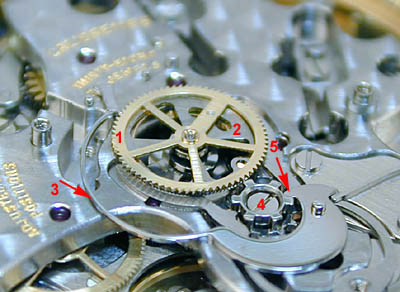
And with reference to Lange's double split diagram:
The summarised explanation is that the brass gear in the Piguet photo is the disengagement wheel (1), while the rattrapante wheel itself is (2). The column wheel (4) coordinates an extra disengagement ratchet (5) via the lever (3). When rattrapante is activated, lever (3) flicks outwards and rotates (1) to activate it.
Rotation of (1) forcefully pushes the spring loaded lever on the rattrapante wheel out of the way, as seen in direction of blue arrow:
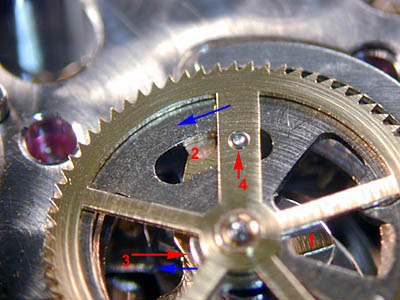
In diagram above, (4) pushes against lever (2); (2) is the lever that drags around the rattrapante heartcam in a "regular" rattrapante. This drag causes extra resistance load onto the main geartrain of the watch - therefore which may affect amplitude of the rest of the watch (correct me if wrong!)
Why am I going into this? Essentially, the Lange works the same way (well, the Piguet is a Class 3 Lever ilke a Habring, while the Lange DS is a typical Class 1 scissors Lever...). The main innovation in my opinion, is that Lange integrated two rattrapantes into one. You raised a very good point - Lange had to have two simultaneous isolators for each set of rattrapantes (minute, and seconds). Each rattrapante column dragging of heartcam would result in massive resistance - with the minute register, there now is a dragging rattrapante lever running seconds hand that has to further flick every minute an extra rattrapante column with another set of dragging rattrapante lever; that is a monstrous load spike onto the mainspring!
My point being, I wouldn't say that Lange were the first to come up with this ingenious system - however they did the ingenious engineering of having two into a single chronograph which is a deeper technical challenge than it appears to be...Something that no one else to my knowledge has done even till today.
I wouldn't dismiss having an isolator as merely an extra luxury; its always a nice thing to have to prevent unnecessary dragging of the rattrapante lever onto the heartcam (therefore avoiding extra load; wear is arguably insignificant considering the quick resets that is done in a fraction of a second when the rattrapante brakes are released and the rattrapante hand resets..)..Its another layer of mechanical refinement to the rattrapante while adding thickness, demonstrates a technically refined solution to the dragging problem. Whether they are more reliable in the long run from extra moving parts I cannot answer however...
Regards,
skyeriding

Is Lange comparable to or even better than PP?
You tell me, after looking at these pictures.... Sam...

The answer can not be found from the pictures.
I bought some 8 years ago Lange perpetual in platinum. I did not like it much - it wasn't very readable and I liked more the slimness of Patek perpetuals built around 240Q calibre. Often Lange's movements are decorated in a nicer way then Patek's. Lange i...
Too bad you did not have a good experience with Lange
Were you referring to the Datograph Perpetual or the Langematic Perpetual (the one photographed above)?
Langematic perpetual.
My issue is that I enjoy (relative) slimness. The other issues I will write a post later. Best, Kari

If we speak about the level of decoration...
Till a certain level of price, yes. Now, with high end Patek watches, I am not sure my answer will be the same. Best, Nicolas

In general..
I would pick Lange over Patek, especially in the entry to mid-end category where finishing is exceptional at this level. However, as what Nico has said, when you get to the top end, I also think Patek is the undisputable king. What do you think? cheers fe...
I think we both love Lange, judging from the pieces we have
In fact, I love both brands, as can be seen from the fact that I have exactly the number of PPs as Langes. Lange, however, is moving more and more towards exclusive pieces and boutique editions, which is both good news and bad news....
At the top end of the spectrum, yes Pateks are nice for those who crave refined and more subtle.
However, ALS is substantially more modern looking coupled with still remaining refined. The manual wind movements look like supernatural beings created them and not humans. Just look at the Double Split, Dato Perp, Dato Perp Tourbillon, etc. I think ALS a...

Sam, Pound For Pound, Dollar for Dollar, Euro for Euro...
.... Hands down it's Lange & Sohne. Period. - Scott
No Doubt. I've Had My Eye On...
... The Monats Werk for a very long time. A personal grail piece and I know one day she will be mine. Oh yes, she will be mine. - Scott
A. Lange it is
Lange has a much more modern approach to watchmaking than Patek. Where as Patek makes watches that are quite close to watches from 100 years ago, Lange has a lot of new innovative designs that represents this century. In my opinion Lange is the new king o...
I agree with the point you made
But in other words, Patek has more to offer in terms of tradition and history
Lange over PP
I agree with you. For me Lange is the new high end brand, and PP is resting on its tradition.

Lange all the way,for many reasons....
but if we stick to look,aesthetic ,solidity,general feel,Lange wins absolutely. Your pictures ,a perfect example Mo

I would not think that Lange has reached the nimbus of Patek
What is the measure for this comparison? if it is value and after market value you can say they are, with Rolex, comparable. In terms of exclusivity not quite. Patek will have more pieces in the main collection that are "reserved" than Lange will have (if...
Sorry to nitpick, but...
The Patek 5004 which came about around 1996 already came equipped with an isolateur mechanism for the rattrapante (in the form of the "octopus arm wheel"), the first DS only came around in 2004 and begun development in 2001 from its serial no L001.1. Mean...
the use of an isolator is not a Lange first but the technically advanced mechanism is a
... Lange first. Patek's octopus was, apparently, difficult to assemble, adjust and thick. Lange's mechanism is by far more advanced than the octopus and with better properties, opposite to the octopus' properties simply speaking. Hence Patek also did a "...
My understanding of the Piguet 1185 as follows:
Fundamentally, the isolator mechanism work the same way for most rattrapantes - an extra gear with a pin is stacked onto the rattrapante wheel; the pin pushes the rattrapante lever out of the way to avoid drag/friction around the heartcam when in use. Her...
Thanks for the yummy read: I have to allocate the right time for it to digest it :-)!
I will respond to it soon as I have to review the Lange fully fist and then read your post. Best Moritz
Hi skyrider
I read your post again today and it all sounds familiar to me again. I assume Lange also positioned some details differently, like the heart cam lever on top of the rattrapante wheel and the pin, that moves it out, also being placed differently on the dis...
Actually that Lange diagram...
Is upside down just to show the spring lever. It is similar in arrangement to most other rattrapantes; the disengagement/isolator wheel on top, underneath is the rattrapante wheel, and finally the heartcam underneath it. Visible here: Underneath all that ...
Words worth of gold
Most people here in Watchprosite state that "only the watch counts, not the value". I'm too poor for that kind of attitude. Last year I spent well, really well, over half a million local on watches. At the same time I know based on discussions with watch ...
I entirely agree with your approach towards purchasing watches.
However, may I ask if the Patek you bought last September was new and at listed price? I do not know many Pateks that can be bought new and sold off at a "profit" so shortly after. Even perpetual chronos, which in my opinion, is Patek's absolute forte, ar...
Yes, it was new
and I paid the list price like always. I am buying all of my PP from Salon or AD with the exception of 3700 which is about 40 years old vintage watch. I value the service experience I get so much that I am not after small rebates. Best Kari

You are right, 99% of the time
95% of modern Pateks bought in the last 5 years at MSRP would have the buyer taking a 20 30 40% hit when sold secondary market. Some other special pieces - like the anniversary pieces and the 5131 - bought at retail can be sold for more. I am sure Kari is...
True!
I bought pieces which I know would loose a lot from their value: 5153G is the first one coming into my mind. At the same time watches like 5131G, 5575G, 5070P, 5550P probably do not loose anything - rather visa versa. And finally watches like 5711, 5980, ...
On the other hand ...
Within the 5 year period that you mention MRSP went also up nearly 40% and secondary market prices went also up, not 40% certainly, but still up. MRSP are not "adequate" for standard collection pieces, everyone knows this. I regret not to have bought more...
As said, I do not buy watches as an investment
but I take the future value into account. It might be that my mind is somehow twisted but I often find rare watches more attractive and those also hold their value better than the ordinary collection watches readily available. Best, Kari
As said, I do not buy watches as an investment but
I take the future value into account. It might be that my mind is somehow twisted but I often find rare watches more attractive and those also hold their value better than the ordinary collection watches readily available. Best, Kari
I don't entirely agree on the exclusivity part
I have always felt that the whole exclusivity part on Patek has been deliberately made so by the Sterns family themselves. Being privately owned, they have absolute control over their production rate and supply, hence creating greater than proportional la...

This is a great point.
And I would add that the Sterns have had a (heavy) hand in creating the inflated market for vintage Pateks by bidding their own watches at auction, around the world for half a century.
Good analysis Moritz
I seemed to have opened the Pandora box and triggered some interesting discussion, and I will try to stay as impartial as I can be. Most of the points you made are valid observations. Thanks.

Better is what wearer feels is right as both make spectacular pieces in my opinion.
Patek having a significantly larger annual production offers a wider range which makes for better chances of finding a personal appeal. The lack of a sport watch, the relatively few dial varieties and the ladies collection narrows Langes reach somewhat. L...

I'm sorry but the Suisse are colder than the Germans...
I would call the Lange style more \'functional\'. Like Audi. But looking at a Lumen (a watch Patek would have never made), Handwerkskunst, Double Split or the new DPT I would call it poetry. And the people at Lange are very warm and welcoming (although I ...

There is some engineering beauty in Lange,
the finishing is better for entry-level and mid-level models but for me I prefer the more unique designs of Patek watches - especially in these same categories of watches. I am not so keen in comparing cars and watches, but IMO, Lange is like Audi: nicely...
I just tired the 2016 novelties on my wrist today and I really like some of them
Too bad you were not tempted to own a Lange. The brand is transforming and IMO did something very smartly over the past couple of years,,,
I would choose Lange over Patek almost universally for several reasons.
Their finishing at this point is vastly superior to Patek, and everyone else except for some independents. Their quality seems superior (when was the last time you heard a horror story about a new Lange; or a Lange that went in for servicing). And the bra...
Very well said. I especially agree with the PC-chronograph comment
which is why I own two 5270s

A horror story
Does having my Dato serviced for a year count? Granted , about half that time, it was due to a dealer paperwork lunacy, but still. And the watch, as much as I love it, stopped working on its own. No impact, no stress, no travel. One day, it simply was not...
Very sorry to hear of this; and for you.
I honestly had never before heard a complaint about Lange such as this.
Two of the best
Agree that at the lower end of the spectrum Lange sits right up there with Patek in quality and design and it really comes down to your particular preference (though Patek has more design variety with their three-handers and calendars). Up the ladder towa...
Also, look at the minute repeaters Patek offers, while Lange only managed to produce their first one this year
though a very nice one indeed....
Aesthetically, I prefer Lange overall.
I don't think this makes them "better" though. At this level of quality, get the one you like to look at the most!
They need to do 1 main thing to be in the same league as Patek
Their finishing is superior to Patek pound for pound (perpetual Lange better finished than Patek perpetual, time only Lange better finished than time only Patek). But Lange doesn't make a true repeater. Sorry, the 50mm grand comp doesnt count. The decimal...

For the lower end watches, definitely Lange
Patek is very traditional and the fact that they are slim, that is traditional. The general fashion is towards larger thicker watches but of course that may not last for long. To me, Lange has a better exterior and visual appeal than Patek, it just looks ...

it is a very complex question
My heart and my taste much prefer Lange. When we compare both brands, we realize that they don't have the same assets. And their movements don't have the same decoration style and more important: the same lay-out. Lange is more homogeneous when it comes t...

No reason but Lange
We may not discuss the PP but i prefer Lange for the way they use the art to build magnificient movements and 's the way i look to this situation. Best ragards, Bülent ...

Why Patek?!
Both brands are definitely at the top of haute horlogerie and it is fascinating to read the number of you who prefer a Lange because it is more modern. I think part of the beauty of a Patek is the fact that their watches look more classical and part of th...
Sham, I can write exactly the opposite.
We are talking about personal experiences which are by the way... the best assessment of course. I have two Patek: two failures (perfectly fixed by the way). 5 Lange: never had a problem. I'm not invited by Patek anymore (don't know why) but I have excell...
From someone who recently went through this dilemma..
My first experience with Lange, was the Lange 1 in Platinum, at the Paris boutique. The moment I put it on my wrist, I immediately "get it" about Lange. The proportions (we'll get back to that in a sec) were perfect. Even the density that Platinum represe...
Lange leapfrogs over Patek.
If ALS was Swiss, it would be numero uno in everyone's books.
Just an after thought
I noticed that from the many posts on this topic that the majority of responses were pro Lange. I am just wondering if it would have been any different if the photos posted were those of Patek watches in the Patek forum. Just an after thought. Sham
Well, Langes photograph better
But Patek's are only appreciated when you put them on the wrist.