
ThomasM
[PuristS]
14331

Your thoughts, please? Integrated vs modular complications
Hi,
One of the perennial "battles" among watch enthusiasts; indeed, among mechanical design enthusiasts of many categories - complex mechanical systems like deep sea explorer vehicles; multilevel complex electronics; even car mechanics and electronic systems; aircraft avionics; et al - is the design philosophy and "engineering elegance" behind integrated vs modular designs.
Some "real world" engineers don't like to get involved in the discussion at all, of course; for them, it is "horses for course" and the design path is strictly driven by functional need and performance specs, which include not only "performance" as we typically think of it - horsepower, torque, "accuracy" and running rate reliability; balance amplitude and stability; etc etc etc - but also serviceability and upgradeability.
In the world of watches, the engineering issue is basically - the essential timekeeping functions are "one unit" and for the most part "integrated" - the going train, the regulatory organs/escapement - hairspring, balance; and the power source (mainspring)
Petite (little) complications like date, center seconds, even simple calendars like day and month, or moonphase, are typically "integrated" as well.
Going up the complication scale, chronographs used to be, in the "golden age" of watchmaking, mostly integrated. In another words, they were purpose build from scratch, even down to the basic timekeeping components, as a chronograph.
Going up to grand complications like repeaters, these can be modular (IWC - a repeater module, attached to a pre-existing base movement) or integrated, like the classical JLC, VC/JLC, LeCoultre, or Audemars movements. (sidebar - there can be some grey area on "integrated" repeaters - some purists could argue that the VC/JLC repeaters are not fully integrated as it is a Dubois Depraz repeater mechanism built onto a JLC base movement, but I think most would agree that it is more integrated than modular. For the purpose of this discussion, I think it only practical to define modular design as "a design based on modules which are designed and can be integrated onto another module or base in whole, and can be removed in whole")
Thus, the AP Grand Comp is a modular design -
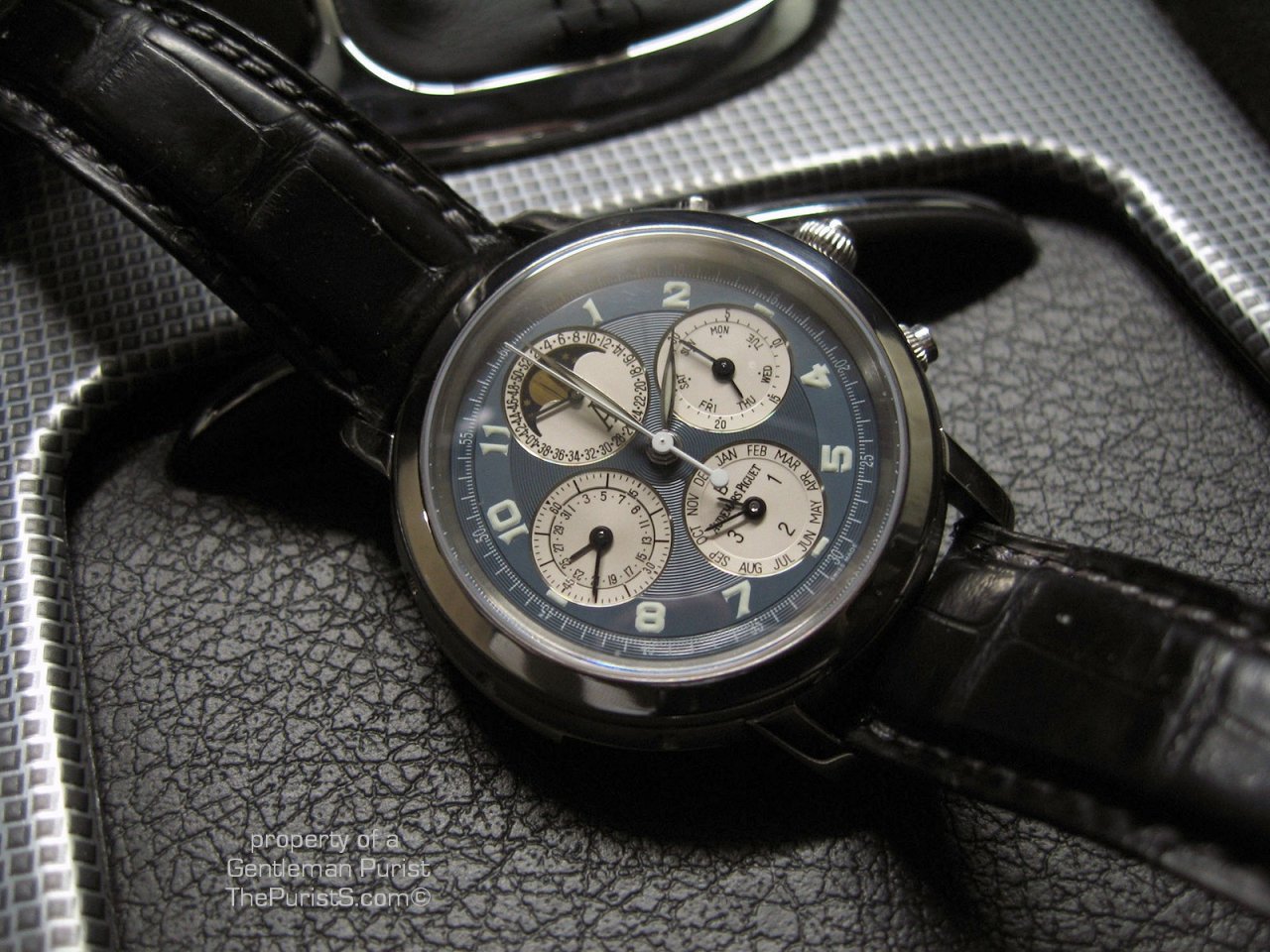
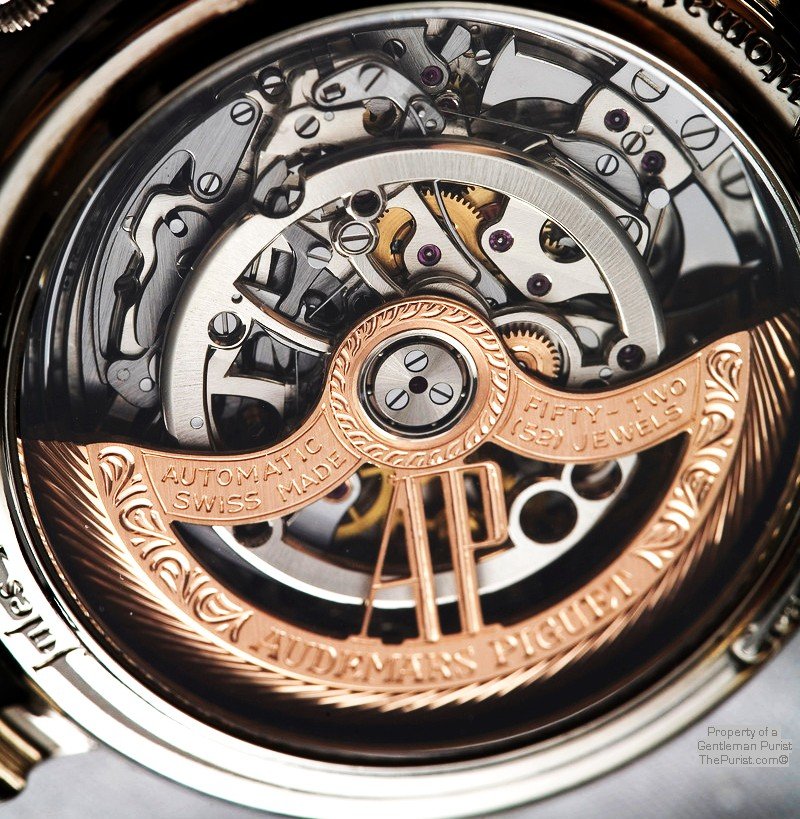
while the Petite et Grande Sonnerie is an integrated design
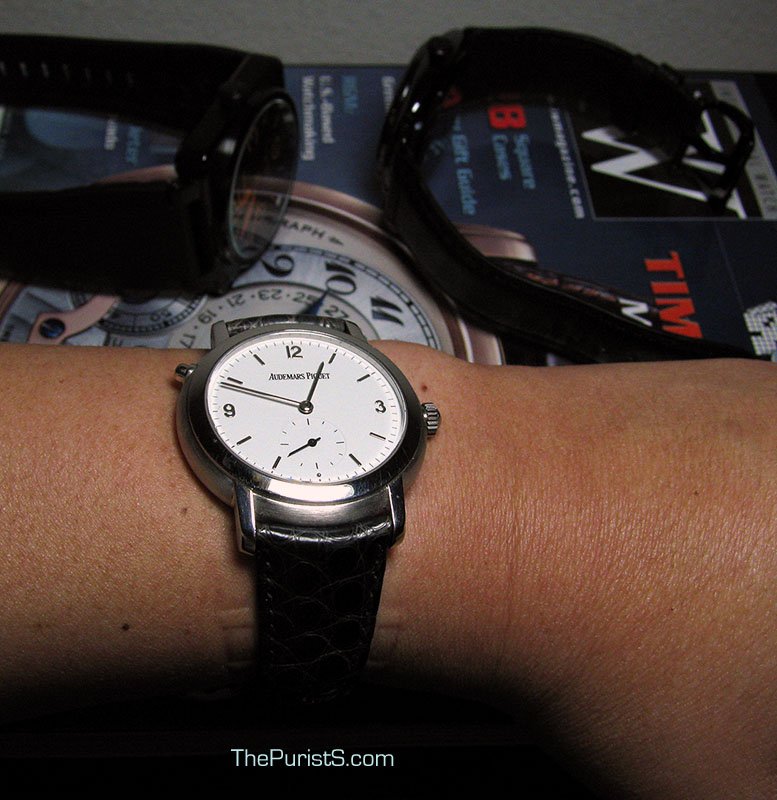
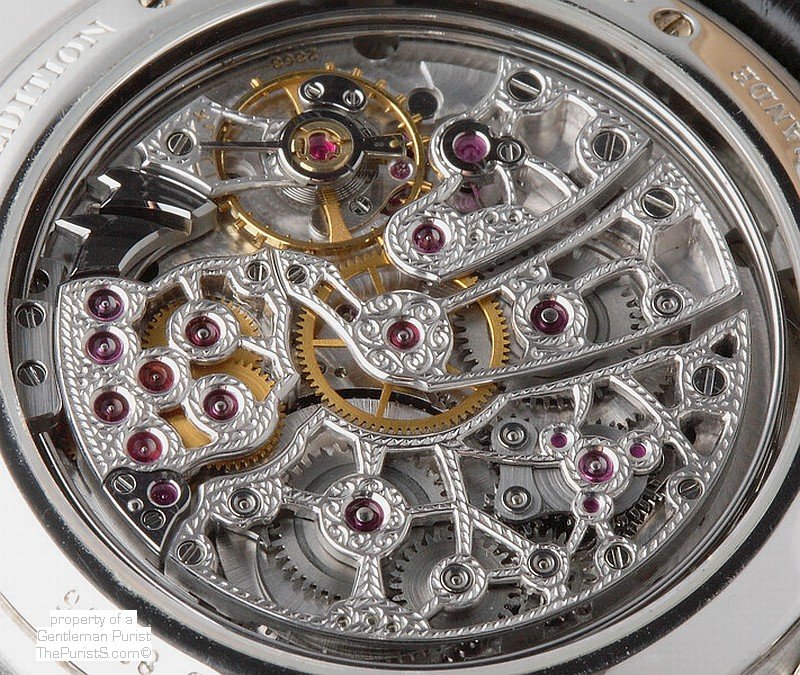
I have heard quite a few arguments for both camps, and I myself have my own opinions about which I prefer.
What I find very interesting is that, especially in the case of the Offshore Chronograph, which is an integrated design - 2326 or 3126 base, 2840 or 3840 chrono module - the two schools are not only very strident, they actually take the whole discussion to the level of religion and dogma.
"The Offshore chronograph is lesser/crap because it is integrated."
"The Offshore chronograph is great because it is fine, yet still relatively easy to service and upgrade because of its modular design - in the worst case, remove the bad module and replace."
There have been long flames and even some peudo-intellectual "analysis" and conclusions on the internet about modular chronos, and specifically the Offshore chrono - "you can identify a modular chrono by the pushers and the crown not being in the same plane."
Most of the time, yes.
So?
Maybe my "So?" is a bit too deliberately flippant, of course; a poorly integrated module to its base can result in coupling issues, and have lousy tactile feel or even unreliability in the activation of its pushers, NEITHER of which is a problem with the Offshore, by the way.
This subject has come up again recently, in the thread about the Grand Prix and its indepth design analysis and inspirations. (case, dial, movement rotor - it was about design, not about engineering, by the way, as is the model itself, and no one every claimed otherwise, as far as I remember.)
I would love to read your thoughts - which, if either, do you prefer - modular, or integrated, movements and complications, and why?
And if you don't care, either way, please feel free to share that too!
Thanks,
TM
Your thoughts, please? Integrated vs modular complications
case by case basis for me
Teleological vs. Naturalistic Horology

Honestly Thomas, I don't care, as long as it is well-made

I don't get worked up about stuff like this, I guess.


For folks interested in the broader topic of integrality vs. modularity...
Interesting analogy to Clayton's work
Good points, Jon
OK, one more quick thought
Hi Gary, points well taken!
Excellent comments and references, Gary, thanks!
My pleasure, Thomas!

Quality is the key.

As long as it is a AP.....
Personally I prefer dedicated chrono, dedicated perpetual, dedicated repeater
+1
