ZoneTecnico
48

Geneva 2016: The Maserati of SUVs Is Here

Will The Levante Wow The Crowd?
Maserati has jumped on the bandwagon and unveiled its first ever SUV. The marque, together with the likes of Bentley and Jaguar, aims to tap into the expanding luxury SUV segment. The Levante is dubbed to be the most important vehicle Maserati has ever built as it may well be the final attempt to revive the brand. The SUV completes Maserati's current product range, comprising the Quattroporte and Ghibli sedans and the GranTurismo coupe and GranCabrio.
"Levante" is the name of a warm Mediterranean wind that can change from a light breeze to an irresistable force of nature in an instant. This gives us a hint of the car's character and we shall now look in detail at its underpinings to see if it has the potential to deliver.
Design
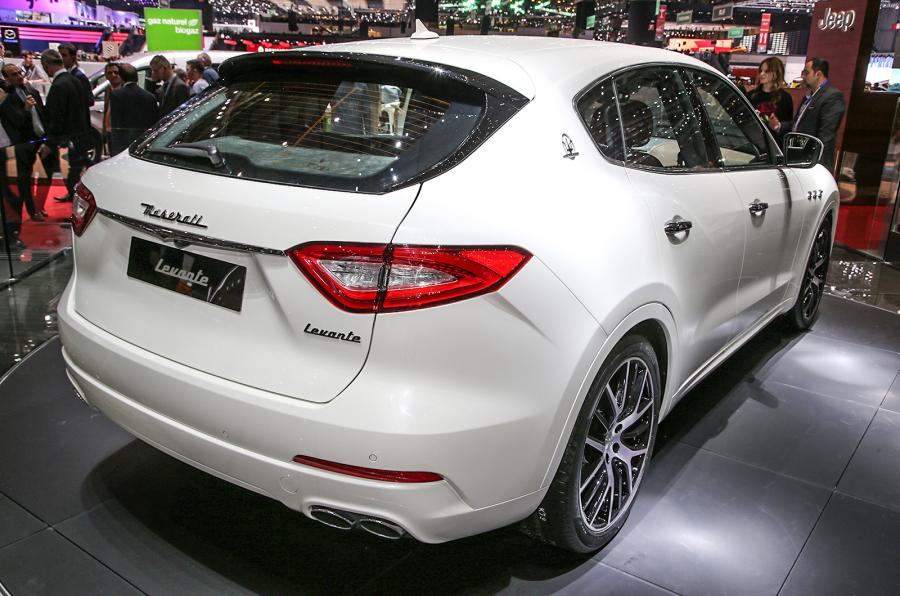
The Levante shares the same platform as the Quattroporte and the Ghibli. At a glance even without the trident, one would identify the Levante as a Maserati from features such as the Alfieri-inspired grille and muscular rear shoulders.
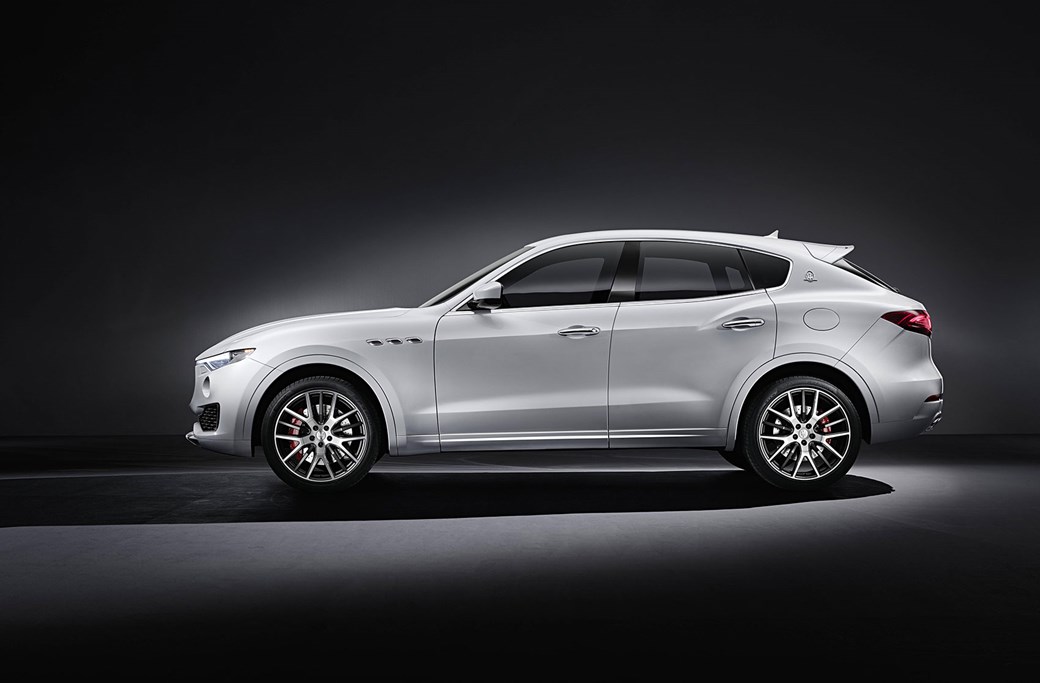
The concave grille dominates the front fascia of the car. And its design is elaborated by the flow of the front fenders, which emphasises the shape of the bonnet. A swage line runs from the side vents, a Maserati signature, to the rear shoulders defining the car's shape and strength. The SUV has been given a coupe-style look with sharp feline-inspired headlights, a slopping roofline and the distinctive Maserati rear pillar.
Interior
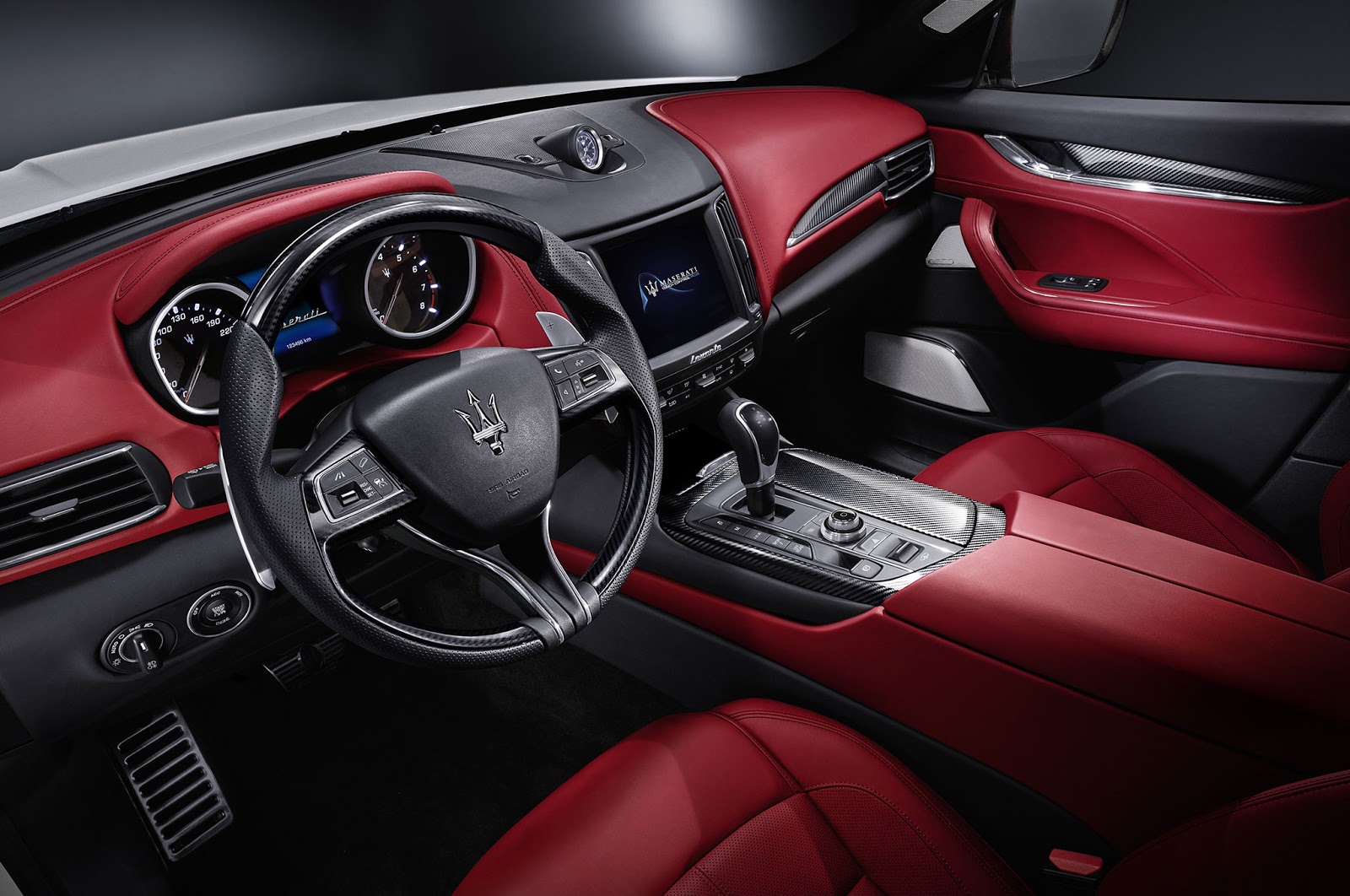
The Maserati touch is carried through into the interior with its high level of standard equipment and personalisation. To give its occupants a feel of luxury and comfort, the interior is furnished with premium materials such as leather and wood. The Italian luxury fashion design house , Ermenegildo Zegna has once again collaborated with Maserati to come up with the Zegna Edition interior. Premium Italian leather, combined with bespoke silk from the label adds sophistication and class to the interior.
Chassis
As the Levante shares the same platform as the Quattroporte and Ghibli, the main body is made of high-strength steel. To save weight, aluminum have been used to make the front section of the chassis, doors, bonnet and luggage compartment. The rear section is made of heavier rolled steel for strength and weight distribution.
Its larger chassis maintains the same high levels of rigidity while achieving a very low center of gravity for a SUV. Engineers at Maserati have also given the Levante that perfect 50:50 weight distribution to enhance handling on-road or off-road.
Suspension
Double wishbone suspension are used at the front for precise handling and multi-link five-arm suspension at teh rear for comfort. The same configuration is used on the Ghibli and Quattroporte. However, the suspension geometry has been tweaked. There is now increased stroke and stiffness for off-road and heavy duty driving. And the introduction of air suspenion allows more flexibility to toe and camber variations.
Maserati opted for the air suspension system on the Levante as it has been tried and proven by other luxury car manufacturers to provide high levels of ride comfort. Its ride height adjustability brings about more room for optimisation. Just by lowering the car at speed, the car's dynamic handling is improved while reducing fuel consumption and carbon emissions.
The shock absorbers are also electronically controlled and are set at comfort mode by default. When the sport suspension mode is activated by pressing the sport button twice, the shock absorbers stiffen. This reduces body roll when cornering and increases the car's handling capabilities.
Aerodynamics
The body of the Levante has a drag coefficient (Cx) of 0.31, an extremely low figure. The X5, the best in class until now, has a Cx of 0.34. This is thanks to the help of an air shutter.

The air shutter is like an air vent between the front grille and the radiator, regulating air into the engine compartment. This regulates engine temperature for better efficiency. When closed, the aerodynamic drag is reduced.
Powertrain
3 variants are available: Levante, Levante S and Levante Diesel. The Levante and Levante S is powered by a 3.0-litre V6 twin turbocharged engine. Power has been increased by 20bhp to produce 350bhp and 430bhp respectively.
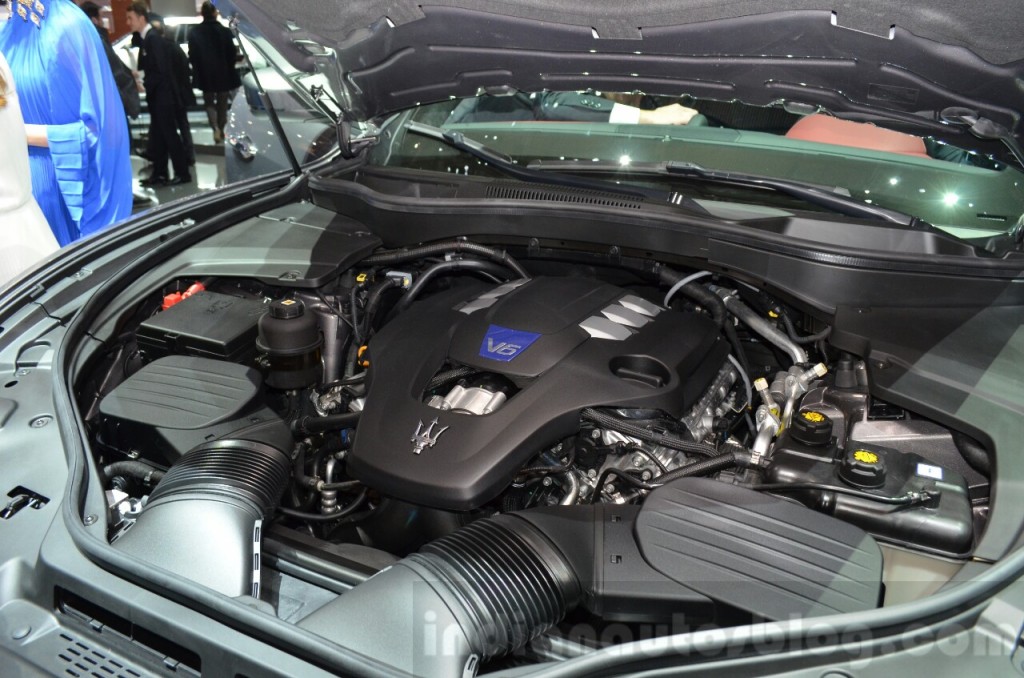
The 275bhp 3.0-litre V6 turbocharged diesel engine is produced by VM Motori, a company owned by the FCA group. And it is one of the most powerful in its class.
All Levantes are fitted with a ZF 8-speed automatic gearbox. And all Levantes are fitted with a mechanical limited slip differential, the only in its class to do so. Power is sent to all 4 wheels with Maserati's Q4 all wheel drive (AWD) system, which can send 50% of the power to the front wheels in just 150 milliseconds.
Torque vectoring technology found on the Levante is introduced by Maserati on its vehicle for the first time. It increases the car's sporting credentials and drivability. And it does so when cornering. The system applies a slight braking force on the inner wheels. This results in more torque distributed to the outer wheels, allowing the car to have higher cornering speeds.
The torque vectoring system, working in conjunction with the LSD and Q4 AWD system, ensures that the Levante will have the best traction in any condition.
Verdict
On paper, Maserati looks like they have done their homework and has ticked all the right boxes. Will the Levante be able to mix with the big boys? Only time will tell .
Written by Z-one
Photo credits: autocar.co.uk; carmagazine.co.uk; indianautosblog.com m
Geneva 2016: The Maserati of SUVs Is Here

I'm very much looking forward to seeing this new Maserati Levante SUV in the flesh!
It has a fighting chance

Seems like a compact SUV with the lower roofline...
Actually it is bigger than the Cayenne


On the roads of a big city, SUV is not needed.
Responding to market
I had four BMW X5 SUVs

Even on the roads of a city a suv can be a nice car to drive
I have been driving with my Cayanne
The Touareg & Cayanne have been developed simultaneously
True. But I leave the real mud jobs for the farmers.
Best to have both:
It is just a trend

Saw it at the Salon in GVA...
Beauty is in the eye of the beholder

For me, this will be a hard sell over the Cayenne.
Same segment as the Cayenne
Being the new kid on the block is not easy
