
ImranLondon
[PuristSPro Moderator]
6312

Patek Philippe : The World Time Moon ref 5575g: a modern icon




The world time: the quintessential Patek complication
Patek are renowned for many complications, the first perpetual calendar wristwatch, the first split seconds wristwatch, serial production of perpetual chronographs. But for me, the world time is what I adore most in Patek Philippe. The World Time complication or “Heure Universelle” ranks amongst Patek Philippe’s most sought after complications. This is hardly surprising, as this venerable complication spans a rich history over the last 80 years. The masterpieces crafted in the manufacture have become icons, enjoying a cult status unmatched- vintage Patek world timers regularly realise world record prices at auction.
Patek Philippe world time complications are intimately connected to Louis Cottier. Louis has become celebrated for developing the movement that allowed indication of the time for all 24 time zones- on a single dial.
His initial creation was a pocket watch with a movement that revealed the local time in the traditional display i.e. in the centre of the dial but with the hour and minute hands connected to a rotating 24hour ring. The names of the numerous cities around the world were engraved onto an outer dial ring. The local time zone or city would be at the 12 o'clockposition thus allowing the central dial and hands, 24 hour ring and outer city ring to display the time in every time zone in the world simultaneously. In 1937 Patek Philippe first requested Cottier to produce the world timer wristwatch. Cottier was already in collaboration with Patek Philippe and as a student of horology attained two awards from the manufacture for the quality of his work.
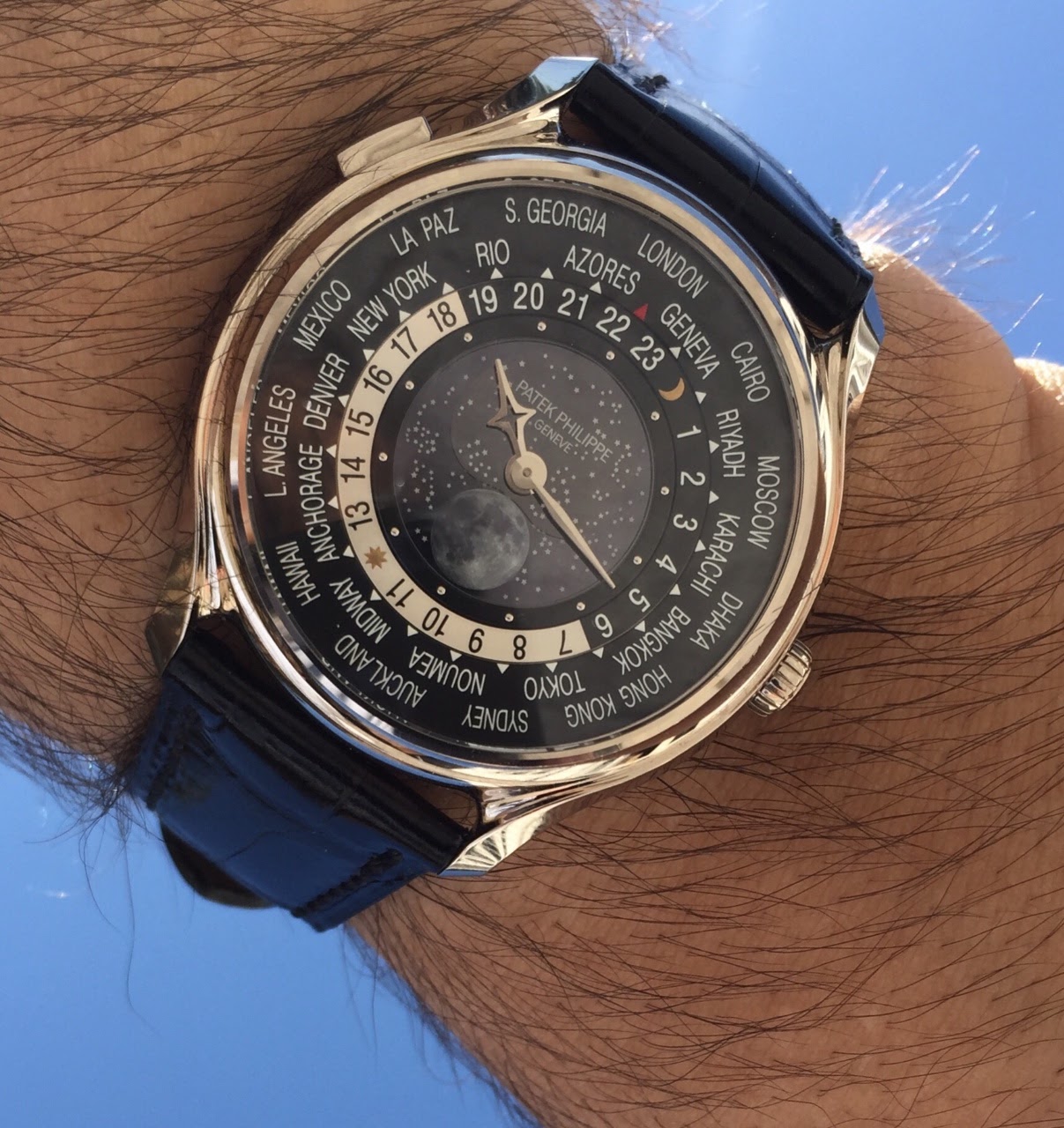
The addition of a moon-phase to the world time complication, was a stroke of genius. To achieve a significantly bigger and more eye-catching moon-phase display, Patek Philippe had to develop a new mechanism, the caliber 240 HU LU (a modification to the existing movement) for the World Time Moon that permitted a central moon-phase display.
The press release describes the mechanics and aesthetics of the display:
“It is composed of two extremely thin, superposed glass disks. The bottom one is decorated with the nocturnal sky using an innovative metallization process. It shows a richly detailed and very large rendering of the moon. Several craters, so-called lunar maria, are faithfully reproduced with fine gray-white gradations. This disk performs one complete revolution every 29.53 days. The upper half of the second stationary disk just above it is metallized with a precisely calculated, heart-shaped contour. This mask exposes only the visible portion of the moon on the rotating disk and covers the area that in reality is darkened by the earth's shadow.”


Cassa di Forma
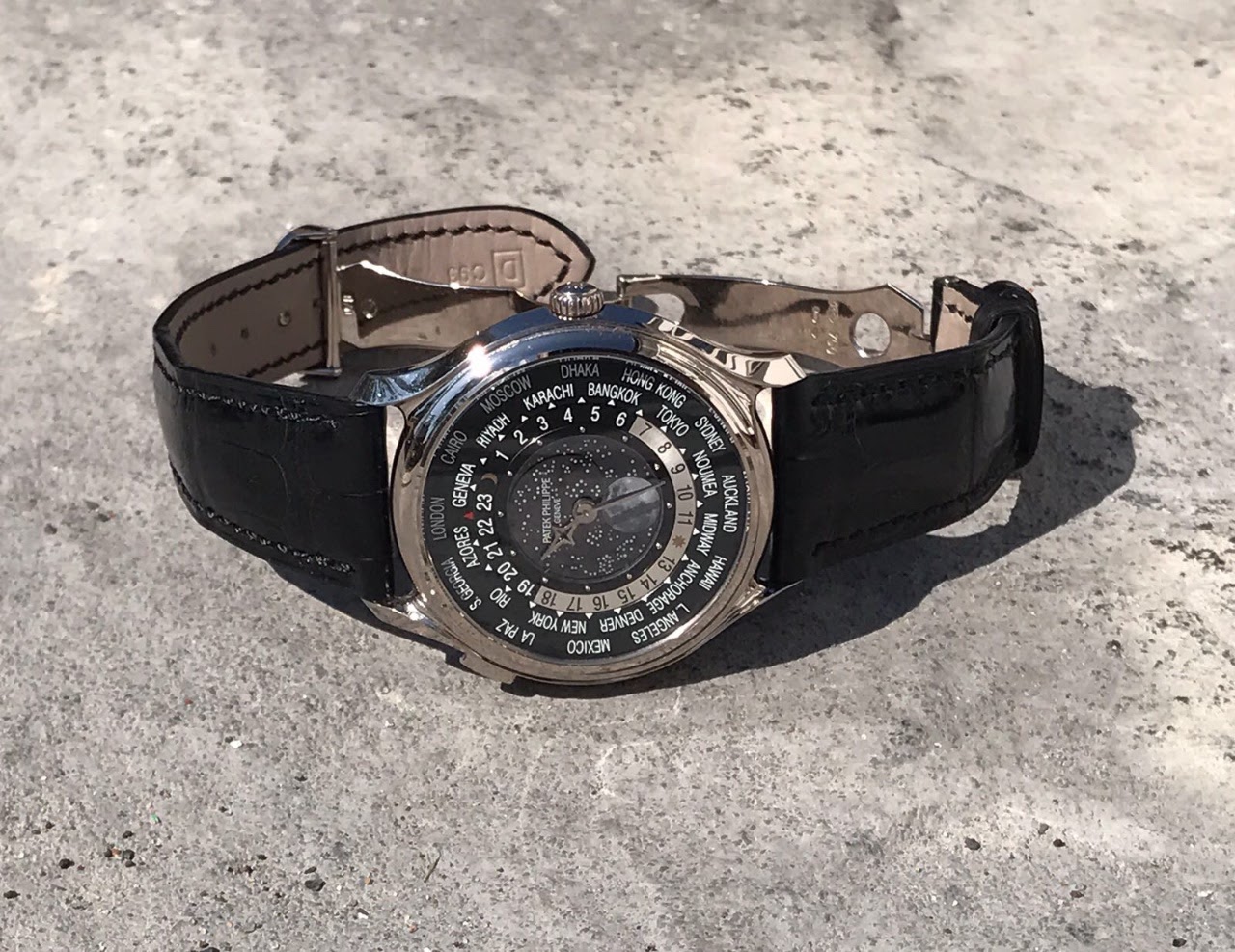
They say beauty is more than skin deep and it’s certainly true with the 5575. The new complication (movement) is exceptional. But, it’s the aesthetics that really capture your heart. Its beautiful starry dial is far removed from any allegation of conservatism, it’s bold and flamboyant. The combination of the stars and big moon, is a joy, perhaps the best way I can explain it is that it’s fun, yes fun- a watch that really slaps a huge grin on your face whenever you wear it. There is a real sense of joie de vivre with 5575, very few watches can illicit such a feeling- you could say like so many vintage classics- this watch has soul. Then there is the case itself. It reminds me of a bygone era, of fantastic artistry in case design and fancy lugs. The asymmetric design is simply stunning, reminds of some vintage pieces like the reference 2537. The whole aesthetic from case to dial is just sublime.
Thanks to a collector here in London, I was able to do a review on this watch- something I have wanted to do for a long time. At least now I can say with conviction, the 5575 world time moon is one of the best modern Patek Philippe watches ever made- and dare I say it- already an icon.






Patek Philippe : The World Time Moon ref 5575g: a modern icon

Spectacular photos in natural light giving life to this watch


Excellent post of an excellent piece!

Fabulous report


You done good.


Great post Imran 👏👏👏

A fantastic write up 👍🏾👍🏾👍🏾


