arolex
516

Patek Philippe: History of the Chronograph/Perpetual (Long)..
Patek Philippe: History of Chronograph/Perpetual wrist watches:
"The Beauty of Mechancial Art”
Written by: arolex: Arthur.
Patek Philippe has always been renowned for its unwavering commitment to quality, innovations and the creation of timeless elegant wrist watches.
During Patek Philippe long and respected history, the company has brought forth significant advancements to the horological world, with important patents that have had a profound impact on the evolution of watch making:
Brief History of Patek Philippe Patents:
1843/1861 Stem-winding systems
1863 Free mainspring
1881 Precision regulator
1889 Independent winding of two barrels
1902 Double chronograph
1949/1951 Gryromax balance wheel
1958 Stud fixture for balance spring
1959 Time-zone adjustment
1959 Helical-line display
1964/1968 Peripheral self-winding rotor
1977 Planetary self-winding rotor
1985 Date 0f Easter mechanism
1986 Secular perpetual calendar with retrograde indicator
1991 Patent instant date change
1996 Annual Calendar mechanism
1998 State of self-winding indicator
2005/2006 First silicon escape wheel for a Swiss lever escapement, and spiromax balance
However, the one aspect that resonates , when one thinks of Patek Philippe, is the company’s long standing commitment to the art of incorporating high complications within the confines of the wrist watch. This pursuit of mechanical art, is a Patek Philippe trade mark, it’s in the company’s DNA, so to speak..
I will briefly touch on Patek’s chronograph perpetual wrist watches, focusing primarily on series production models; 1518, 2499, 3970, and 5970. I have purposely excluded the 1930’s ref. 130 chrono/perpetual, and other models that contained complications over and above the traditional chrono/perpetual ie: 1951 ref: 2571 (split second chrono/perpetual), and the ref: 3615, as these models were not serially produced, and in some cases were unique pieces.
Patek Philippe reference :1518:
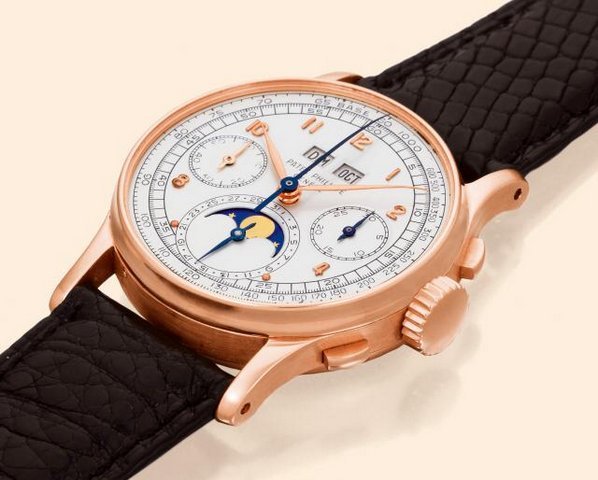
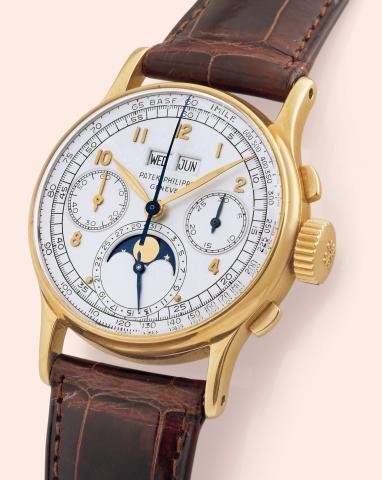
The ref: 1518 was Patek Philippe first serial produced Chronograph Perpetual. Regarded as a true classic, made from 1941- 1954, with a mere 281 examples produced. Most were cased in yellow gold, rose being rare and only 4 known examples in stainless steel.
-First series with applied gold arabics numerals from 1941 to 1954
-Second series presented in 1942 with enameled hour indexes, the 12 in applied gold Arabic numerals.
-Third series with applied gold indexes, the 12 in applied gold Arabic numbers
-Fourth series with applied gold “Baton” indexes.
Thus far, all the examples that I have seen came with tachymeter dial. Movement; Cal: 13 (VZHC), 23 jewels, Valjoux based , manually wound.
Measuring 35mm, the 1518 is considered somewhat small, by today’s standards. However, it actually appears larger then it’s empirical size, due primarily to the thin bezel, and beautiful oversized crown. The oversized crown is not only functional, offering better grip for winding purposes, but also astatically very pleasing, giving this classic vintage piece quite a bit of added visual presence. In fact, I wish Patek would have continued with this detail with the 3970, and 5970, both of which have average sized crowns.
This watch is truly beautiful, with perfect symmetry, lovely elongated lugs, calatrava case, and square chronograph pushers. The Fueille hands are elegant, and the overall look is one of perfect blend of harmony and symmetry, a true gentleman’s chrono-perpetual.
Patek Philippe reference: 2499
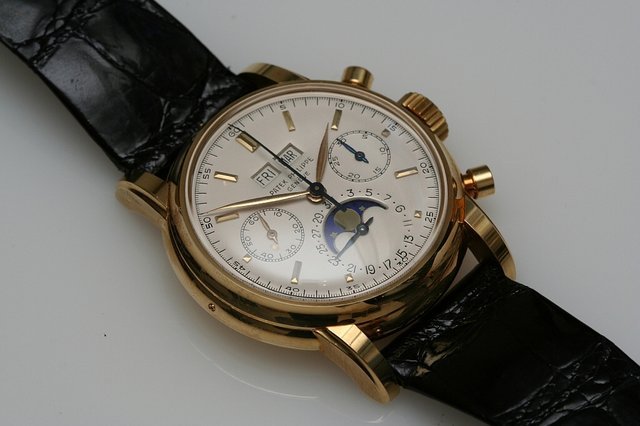
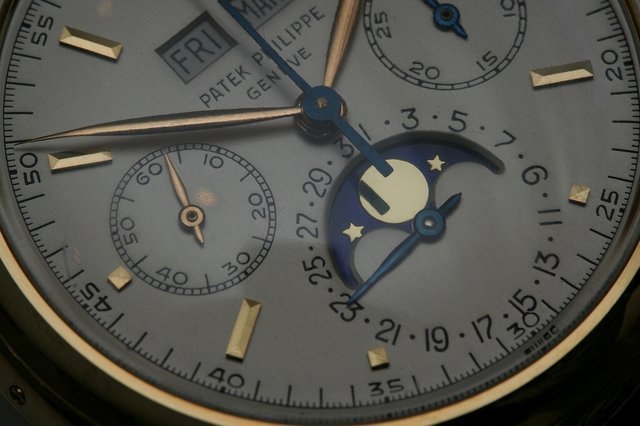
Arguably, one of the best known and surely one of the most corvetted wristwatches of all time.
Produced from 1951 to 1985, very few with tachymeter, the majority in yellow gold, and some in pink and white gold. Production is estimated at 349 examples. Movement; Cal. 13 (VZHC), 23 jewels, Valjoux based, manually wound.
- First series from 1951 to circa 1960, square buttons, “feuille” hands, applied arabics numerals, fluted lugs
- Second series square buttons, “Dauphine hands, applied indexes, the 12 in Arabic numerals.
- Third series, from 1960-1978, round buttons, crystal glass “Dauphine or feuille hands applied baton indexes
- Fourth series: from 1978 to 1985 2499/100, round buttons, sapphire crystals “ Dauphine “ hands, applied “Baton” indexes.
- Very few with tachymeter scale, and only 3 known pieces with sapphire crystal back.
The 2499 is a visual tour de force. With a case size measuring 37.5mm, the 2499 certainly commands a presence without being loud or ostentatious. If I had to make one very small criticism, or wish, it would have been to have a screw back case. Not sure why Patek used a snap back for this model, the ref: 2497 (Perpetual), at approximately the same diameter, came with the better protected water-resistant screw-back case.
Anyway, I’m splitting hairs; it’s my all-time favorite chronograph perpetual, perhaps my favorite wrist watch of all time.
Patek Philippe reference: 3970
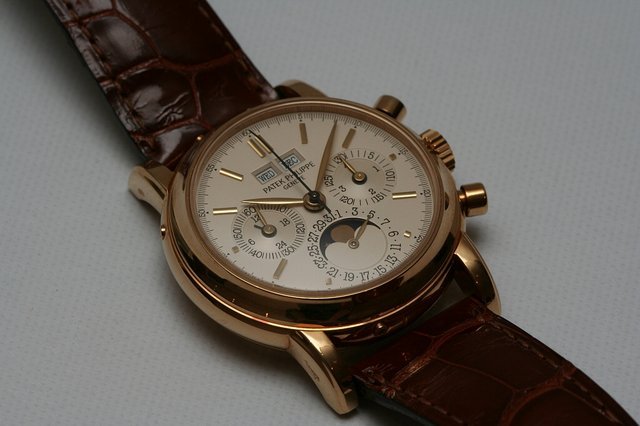
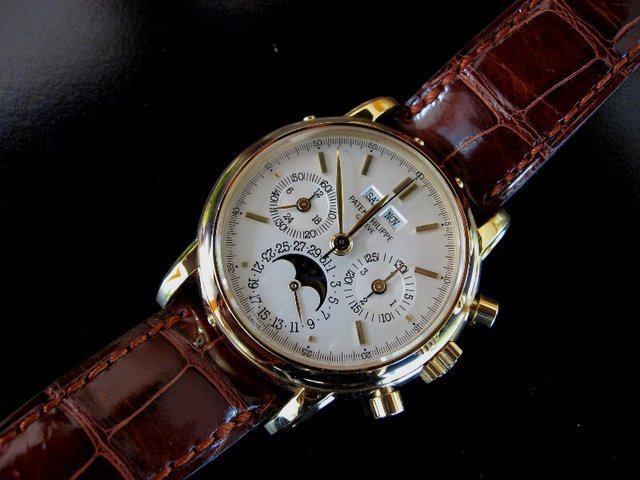
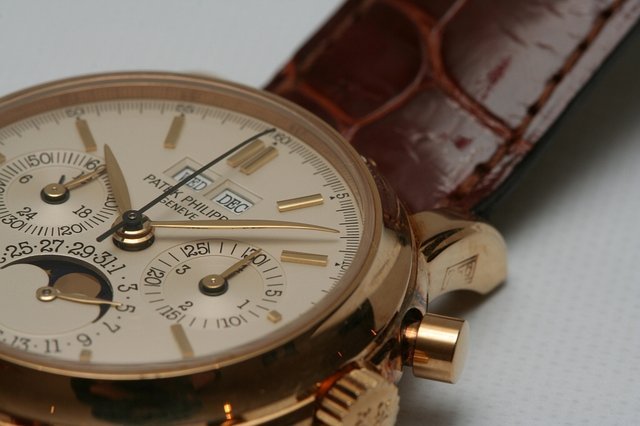
Introduced in 1986 and ending in 2004. The 3970 went through various iterations throughout its 19 year run. Case metals came in yellow, rose, white and platinum. For sake of simplicity, I have categorized the 3970 into three series, although a case can be made for 5 series to incorporate the 3971 and 3970/2. The 3970 measures 36mm, and is very much an elegant and dressy chrono/perpetual. Movement is the CH 27-70Q, 23 jewels, Lemania based, manually wound.
1st series: 1986
The first series is characterized by its stunning two-tone dial, and lighter printing, with serif font on the date wheel and snap-back case. It is estimated that only approx. 100 of these watches with these aforementioned features were produced. The lovely feuille hands, originally found on the 3rd series 2499, are present on this first series 3970.
2nd series: 1987-1990 (approx.)
The case back on the 2nd series was changed from the traditional snap back, to the screw-back case (water-resistant). The watch maintained its classic leaf hands, which made it visually quite similar to its processor; 2499 third series.
The suffix “E” designation signifies that the case was now water-resistant (E is an abbreviation for the French term etanche, which translates to water-proof). The dial is no longer two tone. Date wheel is now sans serif, printing is still light, all other dial details, including the leaf hands, and baton hour markers are the same as the first series 3970.
Sometime early in the 3970 production it is commonly understood that there were a number of clients that requested a sapphire case back, to see the beautiful Lemania based movement. It was sometime early in the production run that Patek introduced the 3971, which is essentially identical to the 3970 2nd series, but now fitted with a sapphire case back. Both these models appear to have been produced simultaneously.
Both these early 3970/3971 would have the following features:
1. Movement number 875XXX
2. 1st series snap back, 2nd series solid case back, sapphire for the 3971.
2. Feuille (Leaf) hands
3. Baton hour markers.
4. Slightly different font vs. the third series.
5. Smaller "older style" certificate of origin.
3rd series: 1991- 1985:
3rd series is considered the most common of the 3970 reference. It came with baton hands, darker printing, triangle hour markers, solid and sapphire case backs, with silver, black and diamond dials.
3970 Production:
I’ve based my production estimates on the assumption that Patek used sequential serial numbers to their movements.
3970 production commenced in 1986 and ended approx. 2004, total of 19 years.
3970, 1st series, 1986: (snap-back case, leaf hands, baton hour markers, two-tone dial)
-movement number 875000-875100
3970-2nd series 1986-1991 (approx.): (leaf hands, baton hour markers, solid case back)
Movement: 875101-875999 (I found that later production 8759XX, seem to have some transitional details found on the third series, but that could also be a result of dial swaps??)
3970 3rd series 1991-2004: (baton hands, two case backs etc.)
Movement: 1991-1996 876XXX
and
Movement: 1996: 3045XX-346XXX+
Assuming that 90% of movement production was used for the 3970, and the remaining 10% of production for the two other Patek models, utilizing the same movement (reference: 3990+5020). It would be a reasonable to assume that total production of the 3970 is approx. 3600 pieces.
Again, the 1st series being the rarest; 100 pieces, followed by the 2nd series, approx. 850-900 pieces, and lastly the 3rd series at 2600.
If you estimate that there were approx. 500 Patek retailers, a rough calculation would equate to each retailer receiving approx. one 3970 every 2 years (210 pieces per year divided by 500 retailers).
This is not a fact, just a rough estimate.
Patek Philippe reference 5970:
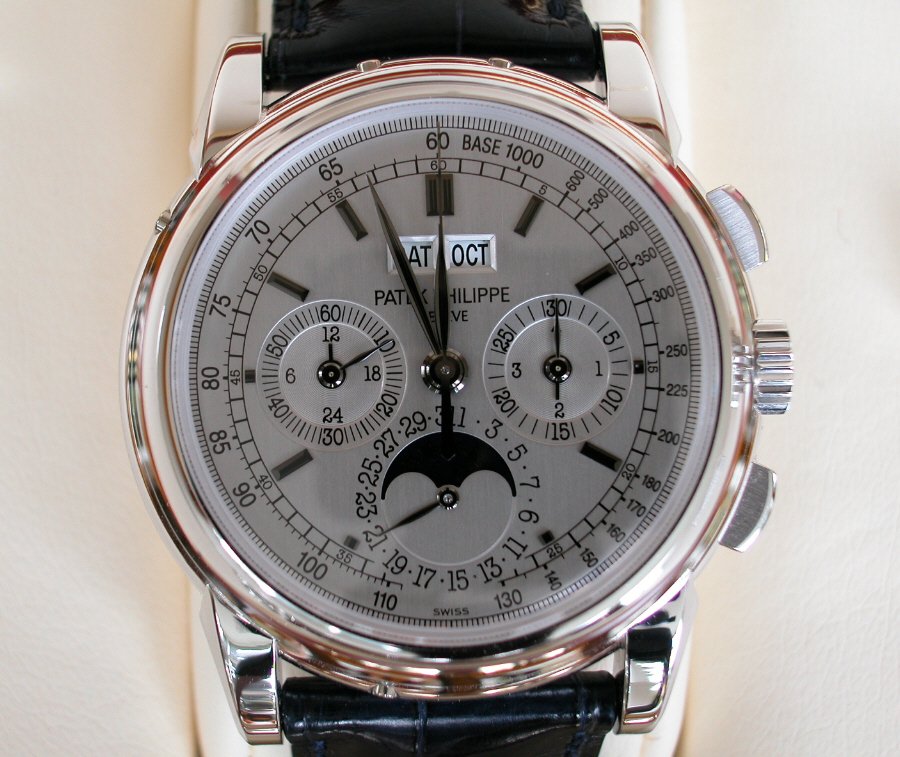
Introduced in Basel, in the spring of 2004, this model was able to incorporate features of past Pateks, but now housed in a more modern case size. Measuring 40 mm, this watch definitely has a presence, but still remains sublime in its classic appearance.
The dial is borrowed from Patek’s “golden age” (very similar to the 1518) with a beautiful steely silver hue dial, feuille hands and tachymeter. This model was immediately very well received and met with quite a bit of popularity amongst collectors, resulting in fairly long waiting lists. It houses the old style lemania based movement, caliber CH 27-70 Q, 23 jewels, Lemania based, manually wound.
A handsome watch, that combines a modern vibe, with a touch of vintage. Although the watch measures an impressive 40mm, it actually wears, and looks smaller. I suspect this is due in part by it’s heavy, substantial case, wide bezel, and better diameter to height ratio then its processor; the 3970.
At time of this post, it appears that this model is no longer available for order. If this is the case, it will have the shortest production run of any Patek chrono/perpetual: 2004-2007. However, due to high demand, and the advances in the manufacturing process, it is expected to have a higher total production then its prior processors: reference: 1518, and 2499. The exact total production may never be known.
In conclusion:
These little mechanical wonders, produced by Patek, do not just tell time, measure elapsed time intervals, and account for leap years. They are magnificent pieces of history, from a manufacturer who prides itself in producing wrist watches that possesses a timeless beauty, and elegance. They are in essence, beautiful “Mechanical Art”.
Copyright 2008
arolex, Arthur.
All rights reserved
Research documents and images:
Antiquorum, 1st and 2nd image + information on various series, and some production figures.
Paul Boutros: 2499, 3971 (1st, and 2nd) image
Arolex: 3970 (2nd) image, and 5970 images
Patek Philippe: Complicated Wrist Watches, Konemann
Patek Philippe Geneva, Huber & Banberry
Patek Philippe: 1990 sales brochure
This message has been edited by Dje on 2008-02-07 01:38:29 This message has been edited by Dje on 2008-02-09 11:00:31