
Z3
944

PuristSPro Interviews Stefano Macaluso - GP's Vice President of Global Operations
PuristSPro's In-depth Interview with Stefano Macaluso - Girard Perregaux's Vice President of Global Operations
By Jonathan Zhang (Z3)
© August 2010
We live in interesting times. In recent years, we have witnessed the rise and fall of many watch brands, in lock-step with the roller-coaster global economy.
Yet, for those that are seriously focused and dedicated, these turbulent times also provide ample opportunities. These are opportunities to truly reexamine its rich past, opportunities to innovate and create products of quality and value, and opportunities to gently steer the confused and tired consumers from all that marketing extravaganza, back to what's important - honest, traditional fine watch-making.
I believe that Girard Perregaux is a brand that is facing these opportunities. This relatively quiet brand has undergone some changes in the recent years, and is at an interesting crossroad. How will it come out victorious? What's the current positioning and future direction of this age-old manufacture?
So with these questions in mind, on a sunny late spring day of 2010, I had the privilege of chatting with Mr. Stefano Macaluso - Girard Perregaux's VP of Global Operations and the son of GP's patriarch Luigi Macaluso.
It has given me a better understanding of GP the brand, and Stefano the man.
The interview took place in GP's newly opened Madison Ave. boutique in New York City.
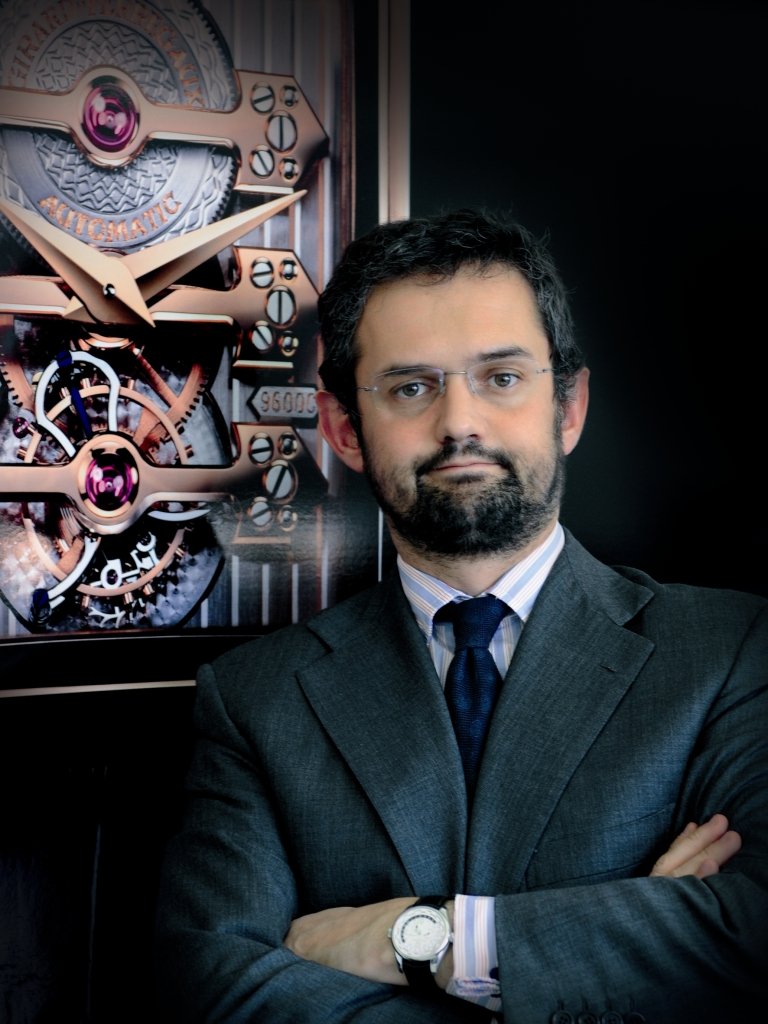
As the VP of Global Operations, what are your daily responsibilities within GP? Can you tell us a bit about yourself?
It's a family company, so I am involved globally in all of its global operations. There are two major aspects.
The first aspect is product development and design. I am not a watchmaker, I am an architect. So I try to combine my training and background in design, with the engineers, to design the watches and the movements. I believe these movements are our long term investment, so as a family member, I need to be strategically involved with these new movements.
Secondly, I am also in charge of all the distribution. I take care of the subsidiaries where we have direct distribution, and relationships with distributors. For example, we have distribution by subsidiaries here in the U.S. in most of the European countries, and in Japan. Otherwise we have distributors in areas such as Asia, the Middle East, and Eastern Europe. Sometimes we also deal directly with retailers.
How many years have you been involved with GP?
Since 2003, so this is my 8th year
Before that?
Before that, I was in the university and I also spent 5 years in rally car competition.
So you were a professional racer for 5 years?
I wouldn't say I was too professional, but it was indeed a very serious full-time activity.
I understand that the Macaluso family has a majority stake in GP. What's the ownership structure like?
It's simple. There's a Sowind group that owns 23%, a minority stake by Gucci group, and the rest [majority] by the Macaluso family.
There are not a lot of family owned Swiss watch companies at the top-tier. How does family ownership impact the growth of the brand? Advantage and challenges?
Our advantage, compared to major conglomerates, is our flexibility. We can react quickly, and are not burdened by internal bureaucracy. The dynamic of a family company is that we don't have many levels, so if something happens, we can measure the impact immediately. This fast pace is both an advantage and a challenge, but I am proud to be a part of this challenge.
Must also be an emotional experience to be part of it.
Definitely emotional. After months of working on the development of a new product, say the new Vintage 1945, and to finally see it produced and worn on the wrist of a customer thousands of kilometers away, is an emotional experience. Beyond just a company, we feel all the GP watches are products from our family. I am sure this feeling is also shared by my brother and father.
How many employees does GP currently have?
Around 300.
How severely has the recent economic downtown affected GP?
In the past 2 years, we experienced a change in the customers attitude and what they bought. As the result, we have become more focused. In the past, GP had a diverse offering with many product lines. We still do, but we see that customers are now selecting the understated pieces. Currently, the best seller is the 1966, which is a very classic and simple design. Although it also has complicated features such as perpetual calendar, the design is nevertheless simple and classic. Of course, we never stopped selling, say ladies pieces such as Cat's Eye or the Vintage 1945. The major impact, however, is the 1966. It's currently our best seller.
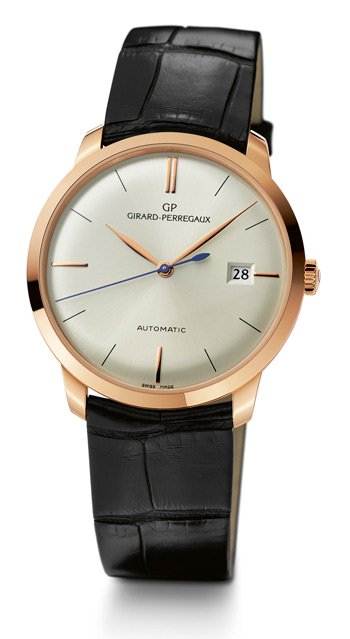
GP 1966
I often hear that the original idea behind 1966 is a watch that's geared towards the Chinese market. Is there truth to that?
Yes. Although GP always had round watches, inside the company we were very interested in complications so we always had a small function on our contemporary pieces, be it power reserve, date or big date. We never thought about making just a simple time only round watch. The Chinese are very conservative people, so about 4 or 5 years ago, we had a proposal to make a simple, round, time only watch. So it's often said that the very first inspiration for the 1966 is derived from the preferences of the Chinese customers.
1966 is very popular in China, Hong Kong, and the rest of Asia. Nowadays, Europeans and Americans like it too.
What's appealing about the 1966 is a mixture of classic design and contemporary elements. From the onset, it's a classic round watch, but if you look at the details - the angle, the shape from the sides, you will find it to be very sharp-looking and contemporary. The movement is a beautiful GP Calibre 3000. It's definitely not a replica of a watch from the 60's.
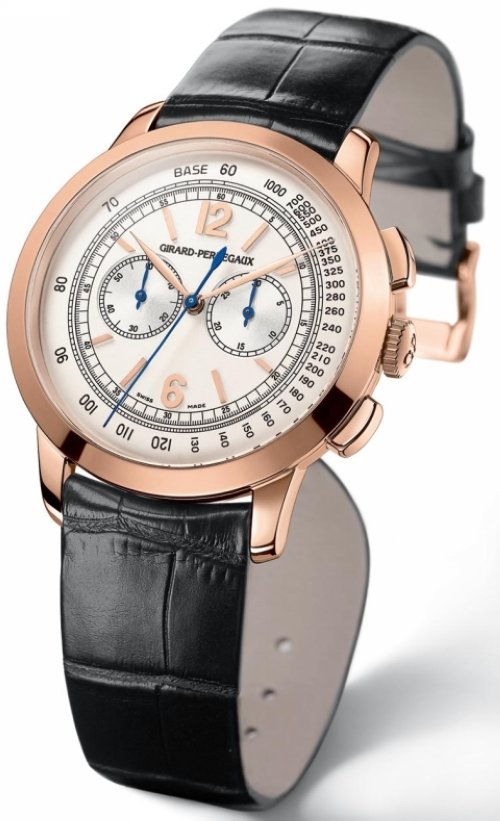
1966 Chronograph
Who are your closest competitors?
VC, Breguet and Patek. AP, because it is also an independent company. JLC, because it is also a fully-integrated manufacture.
What's your sales volume?
We sell 15,000 GP watches a year. We produce more movements, of course, because we supply movements for Sowind group, JeanRichard and friend companies like Gerald Genta, Harry Winston, Daniel Roth, Boucheron, etc...
Interesting that you brought up AP and JLC as your competitors. AP's marketing strategy has been focused on celebrity, lifestyle and design. JLC's marketing message has focused more on its role as an integrated high-end movement manufacture. What's GP's global marketing message and theme?
Until last year we had a theme, but this year we will probably abandon it because people weren't happy about it. It was...how to define it...a bit too complex to understand, maybe. It was based on the theme of "Wait", which takes comparison between another high-end product that takes time to develop. An example was an ad that showed a bunch of grapes, and then a bottle of Chateau Latour, with the message "Wait", conveying the idea that it takes time to develop something good.
It's a very nice idea, we will keep the same concept that good things take time to develop, but we are thinking about opting for something with a more direct visual in communicating this concept.
Many brands nowadays use celebrity endorsement. If memory serves me right, GP has never used any brand ambassador in the past.
Yes that' correct. Never. At the moment, GP has always focused on our products and pure watch-making. This is our global strategy. We might use celebrity in the future, but we are not forced to do it.
You have sponsored events in the past.
Yes we have sponsored events such as concerts, sailing, racing. We always get involved in the events - for example, for the BMW Oracle sailing, we involved the team and made a team watch. During the Ferrari days, we had driver friends participating in the event. We don't use brand ambassadors as I believe it's a slightly more mass-market approach. We want to remain exclusive - this is similar to the strategies of VC, Breguet and Patek.
Let's talk about the company's brand strategy. How has it evolved over the years?
We can talk about in 3 levels. First, the movements. For years we have invested very heavily in base calibres. At this moment, being an independent manufacture, we have one of the richest portfolios of base calibres [5 to 6], which will be enough for the next years to come. Right now, we are more involved in fundamental research, such as constant escapement. Second, the complications. We are working on chronographs, minute repeaters, and new tourbillons.
Regarding design, we are mostly focusing on 4 main collections - 1966, 1945, ww.tc, Cat's Eye for ladies. We will expand within these 4 collections, offering different complications. For example, this year we have a new 1945 curved case, and we are in the process of fitting a movement to this case.
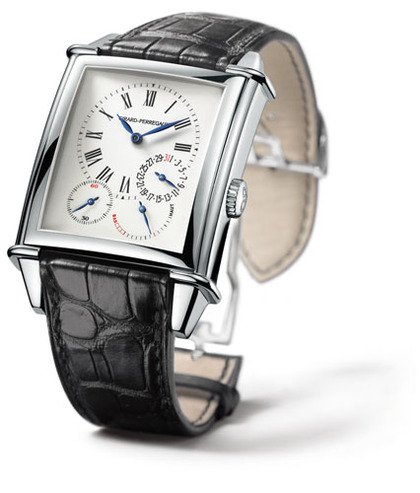
Vintage Off-center in White Gold
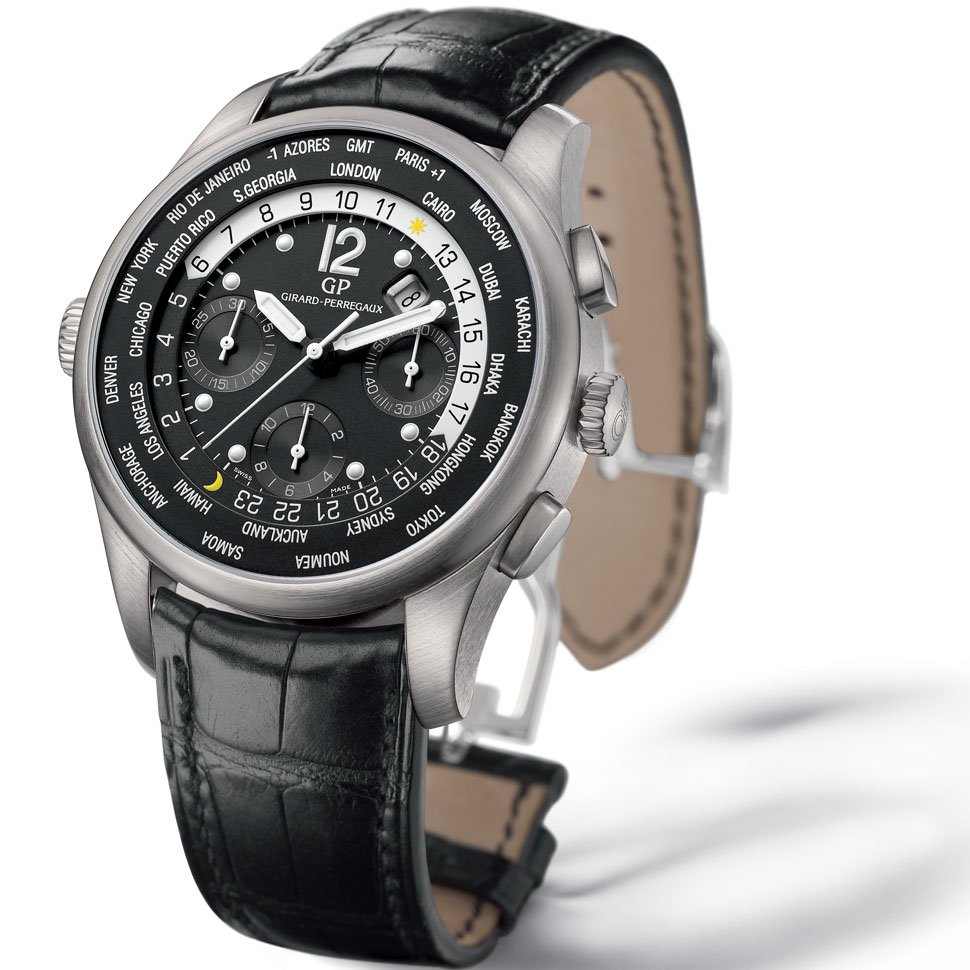
WW.TC. in Steel
What about the Laureato and the Seahawk?
We will always keep them in the catalog, as they are special designs. For example, this year we introduced the 40th year commemorative quartz version of the Laureato. But these collections are not the main focus anymore, and we will probably only have 1 new design a year for each collection.
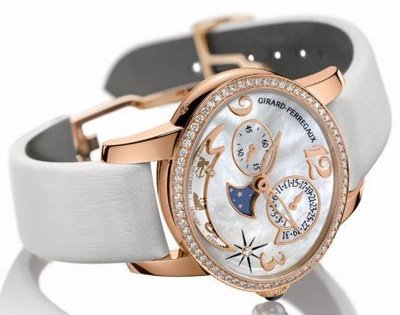
Lady Cat's Eye
On the topic of re-editions. GP celebrated the quartz watch this year. Many years ago, GP introduced the Vintage 1994, which was a re-edition of the 1948 model. What other models does GP plan to bring back from the past?
The GP museum is quite rich with designs from the past. Our current goal is to keep the 4 main collection, and every year introduce a limited edition from either a design of the past, or a totally new design. Right now, we plan to introduce a model, coming from the next year or two, with our new constant escapement, it will be a good opportunity for a new design.
What new materials are GP incorporating?
The most notable is the Silicium used in our constant escapement. This new material makes such otherwise difficult technology possible. Of course, we also use materials found on other brands such as ceramic, rubber, etc... Another implementation that I like quite much is the sapphire bridges on the Laureato Three-Bridges Tourbillon.
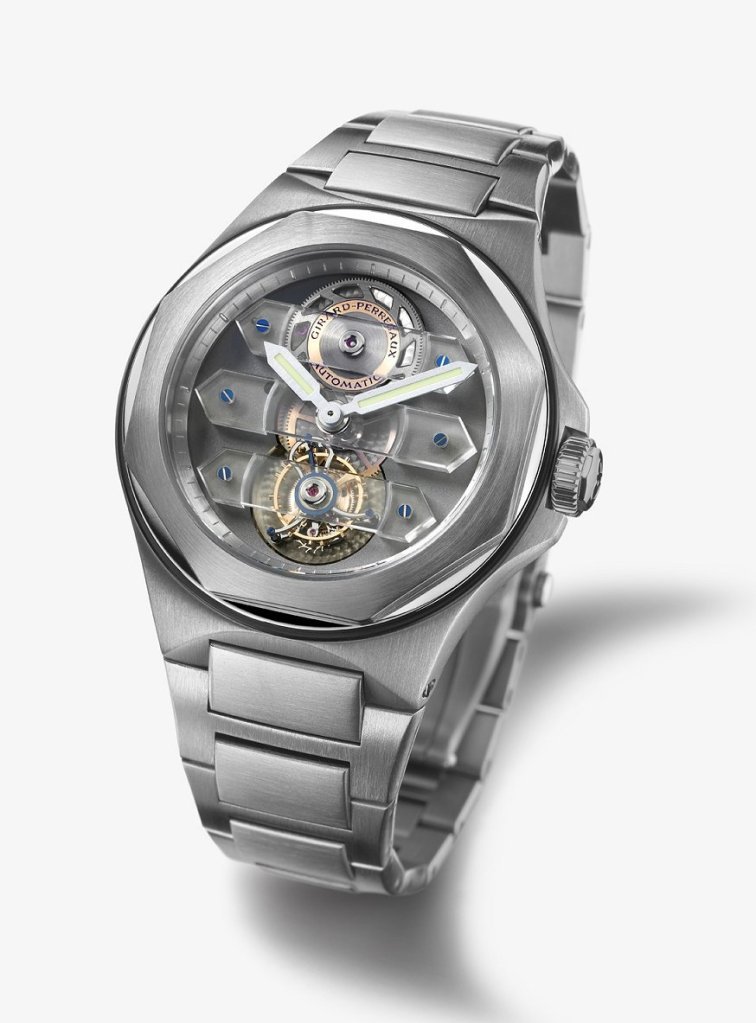
Laureato Three-Bridges Tourbillon
What is the target customer for GP?
It's for somebody...it's very hard to talk about age... of course we sell a luxury product, so it's probably not for a 20 year old. It is for people around the world [as we have distributions everywhere] who appreciate sophisticated design, those who appreciate classic design but are not conformist. They like a company who's able to produce its own movement, not only as a marketing tool, but a company deeply rooted around movement manufacturing. They also like tradition, with contemporary elements. For example, if you take our best seller from the last SIHH, which is the 1966 Chronograph, the for the inspiration is from the GP Museum's chronograph from the 40's and 50's, but it is contemporary in styling.
You mentioned designs. Who makes the design decisions?
We have a design committee, which I myself is a member of.
There is no chief designer?
Well, the president is the "chief designer". The committee involves the marketing people and the product development people. Finally, the design is approved by the president, and by myself.
Is the design decision a top-down or a bottom-up approach?
We will take input from the marketing people, but it is more top-down than bottom-up.
How important are the watch collector communities, for example in this case, PuristSPro, in influencing the design decisions?
It's definitely important to have direct feedbacks from collectors. It's certainly precious helpful for design decisions. We have developed limited edition models for specific markets, based on collector's inputs. Of course, we need our own interpretation of the opinions.
How would you view the importance of the online forums as a channel? Relative to traditional media such as magazine?
It's getting more and more important. It has a relatively short history of say, 6 or 7 years, but it has quickly become a quite important channel. It's important for GP to have a day-by-day discussion with collectors on the forums.
Relative to traditional media, I think it is a network effect. Forums are good because it's a direct communication with people, yet everybody can express his opinion and it is not clear whether it is an interested opinion. For example, you may find someone spreading negative information on a forum, and later discover that the person is a competitor, it's always a possibility.
The traditional media such as print gives the company more direct control. We need to consider all types of media in their proper ways, and be very flexible.
Every brand has a weakness, for example, it could be image, awareness, design or distribution. What are some the areas that you think GP can potentially improve upon?
I am aware that we are a relatively "confidential" brand, so we need to work on getting more awareness in the market. That's why we are here [in New York] with the opening of our flagship store. Historically speaking, Girard Perregaux is more of a technical manufacture, than a marketing and brand development company. So in the future, we definitely need to work on distribution and marketing.
Our brand image is quite good, we just need to make sure that we are not as confidential anymore.
How many boutiques do you have globally?
Two directly owned - one in Gstaad, the second one here in New York, and we are thinking more in the future. In addition, we have boutiques in cooperation with local partners - two in China, one in Hong Kong, one in Macau, one in Prague, another one opening right now as we speak, in Beirut, Lebanon.
Do you foresee a change in the distribution going forward, for example, moving towards a distribution model where you sell primarily through the boutiques?
We make 15,000 watches a year, so we definitely need the multi-brand channels. There will be coexistence and cooperation between the boutique and the multi-brand channels. However, our own distribution network like this boutique here in New York is certainly something we need to do more on.
At c urrently 15,000 watches a year, what do you think / hope to be a long-run equilibirum?
Difficult to say, GP will never be a mass brand. So I am thinking, maybe 30,000 watches a year. It's a good size for us, at least for the next 10 years.
Of course, we all know from history that watch markets change many times. The current kinds of appreciation for fine mechanical watches that collectors have is a relatively new thing. For example, looking back in the 60's, a precious watch was a gold watch with diamonds. A good watch back then would be a quartz watch, because good watches are considered to be accurate. If we go back to the end of the 19th century, a mechanical pocket watch was a real instrument, like a cellphone today.
Hence, although the next 10 years might be okay, it will be difficult to say what will happen 20, 30 years from now.
Speaking of trends, do you think a collectible mechanical watch will retain its prestige that it currently enjoys, many years from now on?
I think the mechanical watch technology can be compared to sailing. In the past, mechanical watch was the only way to measure time - just like how sailing was the only way to transport people and goods. Today, nobody uses sailing for transportation anymore. Yet sailing is very popular, just like mechanical watches. So there is a chance for old technologies in terms of concept. Of course, the technologies evolve - today we have world-class manufacturing facilities with CNC, but the concept remains the same.
I think people will always be interested in these old technologies because of the crafts and the skills needed to produce them. Unless we have a dramatic change in lifestyle, hopefully not, people will always enjoy mechanical watches, just like how people will always enjoy sailing.
In the 60's, quartz watches ruled because it was accurate. But then a small group of people fought back, because they were nostalgic about the old technologies of watchmaking. The human approach involved is very appealing to collectors.
Finally, what are your top markets?
If you combine Hong Kong with China, then it is easily China. The second largest market is Italy, which has been traditionally big market for us, as we have had distribution there since the 1970's. Then, Swiss and Russia are important. The U.S. is very strategic market, but that's the one which has been most affected by the economy.
That's all. Thank you Stefano, for your time.
Thank you. It's always a pleasure to talk to PuristSPro.
PuristSPro Interviews Stefano Macaluso - GP's Vice President of Global Operations

Loved the interview Jon!
Agree. Good products need to be well marketed

Excellent questions
Glad you like it Damien.


Very nice interview
Thanks vlkcheng...

Great interview with a very interesting and talented

I just love GP as a brand...
Thanks Daos. From your review of the 1966 Annual Calendar..
a bit disappointed...
Seems like GP is focusing on the more "dressy" watches...
Dressy vs. Sporty

Celebrity owners of Girard-Perregaux watches


Great report Jon........
