
MTF
[PuristS]
13383

Review New Chronometer Ferdinand Berthoud FB 1 watch: part 1 - Movement
We report on the new FB-T.FC movement and the rationale for the decision choices during development at La Chronométrie FERDINAND BERTHOUD S.A. We reveal the background and project team thinking behind the scenes with engineering illustrations and photos.

Chronomètre FERDINAND BERTHOUD FB 1.1 (18K white gold and titanium)
Case: Bimetallic in 18K white gold with Grade 5 titanium inter-horn space
Crown in 18K white gold with 18K rose gold medallion

Chronomètre FERDINAND BERTHOUD FB 1.2 (18K rose gold and black ceramic)
Case: Bimetallic in 18K rose gold with black ceramic inter-horn space
Crown in 18K rose gold with black ceramic medallion
Total diameter: 44 mm
Watch Thickness 13 mm
Water resistance 30 metres
Octagonal case fitted with four watertight portholes in glare proofed sapphire crystal.
Screw-in case-back with glare proofed sapphire crystal.
Domed, arched and glare proofed sapphire crystal.
The new Chronometer Ferdinand Berthoud FB 1 was announced in Paris with a media frenzy. Everyone was trying to get wi-fi bandwidth even before the presentations had finished so they could be "first" with Instagram and Twitter. I did not even try as I knew that I had no wi-fi connection. I also needed time to absorb and cogitate on what we had seen.
Was it all hype?
Was it a modern creation with reinterpreted features of Berthoud's legacy?
Was it desirable?
La Chronométrie FERDINAND BERTHOUD S.A. president, Karl-Friedrich Scheufele, explained the guidance used by the Project F team during development of this new watch: “We sought to transpose what Ferdinand Berthoud might have created if he was living now. The contemporary translation of his genius consists in drawing inspiration from the master-horologist’s most remarkable accomplishments in order to offer modern creations bearing reinterpreted distinctive features and evoking emblematic historical constructions.”
Was that achieved? Let's study the evidence:
Objectively:
We were presented with a chronometer wristwatch housed in an octagonal case with watertight portholes (30m). The Chronomètre FERDINAND BERTHOUD FB 1 is specified with a new mechanical hand-wound movement constructed from more than 1,120 components. The FB-T.FC calibre is entirely independently conceived, developed and produced by Chronométrie FERDINAND BERTHOUD in Fleurier. The movement features a tourbillon with central seconds, a distinctive pillar-type architecture, an innovative suspended fusée - chain regulating system and a mobile cone indicating power-reserve. Patents have been filed for those 4 innovations.
Subjectively:
The immediate reaction was actually a stunned silence in a roomful of cynical journalist hacks and mass media representatives from international lifestyle, specialised horology and business interests publications.
They had seen phantasmagoric announcements before that did not deliver in production.
They may even have been stunned by the Manufacture Recommended Sale Price of Euro 220,000 plus taxes.
After a collective intake of breath, the questions started and reached a crescendo.
Questions:
As if in homage to the Karl-Friedrich Scheufele’s track record, there were no substantial questions about the 4 patent-pending features. It was as if the audience recognised the R&D fervour at La Chronométrie FERDINAND BERTHOUD S.A. and CHOPARD and accepted that they were the best practical solutions to the engineering issues.
Let’s see what those challenging requirements were:
1. Chronometric accuracy as fundamental.
2. Innovative constant-force device.
3. Pillar-type architecture.
4. Highest finishing standards.
5. Proven reliability and stability.
6. Flat movement.
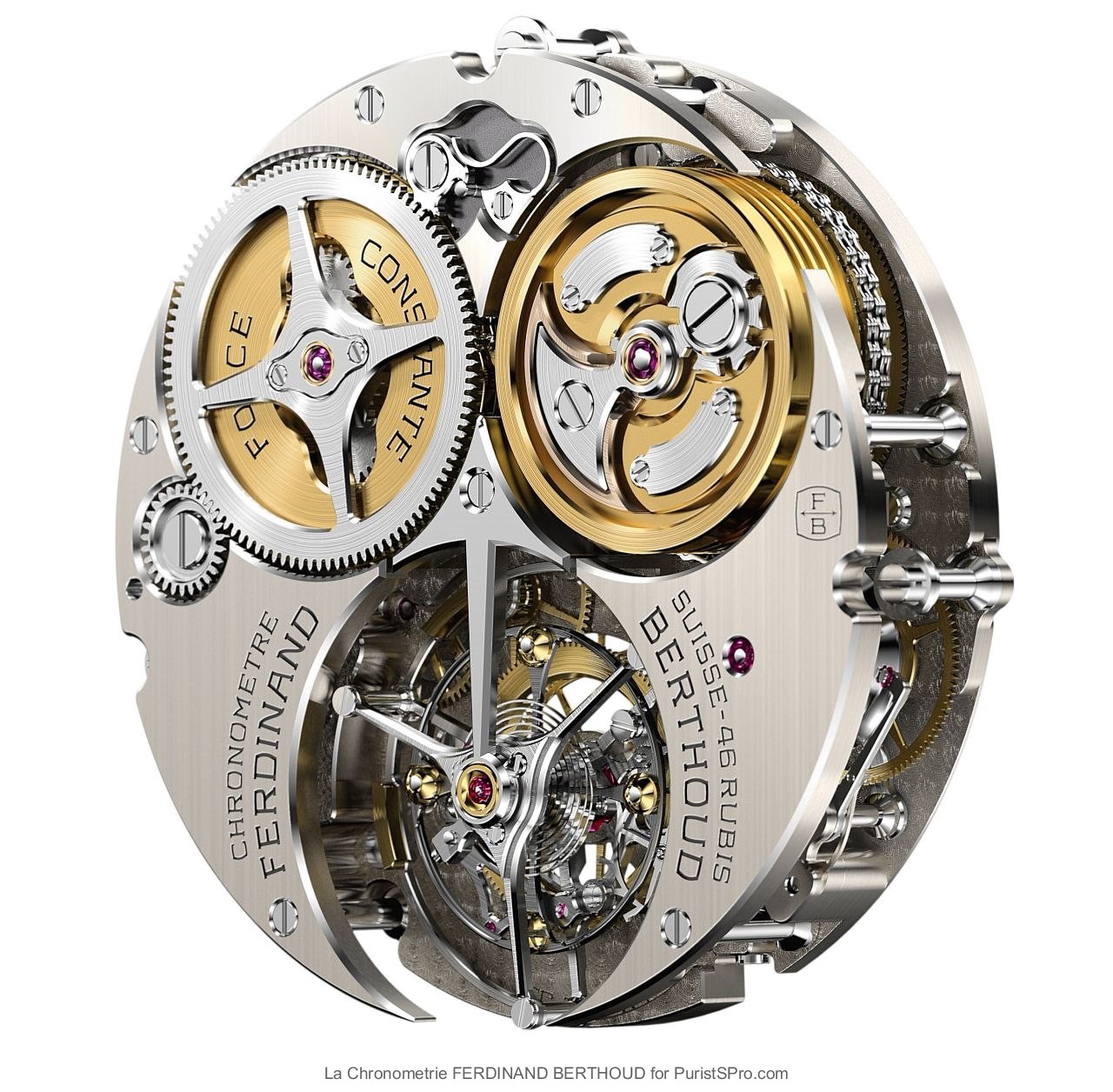
The result is the Ferdinand Berthoud – Tourbillon. Force Constante (FB-T.FC) movement.
Mechanical hand-wound FB-T.FC
Total diameter 35.50 mm
Thickness 8 mm
Number of jewels 46
Frequency 21,600 vph (3 Hz)
Power reserve 53 hours
Suspended fusée - chain constant-force transmission regulation
Suspended mobile power-reserve cone – 3 Hz low-frequency tourbillon with central seconds
Balance-spring with hand-shaped Philips terminal curve
Nickel silver half-bridges supported by stylised titanium pillars
Chronometer-certified (COSC)
New Movement Overview

Marine chronometers by Ferdinand Berthoud were capable of measuring longitudes to within half a degree at sea, an improvement over his nearest rivals (LeRoy, Harrison and Arnold). Thus, the fundamental requirement for FB 1 is chronometric precision.
In the Chopard L.U.CEUM museum, Marine Chronometer M.M. n° 6 (1777) is one of the main sources of inspiration during the rebirth of Chronométrie FERDINAND BERTHOUD. This marine chronometer is driven by a movement equipped with a constant-force module (fusée - chain transmission system) as well as a pillar-based construction. The new Chronomètre FERDINAND BERTHOUD FB 1 reinterprets these characteristic features to achieve reliability and chronometric precision.

The low frequency (3Hz) escapement allows for a long power reserve of 53 hours while delivering exceptional precision and rating regularity as certified by the Swiss Official Chronometer Testing Institute (COSC). Such performance is achieved by the constant-force regulating device with suspended fusée - chain transmission. The watch is wound by a differential winding system and the highly specific power reserve mechanism uses a “suspended mobile cone”.

Patent 1: Innovative fusée - chain transmission
The fusée - chain systems of 18th century timepieces compensated for torque variations from the degree of wound mainspring. The innovation in Calibre FB-T.FC is the fusée - chain mechanism occupies a very small space because of the “suspended” construction; it is secured exclusively to the mainplate. The hand-assembled barrel and the fusée are linked by a 28 cm-long chain composed of 474 steel links and 316 pins measuring 0.30 mm in diameter.

When the mainspring is associated with a fusée (spindle), the barrel drum turns in one direction while the spring winds down and in the opposite direction when it is wound up. The rotation of the drum causes the chain to coil around the fusée. The movement must continue to work during winding so as to maintain accuracy; the fusée mechanism of Calibre FB-T.FC is equipped with a differential gear. The mainspring barrel is linked to a Maltese cross stopwork device that limits the number of winding turns of the mainspring and to ensure pre-determined, constant-force transmission during the letting down process.


Patent 2: Power Reserve mechanism
Influenced by a George Daniels idea – and a nod to the ties cultivated by Ferdinand Berthoud with The Royal Society of England – this new mechanism directly linked to the barrel by a driving wheel, uses the winding and letting down motion of the mainspring to make a truncated cone move up and down along an arbour secured to the mainplate. A mobile arm tipped with a roller jewel serves as a feeler-spindle in measuring the motion of the cone and transmitting the movement’s power-reserve level to a dedicated hand.


The innovation here is the direct-drive seconds hand driven by a variable-inertia balance oscillating at 3 Hz, while the tourbillon carriage performs one rotation per minute. The balance made of copper beryllium (CuBe) alloy is equipped with an unbreakable, stainless and anti-magnetic self-compensating balance spring whose terminal curve is shaped by hand. Two sets of inertia-blocks on the balance rim enable micrometric adjustment of its amplitude. The 67-part titanium tourbillon carriage is held in place by a bridge with a single arch and poised by means of two 18-carat gold studs. Identical and coaxial with the wheel driving the tourbillon carriage, the central seconds-wheel allows a central display of the seconds.
The unique architecture of the FB-T.FC calibre highlights a fascinating play on the symmetry between the barrel, the fusée and the tourbillon, visible through the generously open back of the octagonal case. Fitted on gear wheels with tapering spokes and supported by stylised pillars, the barrel, fusée and tourbillon appear to be suspended in mid-air, thereby creating an airy, light feel. The polished titanium pillars securing the bridges to the mainplate generate a space that draws light to the heart of the movement and reinforces the pure nature of this exceptional construction comprising more than 1,120 components within a 35.50 mm diameter and a modest 8 mm thickness. The entirely hand-decorated half-bridges are satin-finished and bevelled with straight-grained flanks, while the jewels are set in finely polished and chamfered chatons.
Balance wheel amplitude is 300° at T0 and 280° at T48.
Manufacture in-house tolerances for daily rate variance far exceeds C.O.S.C. standards and current Version 2 development movements have already undergone 8 months of Chronofiable® testing. Final production models will have Version 3 of the movements incorporating knowledge from testing of earlier versions. This is to ensure thorough development and not use clients as beta-testers.
The FB-T.FC movements will not be subjected to Qualité Fleurier certification because the 5% destruction proportion demanded by the FQF is not viable for a model with low production rates and totals.
Short of subjecting the watches to an At-Sea test for one year across the Atlantic and back, we could not really test the longitude calculation precision. Although that question is moot with the advent of GPS technology, some members of the audience volunteered to do the maritime testing!
CONCLUSION
Objectively, Project F achieved the movement specifications listed at the start of this report:
1. Chronometric accuracy as fundamental: YES: C.O.S.C. tested.
2. Innovative constant-force device. YES.
3. Pillar-type architecture. YES.
4. Highest finishing standards. YES.
5. Proven reliability and stability. YES: Chronofiable® tested.
6. Flat movement. YES: 8mm.
Subjectively, I reserve judgement until the second instalment of this Review Series....

In the next instalment of this Review Series, we will look at Chronometer Ferdinand Berthoud FB 1 watch case and dial design with the rationale for the decision choices during development at La Chronométrie FERDINAND BERTHOUD S.A.
Meanwhile, here is an image of the open FB-T.FC movement that supercedes any potential concerns of the engineering involved.

www.watchprosite.com
Dr M. Teillol-Foo, 2015.


Review New Chronometer Ferdinand Berthoud FB 1 watch: part 1 - Movement

Thanks for this very interesting report, Melvyn.
Maybe not for chronometry contest

The interest of the large opening
This is whay I said that aesthetically speaking, that was not my cup of tea.
