Tony C.
1239

What? A Happy Marriage?! Is it possible?
Even in contemporary times, during which divorce rates are relatively high, there are plenty of happy marriages to be found. However, in the world of vintage watch collecting, the phrase carries far different connotations. In fact, amongst vintage collectors, the word “marriage” is heavily loaded, and in a distinctly negative manner.
Vintage collectors tend to crave, seek out, and in some cases demand originality. Fully original, high-quality watches are particularly prized, especially if there is sufficient circumstantial evidence to support the claim.
Collectors have differing tolerances for a lack of originality in vintage watches. Some cannot bear the thought of a replacement crown, while others are quite comfortable with such replacements as long as they are “correct”, or reasonably appropriate for the period and style of the watch. Broadly speaking, collectors are tolerant of replacement crowns, crystals, and parts of movements that occasionally require replacement (e.g. mainsprings). Some are comfortable with factory replacement dials, though far fewer find third-party redials to be acceptable, no matter how well executed.
When it comes to cases and movements, however, collectors are almost uniform in rejecting anything other than original as “marriages” (also, at times, derogatorily referred to as “Frankenwatches”). This is understandable, and the value of such watches is typically a small fraction of equivalent, original examples.
The Impact of the Broader Economy
Though held in low regard by most collectors, marriages are nevertheless created to fill a market. There are cases and movements that come to market without associated parts, and it is rarely possible to match them with correct, corresponding parts. Even when a correct case reference is matched up with the appropriate movement and dial, the reference numbers of each (if available) will confirm that the watch did not leave the factory in that specific (parts) configuration.
Cases tend to show up on the market in NOS form, while movements are more often “orphaned”. The latter is being seen with increasing frequency, which should come as no surprise given the relatively high value of gold. In other words, vintage gold watches are being scrapped for the value of their cases, leaving movements (and some dials) as “orphans”.
As a related aside, my view of the world economy is such that I fully expect the value of gold to rise significantly in the next few years. If I am proven correct, such rising values will, unfortunately, act as an accelerant to this insidious dynamic.
Personal Perspective
While vintage collectors have different perspectives on the issue of marriages, most will never own such watches, and many feel an almost visceral disdain towards them. I admit to having fallen into the latter category for most of my collecting years. Even those marriages that happened to feature high-class movements were of no interest, and I was never even remotely tempted to acquire such a watch.
Well, as you have probably surmised by now, all of that has changed recently. It has been a very interesting, enriching, and ultimately gratifying experience, spanning almost a year. I hope that you will also find the details of my unexpected conversion to be of some interest.
The House of Gübelin
One of the many sub-categories of interest to vintage collectors is that of “branding”. Beyond the obvious point that the names and reputations of various watch manufacturers impact both perception and price in the marketplace, some vintage collectors also pay special attention to watches that were sold through high-end retailers.
At times, such watches were “co-branded”, displaying the names of both the manufacturer and retailer on the dial. Some of the best known and most sought after are Tiffany & Co., Cartier, Türler , Beyer, and Gübelin. Some of those prestigious retailers also sold watches under their own names (solely). They would source parts from various manufacturers, and, in some cases, assemble and finish them in house.
Pocket watch collectors are well aware of the quality of many of the offerings of Tiffany and Cartier during the early and middle parts of the 20th Century. Such watches often featured top-class movements from manufacturers such as Patek Phillipe, while the cases reflected the retailers’ impressive expertise in jewelry design.
In the wristwatch genre, I believe that a strong case can be made that Gübelin stood apart from other high-end retailers in at least one important respect. During the golden age of watchmaking (i.e. the mid ‘40s through the mid ‘60s), they sourced a wide array of good to excellent movements from different manufacturers, incorporated them into their in-house designed watches, and produced a fair number of interesting and (in some cases) very fine timepieces under their own banner.
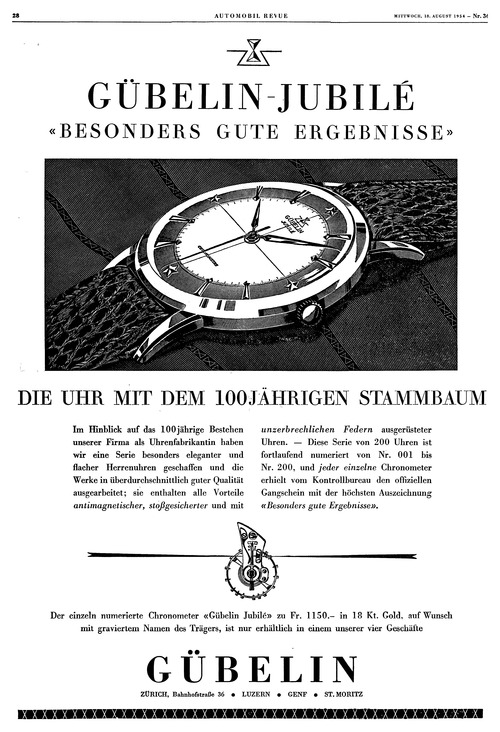
That aspect of Gübelin’s business culminated in 1954, the company’s “Jubilé” year. To mark their 100th anniversary, Gübelin created three special, limited edition series of watches. One was a nice version of their successful “Ipso Matic” watch (based on the Felsa 690 movement), limited to 300 pieces. The other two, however, were both manual-wind, and quite special.
The Best of the Golden Age Movements
While there is always some subjectivity involved in compiling such lists, it is generally agreed that there were a few extraordinary production movements developed during the ‘40s, ‘50s and ‘60s that tested the upper limits of mechanical watch performance capabilities. Much like production automobile engines that were based on specialized, race-tested engines, these movements typically evolved from successful Observatory chronometers. In stark contrast to automobile engines, however, the best of the hand-finished chronometer-grade movements of 60 years ago remain virtually unsurpassed in potential accuracy, a truly remarkable achievement given the advances in materials, computer design, and machine technology.
There may well be others worthy of mention, but my short list of manual-wind movements includes the following (in no particular order):
Zenith 135
Peseux 260
Audemars VZSS/c (based on a Valjoux ebauche)
Patek 27SC
Movado 126
Omega 30T2rg
JLC 478/BWS/br
Vacheron Chronometer Royal (based on the above JLC ebauche)
Longines 30L/LS (chronometer version)
Along with many vintage collectors, I have been attracted to watches powered by such elite movements for some time. They were all produced in relatively small numbers, and, as awareness of them has spread in recent years (thanks largely to the internet), there are fewer good examples available, and values have escalated.
Most collectors would be delighted to own a nice example of a watch powered by any of the above movements, myself included. But even given a generous budget, we all tend to express our individuality by making distinctions, and narrowing our focus. In that context, I found myself, over time, gravitating towards one of the lesser known calibers on the list: the Audemars Piguet VZSS (VZSSc for the center-second version).
My reasons for developing a particular interest in, and attraction to that caliber were basically threefold. It is arguably the most esoteric of the top-tier, golden age calibers; it has an interesting and unusual pedigree; and it features uncommon (and to my eye quite pleasing) aesthetics. The short version is that these 13 ligne movements were derived from a Valjoux ebauche, and were used by both Patek Philippe and Audemars Piguet in their Observatory chronometers. For a much more detailed and thorough treatise on this interesting caliber, follow this link to an excellent post authored by Suitbert Walter:
A Stroke of Luck
Most of the VZSS movements are found in fine, often understated Audemars Piguet watches from the 1950s. But a total of 400 of them also ended up in watches produced by another company, and yes, that company was Gübelin.
Of the various superb calibers available at the time, the VZSS was chosen by Gübelin to power the finest, and most historically important hand-wind watches that they ever produced. They made 200 sub-second versions, which were quite thin for the time, and 200 center-second versions. They were all finished to a very high standard, and serialized on the main-plates. The movements also featured a reference to Gübelin’s anniversary on the main-plates. All of the watches were cased in gold.
Given how few were produced, it is no surprise that they rarely appear on the market. I found one on ebay a few years ago, but someone snapped it up with a private offer, leaving those of us taking part in the auction empty handed.
During the winter of 2012, as I was cycling through some of my saved searches on ebay, I stumbled across – of all things – an orphaned Gübelin VZSSc Jubilé movement and dial. They were located in Germany, and appeared to be in very good condition. Acutely aware of my previous, frustrating experience, I contacted the seller, made an offer, and quickly consummated the deal.
The acquisition was utterly inconsistent with my long-standing position on marriages. I also had no illusions about the possible difficulties that I might face in terms of completing such a project, not least of which would be finding a suitable case. I knew full well that I was heading into uncharted waters, and yet, for some reason, I didn’t hesitate.
Three Essential Ingredients: Luck, Skill, and a Good Friend
While I considered myself lucky to have found and acquired such a fine, rare and desirable movement and dial, I wouldn’t have had a prayer to complete the project successfully without the help of an exceptional watchmaker. I say that, in part, because I would never have embarked on the journey with modest goals. No, I have high standards, and from the beginning I envisioned a watch that would be a showcase for the top-class movement, yet also stand on its own as a superbly integrated timepiece.
I had worked previously with Keaton Myrick, who is based in Oregon, and had been very impressed by his work, highlighted by two previous display back projects. His ability to fabricate parts, coupled with his experience in creating his own independent designs, also pointed him out as a logical choice for the job.
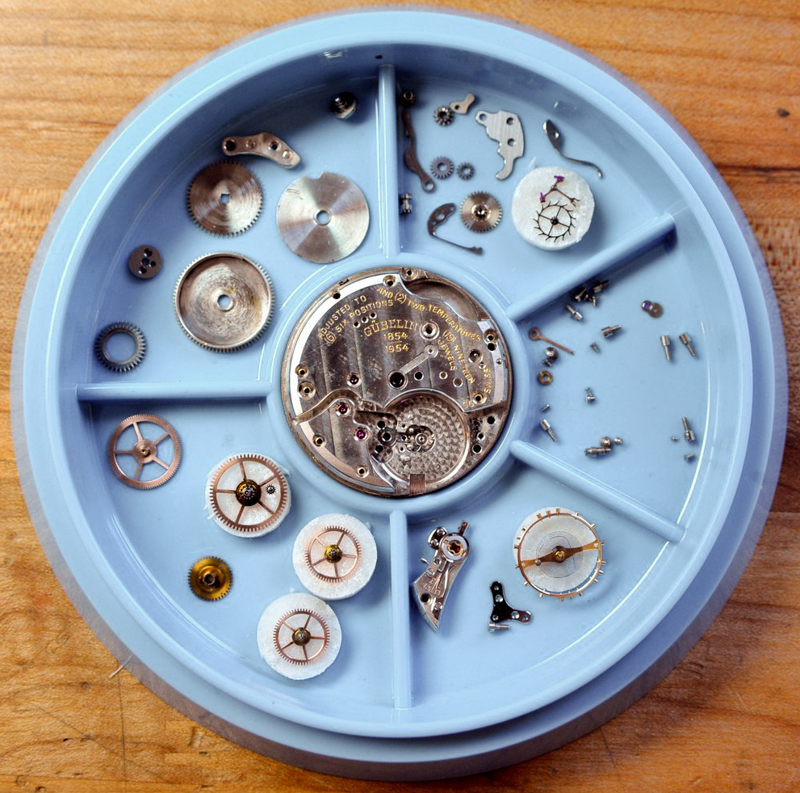
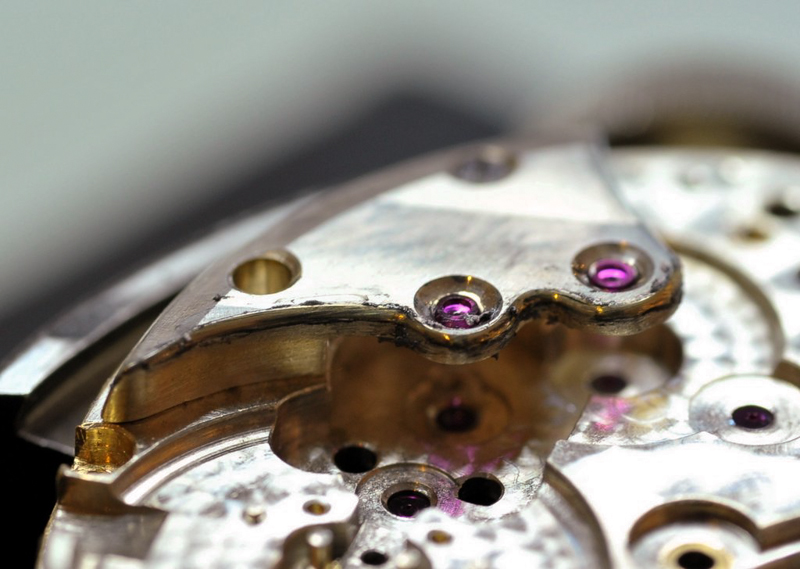
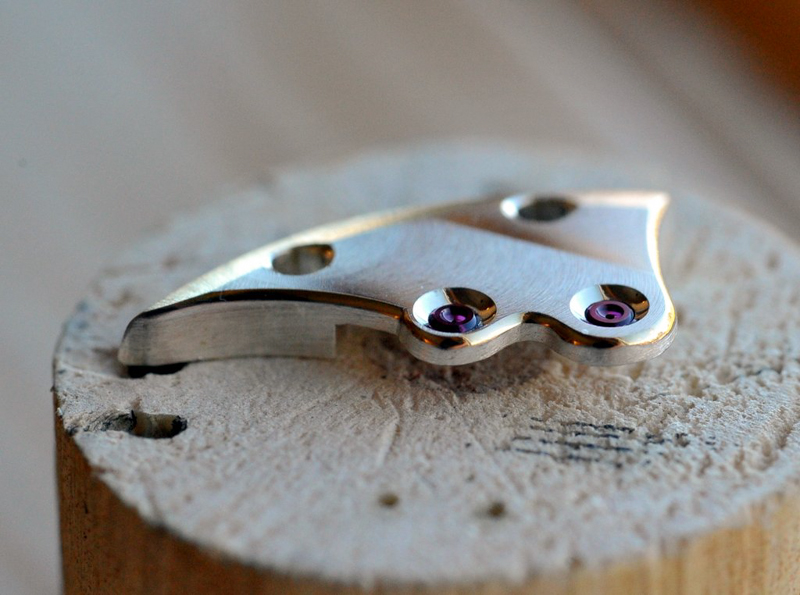
I sent the movement and dial to Keaton, and awaited his feedback. I was relieved to hear that the movement was fundamentally sound, and in excellent condition overall. However, he added that the set lever was broken. He assured me that he would be able to fabricate a replacement, so, to my relief, one potentially difficult (if not hellish) hurdle had apparently been cleared.
Keaton then measured the movement and dial to very close tolerances, so that he could gain a good feel for the approximate dimensions needed in a donor case. The VZSS movements are 13 ligne (30mm), which was typical of the best movements of the day, as they were capable of accommodating larger balance wheels. It was predictable, therefore, that a good-sized case (by period standards) would be required. What wasn’t expected, however, was that the dial was unusually large (30mm). This meant that I would either have to source and be satisfied with an oversized case, or somehow find a more normal one that could be adapted to the extra-wide dial.
I hasten to add that I had no interest in sourcing a gold case, not due to cost considerations, but because I prefer steel cases, and knew that I would want to have the movement visually accessible at all times through a display back.
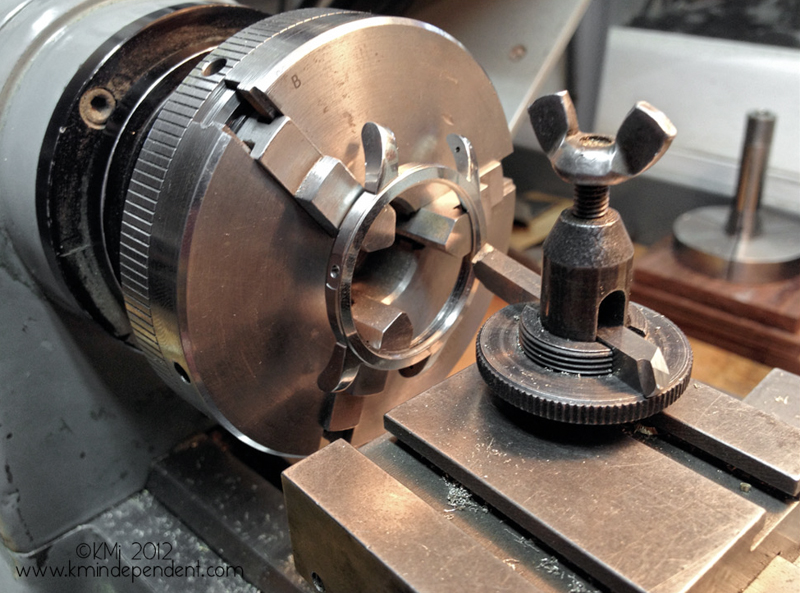
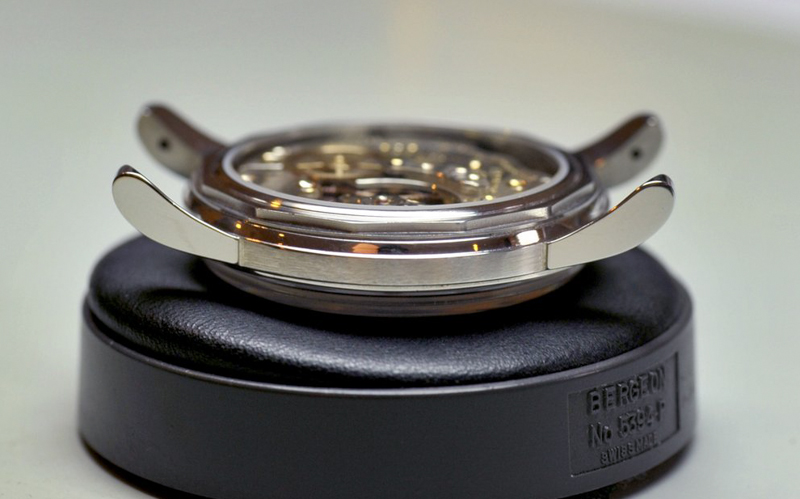
Keaton and I tested two or three candidates, none of which were quite right, before a good friend came to my rescue. That friend is known to many collectors as the exceptionally knowledgeable and excellent moderator of The Purists’ Omega forum, Bill Sohne. Bill, who has long been ahead of the curve as a collector, had somehow found and acquired a NOS case for an Omega cal. 333 bumper chronometer, and, given its size, suggested that it might just work for my project. I sent the case to Keaton, and he confirmed that, with only very minor modifications, the case would likely work well. This was great news, as I happen to own a couple of 333s, and like the case design very much.
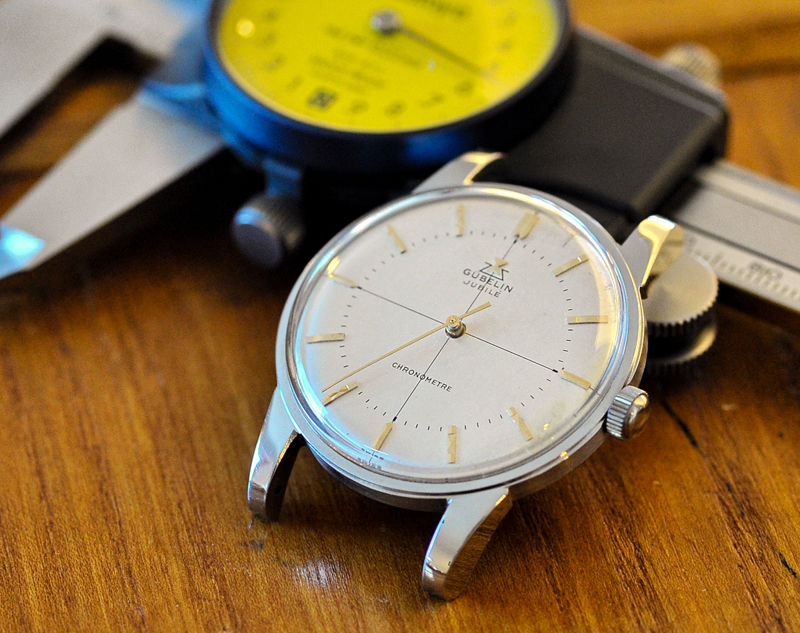
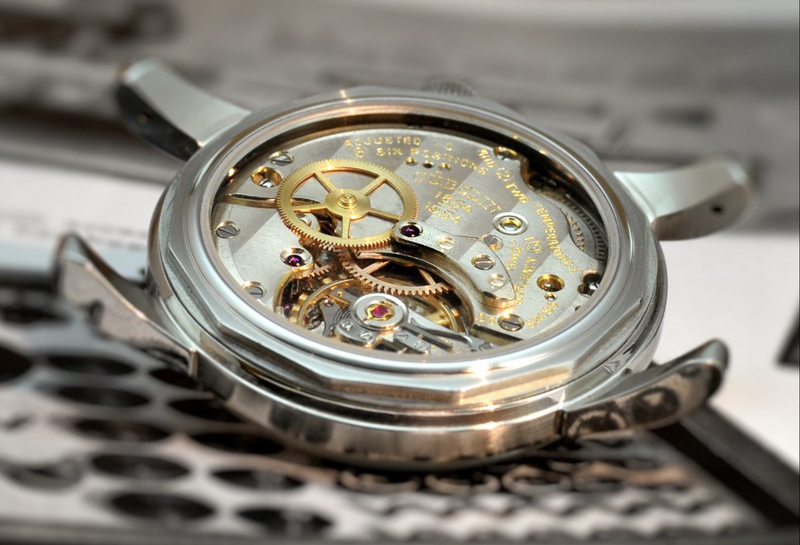
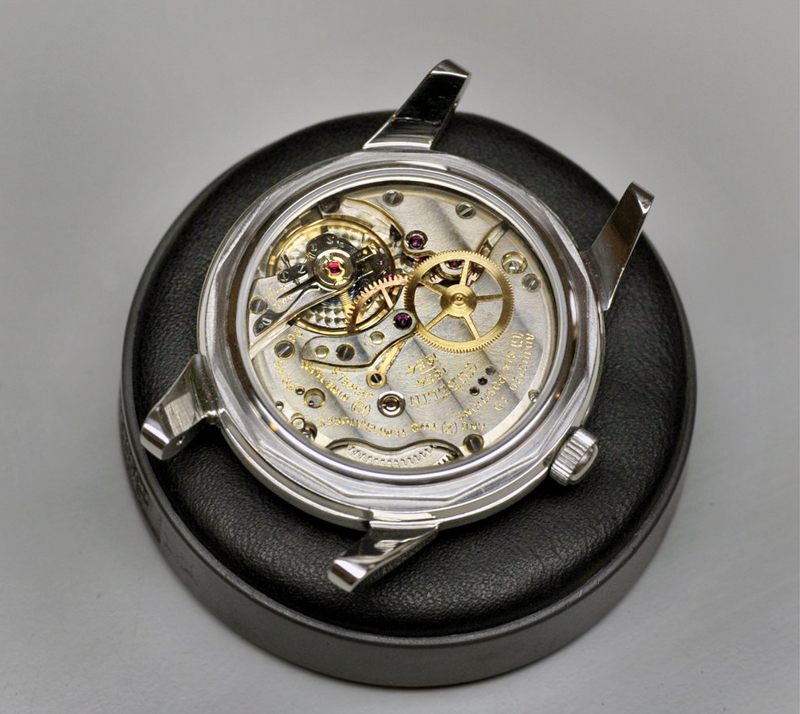
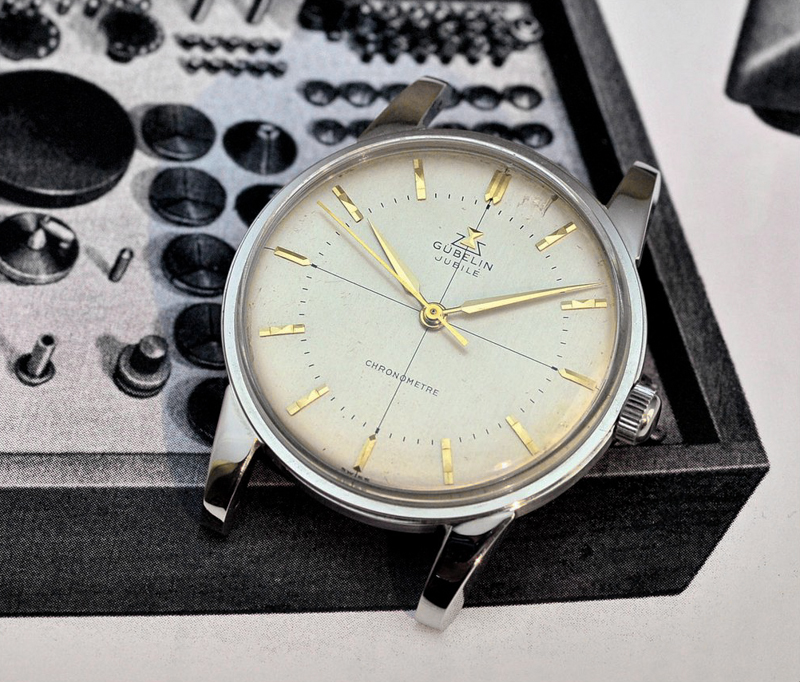
Fast forward several months, and the project was finished. The result, frankly, exceeded my expectations, and by more than a small margin. The case suits the movement and dial beautifully, and it is not difficult to imagine that if Gübelin had chosen to create a steel cased version of this special edition watch, it might have looked something like this.
The movement, not surprisingly, is highly accurate, and shows very well through the display back. It was originally adjusted to six positions and two temperatures. The winding action is silky smooth. The dial, while showing a scratch between the 12 and one o’clock markers (I liken it to a scar on a lovely woman's face), is very attractive, and the contrast of the gold markers and hands with the steel case is quite pleasing to my eye. A couple of small details worth noting are that the “sword” hands are the finest of their type that I have ever seen; the second hand must have a very high gold content (as many from that period, even those produced by top-class houses, tended to tarnish over time due to a lower content); and the eye-catching beveling of the markers are, on close inspection, small mirrors of the iconic Gübelin (hour glass) logo.
Hopefully I didn’t bore you with all of the above background and detail, but given how interesting and ultimately satisfying I found the project to be, a thorough review seemed appropriate.
As a final note, many thanks to Bill and Keaton (who is also credited with the photos below), without whom the project could not have been completed to anywhere near such high standards. And what a journey, from turning my nose up at marriages for years (decades, in fact), to envisioning, creating and owning one that I would never consider selling! It’s yet another example of just how interesting the world of vintage watch collecting can be, and how gratifying it can be to follow an unexpected fork in the road.
(Please respect the copyright of the images, but feel free to link to the post.)
Tony C.




What? A Happy Marriage?! Is it possible?

VZSS gave lots of influence on the then-future watchmakings...
Yes...
Great post and very "authentic" looking watch...
Bravo!
Thanks much, Steve...

What I can say ...

a superb result Tony.
Thanks Graham...
Thank you...
outstanding
Tony... it looks GREAT !!! congrats on finihsing it !!


The results look superb, congratulations on such a success.

Great post

Ouch! To have found an original of these!!
Great get!
Found in Zurich

Well done!

Great write-up of an even greater journey.
Truly enjoyed this marvellous, and inspiring write-up.. Liked every word of this amazing .

7 Years late to reading of this remarkable project and post
