
Watch Review: Vacheron Constantin Malte Small Seconds
Soon after the birth of the wristwatch, a product designed to meet the demand from fashionable women for jewelry that also told time, just over one hundred years ago, there was a desire to break away from the tradition of roundness that early wristwatches had inherited from pocket watches. This signified that the wristwatch was not a derivative and a lesser type of watch from the pocketwatch, but rather that it was an object of interest on its own merits. The tonneau, or barrel shaped, case would come to comprise many variations of curvature and size, and for Vacheron Constantin it would be a material part of series production of ladies timepieces, beginning in 1912, and continue in men’s timepieces after they became fashionable after World War I. Alex Ghotbi of The Hour Lounge authored an exhaustive survey of Vacheron Constantin’s production of tonneau form wristwatches in a four part series of articles titled, “Vacheron Constantin and the Tonneau: 100 Years of Creativity,” which I highly recommend for those who are interested in learning more about Vacheron Constantin’s historical timepieces.
Jumping ahead to the modern era of watchmaking, with the mechanical watch renaissance firmly established as durable and growing phenomenon, Vacheron Constantin debuted the Malte collection in 2000 with a series of round cased watches of varying complexity, and a tonneau form tourbillon featuring an in-house movement that proudly announced that Vacheron Constantin was joining the ranks of manufactures.

Sharing the sword blade hands and stepped lugs of its round cousins in the Malte collection, Vacheron Constantin had a winning design on its hands.
In 2001, those design cues were applied to the Royal Eagle collection of timepieces, with a Chronograph, shown below, and a Day-Date Chronometer.

Vacheron Constantin would later add a Dual Time complication to the Malte collection, which is still in production today.

In 2008, Vacheron Constantin introduced a major revision to the concept of the Malte collection, focusing it exclusively on the tonneau form, again with the tourbillon, now with regulator display, as the prestige piece in the collection:

and with a Chronograph:

and finally with the Moonphase with Power Reserve rounding out the collection.

Characteristic of all three models was an oversized case, with the Malte Moonphase and Power Reserve the smallest at 39 mm diameter, which with a tonneau case has the wrist presence and feel of a 42 mm round watch, and a lessening of the prominence of the lugs. More effort went into making the dials of these watches, with multiple finishes applied on the gold base: guilloche, satin graining, snailing, smooth opaline, and also applied numbers and indices. The sword blade hands were modified to echo the look of the incomparable 250th anniversary collection.
A New Generation
Vacheron Constantin had a strong showing at SIHH in 2012, with natural extensions of existing lines within the Overseas and Patrimony Traditionnelle families, and the exquisite beauty and inventiveness of the Metiers d’Art “Les Univers Infinis” collection. But the focus this year was on the new Malte collection. The cornerstone of the collection is the updated Malte Tourbillon:

Which uses the same base movement as the original Malte Tourbillon, but going for a more understated look by removing the date and power reserve indicators on the dial, and leaving the dial without texture.
That simplicity was taken to its minimalistic extreme with the limited edition, 100 pieces, platinum Malte 100th Anniversary watch:

This timepiece celebrates the 100th year of the tonneau form in Vacheron Constantin’s long and distinguished history. One wonders why Vacheron Constantin did not give it a platinum sandblasted dial for a new entry into Excellence Platine collection.
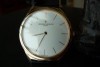
The base model is the Malte Small Seconds:

A simple, elegant, manual winding timepiece that is the focus of this review.
Case
The tonneau form can hold many variations in the proportions of the barrel shape, and with the Malte Small Seconds Vacheron Constantin has chosen a more complex curve than the smooth arc of the previous generations of Malte cases. Here it bulges outward towards the middle of the case, bringing a roundness to the form that was not present in earlier Malte models.
The three part (bezel, main body, and case back) 18K rose gold case measures 36.70 mm wide and 47.60 mm high, with a thickness of 9.1 mm, and like all Vacheron Constantin dress watches, is water resistant to 30 meters. While 36 mm would seem small in this era for a round watch, in the tonneau form it has the presence of a 40 mm round watch:

The bezel, lugs, and sides have a high polish finish.


The solid case back has a beautiful satin finish, able to support a custom engraving, and the inside is exquisitely decorated with a perlage finish.


Dial
Present in each of the Malte Tourbillon Regulator, Malte Moonphase and Power Reserve, and Malte Chronograph models is a circle on the dial for the minute ring and applied hour markers, downplaying the tonneau shape and creating a visual counterpoint of shapes between the case and dial. The updated Malte collection reemphasizes the tonneau form of the case by echoing it in the dial. The applied hour markers, a mix of Roman XII and XI and carefully shaped index markers outline the tonneau form in the interior of the case:

A dramatic change from the last set of Malte models is the flat opaline finish, and even the omission of any minute track.
Consistent within the updated Malte collection is the use of Alpha hands, with frosted and high-polished halves to aid legibility.
Movement
Inside the case sits Vacheron Constantin’s Calibre 4400, previously used in the Historiques American 1921 and the Patrimony Traditionnelle. The calibre 4400 is a manual winding movement, 28.60 mm in diameter and only 2.80 mm thick. It employs a single barrel with an extra long mainspring, giving the watch a 65 hour power reserve.

The Calibre 4400 was designed to fulfill the requirements to earn the Geneva Hallmark, a quality measure that ensures a movement’s longevity, durability, and quality. This year, the criteria for earning the Geneva Hallmark have expanded to dictate qualities that the entire watch must possess, not just the movement. Included in these are timing accuracy, and qualifications for how the movement is encased. Vacheron Constantin will be offering the new Geneva Hallmark certificate for all eligible watches by June, 2013.
The Malte Small Seconds being delivered at the time of this writing are with the old style Geneva Hallmark certificates, but it has have been designed to meet the updated criteria, and an obvious change is to see that the movement is attached directly to the case, eschewing the need for a casing ring, flange, and screws.

Finishing of the Vacheron Constantin calibre 4400, though never to be seen through the solid case back, is exquisite, with all the hallmarks of fine Geneva decorative and functional finishing: mirror polished screw heads, anglange on the bridges and jewel sinks, perlage on the gear sinks and top plate under the dial, and straight and circular graining on the steel parts and brass wheels, respectively.

Conclusion
The third iteration of the Malte is the most refined version to date. The bold elements like the stepped lugs and sword blade hands from the first generation, and the domineering size and complex dials from the second generation, have been toned down. Considering Vacheron Constantin’s history in exploring the tounneau form, and with some historical ancestors to this watch having a similar outline, the Malte Small Seconds could fit quite comfortably in the premium Historiques collection. It also shares the elegance and simplicity of the timepieces from Vacheron Constantin’s Patrimony Contemporaine collection. I predict that collectors will appreciate the Malte Small Seconds, along with the Malte 100th Anniversary and Malte Tourbillon, with the same high regard as these other two successful collections.
Bill Lind
VC Forum Moderator

Its huge size, and its coffin shaped case left me cold.
Then to see the same movement in the Patrimony, then in the American, then in this one is another argument which didn't please me.
I know that Vacheron is far from being the only one to do so, but what I don't like here is something I don't like elsewhere.
If I got it well, VC decided to opt for a solid case back? If, so, it is a good solution, but a round movement in a coffin shaped watch...Hmmm, I really don't like that.
I much preferred the case of the first generation.
Thanks for the write up, Bill. Good job!
Best,
Nicolas

Thank you Bill

Please!
Right before 1938?
the Maison Genevois
I share your interest in the history of Swiss watchmaking and particularly the "Maison Genevois"; an intricate collaboration of resources in the Genevan canton that worked as a symphony to produce, in the end, a watch! V&C has been in existence since 1755 and, up to the merger with Jaeger-LeCoultre (that's 183 years), produced the majority of it's own calibers. Yes, specialists have long existed for small-series complications, as they do today. LeCoultre supplied the vast majority of repeater mechanisms to all Swiss brands, as Victorin Piguet did with chronographs. However, where does one draw the line between in-house and out-sourced? During the 19th century, the process followed by all manufactures consisted of farmers using their off-time to cut, punch and file raw components, which were delivered in batches to the manufactures for assembly and finishing. Dial manufactures, like the Sterns, provided their particular components into the process as well. Sorry, I digress, but its a fascinating story that is so at-odds with our modern industrial concepts and leads to the presumptions you began with.
So, to answer the question directly; prior to 1938, and other than specialized ebauches, V&C made the vast majority of its own calibers - starting with the farmer-repassient right through to final assembly. Ironically, it was their success following the Great Depression that led to the JLC "solution". In 1936 they had so many orders on the books which they were unable to fill, as the lack of orders and reductions of staff over the previous years had strangled their manufacturing capacity. It was either find a rich partner or turn away the business. I think they did the right thing!
If I may suggest one of the most authorative readings can be found in Charles Constantin's Annales de la Maison d'Horlogerie Vacheron & Constantin, partially reprinted in the forward to Antiquorum's Art of Vacheron Constantin catalog of 1994. If I may quote from his notes of 1935 regarding the increased popularity of shaped calibers - in some attempt to bring this post back to being relevant to the thread: "The form movement for men's wristwatches became more established and we did not feel financially able to put one up quickly and under the conditions that I wanted for a modern result. After a detailed review, we addressed ourselves to "La Generale", a watchmaking factory in Reconvilliers, where they kept an 8 3/4 calibre specialty tonneau machine that had been made at the beginning of the crisis and remained unused." V&C purchased this press and with it manufactured their first shaped movement called, rather drably, the 20x26 caliber.
This message has been edited by Tick Talk on 2012-12-02 08:38:21
Many Thanks


Nice familly overview
It's so pure an delegant, a nice shaped original watch compared to what we can see here and there in that field.
I'm not a fount of knowledge concering VC so thanks a lot for sharing your thoughts and report Bill.
Cheers,
Mark

I was not seduced by this watch.
Anyway, thanks a lot for this detailed presentation!
Fx
Thanks for the review, Bill
It is interesting that the Malte Small Seconds that was delivered came with the old-style Geneva Seal papers, when I see the Geneva Seal imprinted on the watch caseback. I guess this is a transitional time for VC watches in this regard.
It is fascinating to see how the cal. 4400/1 is encased in the watch under the new guidelines for the Geveva Seal, and I am grateful to you for posting these interior photos that we rarely get to see especially for modern pieces. I must say that I like what I see very much. It is good to see the spacer ring dispensed with and the solution of 9 arms or brackets holding the movement in place and made in the same metal as the case. Since spacer rings are very often made in a non-precious (often unidentified) metal, this seems a like a good way to do away with the nonprecious spacer ring while not increasing the overall weight of the watch needlessly and while also not increasing the price of the watch too much either. I think it also looks very attractive this way as well, not that anyone but the watchmaker gets this view. I had been really eager to see how VC was going to address this issue, and I am very pleased by this development.
I was lukewarm on the new Malte watches when they were first announced, but I know by now that I sometimes need some time to really appreciate many watches. This has been the case with the new Malte tonneau watches. Now I have seen several of them on a few different occasions, and I am more an more impressed with the line. I think that the case shape of the new line is more elegant and refined than the previous recent generations of the Malte tonneau, and the new shape reflects past vintage designs beautifully while creating an new chapter in the rich story of Vacheron tonneau watches. The story is so rich, that I have begun to think that most serious collections of Vacheron watches would need to include at least one tonneau watch -- thank goodness I have the Overseas. ;-)
The form v. round movement for tonneau watches, and the Malte Small Seconds and Anniversary in particular, does not bother me so much. As you have argued before, Bill, and correctly I think, the expense of developing a "simple" form movement is very substantial especially for Vacheron which would not do this by half-measures, and this woud increase the costs of simple tonneau watches offered by VC substantially. Then, too, you would want a form movement that fits well within a range of case sizes, so the movement would need to be small enough for some cases while getting lost in other large tonneau cases, and thus calling into question of why one needed to put a form movement in a form case in the first place. And finally, there is the reality that non-round watches are not really popular enough, perhaps, to justfiy developing in-house a new form movement. Whe we talk about form tourbillon movements, we are taking about another game and price level altogether. So, at the end of the day, I am pretty comfortable with the caliber 4400 in the Malte Small Seconds and the cal. 1400 in the Aronde 1954, for instance. A form movement for these two watches would have been a very expensive proposition for what I suspect will, in the end, be very low production numbers. And a form movement that fit comfortably in the Aronde would look quite small in the Malte case, and negate the desired effect of placing a form movement in a form case.
All the above ridiculousness aside, the Malte Small Seconds is one gorgeous watch., IMHO. The colored metal and small seconds result in a warmer, more alive piece than the exquisitely stark and colder Anniversary Malte, the dial of which must be seen in person to be appreciated.
Thanks again for posting this review, Bill.
Best,
respo
