
Omega 2777-1: my quick review of this military issue amagnetic chronometer
There is a certain aura with British military watches. To be fair, there is an aura to most military watches, but the British ones do seem to attract more attention than most, and that is often reflected in the price. Rolex MilSubs regularly change hands for six-figure sums. But the beauty with the genre is that one can find very interesting military watches at extremely reasonable prices. In this sense, my dip into military Omega falls into the category of interesting and reasonably priced. But it goes further than that…..

Picture courtesy of internet...courtesy of Ludi.
The Omega Reference 2777-1 was produced in 1953 for the British Royal Air Force. It was produced for just one year, with a total of 5900 produced. It was produced for pilots and officers. The 2777-1 is also an amagnetic watch. This was a necessary requirement from the MoD because the aircraft instrumentation could easily have a magnetic effect on a watch and that would not be something that could be tolerated during a military operation. Like other specifically designed amagnetics, the 2777-1 is cased in soft iron. It also houses the chronometer grade caliber 283 movement. Amagnetic. Manual wind. Chronometer. Specific military issue. What a combination!!

But it goes further than that. Over time, I have found a great deal of satisfaction owning the central second feature. The Mk11 IWC and JLC military watches come in a smaller case size than this Omega, and at 37mm the Omega sits with a really comfortable sizing.
The 2777-1 that now belongs to me is nicknamed the “Fat Arrow”. Originally, the dial came using radium on the lume. However, the British MoD replaced these dials with a tritium-based lume. In order to differentiate which watches had been replaced, the tritium dials had the letter “T” printed under the Omega on the dial. I am sure that the original radium-based dial watches are still around and obviously desirable, but actually I find myself equally as drawn to this “T” version.
The watch is supposedly waterproof to 30m, though I won’t be putting that to the test any time soon!
The case back has inscribed upon it the NATO code, the 6B/542 aircraft issue and also the store number and year of issue. In this instance, all these 2777-1 were from the 1953 batch.
The Omega 2914 is often seen as the Railmaster to own. In fact, and as an Omega beginner I will happily bow to more expertise knowledge, but it seems to me that the very first Railmaster was in fact the 2777-2. However, the only difference between the 2777-1 and 2777-2 being that the former has the fixed lugs for military issue whereas the latter does not have the fixed lugs and was aimed for civilian use. Other than that, the watches seem identical. In this sense, could one legitimately argue that the very first Railmaster, albeit not labelled as such, was the 2777-1?
Yes, I am a beginner in a world of vintage Omega snake pits. This 2777-1 is not without some flaws. There are a few chunks dinged into the case. I like to think of these as having been made during military operations! The dial is the MoD replacement (I am guessing in the 1960s). Yes, the watch is not perfect…..but a manual wind chronometer, specifically designed to be amagnetic in order to facilitate military use and ordered for just one year from the British MoD…..WOW! Basically, that is what I thought……
....and thats why its now on my wrist!

This message has been edited by Baron on 2014-09-27 08:49:17

Does yours have the inner ring surrounding the dust cover?
We are not far from perfection, to me.
Yes, I've read that some saw it as the first Railmaster.
Others state that it was the first amagnetic, forgetting that 5 years before, the JLC Mark 11 was issued...
But hey, what's the most important? To own a Watch with History, and a nice one is what interests me the most.
And with some virtues, such as Chronometry and Amagnetism.
Well played, my friend, very well played.
Best,
Nicolas.
I will....

Baron, I agree with Nicolas - well played indeed.
Research?


Collecting Omega? . . .
I didn't get the allure of military issues immediately; it took several years. You're quick on the uptake.
PS - Vegas has the odds at 5:1 you'll find a chronometer by the end of the year
Very nice Omega 'Fat Arrow'...
Question to experts..... (Zirtual/SteveW)
Cal 283 was not made exclusively for the 2777


far from being an expert
From Omega's own website (heritage section):
http://www.omegawatches.com/planet-omega/heritage/vintage-watches-database?ref=14292
and this great article by Bill, that you probably already know:
Funnily enough Mario Richon does not mention this important watch in his Omega Saga. But then it is not the only important omission of this otherwise excellent book.
Kind regards
PS. Please feel free to delete all my links if I have infringed this forums rule.
If I recall correctly it was strictly prohibited to place external links/ non original content on pspro, I cannot remember if this is still the case.
I just want to help without paraphrasing...
Zirtual, that is fantastic provenance for your view!
You're welcome, Joe!

ztirual, the dial in your watch is not legit MoD issue. it is a later repaint; done.....
Thanks Achim
Much remains cloudy after all this time.
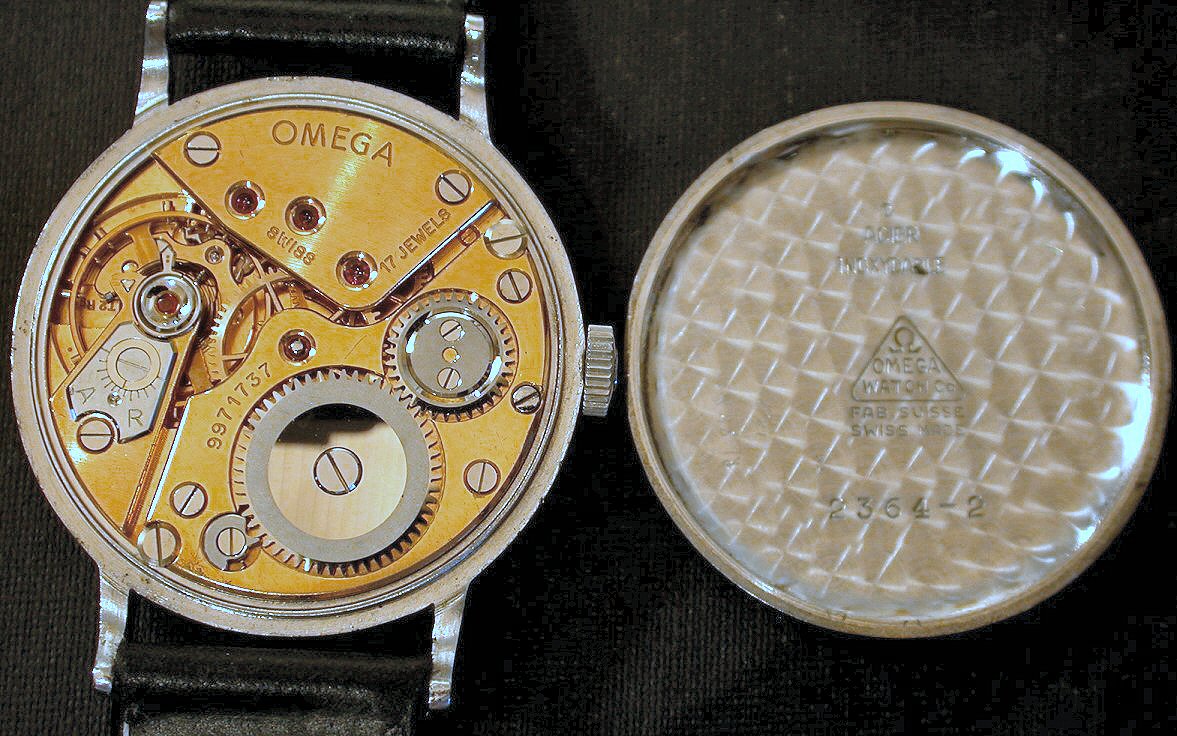
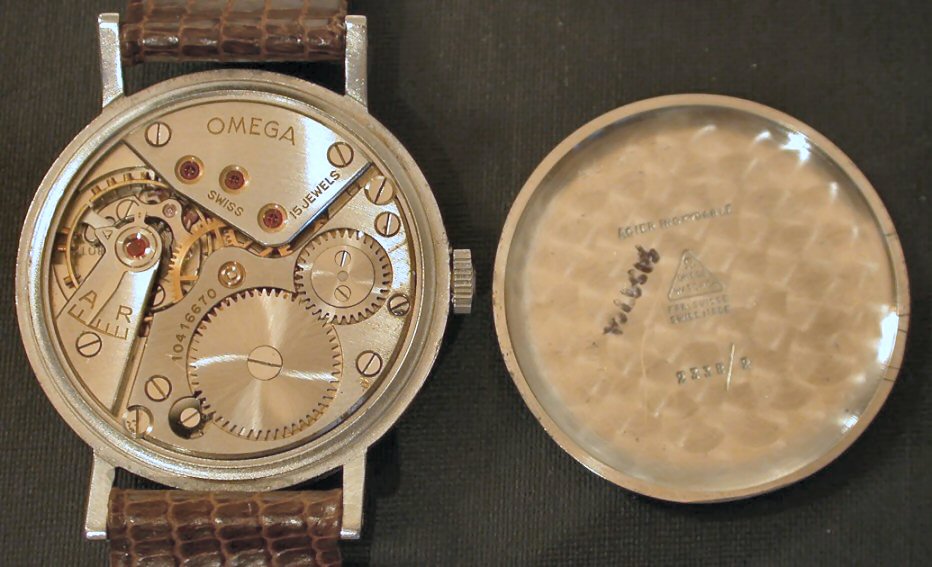
sub second:
30 : 15 jewels, no shock protection
30T1: 15 jewels, no shock protection
30T2PC: 15 jewels, Incabloc
260: =30T2 since 1949, 15 jewels
261: 17 jewels, antimagnetic
262: 17 jewels, excenter regulator
265: 15 jewels, antimagnetic
266,267: 17 jewels, antimagnetic
268: ring- instead screw balance
269: flat- instead Breguet-hairspring
sweep second:
30SC : 16 jewels, no shock protection
30T1: 16 jewels, no shock protection
30T2SC: 16 jwwels, no shock protection
30T2SCPC: 17/18 jewels, Incabloc
280: =Omega 30SC T2 since 1949, 17 jewels
281: 17 jewels, excenter regulator
283,284: 17 jewels, antimagnetic
285: ring- instead screw balance
286: flat- instead Breguet-hairspring

There is an error...
Hi Steve,
There is an error in Ranfft´s database.
There is no such Cal. as 30 SC - the center sec. 30mm movements started with 30 SC T1
whereas there was Cal. 30, then 30 T1
best
Erich
After sifting thru available sources . . .

[my 30T2rg]
. . . on their movements.
Hello Art,
Do you have A journey trough time, by Marco Richon? I don't.
But a friend tells me that it is written that this caliber 30T3, cal 283 with centred second, was adjusted in four positions to keep accurate time to 10 seconds a day, which is chronometer standard, as you know. As you write, probably to match the military specs.
Best regards.
Unfortunately, no, z, I don't own a copy . . .
Let's wait for Joe to post an image of the movement in his ref 2777.
Best,
Art
This message has been edited by Dr No on 2014-09-28 16:57:13
Do not expect fine tuning/ regulating


What I love about vintage collecting is the
Thanks H....

Pilot watches
I question the quoted number of these Omega watches produced for the RAF. Was it really that few? In the 1950’s and 1960’s there must have been more pilots requiring 5,900 new Omega watches in the RAF. Not just those in the front line but also all those under training, their instructors and those officers of senior ranks who still had to maintain flying standards. Many of the larger aeroplanes carried two pilots. There was also the additional stock of pilot watches held in stores around the UK and at many overseas bases. Other aircrew (navigators, flight engineers etc) were issued with smaller diameter military issue watches.
Before my 1962 pilot training I was issued with one of these watches and was told it was accurate to within 10 seconds per day. If the daily rate exceeded that limit, I had to exchange the watch. I did exchange mine twice during my military flying career that finished in 1971.
My pilot watches had a rough time. They were dunked in the cold sea on air-sea rescue exercises and at the monthly dinghy drills held in local swimming pools. They were knocked about on survival training and lengthy escape-and-evasion exercises.
We often considered these watches as crude and bulky, especially when their straps were canvas ones after the Bonklip bracelets were withdrawn. Many of us did not wish to be identified as officers and pilots while in a civilian atmosphere, especially when abroad or just socialising “off base”. It was the “cold war”.
Many of my colleagues in the long range air transport role bought our own watches where it was considered very useful to have a date function. We became used to the 10 seconds per day expected accuracy and often bought mechanical Seiko watches from foreign dealers. I still have my Seiko 5 day/date with its lovely gun-metal blue dial bought in Singapore in 1969. It was very accurate at that time but now lives in its original box with little wrist-time and needs a service.
Sadly I had to hand back my pilot watch when I retired from the RAF in 1971. I had grown to like it, especially when I replaced the canvas strap for a steel bracelet. It prompted my love of Omega watches at a young age such that I bought a used calibre 561 Constellation in 1973 from an impoverished colleague. I cherish my (one of the special 100,000 on its original BOR bracelet) Constellation, but that is another story.
With good wishes to vintage Omega lovers.
I think one of the main reasons why military watches are so . . .
Thanks for joining in the discussion, and please feel free to share your Connie with us anytime.
Cordially,
Art