
PeterCDE
10167

Some short preliminary thoughts on the "Lange 31"
Dear enthusiasts and Lange fans,
please feel kindly invited to share a close look at Lange´s latest, the "31 Days".
The watch was announced earlier last week:
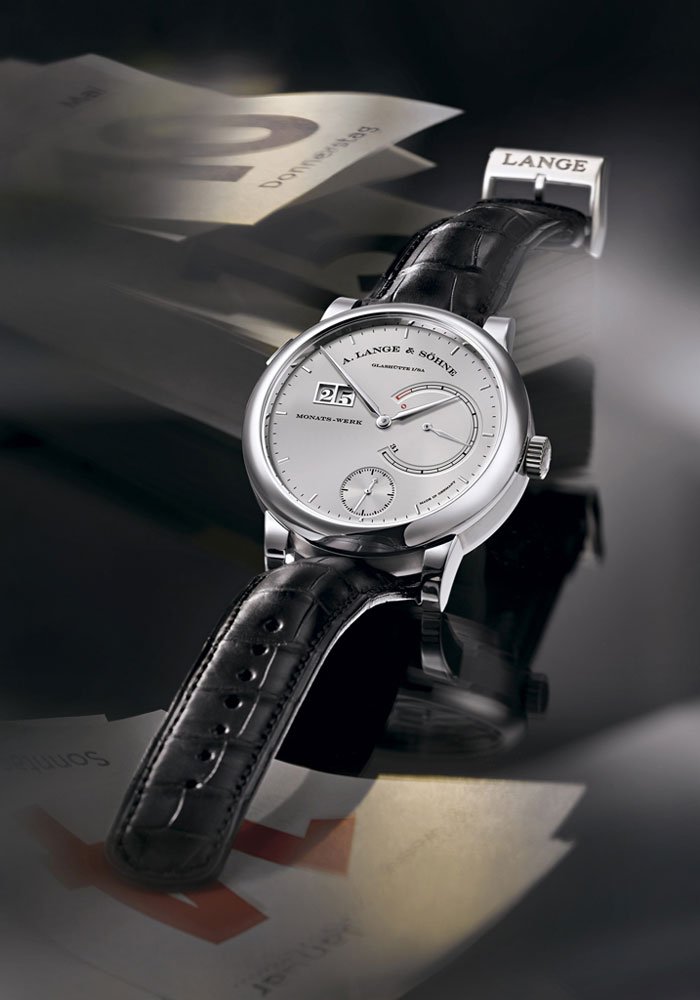
In order to avoid unnecessary grandstanding, sensational and emotional exaggeration, i´d like to address some aspects noted in our earlier discussion.
First of all, the sheer size is a detail frequently commented earlier; this seems to invite for a comparison:
-
"31 Days"
- "Grand Lange 1"
- diameter: 41.9mm
- height: 9.99mm
- diameter: 46mm
- height: 15.9mm
"Double Split"
- diameter: 43.0mm
- height: 15.3mm in height
"Datograph Perpetual"
- diameter: 41.0mm
- height: 13.5mm
Based on this, the absolute figures seem to suggest the "31 Days" not to be a small watch per se; on the other hand, the "Double Split", is referred to as a wearable and substantial piece in earlier reports. A variety of reports commented on the thickness of the "Double Split"; the proportions of the "31 Days", which of comparable height comes with a wider case, may suggest a relatively balanced appearance.
For comparison, IWC´s reference 5002 ("Big Pilot") measures 46mm in diameter and 15.8mm in height - almost the same dimensions, while being a highly coveted model among those who prefer a more massive watch on the wrist.
All this seems to suggest one shouldn´t shy away from the "31 Days"; it´s certainly not a small watch, but it´s neither the largest piece of current make nor is it disproportionally larger than other watches.
The sheer size provokes another question: does it have to be that large?
In this, a comparison of current production Lange calibers may help:
-
L901.0 / L 901.4
- L034.1
- model: "31 Days"
- diameter: less than 46mm
- height: less than 15.9mm
- parts: 406 (61 jewels, of which 1 is transparent)
- power reserve: 744 hours (31 days)
- beat rate: 21,600 A/h.
- model: "Lange 1"
- diameter: 30.4mm
- height: 5.9mm
- parts: 365 (including 53 jewels)
- power reserve: 72 hours
- beat rate 21,600 A/h.
L921.4 SAX-0-MAT
- model: "Langematik"
- diameter: 30.4mm
- height: 5.5mm
- parts: 378 (45 jewels)
- power reserve: 46 hours
- beat rate: 21,600 A/h.
L941.1
- model: "1815"
- diameter: 25.6mm
- height: 3.2mm
- parts: 164 (21 jewels)
- power reserve: 45 hours
- beat rate: 21,600 A/h.
Simply put, the new L034.1 caliber provides a power reserve about 10.3 times longer than the Lange 1 and 16.5 times longer than the 1815.
As we see, it´s hardly 10 times larger.
To do so, we´ve already learned the "31 Days" features two stacked mainspring barrels with an inside diameter of 25 millimetres, which occupy three quarters of the movement’s diameter.
Such space is needed to house the mainsprings, which are 1,850 millimetres in length and five to ten times longer than those found in conventional wristwatch movements.
Simply put in relation, the double mainspring barrel alone is about the same size as the complete movement of the 1815.
Do the self-check and roll a piece of paper, 1.85m long, into a small roll of 25mm in diameter - there´s hardly any air left and the mainspring itself certainly is not as thin as a sheet of paper.
One might conclude the outstanding power reserve, which is unsurpassed, requires a bit of movement space and if forced to voice a wild guess, i´d be confident it would be smaller if such solutions turned out to be a workable way for the Lange movement designers.

"Lange 31" - mainspring and barrel
Workable solutions - "power is nothing without control".
The famous line by Pirelli seems to match the context - all force is nothing, if one doesn´t succeed to bring it on the street. But unlike tires, the "31 Days" requires to do so every day, over an uninterrupted time of 744 hours.
To create a wrist watch capable of running a full month only does not appear to be in line what one would expect from one of the leading brands; it should do so accurately and precise.
As we already learned, the main challenge is the sheer power and torque of the long mainsprings; naturally this will vary as the movement runs down, influencing the timekeeping as mainly provided by the escapement.
And we´ve learned about the solution earlier, which is a so-called "Nachspannwerk" (in german) or "remontoir"/"Constant Force" device.
The remontoir acts like a buffer; the energy of the mainsprings, driving the gear train, loads up the remontoir, which then releases the energy in a more equal way towards the escapement.
This way, the escapement is kept free of varying power supply, which subsequently improves the stability of it´s function and equal timekeeping.

"Lange 31" - movement; foreground: remontoir (left) and escapement (right)
Implementing such a device is not a new technology; remontoirs can be traced back to the 15th century and became almost obsolete as soon as improved production materials and methods allowed for the creation of watch parts with low tolerances.
One reason might be the complexity of the mechanism; a remontoir consists of many parts, of which each has to be created, assembled and "tuned" very accurately. Not an easy task and obviously not suiting mass-production, thus remontoirs make a rare breed.
Among remontoirs, two variants can be found.
The position of the mechanism within the movement tells one from the other; the "train remontoirs" and the "escapement remontoirs".
One approach integrates the "buffer" into the escapement section, which mostly was in use for tourbillon carriages due to available space and the complexity to create these. These are utterly rare and not found in serial production units, but mostly hand-made or unique pieces, often experimental watches.
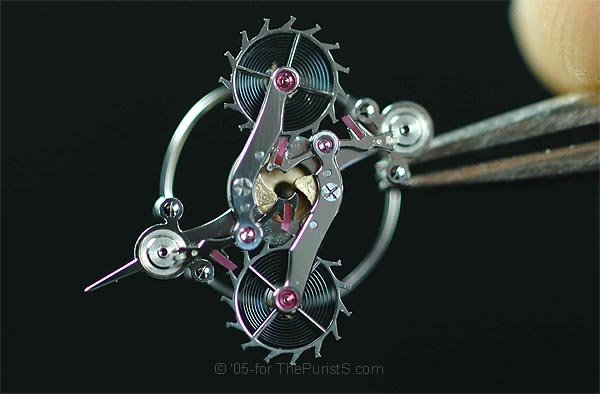
To give an example, Beat Haldimann integrates a resonance mechanism and remontoir in his "H2" double tourbillon:
our earlier coverage on the Haldimann "H2"
"The hairsprings of both systems are connected by a unique "resonance coupling spring". Both escape wheels have an integrated constant force escapement with overcoil hairsprings!
Both hairsprings feature a very unusual outer terminal curve. A "conventional" overcoil is calculated to let the hairspring "breath" as concentrically as possible. Alas, the "H2" is not a conventional piece by any means and here a perfectly concentric or even conventional breathing is not the aim of the overcoils. But the outer ends on both are attached to the "resonance coupling spring" and therefore the hairsprings outer terminal curve is optimized for best interaction by this connecting element."
A different approach integrates the remontoir into the gear train, mostly as near to the escapement as possible.
The execution of remontoirs can vary; while all are following the same approach to act as a "buffer" between gear train and escapement, the 15-seconds-remontoir of Roger Smith in his "No. 3" pocket watch may give an idea:
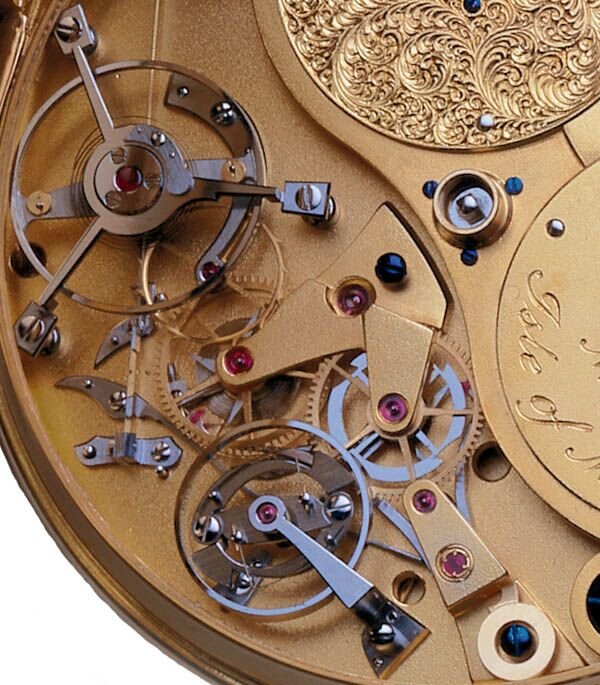
our earlier coverage
Unlike the solution of Roger Smith, F. P. Journe preferred a "flat" spring over the coiled hairspring to load the remontoir:
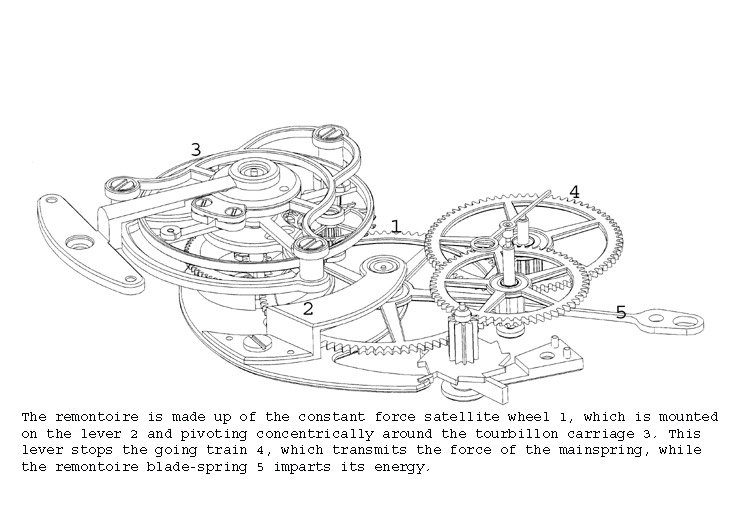
F. P. Journe, train remontoir

Patent US2005088918, F. P. Journe
Another approach is a remontoir using a coiled hairspring, such as this solution as patented by Richemont SA:


Richemont remontoir using pentagonal release cam
which goes back to a patented construction of 1927:

Patent CH120028, Barbezat-Bole SA, Le Locle, published 1927
The Lange remontoir is a different construction:


"Lange 31" - remontoir mechanism
The Lange construction integrates a coiled hairspring, notably of almost the same size as the hairspring in the balance. It is "loaded" every 10 seconds (whereas the Journe mechanism is "loaded" every second) and makes use of a Reuleaux polygon (a triangle with an equal diameter).
It is not integrated into the escapement (thus technically not a "constant force escapement"), in particularly not integrate the escape wheel as a functional part.
The Lange approach includes a directly driven seconds hand; thus no other gears are needed to support this indication.
One may consider this a benefit - the absence of additional gears to add power-consuming friction might be regarded a promising construction to result in a more stable power supply towards the escapement, which is in charge of proper timekeeping.
Over all, one might conclude the remontoir as found in the "Lange 31" not to be a completely new development; obviously, remontoirs are known and have been in use by A. Lange himself, more than 100 years ago.
Nonetheless, the construction of Lange is different from others; it has to be seen in the context of the power reserve, where it makes for a practical solution to combat a real challenge. Naturally the challenge of waning torque, in a movement utilizing a mainspring 5-10 times longer than most and providing a power reserve 10-16 times longer than others, is a lot more of a threat to proper timekeeping than one may believe on first sight. It thus is a technical solution not for the sake of creating a complicated mechanism - for which the number of parts in use may speak for itself.
Finally, despite the sheer dimensions of the encased watch, all this takes place in limited space.
As noted, 75 percent of the movement space are occupied by the double barrel; such leaves limited room for a complex mechanism.
The remontoir mechanism itself is not larger; the dimensions are easily overlooked, but given the barrel measures 25mm in diameter on the inside, it´s a few mm only.
The images of the movement suggest the balance itself to be rather small as well, which subsequently would have the benefit of decreased power consumption - which in case of the long power reserve can be reduced to "the less, the better".
Working in limited space adds a challenge, in that an equal performance of the movement requires all parts to be produced and assembled very carefully. The smaller the parts, the more a possible disturbance or unequilibrated weight will influence the final timekeeping.
If forced to voice a strictly preliminary comment on the first impressions suggested by the images and description of the "Lange 31", to me it appears to be an unusual timepiece.
The sheer dimensions are surprisingly large, accompanied by a design which itself is probably different from what could be expected.
The fact it is one of exceptionally few wrist watches capable to run a full month makes it stand out, but the truly interesting details are found in the mechanism itself. The use of a remontoir is not new, but the execution is and in it´s context, it´s a development that seems to make a lot of sense.
The "Lange 31" appears to have a provocative touch; it´s not for everyone, but it´s certainly interesting!
Greetings from Germany,
Peter
💰587 Marketplace Listings for IWC›F.P. Journe Resonance · 45 for sale · 160 discussions›IWC Big Pilot · 4 for sale · 891 discussions›A. Lange and Söhne 1815 · 2 for sale · 4335 discussions›

Manufacture
Explore foversta's visit to the IWC Paris boutique, featuring hands-on wristshots and reviews of the Mark XVIII and Chronograph Spitfire from the 2016 Pilot's collection.
10 replies4101 views

Manufacture
Explore the new IWC boutique at Piazza di Spagna, Rome, with foversta's detailed report. Discover the exclusive Portofino Chronograph LE and IWC's global retail strategy.
21 replies13278 views

New Release
Explore the IWC Big Pilot's Watch 43 Tourbillon Markus Bühler (Ref. IW329901). Discover its platinum case, flying minute tourbillon with an integrated turbine, and IWC-manufactured 82905 calibre.
4 replies1075 views

Manufacture
Explore A. Lange & Söhne Double-Split and Datograph up/down at Hausmann Rome, with insights on movements, design, and collector preferences.
38 replies20730 views

New Release
Explore the IWC Big Pilot’s Watch Constant-Force Tourbillon Edition “AMG ONE OWNERS,” an exclusive timepiece for Mercedes-AMG ONE owners. Discover its advanced materials and horological innovations.
3 replies1118 views
Complications
Explore A. Lange & Söhne's Perpetual Calendar watches. foversta compares Langematik Perpetual, 1815 PC Chronograph, and Lange One Tourbillon.
10 replies4467 views
Collection
Boccanegra showcases his diverse watch collection, sharing personal stories and insights on Audemars Piguet, Blancpain, Chopard, JLC, and H. Moser & Cie.
26 replies11203 views

Collection
David_S shares his 10-year luxury watch collecting journey, detailing his passion for perpetual calendars, chronographs, and dual time zones. Explore his A. Lange & Söhne Triple Split and other pieces, and join the discussion on collection strategy.
47 replies18404 views
Some short preliminary thoughts on the "Lange 31"
Dear enthusiasts and Lange fans, please feel kindly invited to share a close look at Lange´s latest, the "31 Days". The watch was announced earlier last week : In order to avoid unnecessary grandstanding, sensational and emotional exaggeration, i´d like t...

Dear Peter ... thank you for another great post !!
Amazing! Very informative post and great pictures and CAD renderings as well. The 3rd picture ... is it available in a huge and ultra (tourbo- ?) high res size as well ... as I like to print it to A3 paper and tape it to the ceiling of my bedroom ... I am...
the view through the transparent sapphire jewel ...
is it my imagination or do I really see the "triangle" governing the remontoir loading? Edwin...

Hey, good eyes!
Looks like that is it all right- and it also looks like the big sapphire 'window' was put there, well, as a window . Jack...
good eyes ??? ....
I have been staring at the pictures of the new Lange for hours and only (a little more now then -) minutes ago I saw the light ... uhh, triangle, and I knew the sapphire window was there. Must be nice to look at ... do you think Lange will perzonalize thi...
also I am surprised to see "simple"/untreated SS screws ...
next to the blued steel versions. Edwin ps. only a Guillaume balance and a blued steel hairspring(s) with overcoil(s) are missing between this and the ultimate watch :-) well ... perhaps a counterpoised anchor would be nice as well, but done on the Lange/...



Thanks, Peter,
this is an extraordinary post, and one that does this forum proud. Whether or not this watch is "wearable" will obviously depend on which wrist is wearing it, and there may be few wrists large enough to wear this properly as a dress watch (the same is tru...

Pleasure! Well, "because they can"?
G'day, you´re right - it does nothing than to tell the time, which can be achieved likewise effectively for a lot less. But which watch doesn´t? And is such a reason to buy a Lange timepiece, your reason? In the end, it´s a new creation; Lange didn´t do s...
thanks, Peter,
and I imagine that yours is the best answer that can be given. In a way, it's odd even to be asking the question I pose, given that each of us, for love of the artistry, has already sunk significant money into "old technology" mechanical watches rather th...
The question is perfectly fair, i believe
After all, the tentative list price of the "Lange 31" is about 1 percent below the Porsche Turbo (german list price, incl. 19% VAT)... Such certainly invites for questions But then, to me "what it is" and "why it exists" is different from "how much it is"...
and for REALLY old technology, see
Jack Forster's excellent piece on the recently discovered Icarus sundial: www.watchprosite.com / Wonder what price that would command in the secondary market!



An outstanding post that must have taken a great deal of your time.
It is most educational and as a consequence I now have a greater appreciation of Lange and the Lange 31. Many thanks, Carl...

Thanks for the article, Peter!
I have newfound respect for the Lange 31 now. I would seriously consider getting one if they cased it in titanium! A case that big in PT does not feel very well on my wrist. Here's a link to the Haldiman H2 in motion: http://www.youtube.com/watch?v=RCtOei...
Oh, now THAT is nice! Thank you!
Hi Allen, now that´s some very cool stuff! The Haldiman is soooo lovely Truly outstanding indeed! As per the Lange 31, why not try it? Sure it´s not light, but from earlier reports it seems some even heavier pieces can be wearable! Not sure if Lange suppo...
I've tried on the DoubleSplit and it was too heavy for me
I felt that if I didn't buckle up tight enough, the watch would move around too much due to it's weight. To keep it from flopping about, I would have to tighten the strap so much that it cuts off the blood flow in my wrist! Titanium would be nice, but I w...

Thank you Peter for this great explanation. I only ...
... came to read this and your previous posts on the Lange 31 now and am a little bit confused to see that Richmond has patented a pentagonal release cam remontoir. Do you know whether this is already implemented in one of their watches (most likely the G...

Great explanation - thank you Peter. For me, the Lange 31 might just
be watch of the year. Just IMHO. Your post only served to illustrate to me how innovative it is. Kudos to Lange on a marvellous technical feat. Thanks again Andrew H
I have a lot of questions about this watch: How many turns of the crown
are required to achieve the 31 days autonomy? How realistic is the 46mm x 16mm size of a wristwatch for daily wear?? How much accuracy did Lange sacrifice by making the balance so small and relatively slow, to obtain the long autonomy? How expensive is it...
There you go :-) Two points, nonetheless
G'day, i´d like to pick up two points: Whether or not it can be a daily wearer most probably is a personal choice; i´m aware there´s quite a number of folks to wear even larger pieces (such as the GP Sea Hawk Pro or the Panerai PAM127, just to name two) o...
Thakns Peter. The key-winding concept is something for the owner to get used to...
I'm sure it will be a love-it-or-hate-it proposition. There will be lots of lively discussions around that subject! The circa-$180K pricing is just another take-it-or-leave-it situation, as with so many new designs these days. I can't afford to take it, u...
Key winding
Doesn't the key winding make it a pocket watch? It's certainly big enough!!!
