
Volney.
256

Passemant's astronomical clocks at Versailles.
I come back from Versailles where I was nightly visiting a temporary exhibition "Louis XV. Passions d'un roi." and wanted to share with you my delight at admiring his astronomical clock, conceived by engineer Claude-Siméon Passmant and crafted by horologist Louis Dauthiau, the gilded bronze elements being works of Caffieri, father and son (see pictures 1-2); the clock was being serviced until last October, with partial funding by Rolex.
The clock tells date, both mean and solar time, phases of the moon, and is fitted with a quarter and hour repetition function (on demand, to preserve the owner's sleep) as well an astronomical complication displaying in an armillary sphere the exact positions of then known planets of the solar system; it has been originally programmed to work exactly until year 9999. The pendulum is adjusted for temperatures by using two metals whose reactions to temperature variations compensate each other.
It was about twelve years in the making, being demonstrated before the Académie royale des sciences in 1749 and showed to king Louis XV. in 1750, who decided to buy it. The gilt bronze by Caffieri father and son was added in 1753 in order to protect the mechanism.
I have been moved to see it again, as my last encounter with this clock was years ago, when, as a young boy, I had been struck by its complexity and fragility. I has certainly been instrumental in strengthening my interest in watches.

Picture 1: Passemant's astronomical clock achieved in 1749, from front.

Picture 2: Passemant's astronomical clock achieved in 1749, from back.
Another clock designed by Siméon Passemant was also on display tonight and left a strong impression on me: a pendule astronomique indicating the earth's orb, its hourly rotation, the zenith's exact location and the variation of the polar axis, as well as moon phases and the orbs of the then known planets of the solar planets (see picture 3). Its silver and gold case evokes the Creation and the role of Light among the four elements. It was commissioned by Joseph François Dupleix as he was commandant général des établissements français de l'Inde and governor of Pondichéry, who intended it as a diplomatic present to the monarch of Golconda. As Dupleix fell into disgrace and the monarch lost his throne, the boat carrying the clock sailed back to France and Louis XV. acquired it in 1754. Its grand yet arbitrary, tragic case as well as its story left a strong impression on me.
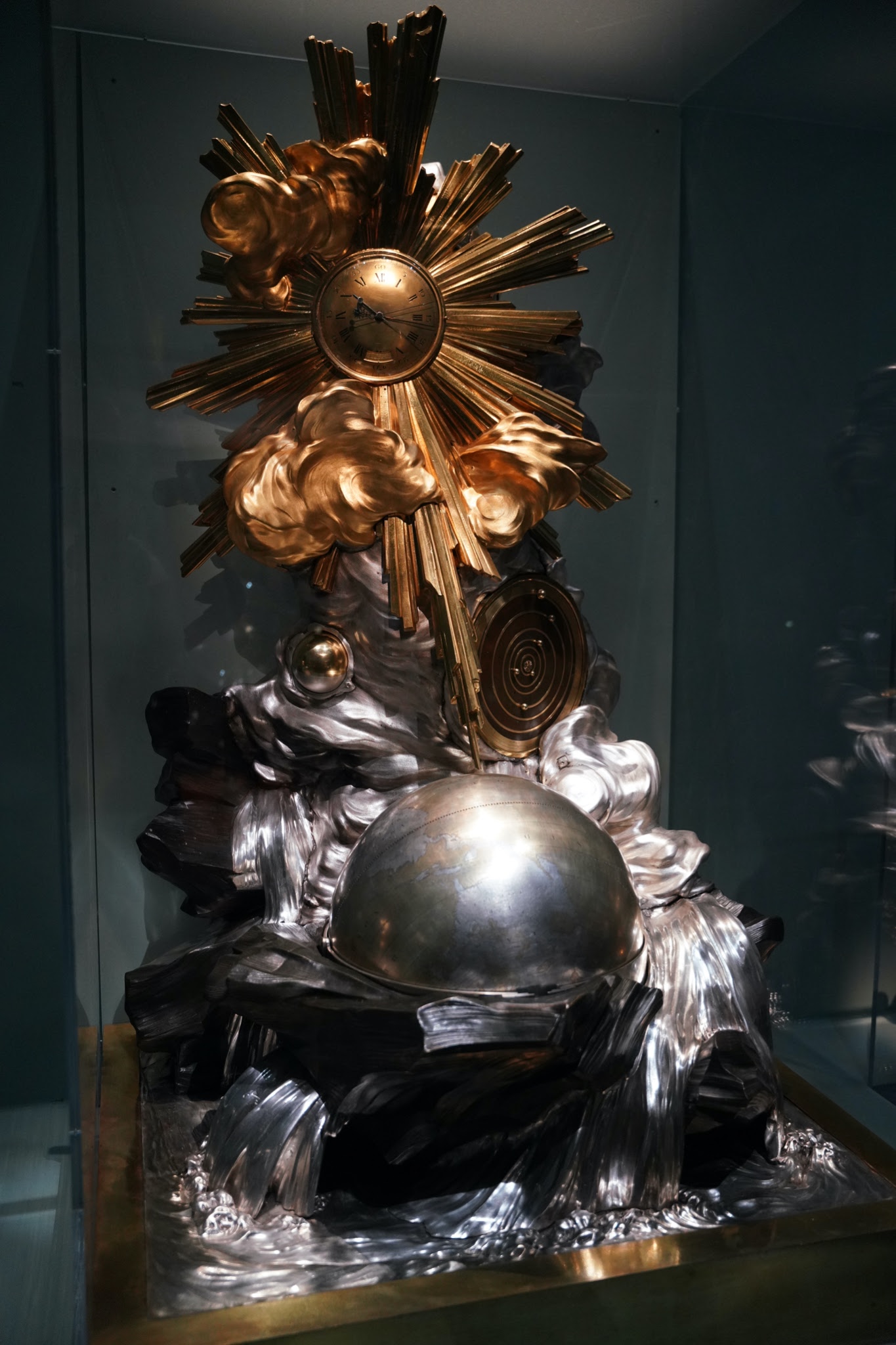
Picture 3: Passemant's astronomical clock "The Creation" (credits: G.Garitan, CC BY-SA 4.0 , via Wikimedia Commons; https://upload.wikimedia.org/wikipedia/commons/2/2e/Pendule_de_la_cr%C3%A9ation_du_monde_C_S_Passemant_1504823.jpg).
You have noticed the low quality of my photographs; for this last clock (picture 3), I even had to resort to a Wikipedia file. But I am prone to believe my weak dexterity might partly be imputable to the strength of conflicting emotions tonight, and so, trust in your indulgence.

New Release
Discover Jaeger-LeCoultre's SIHH 2008 Atmos clocks, including the Klimt Marqueterie and Marc Newson designs, celebrating 80 years of innovation.
45 replies28242 views

Reference Guide
Explore Grand Seiko's "Grammar of Design" with the 44GS, 4520-8000, and 6186-8000 VFA. Learn about Seiko's pursuit of precision and unique aesthetics.
23 replies10707 views

Manufacture
Explore the Jaeger-LeCoultre Atmos workshop with Nicolas (amanico). Discover the perpetual clock's unique mechanism, assembly, and restoration process.
49 replies6889 views

Manufacture
Explore Chopard's 2006 acquisition of La Chronométrie Ferdinand Berthoud S.A., reviving a master horologist's legacy. MTF details the brand's vision and historical significance.
10 replies3511 views

Manufacture
Chopard Group launches La Chronométrie FERDINAND BERTHOUD SA to revive the master horologist's legacy with exclusive, high-end timepieces. Learn about this new brand.
10 replies3128 views

Independents
Discover Martin Braun's innovative watches, including the Tourbillon Perpetual Calendar and Slowrunner, from an exclusive breakfast meeting. Insights into independent watchmaking.
4 replies2870 views
Passemant's astronomical clocks at Versailles.
I come back from Versailles where I was nightly visiting a temporary exhibition " Louis XV. Passions d'un roi. " and wanted to share with you my delight at admiring his astronomical clock, conceived by engineer Claude-Siméon Passmant and crafted by horolo...

I wasn't prepared for such an encounter tonight; the memory of me facing this clock in Versailles some fifteen years ago was not lost,
But had become somehow unfamiliar. That a clock - and such a clock - might underline how continuous yet changing my experiences have been over those years moves me almost inexpressibly.


Exquisite! I probably saw these as a young boy decades ago myself.
Amazing technology considering these clocks are 200 years old! I wonder if the Miki Eleta clocks will be similarly regarded 200 years from now! ...
Great memories indeed...
Despite all my visits to France, I've only been to Paris and Versailles. Never been outside of those areas. Sadly. Gotta rent a car and go for it someday!
From Paris one is only a few kilometers away from Normandy, or even from Amiens and its cathedral.
The diversity of landscapes and petites patries in a country with such a tradition of centralization is in itself a rather strange experience.
