
SJX
[Purist]
8540

Interview with IWC ambassador David de Rothschild, adventurer and environmentalist
Interview with David de Rothschild,
Adventurer and Environmentalist
By Su JiaXian
© April 2009
Adventurer and environmentalist David de Rothschild founded Adventure Ecology in 2005 to raise awareness of ecology issues facing the world. He has trekked across both the South and North Poles, one of the handful to have accomplished that dual feat. De Rothschild is from the banking family of the same name.
After his North Pole expedition in 2006, he conceived the Plastiki Expedition. Inspired by Thor Heyerdahl’s trip across the Pacific Ocean in the Kontiki, the Plastiki aims to sail from San Francisco to Sydney in Australia, visiting ecologically important sites like Tuvalu and the Line Islands en route. This expedition will sail through the Great Eastern Garbage Patch, a vast swirl of garbage accumulated in the Pacific by ocean currents.

Rendering of the Plastiki
Much of ocean rubbish is plastic, and for that reason, the hull of the 60-foot Plastiki will be made of tens of thousands of polyethylene terephthalate (PET) bottles, the transparent containers soft drinks are typically sold in, lashed together to form the structure. Naturally, the rest of the vessel will be made of recycled or recyclable materials, with the vessel being self-sustaining. Plastiki will even have a small garden on board to grow vegetables, which will be maintained by compost generated by the boat’s crew.

Prototype of the garden on the Plastiki
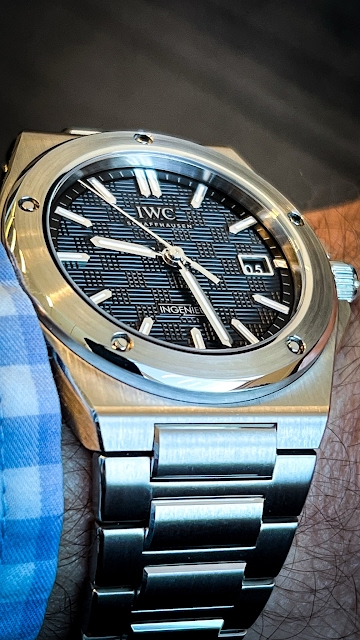
IWC is one of the expedition’s sponsors, and in addition to supporting Adventure Ecology, the firm has also created a limited edition Plastiki Ingenieur, which de Rothschild will have on his wrist as he crosses the Pacific.

IWC Plastiki Ingenieur
The departure date of the Plastiki from San Francisco is estimated to be in June or July 2009, with arrival in Australia three months later.
I spoke with David de Rothschild in December 2008 about his vision for Adventure Ecology and the motivations behind his expeditions. This is Part I of the interview, with the following parts to be published closer to the date of the launch.

David de Rothschild
Su JiaXian (SJX) : Why did you start Adventure Ecology? And how’d you come up with the name?
David de Rothschild (DDR) : You know, it’s funny, most people think Adventure Ecology is some sort of tour operator. We get phone calls from people saying “Can you take us on a tour somewhere?”
It’s probably quite an unimaginative name, but the way it came about: we were sitting on the back of a Russian Ilyushin jet coming into Antarctica full of all these guys telling me how many mountains they’ve climbed and how many push-ups they could do and I sat there and I was like, do you think I should tell them I moisturise and that I can’t do push-ups and I like soft pillows? And they were talking about the accolades, talking about the energy of the expedition, really focused on themselves, rather than about the ecology of what they were seeing.
So as I sat there [and thought] adventure becomes a catalyst for us discussing what we’re seeing, which is also the ecology of these fragile ecosystems. So very unimaginatively – adventure and ecology – let’s call it Adventure Ecology. The full tag name was ‘Adventure Ecology: Making Learning an Adventure’, but then I took learning out because no one wants to feel like they’re learning because everyone is already smart.
SJX : How did you end up doing this, instead of something else?
DDR : It’s kind of an organic process. The whole time I think about it, on the outside it can look a bit erratic, but also because it was health – you are what you eat and you are what you breathe. I was fascinated by the air that we’re breathing, that sounds really geeky. It’s funny we’ll go and spend 25 minutes haggling with a computer salesman about how fast is a computer. What is the screen? Will it do all my photos? Will it do all my emails? You’ll ask that many questions about a computer but you won’t ask a question about what you’re putting in your mouth. Where does it come from? What is its impact on the planet? Is it full of hormones?
It’s kind of bizarre to me that something so powerful that looks after us, we ask very few questions about it. And there’s a synergy between that and the planet in a way. We’ll ask questions about the model, make, number of a nice new car, or our shoes. We’ll spend a lot of time thinking about those things, but we very often don’t ask questions about the state of our planet.
So that was that natural curiosity and just basically being an ants in my pants as a kid. I was never sitting still, I was always out running around, my parents would go, “Where is Dave? He’s probably in a tree doing something.”
Never underestimate curiosity as a driver of change. And that to me is being kind of a manager in a way of how Adventure Ecology is started to grow itself and continues to grow – we ask questions. That removes us from being [merely] green, removes us from being sanctimonious, removes us from being worthy. It just makes us all very curious, very passionate. We sit here today and we go, “Can we build a boat made out of bottles to try and raise awareness about the fact that there’s an accumulation of plastics in our ocean?”
And from that moment it left my mind, it became an adventure. And that adventure then started two years ago to generate stories, to inspire more questions and to inspire more dreams. So it’s that kind of simple equation of change where dreams are the breeding grounds for adventures, adventures are the breeding grounds of stories and stories inspire more dreams. And that’s what this is. In a way it’s a continual question.

Pier 31 in San Francisco where Plastiki is under construction
SJX : You mentioned that you founded Adventure Ecology 2, 3 years ago…
DDR : Yes the concept came to me 4 years ago, almost to the date.
SJX : So what’s your vision for Adventure Ecology? Over the next 10, 20, 30 years. What’s the point of it, over the very long term?
DDR : Basically I give myself three more years and then I will take all these [PET] bottles, build a huge pipe, sit on my porch, get stoned. (laughs)
Seriously, it’s an ongoing challenge. Green has become a thing. It’s become one of those states of mind where it has become a chore; it’s become a campaign. And the campaign basically means that there’s a timeline, starts here and ends there. So when we think about what we’re doing, we’re outside of that.
For myself, personally, it’s not a campaign, it’s just about a way of living, it’s about living smart, it’s about thinking about things in a smart way. For me it’s an ongoing piece, it’s a commitment. When you go and start thinking about getting healthy, for yourself, for your body, it’s a lifelong programme, it’s not like you get to stop in 2 weeks. Dealing with the health of our planet is the same thing. I hope AE becomes and continues to become more powerful in terms of communicating stories. We do our little bit in our little way and hope it all works out.
SJX : You mentioned green has become a campaign – I was talking to one of your colleagues yesterday and she mentioned “green fatigue” – everyone is talking about being green. Even huge companies have green ideas now. So how do you stand out and make sure people hear what you’re saying?
DDR : Like I said before, we don’t do the green thing, we just do the smart thing. It’s about living smart. Sometimes green creates a distraction. I just saw an article the other day where someone said blue is taking over from green.
Is it really about a campaign? Is it really about externalising it? Is it really about making it a chore? Or is it about making it habitualised – living within our means? And when I say living smart, it means living efficiently. For example, change a light bulb because it’s going to save you money, then if you think about the planet as a secondary thing, that’s cool, but you are getting more efficient [at the same time].
We’re already taking steps in the right direction, but at the same time, you read about it, you hear about it, people are talking about it, so they are under the perception that we’re dealing with the situation. But the reality is we’re not dealing with the situation.
We’re taking small steps but we need to be taking strides, we need to be running, we need to be sprinting. Because our ability to live on this planet as a species is in jeopardy. The planet is still going to be here. But we’ve externalised nature to an extent that it’s nature versus us. We say ‘poor old nature’, or ‘poor old polar bear’. And when species collapse, when systems collapse, who’re the first guys to go? It’s the megasauraus, remember him? The big dinosaur? It was the big dinosaurs, they disappeared first. They just went, collapsed. We’re the ones that are going to go first.
We have to rethink and look at it from the point of view that we have to get a handle on this. There’s no socioeconomic divide, no race, religion, colour, we’re all in the same boat. I always find it funny when people go, “Oh you’re part of that green thing!” No, we are part of the same planet!
It’s something that you should care about, I should care about. I find it funny how we like to compartmentalise ourselves. [That’s why] we got to get passionate and showcase solutions. We have to get to the point where [people] say, our problems are bad, but our solutions are great!
This is what Plastiki does. This ability to showcase solutions, smart solutions [with] science involved, marketing involved, design involved, research involved, technology involved. We’ve created a collaboration of designers, architects, filmmakers, students, from NASA to Clean Up the World to the University of San Francisco.
There’s a whole bunch of people who have come together – very smart people – who are creating, collaborating, [what is] hopefully an exemplifying solution. And that’s what this is about, it’s about saying the problems are big, but the solutions are bigger.
The green thing and the noise in that space: green fatigue, green wash, blue-is-the-new-green. Are you getting on with things or are you just labelling things? We’ve got to get to the point where it’s more about acting than just labelling. It makes us feel comfortable, it may salve the consciousness, but it’s not solving the problem. And that’s what we’ve got to do, we’ve got to get ourselves engaged to think about these issues in a much more realistic way. And it doesn’t have to be regressive, it can be progressive, thinking about it from the point of view of just being smart.

PET bottles to be used for Plastiki
Copyright April 2009 - Su JiaXian & PuristSPro - all rights reserved
PuristSPro Homepage | ThePuristS Homepage
Comments, suggestions, and corrections to this article are welcome.
This message has been edited by SJX on 2009-04-30 06:38:08 This message has been edited by MTF on 2009-05-04 18:40:50



Interview with IWC ambassador David de Rothschild, adventurer and environmentalist

Someone here said it before that the IWC Plastiki Ingenieur watch

NOT me but there are 2 schools of thought....

Is it beyond the boundaries of physics to make a "floating watch"?

easiest way
Is Plastiki enviromental friendly?