
ThomasM
[PuristS]
14331

This is fun!

...on historical facts
Date: Apr 23, 2010,10:43 AM - (view entire thread)
"Indeed, Victorin Piguet should be included in the list of specialist firms that provided chrono calibers to PP. (Although, I was inder the impression that the majority suppliers since the 1960's were Valjoux cal. 22/23 and Lemania cal 2320.)"
Here's some information I wrote in 2002 on the Piguet watchmaking family, based on documentary and oral history research I had done in the context of AP -
"Because of the common last name in the company names for F Piguet and Audemars Piguet, it is often asked if there is any direct relationship between these two companies.
F Piguet is an indepedent movement maker that was instrumental in the re-birth of Blancpain. Until Swatch (then SMH) acquired both F Piguet and Blancpain, F Piguet was essentially the movement side of Blancpain, though many other high end houses used F Piguet movements, and have for quite some time.
F Piguet has no direct business ties to Audemars Piguet, though there are some ancestral connections. Piguet is a fairly common Swiss last name, but Le Brassus is also a very small town / village.
AP has used F Piguet movement blanks and ebauche in the past, and currently uses the Piguet 1185 chronograph movement in the Royal Oak Chronograph.
The Famille Piguet settled in the Vallee de Joux in the late 15th century. One of the first Piguet's to get into the watch making business was Charles August Piguet, who set up an ebauch manufacturing facility in the late 1700's. There came a long line of Piguets after this, and the name is an important one and is inextricably intertwined with watch making in the VdJ and the Vaud.
Interestingly, the Audemars and Piguet families were involved together before the famous Jules Audemars - Edward Piguet pairing of AP fame. There were two predecessor companies, Audemars Freres, which iteslf was a spionoff of Louis Audemars, and Piguet-Meylan, which involved Piguet cousins (?) and a brother-in-law of Louis Audemars.
By the late 1800's, several eponymous companies were extant, including Louis-Elysee Piguet & Fie of Le Brassus; Charles Piguet of L'Orient (the original home of Lemania); and Victorin Piguet in Le Sentier.
L-E Piguet evolved into Frederic Piguet in the early-mid 1900's (1940?), Frederic Piguet being the nephew of L-E Piguet (Oesterhausen)
There has been some question and speculation about the relationship of V. Piguet and F. Piguet. Les Fils de Victorin Piguet was doing some of their most famous work for Patek, including a large part of the famous Packer and Graves Super complications, in the early to mid 1900's (1905-1945?), so there would seem to be a bit of an overlap between Victorin Piguet and Frederic Piguet as extant companies. This would lead me to question any direct lineage between V Piguet and F Piguet, though there could very well be less over-arching ties between the two.
The common linkage between all these companies is the Piguet name, a mastery and focus on ultra sophisticated complications, and the family crest - a rearing horse with a flagstaff (or spear) and three stars.
Around the turn of the 20th century, L-E Piguet also supplied to AP many of the ebauche (rough movements) which were in turn supplied to Duerrstein and Glashuette Union, one of the leading watch companies in Glashutte at the time, currently the home of A Lange and Glashutte Original and most of the German watch industry. The L-E Piguet workshops in particular were famous for high complications, with a specialization in chronographs and rattrapantes. They also produced some incredible repeaters and sonneries, some of which are shown, with audio file, lower down on this reference page. One of the finished Louis-Elysee Piguet complicated pocket watches was to become the base for what will be the world's most complicated wristwatch when it is finished and officially unveiled sometime before the end of this year (there have already been plenty of sneak peaks on the work in progress.) This wristwatch is patroned by a regular member of ThePuristS community.
TM
copyright 2000, 2002"
"Also, to my knowledge, PP began production of own calibers only (some years) after the Sterns bought it in 1932. (LC tried to buy, but Sterns eventually got the company.)"
I don't recall the dates and details from memory, so I can't comment. JLC has documentary history of this aspect of the history, but are understandably reticent to offer public access, and those with past access are understandably reticent to speak publically on this subject.
"VC have had and still have an in-house production of the 13"' repeater movement. It was the only in-house wrist-watch movement they've had until recently. But they did have one  "
"
um...define in house. To my memory, the calibre was based on JLC base movements with a Dubois Depraz repeater design, and I believe this is (or has been) publically acknowledged by VC. (I'm a big fan of this movement and the watches that resulted, so please do not take my question or comments as any question on the "worthiness" of the movement or its watches.
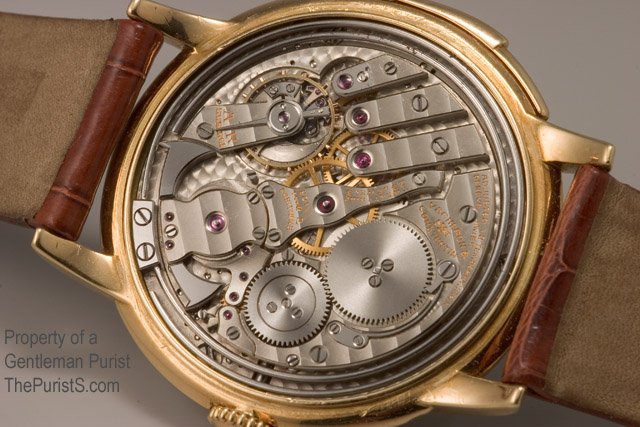
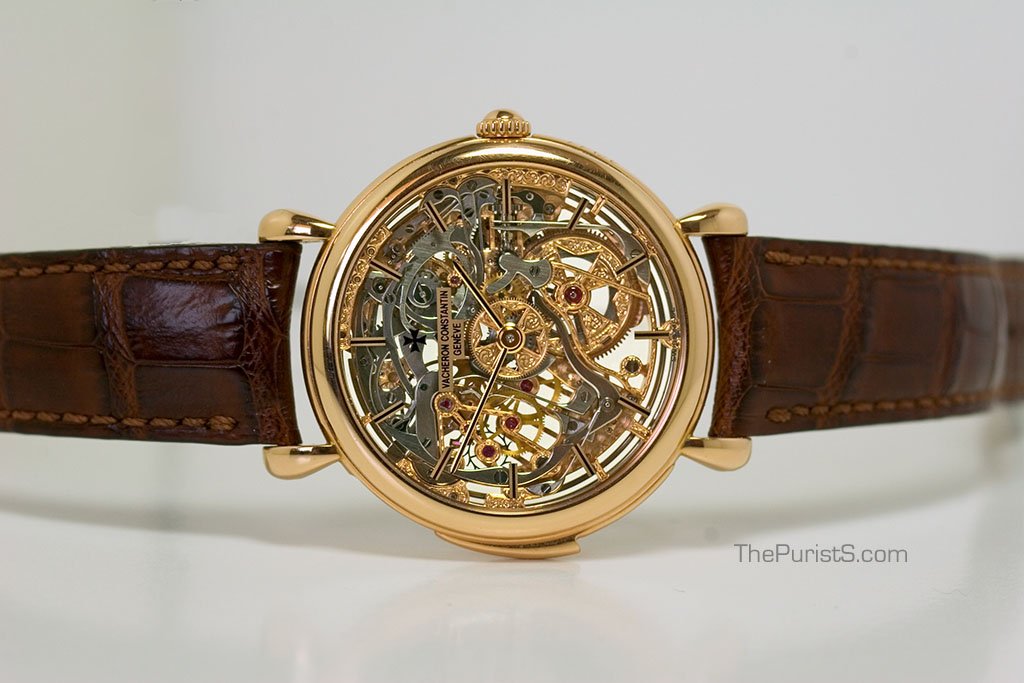
"As to the past, going back eones: after G.-A. Leschot (a talented engineer working for VC) modernized "serial" movement production in mid-19c, VC became a supplier of pocket watch ebauches to the Swiss industry. This is well known. (Who knows, maybe PP bought ebauches from them too.)"
um...I thought we were talking about wristwatches?
"AP did create from scratch many pocketwatch calibres, VC some as well, I believe."
By the way, a common misunderstanding by many enthusiasts (I'm not concluding you are included in this group) is that the pantograph designed and used by Leschot allowed for parts production that made them "drop and play" interchangeable. This is actually not true, the tolerances were pretty loose by todays standards and would be less than the equivalent of today's "rough cut" initial parts production, requiring quite a bit of handworking and fitting.
I wrote this back in 2000; in re-reading it, I would probably re-phrase some of the more potentially misunderstood statements.
"
Cheers,
TM

Patek Philippe 5070 : An In Depth Review.

WOW a titanesque and thorough research work, Bravo! As for the cap on the column wheel
Thanks for your input, Alex

Those chronographs are all stunning

Interesting....

agree for a 5170 comparison with new 1815 chrono.
The 5170 doesn't have a flyback... The 1815 does.
in fact PP 5170 and Lange have in-house movement with 2
Yep, that is their only common point.
Also.....
Well, Jerome
Well it depends...

Interesting rumour
Well, in-house Dressage on its own is approximately 11 hours
Your link doesn't work
The link works perfectly, just in case here again
full article here
patek moonwatch
Sorry but
No need to be sorry
By the way
Yves, please see my reply to Amanico below
Only JLC has a history of true manufacture...
AJ, since we are on the subject of historical facts (and exposing historical myths...
...on historical facts
This is fun!
Thank you Thomas, Yves, Nicolas, all others for this discussion!
Now that's an excellent idea, Jerome.
I fully agree with what you write AJ!
As the in house finish of the movement by VC
The problem with these discussions, Nicolas, Yves, is that this sub-discussion
No problem here Thomas
Thank you, PoyFR
Thanks to you and Jerome for your historical inputs.
Very interesting review Nicolas
Thanks for your nice words, Patrick

Thanks a lot, my friend.

Thanks, Chris

THANK YOU !!!!!
Don't get me wrong, Bruno
Well, so much fun to read this review, Nicolas!
Thanks a lot, Respo
I salute to YOU ..... a wonderful report !!


Excellent comparative review!
Of course, I could have included some more Chronos
I will probably take the time to review it but...

What a review, and what a comparison!!!
I love them 4, my friend.
Thank you so much for putting the time into this post......
That's a terrific thing, Miles.
Agree Nicolas, is it madness to aquire both???? As this would break one of my rules :)

re: 5070 An In Depth Review...
Well my friend.....
Well, PP
MMmmm....
The finish of the Duometre case

Thanks a lot for the compliment, Nomer

What a contribution - In depth is an understatement.
Agreed on the imperfect comparison
Nice review
I understand your point.

great comparo mate

E.Zegna... The Italian Style.

I only can say that...
They are all beautiful, Emilio.

Thanks for sharing...
It is one thing to see a watch alone,

Thanks, Nicolas.
It would have been better without, indeed.
Such a detailed analysis on the 5070.....
Load More Comments >>