
“All the hype, none of the fun.” Discuss.


I am going to copy you and say "All the hype, but none of the fun" Completely Agree 😊👍
Yeah, that Resonance though !

Very sensible post, Jay.
Thanks for your thoughts Michael.
The other point was a comment on where certain indies and other watches sit now in terms of value. It’s hard for these to be fun anymore when they become something of material value. Or indeed when they become something that (regardless of the wearer’s intent) a signal for something socially.

My feeling is that I don't like hype, with or without fun.
Haha, I’d be somewhat with you.
Rather, it’s when that hype takes pricing to a level beyond the comfort of a regular guy some of the “fun” in the affected watches is taken away.
I agree that it becomes less funny when

why not both? 😂

That’s fair.

Hype is not bad.
I’m not against hype, but I’m not particularly for it either—it doesn’t matter that much to me. That said, I do think it’s generally a positive thing, because it likely attracts a lot of new customers. People might initially be drawn in by so-called hype watches—whether that’s Nautilus, Aquanaut, or Royal Oak models doesn’t really matter—but for many, it’s a trigger to get started or at least to begin exploring the broader watch world.
If I go back about 35 years, I bought my first steel Rolex Submariner. I wouldn’t necessarily call it a hype watch back then, but it was certainly popular. Everyone starts somewhere. At the time, I thought it was the ultimate watch. I still think it’s a great piece today, though perhaps a bit more understated in comparison.
So yes, from a marketing perspective, hype is definitely not a bad thing.
To stay on topic, I do own some hype watches, including the Chronomètre Bleu by François-Paul Journe. I think it’s a fantastic watch, but honestly, it’s not among my absolute favorites. For that, I tend to look at pieces that are almost the opposite of hype. Breguet comes to mind—both now and for many years already, it has been one of the most interesting brands to me, and apparently it sits at the other end of the spectrum.
My rattrapante chronograph is probably my favorite watch in my collection. In addition, when I look at neo-vintage pieces—say from around 1990 to the early 2000s—I think of my Andersen Genève worldtimer chronograph. It’s a superb piece and about as far removed from hype as you can get. That said, I have noticed in recent years—especially over the last couple of years—that attention for Andersen has been increasing, and with it, prices on the secondary market.
So to sum it up: I think hype is good for the market. It’s not something I personally need, but it certainly has its place.

"Marketing" and "Hype" are not necessarily mutually exclusive...


I try not to overthink these things.
I came across this article a while back with sums up the FPJ approach
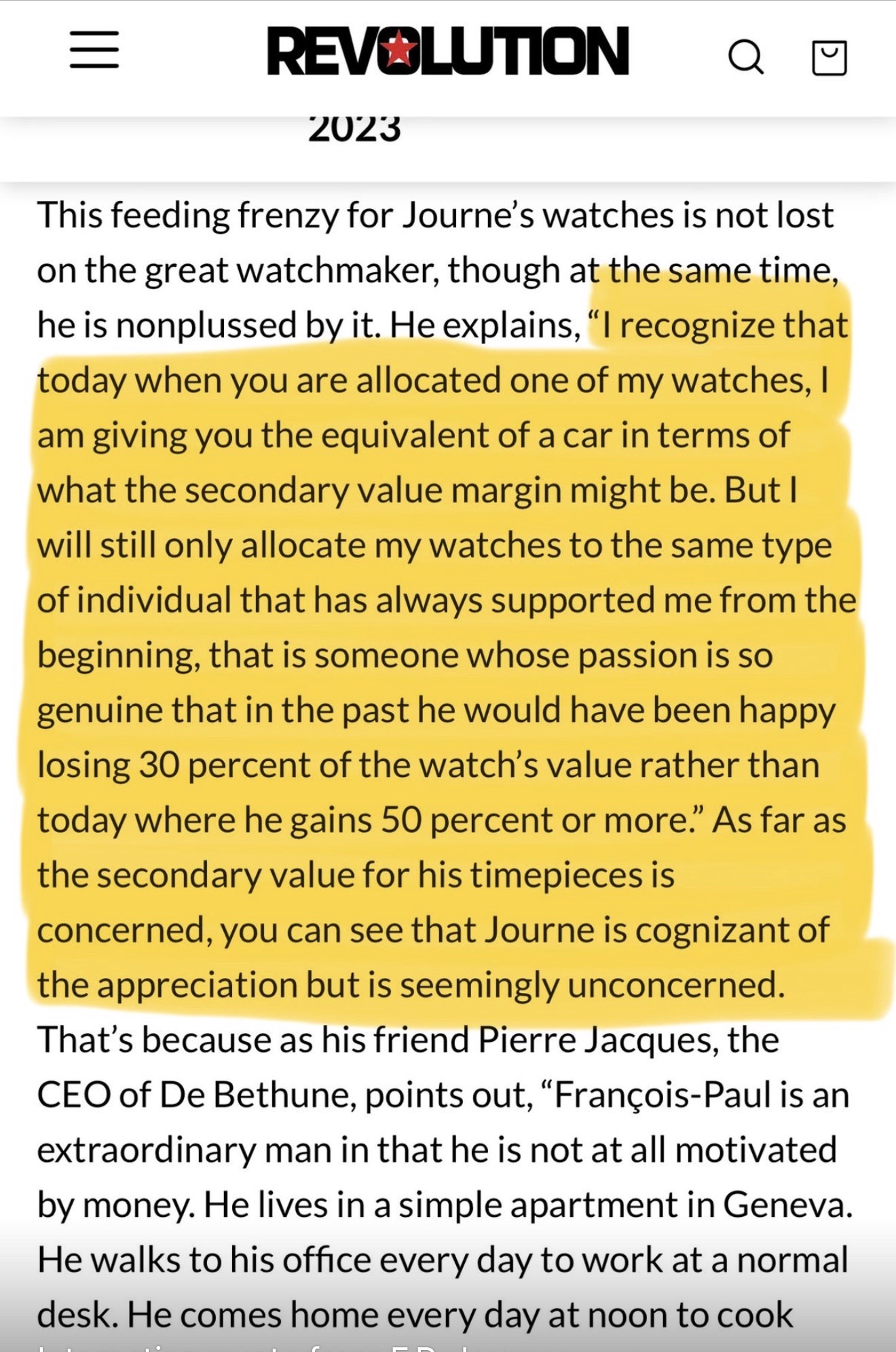
My relationship with Journe came from a longer standing relationship with someone who joined one of their new boutiques who knew I was a long term collector. I had already purchased two Journe pieces in the secondary market (before prices went through the roof) and since then I have been allocated one piece for each of the past 3 years - QP, RN and elegante). Hopefully I’ll get a CO next year - but no guarantees and I’m always careful to send them photos of the special occasions for which the watches were procured and subsequently worn. They know that these are not “safe queens” and I’ve been happy to share them with prospective clients at the boutique - useful from their perspective as they don’t carry inventory of many pieces.
I think the AP Swatch collaboration is fine - not renting space in my head - and if it makes people happy - whether flippers or long term holders then who’s to argue. Doesn’t make me think any differently about my 15202 RO.
All in - I would still say I’m having fun with my FPJ experience 😊
Thanks for sharing.
For me, my quest of late has been to identify and purchase what I would consider an every day Journe.
If I were full time in HKG or TYO then my view on every day would be very different. But I am not, and these days these two watches I shared above do not fit the every day definition. That said, I do wear the CB more often.
Fingers crossed for the CO. It may be a watch for me in the future, but it is not the logical next step for my current Journe collection.
Thanks Jay.

These are wise thoughts

Hype + Watch = Fun ... and later, decent resale value (if timed correctly)

I asked my friend what advice he had to offer about the transportation dilemma. He immediately offered one of his many cars, a Honda Insight with ultra-high mileage capability in exchange for the watch. Soon I was on the train heading towards my new rig, wearing the FPJ and carrying its boxes.

The swap was made and I drove home in the sporty little thing, with F1 technology, alloy body, etc. etc. while he sported a new gold watch.

The job lasted about 10 years, and eventually eighteen years and over one hundred eight thousand miles later,


The plate reminds me that in addition to working, I was going whale watching 2-3 times a week (at least) and saw 1000 whales in one year... wrote a book about it, and sold enough to pay for another watch...
Postscript:


Love the silver green combo❣️🍀🤩

I suppose it all depends on perspective as to if it is fun or not or just hype and a rush of blood to the brain.

I love the one to the left, when it was 19k secondary market I thought it was still expensive..

I love these FPJ watches

Hmm, I don’t know if that is how I feel exactly….
I agree completely.
Pipe dreams and Only Fans
Thanks for taking the time to share your thoughts Christian. Myself, and I’m sure everyone here, value your input and perspectives.
First off, as I sometimes do I was trying to be a little provocative with the heading. In the hope that folks engage.
But there is truth in it, and you correctly noted it needs to be considered in context. It’s very situational.
Of course I enjoy these watches, but how I do that has changed.
A good example of this is that while I would wear these to the Boutique to meet up with some Journe friends, I would not wear them to an Aperitif (at the same Boutique) with countless strangers. Similarly, these are no longer watches I would bring to a WPS GTG, but meeting one on one yes.
And to further emphasize the context or situational element, in contrast the office or meetings are actually places I do tend to wear some of these.
But my post was also about having some watches that can truly just be fun, with no worries or cares. I’ve been a long time Sistem51 wearer (since the very first watch), and I appreciate what these collaborations bring to folks like me and to folks that may never be in a position to purchase a Speedmaster, Blancpain or anything from AP. I just don’t see the negatives.