
patrick_y
[PuristSPro Moderator]
33528

Manual Watchmaking: A Lost Concept; And An Introduction to the Time Aeon Foundation
Moderator Patrick_y looks at the current offering of watches on the market and sees a troubling trend that he identifies as the tragedy of mass manufacturing. Increasing industrialization of the Swiss watch industry and the massive scale of automation has increased watchmaking efficiency more than ten-fold. But how does this "advancement" hurt the artistry behind watchmaking?
A First World Problem Identified
When I see the landscape of watch products; I see a troubling trend. More and more watches are made in assembly lines and fewer and fewer watches are made by individuals who have a wide breadth of talents. Outside of smaller independent brands (like Greubel Forsey, Urwerk, and MB&F), Lange, and Montblanc Villeret, where the entire watch movement is made mostly by one or two people who take pride and responsibility for the end product; the vast majority of products on offer are made by a plethora of over a dozen people. Even at the famous upper-echelon brands such as Audemars Piguet, Patek Philippe, and Vacheron Constantin, most movements are made in an assembly line where a dozen people each graft on modules to the manipulate. Imagining building a complex LEGO toy where you are always building just one small portion over and over again and not allowed to make the whole thing... Any child with creative talent would eventually say, "I'm tired of building just the panda's tail, I want to build the whole panda!" Keeping workers tasked into building one small part repeatedly is great for efficiency, but it comes at a high cost - it ruins creativity! We watch collectors consider watches an art form - and you don't need a Masters in Fine Art to know that creativity is a key ingredient in art!
Some Context
Mass production started when humankind perfected assembly line operations. This meant standardized parts needed to be precisely made - and these parts were so identical, they could be used interchangeably. Early examples of mass production include fire-arms (standardized barrels, triggers, strikers) with the "Brown Bess British Musket" in the 18th century, a standardized rifle used by British military. In the 20th century, Henry Ford started to build automobiles by assembly line - automobiles were previously made individually in an artisan process.
Before we had part commonality and part standardization, we had individually made parts that were all made by one master craftsman. But this product could only be repaired by that same craftsman. And since each product was artisan-made, these products became expensive. The products were incredible, unique, exclusive, and often beautifully made. But difficult to repair, impractically expensive, and difficult to recreate.
Part standardization meant that products could be made in assembly lines. Watches, automobiles, and other mechanical devices were all once artisan-made products and could now be made en masse thanks to part standardization. After all, efficiency is a great driver of business.
When it came to watches; watchmakers were relatively well versed on how watches were made thanks to schooling that taught all the fundamentals of how to make watches; many watchmakers could make a watch from beginning to end. This started to change in the 1970s. The quartz crisis required the Swiss watch industry to pivot and achieve new standards of efficiency. Watchmaking became more specialized. Watch schools also had to teach 3D modeling, CAD (Computer aided design), CNC Machine operation, and more. Soon, more and more workers became highly specialized in one aspect of production.
While this newfound efficiency saved the Swiss watch industry from the quartz crisis, a large part of the identity behind Swiss watchmaking was lost. Today, the big employers have employees specialize in one specific task for efficiency and mastery; whereas in the past, one individual had the skillset to make a large portion of the watch. Small employers and independents have watchmakers that do a wide breadth of tasks.
There are positives here too. Mass manufacturing ensures a quality product and a repeatable process. Our watches are also much more accurate thanks to this process. In the 1800s, Breguet's watches would cost thousands of Francs back in those days, or as much as a modest chateau - so mass production has also brought down the price of watches. Identical products also means identical faults and failures; so troubleshooting problems is a more streamlined and consistent process.
The Time Aeon Foundation
The Time Aeon Foundation has been conscious about this post quartz crisis phenomenon and was founded partly to bring back and preserve traditional watchmaking crafts, many which have been nearly lost. The Time Aeon Foundation also runs a project called Naissance D'Une Montre, French for Birth of One Watch. These project timepieces, which are naturally truly exquisite, hi light traditional watchmaking using traditional manufacturing techniques. The only use of a computer is in the CAD process (computer aided design) but no computers are used in the manufacturing process at all. The manufacturing process is sometimes extremely challenging, as a lot of the century-old machines, lathes, are no longer used by the industry and have been discarded or have not been maintained. Since almost all the major brands are using CNC machines and modern machines, these older machines have been gathering dust, not being maintained, not being calibrated. Finding these old machines and reviving them to working order was a painstaking process, then learning how to use them was certainly a blast from the past.
Please take a look at these amazing Naissance D'Une Montre timepieces:
Version 1; Michel Boulanger, Philippe Dufour, and Greubel Forsey design. Eleven pieces were made and sold to collectors, the proceeds help fund the operations of the Time Aeon foundation. https://timeaeon.org/projects/naissance-dune-montre
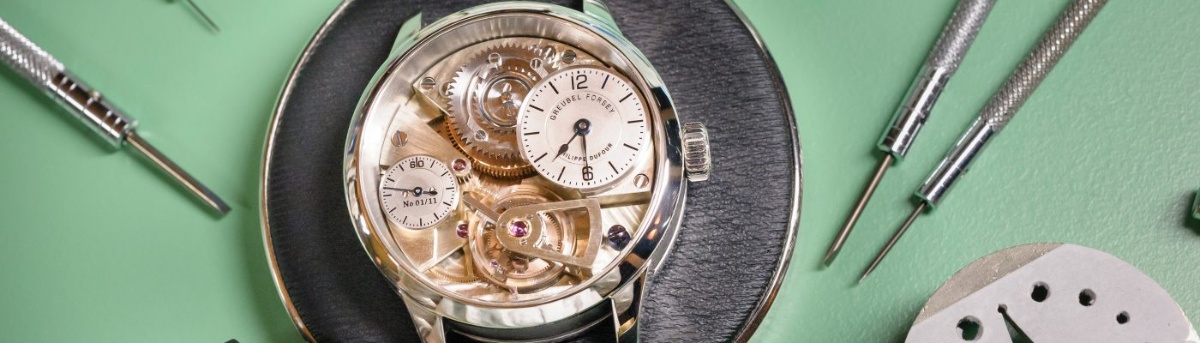
Version 2; Felix Baumgartner and Martin Frei team up with watchmakers Dominique Buser and Cyrano Devanthey to make a modern-looking watch with techniques that could've been achieved a century ago. Only one example exists. https://timeaeon.org/projects/naissance-dune-montre-2
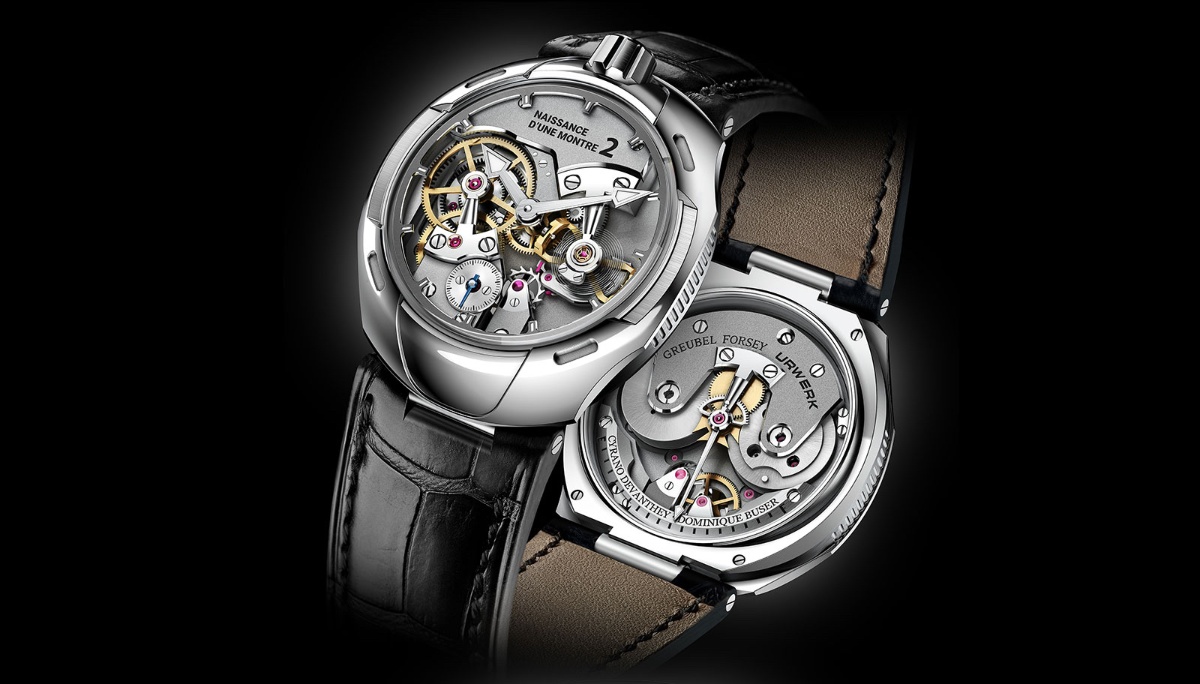
Notice the balance wheel doesn't have a full circular wheel, but four spokes. So cool.
Here are two videos, while they are produced by an auction house, they illustrate some of the process behind the creation of this watch.
Version 3; Ferdinand Berthoud, the centuries-old brand owned by Karl-Freidrich Scheufele, promises to delight us with an incredible timepiece. While it has not been introduced, I eagerly await its debut!
Conclusion
We should certainly get excited if we see a watch that we like, that looks great on our wrist, and that we want to wear. Regardless of the price point and regardless if it was made on an assembly line or at one individual's workbench from start to finish. I own regular production watches; they're accurate, they're great, they work! I enjoy my regular production watches immensely.
However, after owning multiple "normal" watches, you may decide that you want something really artisan-made one day.
If you look at watchmaking as an art form, and you want watches that are fairly original or at least watches that aren't pure commodities, or watches made using old-world computer-less techniques, then keep an eye out for something special. You may have to look hard. You may have to look deep. You may even have to look under rocks. But, taking that path less traveled may make all the difference. Good luck!
Please comment; what are some of your favorite timepieces that are regularly produced and what are some of your favorite timepieces that are truly special works of art?
At the risk of appearing less than original - I enjoy the Patek Philippe Nautilus - especially the 5712/1A with the 240 caliber! I like micro-rotor automatic movements.
But for a true work of horological art, I really like unique objects like Miki Eleta's clocks, Urwerk's amazing watches, and MB&F's horological art pieces!

Miki Eleta's Hammock Clock. This clock was made completely with no computers at all. Save a calculator. Mister Eleta doesn't even like to use a computer - he doesn't even like to use a smartphone! No CAD, no CNC, all made by hand using very traditional techniques!

My favorite Urwerk!

MB&F's HM 3. It's a lady's watch, but Hoot Hoot! What a cool watch! What a concept! This watch took a lot of out-of-the-box thinking!
Manual Watchmaking: A Lost Concept; And An Introduction to the Time Aeon Foundation
Moderator Patrick_y looks at the current offering of watches on the market and sees a troubling trend that he identifies as the tragedy of mass manufacturing. Increasing industrialization of the Swiss watch industry and the massive scale of automation has...

What an excellent and substantive post.
This subject matter is perpetually swirling around in my brain. As in, do I really want a 'regular' Reverso or Overseas as opposed to a completely hand-finished tourbillon etc. version; and then of course we have the Urwerks and Berthouds of the world.......
It's some heavy reading!
For a heavy topic, I did try to keep it to around 1000 words. I really really like simple watches. Sometimes having a bunch of sub dials on the watch doesn't necessarily contribute to a higher elegance. Sometimes less is more. And I'm finding plenty of ve...
Great stuff as always...
... Ferdinand Berthoud has fascinated me since they started. I need to keep playing the lottery...
I'd acquire a Ferdinand Berthoud!
They're a little big for my wrist though - might need to wait until they come out with a smaller version.
I know they are big...
...but I think I could pull it off. Have never seen one live though...

Thanks for the thought provoking thread
I enjoyed it and am currently waiting for a few artisanal watches from Switzerland. This could take a few years but I'm happy to wait for them while enjoying those that I already own. I do wear my other regular mass-produced watches occasionally but the a...
Thank YOU for reading and having your thoughts provoked!
Most of us collect watches for fun, but we don't really think about it in detail all that much. I'm glad that you read this article and gave it some thought! Good luck on your new watches to be! I hope they come soon! I can't say I wear artisan watches 95...

Thank you Patrick for this in depth analysis
of the evolution of watchmaking. The only thing I would maybe add is that, among regular production watches, I tend to see some significant differences between the more industrial ones (like my regular Alpine Eagle) and the ones which have a certain level...
In fact, samwan and ambel have one!
It was great meeting Yosuke Sekiguchi himself and trying on his watches, but I unfortunately can’t afford them and he’s the only one for now to be able to service them…
I hope you are able to get one someday!
I hope you are able to procure one in a fiscally responsible manner someday!

Great and interesting post .
Like you mentioned for me the most interesting watches are from independent watchmakers. If we talk about bigger brands i still think Breguet was and still is doing a great job
I concur. Breguet does do a great job!
Almost all the Breguet dials (enamel and guilloche) are made by one person in artisan fashion. The movements can be made by one individual or can be made in an assembly line. It's just not popular because the design is a little too traditional - when peop...

Very interesting and informative post.
The more time I spend on this site the more I learn and I realise just how little I really know. As I have said in another thread I never realised just how many truly remarkable and talented independent watchmakers there are that make such a wide range an...
Thank you for your kind words!
You're exactly right about that word Profit! I don't know if you watch Star Trek, but I sometimes watch it (lots of good morals in that TV show), and I still get a laugh whenever I hear the Ferengi rules of acquisition (Ferengi is an alien race who care p...
Hi patrick_y
Big Star Trek fan all the way from the start, I think you will find the Ferengi are actually settled on Earth and running the entire luxury goods industry. LOL. Thanks for your kind words I'm not sure I left my mark but I sure had fun trying, Marc
I'm Laughing out Loud!
The luxury industry is exactly the industry the Ferengi would be interested in on Earth! Oh, your words definitely left their mark! Thanks again!
Thank you M4!
I'm imagining a very special watch or clock in your future someday! Something truly special! There was once this beautiful Parmigiani clock that I once saw... Or, maybe you'll be attracted to something Parmigiani has restored... Some amazing automatons.

OooooHhhh! WooW! Looking forward to your impressions!
What a treat! A team member at PF knows me and my preferences, and predicts that my watch and clock evolution will be heading in their direction in a few years. I told that team member, there is a good chance that they are correct.

You mentioned urwerk and MB&F
They do use CNC made parts as well as third parts movements. Does it affect the final result? Not at all, because the idea and the execution is always unique. Time Aeon foundation aims to preserve old techniques, but I always wonder to which extent is han...
Yes! Urwerk and MB&F definitely use CNC machines for many of their watch parts.
Yes! You are correct! Even Greubel Forsey, Montblanc Villeret, and many other small brands use CNC machines to make components. Time Aeon Foundation's purpose is as you said. As for the importance of hand finishing - you raise a good point. One hundred ye...
I'm finally home, so I can write in details
I guess we all love a good finishing, because it shows attention to details and care. But it's getting tougher to spot the difference between an hand made anglage and a machine made with a simple loupe. You're absolutely right, finishing had a mechanical ...
Thank you for coming back and following up! So true...
Very true indeed. Spotting real anglage and comparing it to more industrial anglage is getting harder and harder. Even I'm not sure, and that's looking under a loupe! And yes... You get an A+ in consumer psychology, a large percentage of the population - ...

Fantastic Post Sir 👍🙏, I agree with you about traditional horology vs. Industrialized horology and horology as an art form
I commend the efforts of the Time Aeon Foundation.
Thank you Sir!
As one of our early members, back when PuristSPro was in its very early years, this is all old news to you. I'm sure you saw this coming and had this epiphany many years ago.
Very kind. Thank you Salman for the kind words!
What about you? Anything on your mind lately?

Why I love this community
I have been lurking on here for a while. It is for these kinds of posts. Thank you.
I'm honored to read your first post Frizal! Thank you for the kind words!
Hope to meet you and other members of our community in person someday!

Outstanding read, great info, and why we LOVE WPS. ❤️
Agree, you wrist guys are falling behind with wall clocks, table clocks, tall/Grandfather/mother clocks. Wrist-based timepieces are nice, but then what? PS: And a great music system at home. Trust me, nothing more romantic than serenading.... or Friday pa...
My Music Machine 3 "music system" is sitting in its box unfortunately.
I've got one of these sitting in a basement. I need to get a plexiglass cover made for it - as I really don't display it because I'm afraid of all the dust! ...
Pretty please get the display case made my friend. Sherman sits under a glass 'globe' and it happy :)
All the glorious music you could be enjoying........
Funny. I listen to the YouTube video more than the real thing!
I really enjoy the video! www.youtube.com

Will have to read this carefully....
How much modern hardware and software is "allowed" in traditional watchmaking??? How much balance between tradition and reliability?
Good question...
So... If you look at the exact wording of the press release; the impression I'm getting is that the manufacturing process of making the parts and making the watch is all using very non-computerized parts. BUT! That doesn't mean that they're not using comp...
I would agree.
I think computer aided design should be permitted. Just the manufacturing part should be as traditional as what is reasonably possible. At every point in human kind, we have had an improvement in technology. And our progression in humankind should be allo...

Thanks for such a great post, Patrick.
I’ve enjoyed all the responses as well. There is something very special and very appealing about real craftsmanship. When you spend unreasonable amounts of money on objects that have been rendered obsolete, it makes us feel good to think that there is som...
Thank you for reading and commenting!
Yes, a lot of these responses are all very well thought out! It was supposed to be a thought-stirring post, but I'm even more impressed with the super thoughtful and deep responses! And you're absolutely right. The industry wants the world to think that t...
Yes, my patience was running thin after a year.
They have so few watchmakers at Villeret and none of them are dedicated to service, so it takes a long while to get your watch looked after. You ask some very good questions about “middle ground” watches. Value becomes even more difficult to measure when ...
Indeed. Gently used watches from great Maisons can be great deals.
Unfortunately, not as much labor as one thinks goes into making one of these expensive watches. Especially since they're mostly mass produced. So I hope people don't have unrealistic expectations. Also, people don't realize, production is only a part of t...
Great points!
Always enjoy reading your posts, Patrick. Thanks for all you do to contribute to this place.

Great information and thoughtful opinions.
As far as Urwerk goes I like the 202. I have always liked the rotating cubes more than the discs. I love the Ludovic Ballouard upside down watch, would love to have one. In the mass produced watch category, I like Minerva movements I have seen in some Mon...
Thank you for the kind words!
Yes, the opinions and comments here are very well thought and high quality. Thank you for contributing your thoughts as well! The Montblanc Villeret pieces are absolutely top quality. Top top top. Higher than typical Geneva Seal quality. The balance wheel...

I'm just having a little chat with the owner of the NAISSANCE D'UNE MONTRE 2
On IG. No idea if he is on Watchprosite, I'll ask him Would be great if he joins this forum and give us an insight on this magnificent unique piece (and other interesting watches he owns)
I really regret not bidding on the Naissance dune Montre 2.
Such a cool watch. And it went for a "somewhat" reasonable price! Big congrats to you for being in contact with the fella. I don't know if I know him or not. But what a watch! A true watch appreciator too! I'm sure the conversations are fun and when it co...

A wonderful article, but I fail to see the "troubling trend"
Since the second half of the 19th century, the watch industry was exactly that: an industry based on division of labor and mass production, versus artisan pieces made on individual order. Otherwise, the watch as a cultural good would have been dead. And t...